



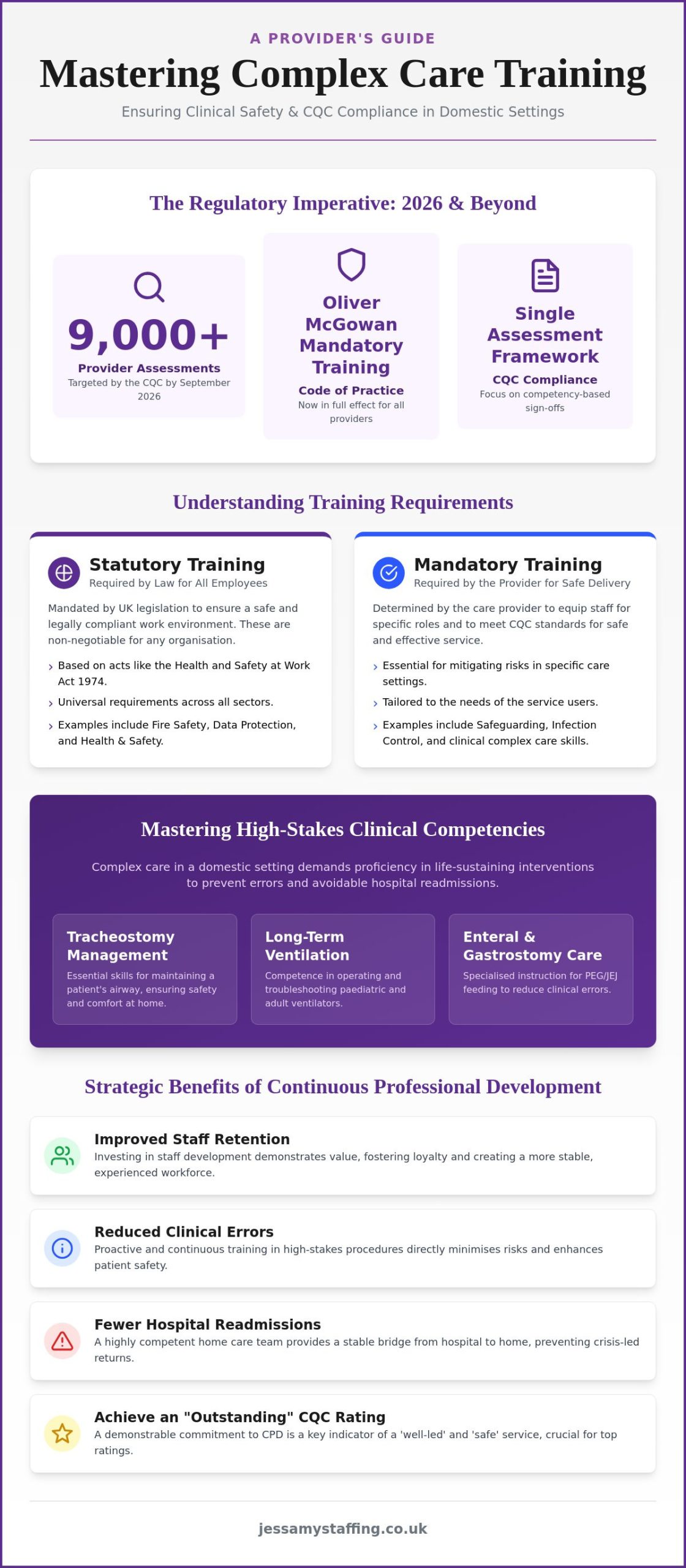
Clinical competence in a domestic setting isn’t just a regulatory checkbox; it’s the vital difference between a patient thriving at home or returning to a hospital ward in crisis. As the Care Quality Commission targets 9,000 provider assessments by September 2026, the demand for high-quality training for complex care workers has never been more urgent. You’re likely feeling the weight of these new mandates, especially with the finalised Code of Practice for Oliver McGowan Mandatory Training now in full effect. It’s a significant challenge to find trainers who truly understand the delicate balance between paediatric and adult high-needs support.
We understand that your goal is to build a workforce that feels as confident with high-tech medical equipment as they do with providing empathetic, values-led care. This guide will help you master the essential standards required to ensure clinical safety and maintain CQC compliance under the Single Assessment Framework. We’ll examine the shift towards competency-based sign-offs, the updated 2025 Care Certificate standards, and the specific renewal frequencies for safeguarding and mental capacity. You’ll gain a clear roadmap to achieving an “Outstanding” rating through a principled approach to professional development that prioritises both safety and human dignity.
Key Takeaways
- Understand the vital distinction between statutory legal requirements and the mandatory training for complex care workers defined by individual providers to ensure full CQC compliance.
- Master the technical competencies required for high-stakes clinical care, including tracheostomy management and long-term ventilation, to maintain safety in domestic environments.
- Recognise how specialised instruction for enteral feeding and gastrostomy care (PEG/JEJ) reduces clinical errors and prevents avoidable hospital readmissions.
- Identify the link between a proactive commitment to Continuous Professional Development (CPD) and improved staff retention within the social care sector.
- Learn how integrating accredited training with values-led recruitment creates a stable and compassionate support network for children’s complex care at home.
The Evolution of Training for Complex Care Workers in the UK
Complex care training represents a sophisticated departure from standard social care. It is defined as specialised instruction designed to equip staff with the skills to manage chronic, high-intensity health conditions within a person’s own home. As the landscape of Social care in the United Kingdom shifts towards community-based support, we have seen a sharp rise in demand for these services across Greater Manchester. This evolution requires a workforce that is technically proficient and deeply empathetic. It is no longer enough to provide basic assistance; modern care requires a rigorous clinical approach delivered with human-centric warmth.
The Care Quality Commission (CQC) has set clear expectations for “safe and effective” care as we move through 2026. With a target of 9,000 provider assessments by September of this year, the regulator is looking for evidence that training for complex care workers goes beyond simple attendance. It is about demonstrating real-world competence and the ability to mitigate risks in isolated domestic settings. Establishing a robust foundation through accredited social care training UK is now considered the essential baseline for any provider aiming for an “Outstanding” rating. This baseline ensures that every staff member understands their legal and ethical duties before they even step into a patient’s home.
Why Complex Care Requires a Different Approach
General support work often focuses on daily living activities, but clinical complex care involves life-sustaining interventions. Whether it is managing a paediatric ventilator or assisting an adult with complex spinal cord injuries, the stakes are exceptionally high. In these settings, a single technical error can lead to immediate hospital readmission or worse. The 2026 standard for complex care is defined by a philosophy where clinical competence meets compassionate delivery. This ensures that technical tasks never overshadow the individual’s dignity or personal preferences.
The Role of Local Standards in Greater Manchester
Manchester-based providers operate within a unique ecosystem of national mandates and local health priorities. Training must align with Greater Manchester’s specific integrated care strategies whilst respecting the sanctity of the home environment. Core stakeholders, including local authorities, NHS trusts, and families, rely on this training to provide a stable bridge between hospital discharge and long-term domestic stability. It is about strengthening the care environment without destabilising the family unit. Effective training programmes must, therefore, be as adaptable as they are rigorous, meeting the specific needs of the local community.
Statutory vs Mandatory: Defining Healthcare Staff Training and Development
Achieving clinical excellence requires a precise understanding of the regulatory framework that governs staff development. Whilst the terms are often used interchangeably, there is a distinct difference between statutory and mandatory training. Statutory training is a legal requirement for all healthcare employees, mandated by legislation such as the Health and Safety at Work Act 1974 and the Management of Health and Safety at Work Regulations 1999. In contrast, mandatory training consists of subjects determined by the care provider to ensure safe and effective service delivery. For those overseeing training for complex care workers, this distinction is vital for maintaining CQC compliance and ensuring that every team member is legally and professionally prepared for their role.
The complexity of home-based clinical support means that providers must look beyond basic induction. You should consult the latest industry guidance on mandatory training requirements to ensure your curriculum meets current standards. Maintaining a high frequency of refresher training is also essential. For example, safeguarding training should be refreshed every three years, whilst Mental Capacity Act (MCA) and DoLS updates are recommended every two years to account for evolving legal precedents and best practices.
The Core Skills Training Framework (CSTF) in 2026
The Core Skills Training Framework (CSTF) remains the definitive benchmark for quality assurance in the UK healthcare sector. It covers essential subjects like Infection Prevention and Control, Fire Safety, and Safeguarding Adults and Children. By aligning your programme with the CSTF, you enable the “passporting” of skills. This allows staff to move between different healthcare providers without the need for redundant retraining, provided their competencies remain within the valid refresher period. CSTF-aligned training is the essential foundation for dependable workforce capacity, ensuring a consistent level of safety across the entire organisation.
Mandatory Modules for High-Needs Environments
In high-needs settings, mandatory units must be tailored to the specific clinical risks present in the home. Medication Administration and Mental Capacity Act (MCA) training are non-negotiable modules that require rigorous assessment. The transition to Liberty Protection Safeguards (LPS) in 2026 has further refined how staff approach consent and the protection of individual rights. For teams providing 24/7 support, specialist care workforce training is particularly important for emergency cover staff who must step into complex environments at short notice. If you are looking to enhance your team’s capabilities with pre-vetted professionals, our staffing solutions provide a reliable bridge to high-quality care.
Specialist Competencies: Training for High-Stakes Clinical Care
Moving from general support work into the clinical domain represents a profound shift in responsibility. In this high-stakes environment, training for complex care workers must encompass advanced technical skills that were once the sole province of hospital wards. Tracheostomy management and long-term ventilation, for instance, require meticulous attention to detail and the ability to respond instantly to physiological changes. Similarly, technical proficiency in enteral feeding, including PEG and JEJ gastrostomy care, is essential to prevent complications like aspiration or infection. These aren’t merely “add-on” skills; they are the fundamental pillars of clinical safety in a domestic setting.
The management of spinal cord and acquired brain injuries adds another layer of complexity to the care plan. Staff must be equipped with the knowledge to handle autonomic dysreflexia, skin integrity issues, and cognitive behavioural changes. Implementing robust professional care training programs is the most effective way to ensure that workers are prepared for these intricate challenges. Training domestic staff within these environments also requires a delicate touch. They must understand how their roles intersect with clinical protocols without overstepping their boundaries, ensuring the home remains a safe yet comfortable sanctuary.
Children’s Complex Care: A Specialist Discipline
Providing care for children with high needs requires a distinct set of paediatric competencies. Airway management in infants and children involves specific anatomical knowledge and equipment that differs significantly from adult care. However, technical skill is only half the requirement. A family-centric approach is vital; workers must integrate into the family’s life whilst maintaining professional boundaries. We place a heavy emphasis on fostering emotional resilience, as supporting disabled children and their parents can be as taxing as it is rewarding. This emotional intelligence ensures that the care provided is as compassionate as it is clinically sound.
Emergency Cover: Ensuring Rapid Clinical Integration
When a crisis occurs, emergency cover staff must be fully trained and “ready to go” the moment they arrive. There is no room for a learning curve when managing a ventilator or a complex feeding regime. Whilst core competencies are established beforehand, site-specific induction is the final, critical step. This ensures that even the most experienced worker understands the nuances of a patient’s specific medical equipment and home layout. At Jessamy Staffing, we ensure all personnel are safe, values-led, and professionally prepared to provide seamless clinical integration from the first minute of their shift.
The Strategic Benefits of Continuous Professional Development (CPD)
Continuous Professional Development (CPD) is a proactive commitment to maintaining professional excellence throughout a care career. It isn’t a one-time event; it’s an ongoing process of refinement that ensures skills remain sharp and relevant. In Manchester, where the demand for specialised support is high, a visible culture of learning attracts the most dedicated candidates. High-quality professionals want to work where their expertise is valued and expanded. By prioritising training for complex care workers, providers build a foundation of reliability that reassures both families and regulators. This investment in knowledge directly translates to the benefits of trained agency care staff, ensuring that even temporary cover maintains long-term operational stability.
Staff Retention and Professional Morale
Competence is a powerful antidote to stress. When a worker feels fully equipped to handle a ventilator alarm or a complex seizure, their anxiety levels drop. This confidence prevents the burnout so common amongst complex care workers in high-pressure environments. For those dedicated to these demanding roles, resources like Journeyessence Retreat & Day Spa offer a template for the holistic restoration necessary to sustain such a high-intensity career. There’s a profound psychological benefit to feeling “invested in” by an employer. It fosters a sense of loyalty and duty that basic recruitment cannot match. We recommend structuring CPD plans that offer clear career progression, turning a daily role into a lifelong vocation within the social care economy. A staff member who sees a future within your organisation is far more likely to stay, reducing the costs associated with high turnover.
While physical restoration is vital, mental health support is equally important for preventing burnout; you can discover Black Sheep Wellbeing for professional online counselling tailored to the needs of those working in high-pressure care environments.
Measuring the ROI of Advanced Care Training
Quantifying the impact of training requires looking at specific key performance indicators that affect your bottom line. Lower incident rates and improved CQC ratings are the most immediate results of a well-trained team. You’ll also see a significant reduction in emergency agency spend as your core team becomes more versatile and capable of handling diverse clinical needs. Training acts as a “guardian of standards” for institutional healthcare providers, protecting the reputation of the facility whilst ensuring the highest level of service delivery. Institutions must view training not as an overhead, but as a strategic asset that reduces the administrative burden of managing clinical errors. The true ROI of training is the preservation of patient dignity and safety. If you’re looking to elevate your service standards with a workforce that is already professionally prepared, you should partner with Jessamy Staffing for your recruitment and training needs.
Implementing Specialist Training with Jessamy Staffing Solutions
The Jessamy model is built upon the belief that clinical excellence and human-centric warmth are inseparable. We don’t simply provide staff; we offer a principled bridge between technical institutional requirements and the sensitive needs of individuals in their own homes. By integrating accredited Social care Training & Development with a rigorous, values-led recruitment process, we ensure that every professional we supply is a meticulous guardian of standards. Our deep roots in Greater Manchester allow us to provide local expertise that understands the unique health mandates of the region, ensuring your service remains compliant and resilient.
Our commitment to training for complex care workers is designed to provide safe, dependable workforce capacity through continuous professional evolution. We understand that high-needs patients require more than just a presence; they require a workforce that is technically proficient and emotionally intelligent. The Jessamy promise is simple: every staff member is professionally prepared for the unique needs of your service, from the first hour of their shift. This proactive approach to development ensures that our personnel are not just filling a gap, but are actively contributing to the “Outstanding” care standards you aim to achieve.
Our Approach to Training and Compliance
We provide a comprehensive suite of clinical and mandatory training to all our temporary and emergency personnel. This includes specialised modules for Children’s Complex Care at Home, where we verify competencies through rigorous practical assessments. We don’t rely solely on theoretical knowledge. Instead, we integrate practical workforce intelligence into our modules, ensuring our staff are prepared for the real-world challenges of domestic clinical care. Whether it is airway management or enteral feeding, our verification process is thorough and evidence-based, aligning with the 2026 CQC Single Assessment Framework.
Your Partner in Exceptional Care
Managing a complex care service requires a partner who understands the high stakes of your environment. We invite care managers to discuss their specific training and staffing requirements with our principled experts. You can access our 24/7 Emergency Cover with the confidence that every worker arriving at your door is already fully trained in the necessary complex care protocols. We aim to instill confidence and reliability, acting as a stable, long-term partner for your organisation. Our focus on the intersection of efficiency and empathy ensures that the well-being of the end-user remains the priority. Partner with Jessamy Staffing for expert training and staffing solutions.
Securing a Future of Clinical Excellence
The transition towards domestic-based clinical care requires a workforce that is as technically proficient as it is compassionate. We have examined how mastering the distinction between statutory legal requirements and mandatory clinical competencies is essential for maintaining CQC compliance in 2026. By focusing on specialist skills like ventilation and enteral feeding, providers can significantly reduce clinical errors and improve the long-term well-being of high-needs patients. A proactive commitment to continuous professional development ensures that your team remains a stable and reliable presence in the lives of those they support.
Investing in rigorous training for complex care workers is more than a regulatory necessity; it’s a principled choice to prioritise patient dignity. As an Accredited Social Care Training Provider specialising in Children’s Complex Care at Home, we offer the expertise and 24/7 Emergency Cover in Greater Manchester that your service requires to thrive. Elevate your care standards with Jessamy Staffing’s specialist training and personnel. We look forward to supporting your journey toward exceptional service delivery and workforce resilience.
Frequently Asked Questions
What specific training do complex care workers need in the UK?
Workers require a combination of statutory induction, mandatory subjects aligned with the Core Skills Training Framework (CSTF), and condition-specific clinical competencies. This includes proficiency in managing tracheostomies, ventilators, and enteral feeding systems. It is vital that this curriculum is tailored to the specific high-intensity health conditions of the individuals they support to ensure both safety and compliance.
Is there a difference between clinical training and complex care training?
Clinical training generally refers to broad medical procedures, whilst complex care training is a specialised discipline focused on managing chronic, high-intensity conditions within a domestic setting. It acts as a bridge between hospital-level intervention and community-based support. This type of training for complex care workers requires a deeper focus on long-term equipment management and the nuances of providing technical care in a person’s home.
How often do complex care workers need to refresh their clinical skills?
Refresh frequencies are determined by the specific risk level of the task, but most critical clinical skills require annual competency sign-offs. Whilst safeguarding and equality training typically follow a three-year cycle, technical tasks such as airway management or PEG care often demand more frequent validation. Regular refreshers ensure that staff remain professionally prepared and aligned with the latest 2026 CQC safety standards.
Can complex care training be delivered entirely online through eLearning?
No, high-stakes clinical competencies cannot be mastered through digital modules alone. Whilst theoretical knowledge is often delivered via eLearning for efficiency, practical tasks like suctioning or gastrostomy care require in-person assessment and sign-off by a qualified practitioner. This blended learning approach is the only way to verify that a worker is technically capable and safe to practice in a domestic environment.
What is the Care Certificate and is it enough for complex care?
The Care Certificate is an introductory framework consisting of 15 standards for new healthcare staff, but it does not provide the depth required for complex care. It serves as a baseline for general support work. Complex environments demand additional, specialised training for complex care workers to ensure they can safely operate high-tech medical equipment and manage intricate clinical care plans.
How does specialist training impact a care home’s CQC rating?
Specialist training is a primary factor in how the CQC assesses the “Safe” and “Effective” categories of the Single Assessment Framework. Providers who can demonstrate a robust culture of continuous development and verified staff competence are far more likely to achieve an “Outstanding” rating. It provides clear evidence that the organisation is meticulous in its approach to risk management and patient safety.
What clinical competencies are required for paediatric complex care at home?
Paediatric care requires distinct competencies in child-specific airway management, neonatal ventilation, and paediatric basic life support. Beyond technical skills, workers must be trained in family-centric care models that respect the sanctity of the home. This specialised training ensures that staff can support disabled children with technical precision whilst maintaining the emotional resilience needed for long-term domestic placements.
How does Jessamy Staffing ensure agency staff are trained for complex needs?
Jessamy Staffing employs a rigorous clinical vetting process that combines CSTF-aligned training with practical competency assessments. We verify the specific skills of every professional before they are placed in a high-needs environment, especially for our 24/7 emergency cover. This meticulous approach ensures that our staff are not only technically proficient but also values-led and ready to provide dependable workforce capacity from their first shift.