



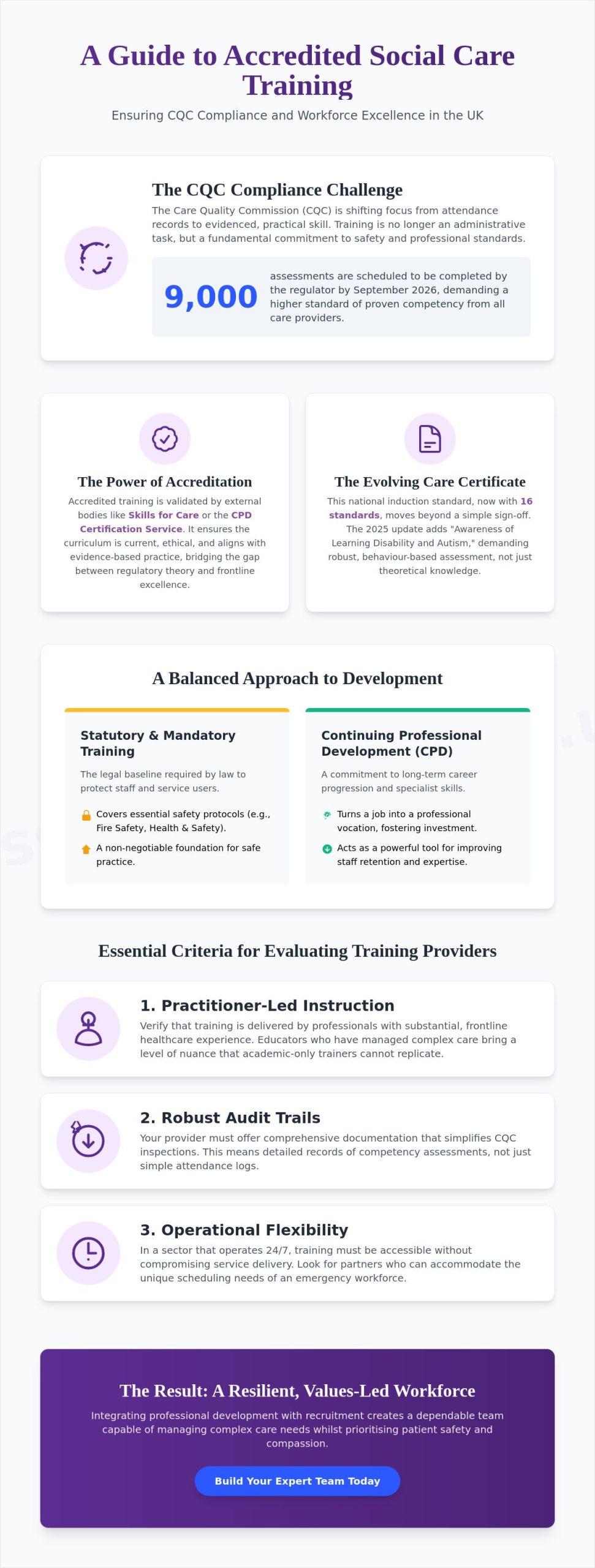
Could your staff confidently demonstrate their competency if a CQC inspector arrived at your door tomorrow? With the regulator aiming to complete 9,000 assessments by September 2026, the industry has moved beyond simple attendance records toward a rigorous demand for evidenced, practical skill. Securing high-quality accredited social care training UK is no longer merely an administrative task; it is a fundamental commitment to the safety of your service users and the integrity of your professional standards.
We recognise the pressure care providers face, from the anxiety of upcoming inspections to the persistent challenge of high staff turnover. It is difficult to find specialist training that addresses complex needs whilst maintaining a culture of genuine compassion. This resource will help you identify accredited programmes that ensure full regulatory compliance and cultivate a workforce driven by shared values. We’ll examine the updated 2025 Care Certificate standards, the legal mandates for Oliver McGowan training, and the practical steps to building a dependable team that prioritises patient safety through expert knowledge.
Key Takeaways
- Understand how accredited social care training UK serves as the foundation for CQC compliance and high-quality service delivery.
- Identify the essential benchmarks for evaluating training providers, prioritising those who blend rigorous theoretical knowledge with real-world healthcare expertise.
- Explore the specific training requirements for sensitive environments, including children’s complex care and advanced clinical support at home.
- Gain insights into regional staff development strategies specifically tailored for the Greater Manchester healthcare infrastructure.
- Discover how integrating professional development with recruitment creates a resilient, values-led workforce capable of managing complex care needs.
What is Accredited Social Care Training in the UK?
Accreditation is the cornerstone of professional integrity in the care sector. It refers to educational programmes that have undergone rigorous external validation by recognised bodies such as Skills for Care or the CPD Certification Service. When a provider invests in accredited social care training UK, they are doing more than meeting a basic requirement. They are adopting a curriculum that aligns with the latest evidence-based practices and ethical frameworks. This alignment is vital for satisfying the Care Quality Commission (CQC), as inspectors increasingly focus on the practical competency of staff rather than just the presence of a training folder.
The Social Care Institute for Excellence (SCIE) frequently highlights that high standards in training directly correlate with improved outcomes for service users. Accreditation provides a reliable benchmark, ensuring that the information taught is current, ethical, and legally sound. In 2026, accreditation represents the gold standard because it bridges the gap between regulatory theory and frontline excellence, ensuring every staff member possesses the verified competence required for safe, high-quality care.
The Role of the Care Certificate
The Care Certificate serves as the national induction standard for health and social care workers in England. It now comprises 16 specific standards, including duty of care, safeguarding, and the 2025 addition of “Awareness of Learning Disability and Autism”. Whilst many agencies view this as a preliminary induction, accredited training ensures these standards are deeply embedded in a support worker’s daily practice. It moves the process away from a simple sign-off towards a robust assessment of real-world behaviour. This ensures that healthcare assistants aren’t just reading about safety, but are actively practicing it in sensitive environments.
CPD vs. Mandatory Training: Knowing the Difference
Distinguishing between these two paths is essential for any principled care provider. Statutory and mandatory training is the legal baseline; it covers the essential safety protocols required by law to protect both staff and clients. However, by offering accredited social care training UK opportunities through Continuing Professional Development (CPD), providers demonstrate a commitment to their team’s long-term career progression. CPD acts as a powerful tool for staff retention. It turns a job into a professional vocation, fostering a workforce that is both technically skilled and emotionally invested in their roles. A balanced approach combines these legal necessities with specialist development to create a resilient, expert team.
Essential Criteria for Evaluating Training Providers
Selecting a training partner is a decision that carries significant weight for the safety of your service users and the professional standing of your organisation. High-quality accredited social care training UK should never be viewed as a checkbox exercise or a low-cost commodity. Instead, it’s a strategic investment in workforce resilience. To ensure your training delivers genuine value, you must evaluate providers against a set of rigorous standards that go beyond basic certification.
A dependable provider offers a balanced curriculum that marries theoretical depth with practical, hands-on application. It’s insufficient for staff to simply watch a presentation; they must demonstrate their ability to apply knowledge in real-world scenarios. Consider these essential benchmarks during your evaluation:
- Practitioner-Led Instruction: Verify that the training is delivered by professionals with substantial frontline healthcare experience. Educators who have managed complex care environments bring a level of nuance that academic-only trainers cannot replicate.
- Robust Audit Trails: Your provider must offer comprehensive documentation that simplifies CQC inspections. This includes detailed records of competency assessments, not just attendance logs.
- Operational Flexibility: In a sector that operates 24/7, training must be accessible without compromising service delivery. Look for partners who can accommodate the unique scheduling needs of an emergency workforce.
Checking for Regulatory Alignment
Alignment with national standards is non-negotiable. You should always verify a provider’s credentials with bodies like Skills for Care to ensure their curriculum remains current. The Care Workforce Pathway for Adult Social Care provides a clear framework for the skills and knowledge required at every level of the profession. Avoid generic, “off-the-shelf” programmes that fail to address the specific health and safety legislation relevant to your particular care setting. Customisation ensures that the training reflects the actual risks and responsibilities your staff face daily.
The Importance of Values-Led Curriculums
Technical proficiency is only half of the equation. A truly expert training programme embeds a culture of care, emphasising dignity, respect, and patient-centred outcomes. When staff understand the “why” behind a procedure, their behaviour shifts from compliance to compassion. At Jessamy Staffing Solutions, we integrate these core values into every module of our accredited social care training UK, ensuring that every support worker we supply is as empathetic as they are skilled. Our social care training and development programmes are designed specifically to bridge the gap between institutional requirements and human needs.
Specialist Training for Complex and Children’s Care
Specialist care demands a higher register of technical proficiency that extends far beyond the basics of daily support. When a service involves children or adults with complex clinical needs, the requirement for accredited social care training UK becomes a matter of life-sustaining importance. These environments are often fragile, requiring a workforce that can navigate sophisticated medical technology whilst maintaining the warmth and intimacy of a family home. Specialist training acts as a critical safeguard, preventing the destabilisation of sensitive home care environments by ensuring staff can manage clinical crises without immediate hospital escalation. For a detailed roadmap on developing your team’s capabilities in this area, our specialist care workforce training guide for UK providers offers comprehensive strategies for building a professionalised, resilient team.
Accredited programmes in this niche must provide rigorous instruction in specific clinical protocols. This includes, but is not limited to, the following areas:
- Airway Management: Ensuring staff are competent in tracheostomy care and suctioning to maintain respiratory safety.
- Enteral Nutrition: Providing verified skills in PEG feeding and the management of gastrostomy sites.
- Seizure Protocols: Training staff to recognise diverse seizure types and administer emergency medication with precision.
Clinical Competency in Home Settings
The transition from a clinical hospital ward to a private residence is a significant shift for any support worker. Staff must be capable of operating specialist medical equipment in a setting that lacks the immediate backup of a multidisciplinary hospital team. To achieve this, providers should look for training that aligns with the Minimum standards for social care. Ongoing supervision and regular competency assessments are vital. It’s not enough for a worker to be trained once; they must be observed in the home environment to ensure their clinical skills remain sharp and safe.
Safeguarding Amongst Vulnerable Populations
Safeguarding children with disabilities and complex needs requires a nuanced approach that goes beyond standard protocols. Traditional signs of distress or neglect may be masked by a child’s underlying medical condition or communication barriers. High-quality accredited social care training UK teaches staff to recognise subtle changes in behaviour or physical health that might indicate a safeguarding concern. This specialist knowledge is most effective when integrated into a multi-agency framework, ensuring that support workers, social workers, and clinicians share a unified understanding of the child’s well-being. By fostering this expert vigilance, care providers can protect the most vulnerable members of our society with the rigour they deserve.
Organising Staff Development in Greater Manchester
Greater Manchester operates within a distinct care economy, shaped by its devolved health and social care budget and a diverse demographic landscape. Local providers face the dual challenge of meeting high demand whilst navigating a competitive recruitment market. To thrive, organisations must secure accredited social care training UK that reflects the regional infrastructure. This means partnering with educators who understand the specific requirements of the Greater Manchester Integrated Care System and the local standards set by the Social Care Academy, which provides fully funded licences for individuals working in the region’s adult social care sector.
Choosing a Manchester-based training partner offers more than just geographic convenience. It facilitates essential in-person practical assessments that are often difficult to coordinate remotely. These face-to-face sessions allow for the verification of physical skills, such as moving and handling or clinical procedures, within the context of local facilities. Crucially, these sessions must be organised with precision to ensure they don’t disrupt 24/7 emergency care staffing UK. Maintaining a seamless rapid response whilst upskilling the team requires a partner who respects the operational realities of frontline care.
Logistics for Manchester Care Managers
Balancing complex shift patterns with mandatory training is a persistent hurdle for care managers across the North West. Success lies in flexible delivery models that combine online theory with onsite practical sessions. By conducting assessments within your own residential care facility, you reduce staff travel time and ensure that training is relevant to the specific layout and equipment used by your team. Additionally, managers should explore regional funding opportunities, such as the Learning and Development Support Scheme (LDSS), which allocated up to £10 million for the 2026/27 financial year to support professional growth in the sector.
Building a Dependable Local Workforce
Robust training programmes are a powerful engine for local recruitment and retention. When support workers see a clear path for progression, they’re more likely to remain within the regional care community. Jessamy Staffing plays a vital role in this ecosystem by supporting Manchester’s care homes and supported living services with highly trained professionals. We help providers foster a “culture of excellence” that elevates the reputation of the entire service. By investing in accredited social care training UK, you don’t just fill a rota; you build a stable, loyal team. If you’re looking to strengthen your workforce, our socialcare training and development solutions provide the expertise needed to maintain high standards of patient safety and CQC compliance.
The Jessamy Advantage: Integrating Training with Workforce Capacity
Jessamy Staffing Solutions operates at the vital intersection of recruitment and professional development. We recognise that workforce capacity is not merely about the number of personnel on a rota, but the depth of their collective expertise. By providing accredited social care training UK as a core component of our workforce strategy, we ensure that every placement is underpinned by verified competence. This integrated model allows us to bridge the gap between traditional recruitment and the high-level professional standards required by modern healthcare institutions.
Our approach to developing a dependable workforce starts with a deeply embedded culture of care. We don’t view training as a secondary administrative task; it is the primary filter through which we select and prepare our staff. This ensures that every support worker we supply is professionally prepared for sensitive environments, from private homes to complex residential settings. Understanding the benefits of trained agency care staff is essential for any organisation seeking to maintain quality and compliance whilst managing the pressures of high workforce turnover. Our “safe, values-led personnel” model is designed to provide institutional clients with absolute confidence in the quality of care being delivered.
Ensuring Compliance Awareness in Every Placement
Maintaining CQC compliance is a continuous challenge, particularly when utilising temporary or supplementary staff. Our training programmes guarantee that every worker is fully aware of their regulatory responsibilities before they step into a placement. We follow rigorous recruitment pathways that are intrinsically linked to our accredited social care training UK modules. This means that when a Jessamy support worker arrives, their training records are transparent, up-to-date, and readily available for audit. We provide healthcare organisations with the peace of mind that comes from knowing their staffing solutions are as compliant as they are capable.
Our Commitment to Professional Excellence
The ultimate measure of our success is the well-being of the end-user. Whether we are providing support worker supply or children’s complex care at home, our training design prioritises the dignity and safety of those receiving care. We focus on developing a competent and dependable workforce that can adapt to the evolving demands of the modern care economy. This commitment to excellence ensures that our partners receive more than just staffing; they receive a long-term professional ally dedicated to maintaining the highest standards of service.
Maintaining these high standards of dignity often involves collaborating with other principled professionals within the wider care community. For example, independent funeral directors like Ashley Edwards demonstrate how a commitment to compassion and professionalism should continue when supporting families through the most sensitive transitions.
If your organisation requires a workforce that combines technical clinical skills with genuine human warmth, we’re ready to assist. Contact us today to discuss bespoke training or to explore our socialcare training and development and staffing solutions. Together, we can build a resilient care environment that prioritises patient safety and professional integrity above all else.
Elevating Care Standards Through Professional Development
Professional excellence in social care requires a meticulous balance of technical clinical competency and genuine human empathy. We’ve explored how accredited social care training UK serves as the essential foundation for CQC compliance, particularly as the focus shifts toward evidenced staff behaviour. By integrating specialist training for complex needs with robust local development strategies, providers can address the persistent challenges of staff turnover and regulatory anxiety. This comprehensive approach doesn’t just satisfy an inspector; it ensures the safety and dignity of the individuals who rely on your services every day.
As an accredited social care training provider and specialists in 24/7 emergency cover, we’re dedicated to supporting your organisation through values-led recruitment for sensitive environments. Our model ensures that every support worker is professionally prepared and ethically aligned with your mission. Discover our accredited training and staffing solutions to see how we can strengthen your workforce capacity. Investing in the skill and well-being of your team is the most dependable path toward a stable, high-quality care environment. Let’s work together to build a workforce that truly delivers.
Frequently Asked Questions
Is accredited social care training a legal requirement in the UK?
Yes, specific elements of training are mandatory under UK law. The Health and Care Act 2022 made it a legal requirement for all CQC-registered providers to ensure staff receive training on learning disability and autism, specifically the Oliver McGowan Mandatory Training. Beyond these specific mandates, the CQC requires all providers to evidence that their workforce is competent and appropriately trained to perform their roles safely.
How long does it take to complete the Care Certificate?
The Care Certificate is typically completed within a 12-week induction period for new healthcare assistants and support workers. It involves meeting 16 different standards, ranging from duty of care to the 2025 addition of learning disability awareness. Whilst the theoretical components can be finished relatively quickly, the full certificate requires practical observation and assessment in the workplace to verify genuine competency.
Can I access accredited social care training UK online?
Many providers offer accredited social care training UK through blended learning platforms that combine online theory with in-person assessments. Online modules are excellent for building foundational knowledge in areas like safeguarding or legislation. However, clinical skills and physical tasks, such as moving and handling or PEG feeding, must be assessed face-to-face by a qualified professional to ensure safety and compliance.
What is the best way to track staff training compliance for CQC?
The most effective method is maintaining a digital training matrix or a Learning Management System (LMS) that provides real-time oversight of certification dates. CQC inspectors look for a clear audit trail that proves not just course completion, but evidenced competency. Regularly updating these records ensures you can identify upcoming expiry dates before they lead to a breach in compliance or a risk to patient safety.
Does Jessamy Staffing provide training for external organisations?
Yes, we offer comprehensive socialcare training and development solutions tailored for external healthcare organisations and residential facilities. Our programmes are designed to bridge the gap between institutional requirements and frontline human needs. We provide bespoke sessions that cover both mandatory requirements and specialist clinical skills, ensuring your workforce remains compliant and capable of delivering high-quality, values-led care.
What happens if my staff do not have up-to-date mandatory training?
Failure to maintain up-to-date training can lead to significant regulatory action, including “Inadequate” ratings from the CQC or financial penalties. More importantly, it compromises the safety of both your staff and the individuals in your care. If an incident occurs and training is found to be lapsed, the provider may face legal liability and a total loss of insurance cover for that specific service.
How much does accredited social care training cost for a small care home?
Costs vary significantly depending on the level of qualification required and the number of staff members being trained. For example, a Level 5 Diploma in Leadership and Management will naturally command a higher investment than a short CPD course. Many providers in Greater Manchester can offset these costs by accessing government funding schemes, such as the Learning and Development Support Scheme (LDSS), which supports professional growth across the sector.
What specialist training is needed for children’s complex care at home?
Specialist pediatric care requires a combination of advanced clinical skills and pediatric-specific safeguarding knowledge. Staff must be trained in airway management, gastrostomy care, and seizure protocols tailored for younger patients. It’s also vital that training focuses on the unique dynamics of the home environment, ensuring support workers can operate medical technology whilst respecting the privacy and routines of a family setting. Providers seeking a structured approach to this challenge will find valuable guidance in our specialist care workforce training comprehensive guide, which outlines the latest 2026 implementation plans for children’s social care.