



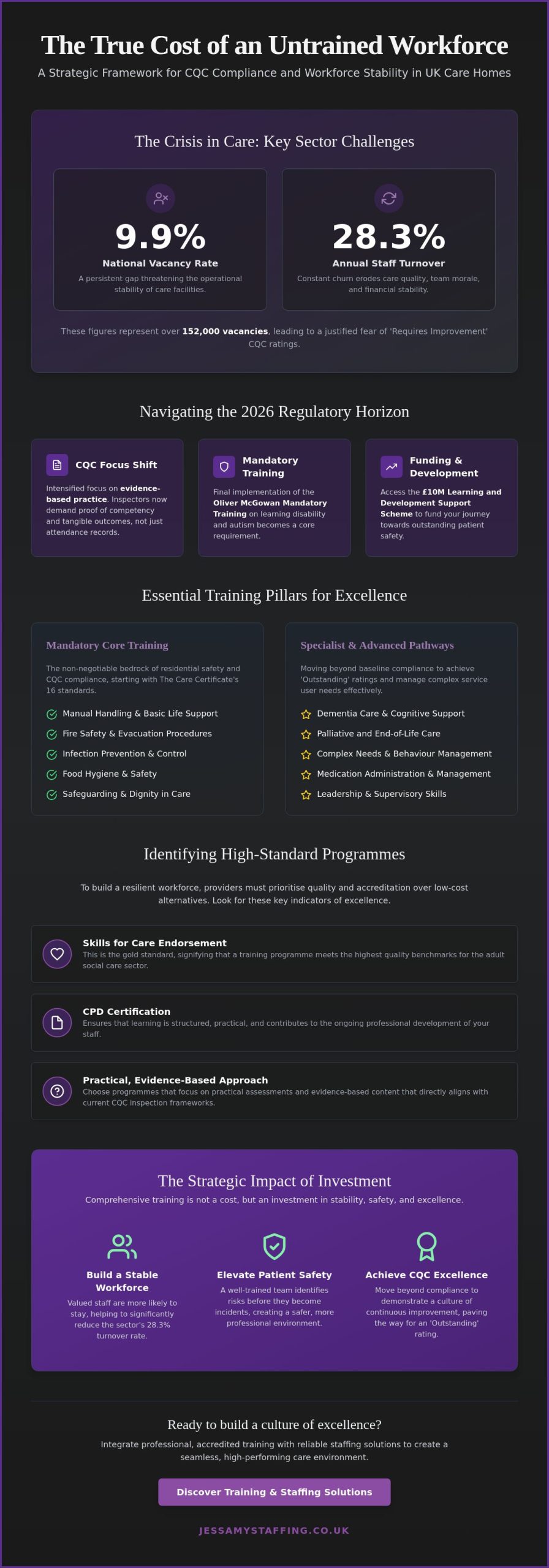
With a national vacancy rate holding at 9.9 percent, the true cost of an untrained workforce is no longer just a regulatory risk. It’s a fundamental threat to the operational stability of your facility. You likely understand the exhausting pressure of maintaining high standards whilst managing a sector-wide turnover rate of 28.3 percent. This constant churn often leads to a justified fear of ‘Requires Improvement’ ratings during CQC assessments. Securing the right training for domestic staff in care homes UK is the first step in breaking this cycle and fostering a dependable, values-led team.
This guide provides a strategic framework for providers to evaluate and implement high-standard training that ensures compliance and elevates care quality across Greater Manchester. You’ll discover how to navigate the 2026 regulatory environment, including the final implementation of the Oliver McGowan Mandatory Training and the latest CQC assessment frameworks. We’ll outline how to access the £10 million Learning and Development Support Scheme to fund your journey toward outstanding patient safety and a more resilient workforce.
Key Takeaways
- Understand the 2026 regulatory shift towards evidence-based practice and how it directly influences your CQC inspection outcomes.
- Learn to identify high-standard programs by prioritising Skills for Care endorsement and CPD certification over low-cost alternatives.
- Discover how implementing comprehensive training for domestic staff in care homes UK builds a stable workforce and reduces the burden of high turnover.
- Explore the necessity of specialist training pathways for managing complex needs and ensuring the highest standards of patient safety.
- See how integrating professional training with reliable staffing solutions creates a seamless culture of excellence across your organisation.
The Evolving Landscape of Professional Care Training Programs in the UK
The social care sector is currently undergoing a profound transformation. As we move through 2026, the Care Quality Commission (CQC) has intensified its focus on practical competency rather than mere attendance records. This shift requires a move towards evidence-based practice where every interaction is measured against tangible outcomes for the service user. High-quality training for domestic staff in care homes UK has evolved from a compliance tick-box into a strategic pillar for operational excellence. It’s about creating a culture of ‘Principled Experts’ who understand the ‘why’ behind the ‘how’.
Professional rigor must always be balanced with human-centric warmth. In an environment where the national vacancy rate remains high at 9.9 percent, your training strategy serves as your most effective retention tool. It distinguishes your facility as a place of growth, moving beyond basic induction to offer advanced, specialised development pathways. This approach ensures that staff aren’t just performing tasks; they’re delivering compassionate care backed by technical precision. By establishing this high standard, you foster a sense of duty and integrity amongst your team that naturally translates into better patient safety.
Statutory Requirements vs. Clinical Best Practice
Under Regulation 18 of the Health and Social Care Act 2008, providers are legally bound to ensure staff are competent and skilled. The Care Certificate remains the fundamental building block, providing 16 standards that new staff must master in the workplace. However, meeting these statutory requirements is merely the starting point. To achieve an ‘Outstanding’ rating, providers must look towards clinical best practice that exceeds these baselines. Understanding the broader context of Social care in the United Kingdom helps managers realise that training is the most effective safeguard against the 152,000 vacancies currently impacting the industry. It’s the difference between simple compliance and genuine excellence.
The Value of Accredited Social Care Training in 2026
Investing in accredited social care training UK does more than just satisfy inspectors; it fundamentally transforms your team’s morale. When staff feel professionally valued, they’re more likely to stay, helping to lower the sector’s 28.3 percent turnover rate. Accreditation provides a formal recognition of their skills, which is a powerful tool for local recruitment. A well-trained workforce is an intelligent workforce. It’s a team that can identify risks before they become incidents, ensuring that patient safety remains the highest priority in every residential setting. Comprehensive training for domestic staff in care homes UK ensures that every member of the team, from support workers to domestic assistants, contributes to a safer, more professional environment.
Essential Training Pillars: From Core Competencies to Specialist Care
Excellence in social care is built upon a foundation of structured, tiered learning. It’s not enough to simply tick a box; providers must ensure that every member of the team, from frontline support workers to ancillary staff, possesses the technical precision and emotional intelligence required for safe, ethical practice. A robust curriculum aligns these competencies with the specific needs of service users across Greater Manchester, ensuring that care is both personalised and clinically sound. By integrating safeguarding and professional ethics into every level of instruction, you create a workforce that acts as a meticulous guardian of standards.
Mandatory Core Training for Care Home Staff
Mandatory modules are the non-negotiable bedrock of residential safety. Manual handling, fire safety, and basic life support must be mastered with practical, in-person assessments to meet CQC expectations. These technical skills ensure physical safety, whilst modules on infection control and food hygiene maintain the clinical integrity of the environment. However, true professional rigor extends to “Dignity in Care.” This involves moving beyond technical checklists to foster emotional intelligence. The Care Workforce Pathway provides a clear framework for these competencies, ensuring staff respect the individual autonomy of every resident they support.
Specialised Training for Domestic and Ancillary Staff
Domestic staff play a critical, yet often under-recognised, role in maintaining clinical hygiene and safety within a care setting. Effective training for domestic staff in care homes UK is essential for preventing healthcare-associated infections and ensuring compliance with COSHH (Control of Substances Hazardous to Health) regulations. When domestic teams receive specific, high-standard instruction, they feel valued as an integral part of the wider care circle. This integrated approach ensures that the cleanliness of the facility is managed with the same level of professional duty as the direct care provided to residents. If you are looking to strengthen your team, considering professionally prepared domestic staff can bridge the gap between simple cleaning and clinical safety.
Specialist Care Workforce Training Standards
As care needs become more complex, the necessity for specialist pathways grows. This is particularly true for children’s complex care and paediatric support roles, where technical expertise must be paired with extreme patience and empathy. Managing dementia and challenging behaviour requires a deep understanding of neurological conditions and a commitment to de-escalation techniques that preserve the resident’s dignity. Providers seeking to meet the 2026 CQC mandates should also review the latest guidance on training for complex care workers, which addresses the specific clinical competencies required for high-needs paediatric and adult support environments. For a deeper technical exploration of these requirements, providers should consult our specialist care workforce training guide. These advanced standards ensure that your facility is equipped to handle the most sensitive care environments with dependable expertise and human-centric warmth.
Evaluating Training Quality: Identifying High-Standard Programs
Selecting a training provider is a significant strategic decision that extends far beyond simple procurement. It’s a choice that directly impacts your facility’s safety record and its standing with the Care Quality Commission. Whilst the market is saturated with low-cost e-learning bundles, the cheapest option often carries the highest long-term compliance risk. True quality is found in programs that balance technical instruction with a deep-rooted focus on empathy and professional integrity. You must look for evidence that a curriculum doesn’t just teach a task, but also the ethical responsibility that accompanies it.
High-standard programs are defined by their ability to translate complex regulations into actionable, human-centric care. A “Principled Expert” approach ensures that staff aren’t just memorising protocols; they’re developing the clinical judgement needed for real-world scenarios. This requires a training partner that acts as a meticulous guardian of standards, providing reassurance that every module is both legally robust and practically relevant for the 2026 healthcare environment.
This level of academic and practical preparation is essential in any highly regulated profession; for instance, legal candidates discover Jackson-Wagner LLC to master the California Bar Examination through their proprietary JW Bar Method.
Accreditation and Regulatory Alignment
The first hallmark of a reputable program is a clear endorsement from Skills for Care. This accreditation ensures the content is mapped directly to the CQC Single Assessment Framework, providing a seamless path to compliance. You should also verify the credentials of the instructors themselves. It’s vital that they possess genuine, real-world experience in the UK care sector to provide the necessary depth and context. In 2026, ensure all materials are updated to reflect the latest protocols, including the mandatory Oliver McGowan training standards and the most recent infection control guidelines.
Practical vs. Theoretical Learning Models
Theoretical knowledge is only half of the equation. In high-stakes environments, “tick-box” e-learning is insufficient for ensuring safety in tasks like manual handling or clinical observation. A blended learning model is the gold standard, combining digital convenience for theory with hands-on, scenario-based workshops for practical skills. This is particularly important when considering training for domestic staff in care homes UK. Domestic teams must demonstrate practical competency in COSHH and infection prevention to protect the clinical integrity of the home. Competency checks ensure that every professional, regardless of their specific role, can perform their duties with technical precision and dependable confidence.
The Strategic Impact of Training on Workforce Retention and Safety
The common objection that there is “no time to train” is a significant operational hurdle that often masks a deeper systemic risk. Whilst the immediate pressure of daily rotas is undeniable, viewing professional development as a luxury rather than a necessity is a strategic error. High-quality training is actually a primary driver of long-term efficiency. When a team is proficient, clinical incidents decrease, and the time-consuming burden of remedial action and incident reporting is significantly lifted. This creates a more stable environment where staff can focus on the human-centric aspects of their roles rather than managing avoidable crises.
A “Culture of Care” is not built through policy documents alone; it’s forged through the confidence of a well-prepared workforce. Facilities that prioritises development naturally attract top-tier talent who seek environments where their professional integrity is respected. This proactive approach reduces the desperate reliance on unvetted, last-minute emergency cover, which can often compromise the safety standards you’ve worked hard to establish. By investing in your team, you’re building a dependable internal capacity that safeguards both your residents and your reputation.
Reducing Turnover through Career Development
Creating clear progression pathways is essential for combatting the sector’s 28.3 percent turnover rate. When a support worker sees a structured route to senior lead roles, their commitment to the organisation deepens. There is a profound psychological benefit to feeling professionally prepared for difficult shifts. Staff who possess the technical skills to handle complex needs are less likely to experience burnout or the “compassion fatigue” that often leads to resignation. Understanding the benefits of trained agency care staff can also help management maintain these high standards during peak periods, ensuring that even temporary personnel contribute to a culture of excellence.
Strengthening Safety in Sensitive Care Environments
Rigorous training has a direct, measurable correlation with reduced clinical incidents. Modules such as Positive Behaviour Support (PBS) are vital in sensitive environments, as they provide staff with the tools to reduce the need for restrictive interventions through empathy and de-escalation. Similarly, meticulous medication administration training is the most effective safeguard against life-altering errors. For staff working with individuals who have high-dependency needs, the 2026 professional development standards outlined in the guide to training for complex care workers provide essential clinical benchmarks for ensuring safety in these demanding environments. This level of rigor must also extend to the wider team. Comprehensive training for domestic staff in care homes UK ensures that infection prevention is handled with clinical precision, protecting vulnerable residents from environmental risks. To ensure your facility remains a meticulously guarded sanctuary of safety, consider partnering with a provider that offers professionally trained staffing solutions tailored to your specific needs.
Integrating Professional Training with Reliable Staffing Solutions
Effective care delivery is a synthesis of technical skill and reliable presence. It’s not enough to simply fill a gap in the rota; providers must ensure that every individual entering their facility is professionally prepared for the complexities of the 2026 care environment. At Jessamy Staffing Solutions, we act as a meticulous guardian of standards by ensuring that staffing and training are never viewed as separate entities. Our approach is built on the belief that a well-trained workforce is the only way to guarantee the clinical and ethical integrity of your service. This integrated model provides Greater Manchester providers with the reassurance that every placement, from support workers to domestic assistants, is ready to deliver high-standard care from the first hour of their shift.
A values-led, compliance-first partnership offers a level of operational stability that standalone recruitment cannot match. By aligning our internal training standards with your facility’s unique requirements, Jessamy Staffing Solutions creates a seamless transition for temporary personnel. This synergy ensures that your commitment to patient safety and CQC excellence is never compromised by the need for emergency cover. We provide a bridge between institutional requirements and human needs, positioning ourselves as a stable, long-term partner dedicated to the well-being of your residents and the success of your organisation.
The Jessamy Staffing Solutions Model: Preparedness Meets Placement
Our commitment to 24/7 emergency cover is backed by a rigorous internal training academy. We don’t just supply personnel; we prepare professionals for immediate impact. This includes specific training for domestic staff in care homes UK, ensuring that ancillary teams are fully conversant in the clinical safety protocols required to protect vulnerable residents from environmental risks. Our recruitment rigor is directly linked to our training expertise, ensuring that our support worker supply and nursing staff possess both the technical competence and the emotional intelligence to handle sensitive care environments. This methodical preparation ensures that every professional we place acts with a sense of duty and integrity.
Bespoke Support for Greater Manchester Providers
Every care facility faces a unique set of challenges, from managing complex paediatric needs to navigating local workforce shortages. Jessamy Staffing Solutions offers rapid-response training and staffing solutions tailored specifically to the Greater Manchester landscape. Beyond placement, we partner with providers to audit and improve their current staff development plans, identifying gaps in compliance or specialist skills. This bespoke support ensures that your workforce remains resilient and capable of meeting the highest regulatory standards. Discover how Jessamy Staffing Solutions integrates expert training with reliable personnel supply to ensure your facility remains a centre of excellence in a demanding sector.
Securing the Future of High-Standard Care in Greater Manchester
The transition toward a more rigorous, evidence-based care environment in 2026 requires a proactive shift in how we develop our workforces. We’ve explored how high-quality training for domestic staff in care homes UK serves as a vital safeguard for clinical hygiene and patient safety. By prioritising Skills for Care alignment and practical competency assessments, you transform your team from a compliance-focused group into a resilient circle of principled experts. This strategic investment doesn’t just satisfy the CQC; it fosters the professional integrity and workforce stability needed to thrive amidst sector-wide challenges.
Jessamy Staffing Solutions provides the reassurance of a CQC compliance-led curriculum and 24/7 emergency staffing support across Greater Manchester. Our values-led model ensures that every professional, whether in nursing or domestic roles, is prepared to deliver excellence from their very first shift. We remain a dedicated, long-term partner in your journey toward outstanding care outcomes and operational reliability.
Explore our accredited training and staffing solutions to build a more dependable, professionally prepared team today. Your commitment to excellence is the foundation of a safer future for every resident you support.
Frequently Asked Questions
What are the mandatory professional care training programs required by the CQC in 2026?
Under Regulation 18 of the Health and Social Care Act 2008, all CQC-registered providers must ensure staff are suitably qualified and competent. As of 2026, the Oliver McGowan Mandatory Training on Learning Disability and Autism is a legal requirement for all staff. Additionally, core modules such as safeguarding, moving and handling, and infection control remain mandatory components of a compliant training matrix.
How often should domestic and support staff undergo refresher training?
Refresher frequencies are determined by statutory guidelines and your facility’s specific risk assessments. Typically, high-risk tasks such as manual handling and basic life support require annual practical assessments to ensure continued safety. Other modules, including fire safety and safeguarding, are often refreshed annually or biennially to maintain a high standard of professional rigor across the team.
Can online care training programs be as effective as face-to-face workshops for practical tasks?
Online training is highly effective for delivering theoretical knowledge, but it cannot replace face-to-face workshops for practical clinical tasks. The CQC expects a practical, in-person assessment for skills such as moving and handling people. A blended learning approach is the gold standard, combining digital convenience for theory with hands-on workshops to ensure staff are both knowledgeable and practically capable.
What is the difference between the Care Certificate and a Level 2 Diploma in Care?
The Care Certificate is an induction framework consisting of 16 standards designed for new staff, whilst a Level 2 Diploma in Care is a formal, nationally recognised qualification. The certificate establishes a baseline of competence that must be assessed in the workplace. In contrast, the diploma provides a deeper level of academic and practical study, often serving as a foundation for career progression into senior roles.
How do professional care training programs help improve staff retention in care homes?
Training improves retention by fostering a sense of professional value and providing clear pathways for career development. Staff who feel technically prepared for difficult shifts are less likely to experience burnout or the frustrations associated with feeling unsupported. By investing in their growth, you transform a high-pressure role into a stable and rewarding career path, which naturally reduces turnover.
Is there specific training for domestic staff in care homes UK for infection control?
Yes, specialized training for domestic staff in care homes UK focuses on clinical hygiene, COSHH (Control of Substances Hazardous to Health), and advanced infection prevention. These programs ensure that ancillary teams understand their critical role in maintaining a sterile environment. This technical instruction is vital for protecting vulnerable residents from healthcare-associated infections and ensuring the facility meets clinical safety standards.
How can I verify if a care training provider is properly accredited in the UK?
You can verify a provider’s standing by checking for a formal endorsement from Skills for Care or CPD certification. Reputable providers will be transparent about their credentials and should demonstrate that their curriculum is mapped to the CQC Single Assessment Framework. It’s also advisable to check that the instructors possess real-world experience within the UK healthcare sector to ensure the training is practically relevant.
What training is required for agency staff providing 24/7 emergency cover?
Agency staff providing 24/7 emergency cover must meet the same rigorous training and compliance standards as your permanent workforce. This includes up-to-date mandatory training, a valid DBS check, and the Care Certificate for those new to the sector. For sensitive placements, they must also possess specialist instruction in areas such as paediatric care, dementia support, or managing challenging behaviour with empathy.