



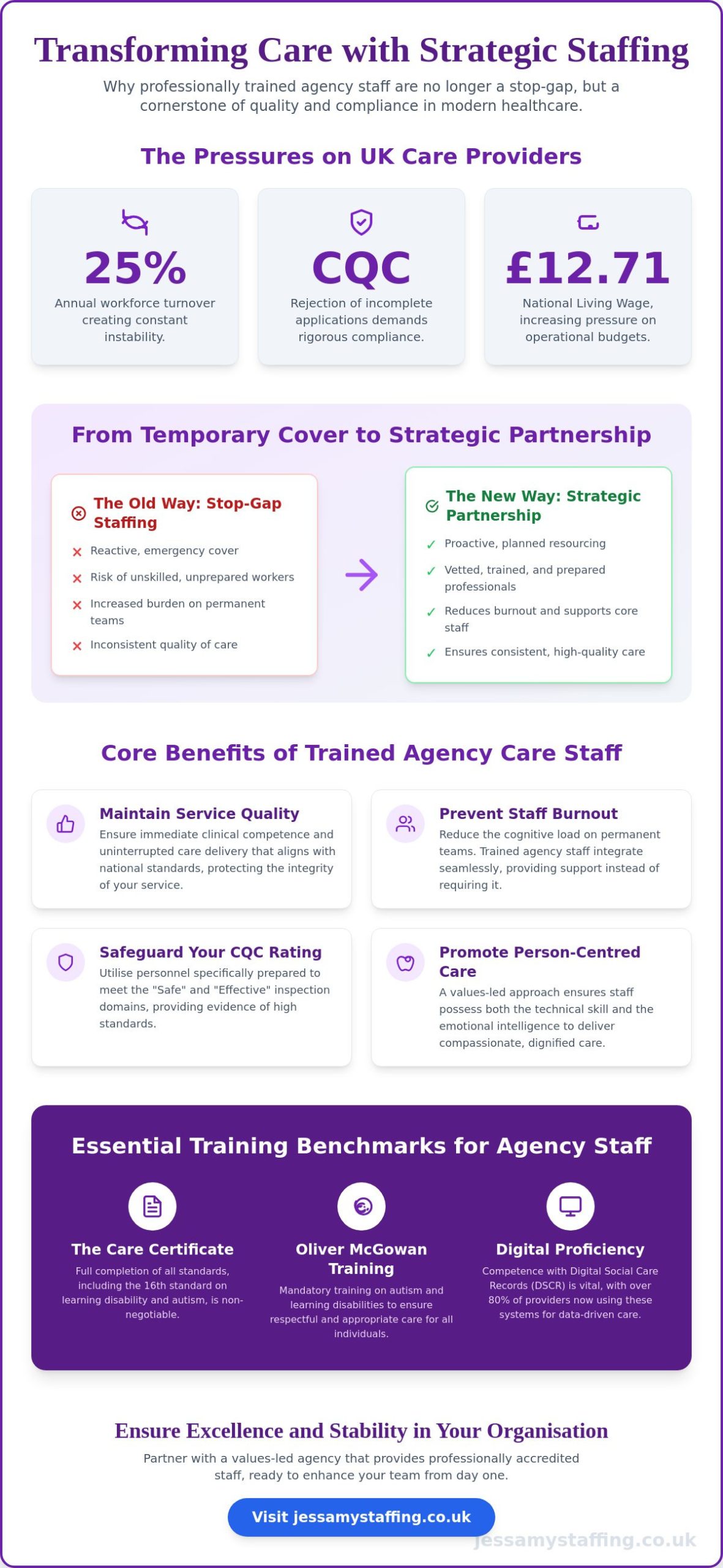
In a regulatory climate where the Care Quality Commission (CQC) now rejects incomplete registration applications without assessment, the traditional view of temporary staffing as a “stop-gap” is no longer a viable strategy. You likely feel the constant pressure of a 25% annual workforce turnover, making the strategic benefits of trained agency care staff a vital consideration for your operational stability. It’s a challenging balance to strike, maintaining high standards whilst managing the administrative weight of internal training and the new £12.71 National Living Wage.
This article explores how professionally accredited personnel enhance care quality, ensure rigorous CQC compliance, and provide the necessary resilience for healthcare organisations. We’ll examine how integrating specialist expertise and ensuring seamless service continuity can transform your operational efficiency and protect the well-being of those in your care. By the end of this guide, you’ll understand how to turn temporary staffing into a long-term asset for excellence and safety.
Key Takeaways
- Understand why the shift towards a professionalised care workforce has made “unskilled” care obsolete in the 2026 healthcare landscape.
- Discover the clinical and operational benefits of trained agency care staff in maintaining immediate safety and preventing burnout amongst your permanent teams.
- Learn how to safeguard your CQC rating by utilising temporary personnel who are specifically prepared for “Safe” and “Effective” inspection domains.
- Identify the critical training standards and recruitment benchmarks you must verify to ensure an agency is truly values-led rather than volume-driven.
- Explore how integrating accredited training with practical workforce intelligence creates a more stable and dependable staffing solution for complex care needs.
The Evolution of Health and Social Care Development in the UK
The landscape of the social care system in England has undergone a profound transformation, moving away from a model of basic assistance towards a highly professionalised sector. In 2026, the notion of “unskilled” care has been firmly left behind. As the complexity of patient needs increases, particularly with the shift towards community-based services and “neighbourhood health services,” the demand for technical competence has never been higher. This evolution has redefined the role of staffing providers. Modern agencies are no longer mere suppliers of labour; they’re essential contributors to health and social care development, ensuring that the workforce is equipped to handle the intricacies of modern clinical requirements.
Understanding the benefits of trained agency care staff is crucial for providers who must balance rising costs with the strict mandates of CQC Regulation 18. With the National Living Wage reaching £12.71 per hour in April 2026, the financial investment in staff must yield high-quality outcomes to be sustainable. Accredited training ensures that every hour of care delivered contributes to patient safety and organisational reputation. It’s no longer enough to simply fill a rota; providers need partners who understand the intersection of technical excellence and human-centric warmth.
Rising Standards in the 2026 Care Economy
The regulatory environment has set a high bar for excellence. By July 2025, the Care Certificate was updated to include a 16th standard on learning disability and autism, making the Oliver McGowan Mandatory Training a cornerstone of professional practice. Providers, particularly those in the Greater Manchester area, are increasingly prioritising values-led recruitment. They recognise that technical skill must be paired with emotional intelligence to meet the expectations of a modern service. Digitisation has also reshaped requirements. With over 80% of adult social care providers now using Digital Social Care Records, staff must be technically proficient enough to manage real-time data and monitoring systems. This digital-first approach requires a level of training that goes far beyond basic care tasks, focusing instead on precision and data-driven accountability.
From Temporary Cover to Strategic Partnership
The most successful healthcare organisations have moved beyond using agency staff for last-minute “emergency cover.” Instead, they view these professionals as a strategic extension of their own teams. One of the primary benefits of trained agency care staff is their ability to integrate into complex environments with a “professionally prepared” mindset. This reduces the friction typically associated with temporary personnel and ensures that service quality remains consistent. Poor-quality care carries hidden costs, from increased administrative burdens to the risk of CQC intervention. By choosing staff who are already vetted and trained in specialist areas, such as children’s complex care at home, organisations can manage their workforce capacity more effectively. This partnership model allows providers to focus on their core mission, confident that their temporary staff meet the same rigorous standards as their permanent workforce.
Core Benefits of Trained Agency Care Staff for Providers
Registered Managers often face the dilemma of choosing between an empty shift and an unknown quantity. One of the primary benefits of trained agency care staff is the immediate assurance of clinical competence. This isn’t just about filling a gap; it’s about maintaining a standard that aligns with the national career structure for care workers. By utilising personnel who have already been vetted through rigorous training pathways, you protect the integrity of your service whilst ensuring that care delivery remains uninterrupted and safe.
When temporary staff possess high-level training, they integrate seamlessly into multidisciplinary teams (MDTs). They don’t require constant supervision for basic tasks, which significantly reduces the cognitive load on your permanent staff. This support is vital in preventing secondary burnout, a common issue when overstretched teams have to “carry” untrained temporary workers. Instead, trained agency professionals provide the stability needed to maintain person-centred care during periods of high demand, allowing permanent employees to focus on their specific clinical responsibilities and long-term care goals.
Safeguarding and Clinical Competence
Competence in Manual Handling, First Aid, and Safeguarding is the absolute baseline for safe practice. Accredited training serves as the first line of defence against workplace incidents, ensuring that every intervention is performed with technical precision and empathy. Trained agency staff act as a proactive safeguard, identifying and mitigating risks before they escalate to protect the dignity and physical safety of vulnerable service users. This verified proficiency means your organisation remains compliant with safety standards from the moment the worker arrives on site.
Specialist Skills for Complex Environments
Certain settings require more than just general care knowledge; they demand a nuanced understanding of clinical protocols. Accessing staff with expertise in children’s complex care at home allows providers to manage clinical behaviours and specialist equipment with total confidence. Whether it is managing tracheostomies, PEG feeding, or supporting children with neurodivergent needs, trained personnel stabilise sensitive environments rather than causing disruption. This specialist focus ensures that even the most complex cases receive continuity of care without compromising safety standards, effectively bridging the gap between hospital and home. If you are looking to strengthen your team with vetted professionals, our staffing solutions focus on delivering this exact level of verified competence.
Protecting Your CQC Rating Through Accredited Training
The Care Quality Commission views the quality of care through a single lens, regardless of whether a shift is covered by a permanent employee or an external partner. One of the strategic benefits of trained agency care staff is their direct contribution to the “Safe” and “Effective” domains of the CQC assessment framework. Inspectors look for tangible evidence that staff are competent and that their training is current. Utilising personnel who are already proficient in mandatory requirements means you won’t have to worry about compliance gaps during an unannounced inspection. It transforms temporary staffing from a potential regulatory risk into a demonstrable strength.
High-quality personnel mitigate the inherent risks often associated with “agency-heavy” rotas. Whilst a high reliance on temporary staff can sometimes be a red flag for regulators, maintaining a team of accredited professionals who understand your specific protocols changes the narrative. It demonstrates a proactive commitment to safety rather than a desperate attempt to fill gaps. Technical training provides the “how” of care, but a values-led approach provides the “why.” Regulatory success depends on staff who treat individuals with dignity and respect, ensuring that the human element of care is never lost in the pursuit of clinical precision.
The Audit Trail: Training and Compliance
Providers must maintain robust documentation to survive a rigorous audit. Every temporary worker should have a verifiable accredited social care training UK record that is accessible and up to date. This goes beyond just a certificate; it includes enhanced DBS checks and thorough professional references that confirm a history of safe practice. At Jessamy Staffing Solutions, we maintain “inspection-ready” documentation for every professional we supply. This proactive approach removes the administrative burden from your management team, allowing them to present evidence of compliance with total confidence during any regulatory review.
Maintaining High Standards During Crisis
When an unexpected shortage occurs, the pressure to hire can lead to compromises. However, 24/7 emergency care staffing UK must never sacrifice training standards for speed. Last-minute hiring without rigorous vetting is a significant risk to your CQC rating and service user safety. Trained staff implement care plans with precision because they understand evidence-based practice and technical protocols. They don’t just “watch” a service user; they actively contribute to their care goals, ensuring that even in a crisis, the standard of support remains exemplary and fully aligned with the individual’s needs.
Evaluating an Agency: What Training Standards Should You Expect?
Selecting a staffing partner requires a meticulous approach that prioritises quality over mere volume. When you evaluate a potential partner, the first step is to verify the accreditation of their training programmes, specifically looking for alignment with Skills for Care standards. One of the most significant benefits of trained agency care staff is the peace of mind they provide, but this only exists when the agency demonstrates a commitment to rigorous recruitment. You must ask whether they’re values-led or simply volume-driven. A principled agency doesn’t just fill gaps; they match professionals who share your organisation’s ethical standards and clinical rigor. Understanding the full scope of training for domestic staff in care homes UK is essential to evaluating whether a prospective partner’s programmes truly meet the 2026 regulatory landscape.
The Quality Checklist for Care Managers
Procuring a support worker recruitment agency involves asking the right questions to uncover their operational integrity. You should enquire about their specific vetting processes and whether they provide 24/7 support for both staff and clients. For providers in Greater Manchester, it’s beneficial to look for an agency that combines deep local knowledge with national benchmarks of excellence. This “Principled Expert” approach ensures that the personnel supplied aren’t just technically capable but are also emotionally prepared for the nuances of your specific care environment, whether that involves paediatric care or complex adult needs.
Refresher Training and Continuous Development
Professional training shouldn’t be a static, one-off event. It must be a continuous process of development that keeps staff aligned with the latest health and social care development trends, such as the 2025 updates to the Care Certificate standards. High-quality agencies invest in staff through regular supervision and refresher courses, ensuring their skills don’t stagnate whilst they’re deployed in various settings. Investing in specialist care workforce training is what transforms temporary personnel from reactive cover into essential partners who are deeply invested in their roles and the outcomes of those they support. When an agency prioritises the long-term career progression of its workers, it leads to higher retention and more consistent performance. This commitment to growth is what allows temporary personnel to function as a seamless extension of your permanent team. If you require a partner that prioritises these rigorous standards, you can explore our support worker supply services to see how we maintain excellence.
The Jessamy Approach: Values-Led Staffing and Training
At Jessamy Staffing Solutions, we believe the true benefits of trained agency care staff are only realised when technical proficiency is matched by a deep-seated commitment to human dignity. We don’t just fill rotas. Our approach is built on the understanding that every professional we place acts as a direct representative of your organisation’s values and standards. By integrating accredited training with practical workforce intelligence, we ensure our personnel are prepared for the clinical and emotional realities of modern care. This principled approach provides the stability you need to maintain a culture of excellence even during periods of high demand.
Our commitment to Greater Manchester providers is rooted in being a local partner that understands regional challenges whilst maintaining national benchmarks of rigor. We recognise that the 2026 care environment requires more than just compliance; it requires a proactive partnership. Whether you are managing a residential facility or a specialist home care service, our model is designed to strengthen your environment through a consistent supply of safe, dependable, and professionally prepared personnel who hit the ground running.
Beyond Compliance: A Culture of Excellence
We prioritise values-led recruitment because technical skills can be taught, but empathy and integrity are inherent traits. This ensures that our staff align perfectly with your facility’s unique ethos, reducing the friction often associated with temporary workers. Our integrated training and staffing model is specifically designed for long-term stability, providing a reliable pool of professionals who are familiar with your protocols. We take particular care in preparing our staff for the unique challenges of Children’s Complex Care at Home, ensuring they possess the specialist skills and the gentle touch required for sensitive paediatric environments.
Your Partner in Workforce Capacity
Operational gaps don’t follow a schedule, which is why our 24/7 Emergency Cover is a cornerstone of our service. We provide rapid response solutions without ever sacrificing the quality of the personnel we supply. Our reach extends across Manchester, supporting care homes, supported living environments, and private clients with a focus on precision and reliability. We act as a meticulous guardian of your standards, ensuring that every shift is covered by a professional who is as invested in the service user’s well-being as your permanent team. You can contact Jessamy Staffing Solutions today to discuss your bespoke staffing requirements and discover how our principled expertise can support your organisation’s success.
Building a Resilient Future for Healthcare Delivery
The shift towards a professionalised care economy represents a significant opportunity to strengthen your organisation’s operational resilience. By moving beyond reactive staffing and prioritising accredited training, you ensure that every temporary placement supports your CQC rating whilst enhancing person-centred outcomes. The benefits of trained agency care staff extend far beyond simple shift-filling; they provide the specialist expertise required for Children’s Complex Care and the peace of mind that comes with reliable 24/7 emergency cover across Greater Manchester.
As a dedicated provider of Socialcare Training and Development, we’re committed to bridging the gap between rigorous regulatory requirements and compassionate service delivery. We invite you to secure high-quality, trained care staff for your facility today and experience a partnership built on integrity and high standards. Let’s work together to maintain the highest levels of safety and professional excellence for those who depend on your care. Your commitment to quality is our priority.
Frequently Asked Questions
What are the main benefits of using trained agency care staff?
The primary benefits of trained agency care staff include immediate operational safety, reduced pressure on permanent teams, and guaranteed compliance with CQC Regulation 18. By deploying personnel who are already proficient in technical clinical tasks, providers avoid the administrative burden and costs associated with internal training. This approach ensures that service delivery remains seamless even during unexpected shortages or periods of high demand.
How does agency staff training impact CQC inspections?
Agency staff training directly influences the “Safe” and “Effective” domains of a CQC inspection by providing evidence of workforce competence. Inspectors require robust documentation that every individual on the rota is suitably qualified and experienced. When an agency provides “inspection-ready” training records, it demonstrates a proactive commitment to safety, helping to protect the provider’s overall rating during unannounced regulatory reviews.
What specific training should I look for in a support worker?
You should prioritise staff who have completed the Care Certificate and the Oliver McGowan Mandatory Training on learning disability and autism. Beyond these legal requirements, look for specific competencies in Manual Handling, Safeguarding, and First Aid. For more complex environments, ensure the worker has received specialist care workforce training relevant to the service user’s specific clinical needs or behavioural support requirements.
Can agency staff handle complex care needs, such as pediatric or palliative care?
Yes, specialist agency staff are specifically prepared to manage complex clinical cases, including children’s complex care at home and palliative support. These professionals are trained in the use of specialist equipment and evidence-based clinical protocols. This level of expertise allows for the safe transition of care from hospital to community settings, ensuring that even the most vulnerable individuals receive high-quality, person-centred support.
How do you verify the training and compliance of your agency workers?
Compliance is verified through a rigorous vetting process that includes enhanced DBS checks, verified professional references, and a thorough audit of all training certificates. Every worker’s file is kept “inspection-ready,” with training dates and accreditation levels meticulously recorded. This systematic approach ensures that every professional supplied meets both national standards and our own internal benchmarks for clinical and ethical excellence.
Is it possible to get trained agency staff at short notice in Greater Manchester?
Reliable staffing is available at short notice through 24/7 Emergency Cover, which supports healthcare facilities across Greater Manchester. We maintain a pool of professionally prepared staff who are ready for immediate deployment to cover unexpected gaps or crises. This rapid response capability ensures that your facility maintains safe staffing levels without compromising the quality or competence of the care provided.
What is the difference between basic induction and accredited social care training?
A basic induction typically focuses on site-specific protocols and local fire safety, whereas accredited social care training involves verified learning against national standards like Skills for Care. Accredited training ensures that a worker’s clinical and technical skills have been assessed by a recognised body. This distinction is vital for regulatory compliance, as it provides a higher level of assurance regarding a worker’s professional competence. Providers seeking a comprehensive framework for evaluating these standards can benefit from reviewing professional care training programs for UK providers in 2026 to understand the full scope of current requirements.
How does using trained agency staff improve permanent staff retention?
Using trained agency staff improves retention by reducing the workload and emotional strain on your permanent team. When temporary workers are competent and self-sufficient, they don’t require constant supervision, which prevents the secondary burnout often caused by “carrying” untrained staff. Understanding the benefits of trained agency care staff allows you to create a more stable and supportive working environment where your permanent employees feel valued and supported.