



A staffing rota is not a compliance exercise. It is a safeguarding decision made every single day. Yet for many care providers across Greater Manchester and beyond, safe staffing in social care has been reduced to a numbers game: fill the shift, tick the box, and hope for the best. That approach is no longer sustainable, and the Care Quality Commission’s inspection framework makes that abundantly clear.
If you’re managing a care service, you already know the weight of this responsibility. You’ve felt the anxiety of a last-minute call-off, the frustration of agency workers who don’t know your service users, and the quiet dread that comes before a CQC inspection when you know your staffing records won’t tell a flattering story. Those pressures are real, and they deserve a serious, structured response.
This guide is designed to give you exactly that. You’ll find a clear framework for calculating appropriate staffing levels, practical strategies for reducing your reliance on unreliable cover, and a values-led approach to workforce planning that positions your service for regulatory confidence and, more importantly, genuine quality of care. What follows is a thorough, step-by-step resource built for 2026 and the compliance landscape it brings.
Key Takeaways
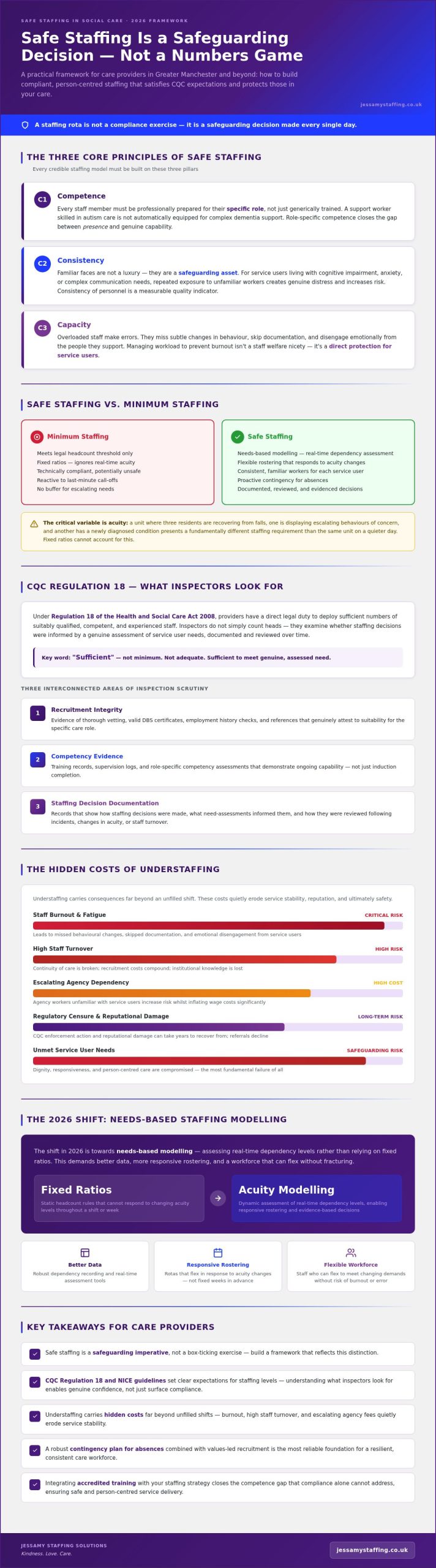
- Safe staffing in social care is a safeguarding imperative, not a box-ticking exercise — and you’ll discover exactly how to build a framework that reflects that distinction.
- CQC Regulation 18 and NICE guidelines set clear expectations for staffing levels; understanding what inspectors are actually looking for will help you approach your next inspection with genuine confidence.
- Understaffing carries hidden costs far beyond unfilled shifts — including burnout, high staff turnover, and escalating agency fees that quietly erode your service’s stability.
- A robust contingency plan for absences, combined with values-led recruitment, is the most reliable foundation for a resilient and consistent care workforce.
- Integrating accredited training with your staffing strategy closes the competence gap that compliance alone cannot address, ensuring safe and person-centred service delivery.
Understanding Safe Staffing in Social Care
At its most precise, safe staffing in social care means deploying the right people, with the right skills, in the right place, at the right time. That definition sounds straightforward. In practice, it demands a level of professional rigour that goes far beyond filling a shift with a warm body and a valid DBS certificate. It requires a considered, ongoing assessment of who your service users are, what they need in any given moment, and whether the people responsible for their care are genuinely equipped to meet those needs.
This distinction matters enormously. Staffing is not a logistical function sitting quietly in the background; it is the primary mechanism through which person-centred care is either delivered or undermined. When staffing is genuinely safe, service users experience consistency, dignity, and responsive support. When it isn’t, the consequences range from unmet needs and avoidable incidents to regulatory censure and reputational damage that can take years to recover from. The Care Quality Commission (CQC) is unequivocal on this point: staffing decisions are safeguarding decisions, and they are scrutinised accordingly.
The Core Principles of Safe Staffing
Three principles underpin any credible staffing model:
- Competence: Every staff member must be professionally prepared for their specific role, not just generically trained. A support worker skilled in autism care is not automatically equipped for complex dementia support. Role-specific competence closes the gap between presence and genuine capability.
- Consistency: Familiar faces are not a luxury; they are a safeguarding asset. For service users living with cognitive impairment, anxiety, or complex communication needs, repeated exposure to unfamiliar workers creates genuine distress and increases risk. Consistency of personnel is a measurable quality indicator.
- Capacity: Overloaded staff make errors. They miss subtle changes in behaviour, skip documentation, and disengage emotionally from the people they support. Managing workload to prevent burnout isn’t a staff welfare nicety; it’s a direct protection for service users.
Safe Staffing vs. Minimum Staffing
Meeting the legal minimum is not the same as meeting the need. A service operating with the lowest permissible headcount may technically satisfy a regulatory threshold whilst remaining genuinely unsafe in practice. The critical variable is acuity: the complexity and intensity of your service users’ needs at any given time. A unit where three residents are recovering from falls, one is displaying escalating behaviours of concern, and another has a newly diagnosed condition presents a fundamentally different staffing requirement than the same unit on a quieter day.
The shift in 2026 is towards needs-based modelling, which assesses real-time dependency levels rather than relying on fixed ratios. This approach demands better data, more responsive rostering, and a workforce that can flex without fracturing. It also demands that providers understand the true cost of understaffing, which extends well beyond unfilled shifts to encompass staff turnover, agency dependency, and the slow erosion of service reputation that follows a pattern of stretched, reactive care.
The UK Regulatory Framework: CQC and NICE Standards
Regulation without understanding is a liability. Many care providers approach the CQC inspection framework as a checklist to survive rather than a standard to internalise, and that distinction shows up clearly in inspection outcomes. The legal framework governing safe staffing in social care is precise, consequential, and increasingly difficult to satisfy through surface-level compliance alone.
CQC Regulation 18: What Inspectors Look For
Regulation 18 of the Health and Social Care Act 2008 (Regulated Activities) Regulations 2014 places a direct legal duty on providers to deploy sufficient numbers of suitably qualified, competent, and experienced staff. The word “sufficient” carries significant weight here. Inspectors don’t simply count heads; they examine whether staffing decisions were informed by a genuine assessment of service user needs, and whether those decisions were documented and reviewed over time.
During an inspection, you should expect scrutiny across three interconnected areas:
- Recruitment integrity: Evidence that safer recruitment processes were followed rigorously, including DBS checks, reference verification, and values-based selection criteria.
- Training and development records: Documentation demonstrating that staff competence is actively maintained, not just established at induction. Inspectors look for evidence of ongoing professional development, not certificates that were filed and forgotten.
- Responsive rostering: Records showing that staffing levels were reviewed and adjusted in response to changing dependency levels, seasonal pressures, or significant incidents. A static rota that never flexes raises immediate questions.
Failures under Regulation 18 can result in requirement notices, conditions placed on registration, or in serious cases, enforcement action. The Health and Social Care Act provides the CQC with substantial powers, and providers who cannot demonstrate a systematic approach to staffing decisions face genuine legal exposure, not merely a poor inspection rating.
NICE Guidelines for Safe Staffing
Alongside the regulatory framework, the NICE safe staffing guidance offers an evidence-based methodology for workforce planning that complements CQC expectations. NICE emphasises the use of validated tools to assess dependency and workload, rather than relying on fixed ratios that can’t account for the real variability of care needs.
Critically, NICE guidance advocates for involving service users and their families in staffing discussions. This isn’t simply good practice; it’s a transparency commitment. When families understand how staffing decisions are made, and when providers can articulate the rationale clearly, trust is built and complaints are reduced. Maintaining that openness, even when staffing is under pressure, is a hallmark of a well-governed service.
The Registered Manager carries specific accountability within this framework. Justifying staffing decisions requires contemporaneous records, not retrospective explanations. If your documentation doesn’t tell a coherent story of responsive, needs-led staffing, it won’t satisfy an inspector regardless of how well your service actually performs. Building that evidential trail is a professional discipline, and it starts with the rostering decisions made every single week. Providers seeking a staffing partner who understands these obligations can explore how values-led recruitment supports regulatory confidence.
Identifying and Mitigating the Risks of Understaffing
Understaffing doesn’t announce itself with a single catastrophic event. It accumulates quietly, through small compromises and stretched shifts, until the damage becomes impossible to ignore. The correlation between staffing levels and safeguarding incidents is well established in social care literature: when workers are stretched beyond their capacity, the conditions for harm become structurally embedded in the service itself. Understanding precisely how that harm manifests, and where it strikes hardest, is the first step towards preventing it.
Clinical and Emotional Risks to Service Users
The clinical consequences of understaffing are measurable and serious. Medication administration errors become more likely when a single worker is responsible for a caseload that demands more time and attention than a shift allows. Health changes, the kind that are subtle in the morning and critical by evening, go undetected when staff are moving too quickly to observe, record, and escalate. These aren’t isolated failures of individual workers; they’re predictable outcomes of impossible workloads.
Beyond the clinical, there’s an emotional dimension that’s frequently underestimated. Task-focused care, where a worker completes the physical requirements of a visit but has no capacity for meaningful interaction, is deeply damaging to service user wellbeing. Dignity isn’t preserved by completing a personal care routine in silence under time pressure. For people living with dementia, complex mental health needs, or profound learning disabilities, that quality of interaction isn’t incidental to the care; it is the care. Understaffing destabilises sensitive care environments by stripping away the relational consistency that vulnerable people depend on for their sense of safety and identity.
Operational and Financial Risks to Providers
The financial consequences of chronic understaffing follow a predictable and damaging spiral. Providers who can’t maintain a stable workforce turn to agency cover. Agency cover is expensive, inconsistent, and unfamiliar with individual service users. That inconsistency generates more incidents, which increases staff anxiety and accelerates turnover amongst permanent staff, which increases agency dependency further. The cycle compounds itself.
For care homes across Greater Manchester, this operational fragility directly affects local authority partnerships. Commissioners assess provider stability when allocating placements, and a service with a documented pattern of high agency use, staff turnover, or CQC requirement notices will find its referral pipeline shrinking. Reputation in this sector travels quickly and recovers slowly.
The regulatory exposure is equally significant. Persistent understaffing is one of the most common triggers for CQC enforcement action, ranging from formal requirement notices through to conditions placed on registration. In serious cases, providers face the prospect of suspension or closure, outcomes that are devastating for service users, staff, and the organisation alike. Maintaining safe staffing in social care is, therefore, not simply a quality commitment; it’s a fundamental condition of sustainable operation. Providers who treat workforce planning as a strategic priority, rather than a reactive function, are the ones who remain viable, trusted, and compliant when it matters most.
Practical Strategies for Maintaining Safe Staffing Levels
Knowing the risks of understaffing is one thing. Building the operational infrastructure to prevent those risks from materialising is an entirely different discipline, and it’s where many providers fall short. The gap between understanding and action is where services become vulnerable. Closing that gap requires practical, systematic strategies that function reliably under pressure, not just on a quiet Tuesday morning when everything is running smoothly.
Effective Workforce Planning and Rota Management
Reactive rostering is the enemy of consistency. Providers who plan rotas week by week, without reference to historical demand patterns, leave themselves perpetually exposed. Effective workforce planning begins with data: identifying peak demand periods such as winter months when sickness rates climb, post-holiday periods when staff fatigue is highest, and the specific times of day when your service users’ needs are most intensive.
Skill mix matters as much as headcount. A shift team composed entirely of newer workers, however well-intentioned, carries a different risk profile than one that balances experience levels across the team. Every shift should include at least one worker with the seniority and confidence to make autonomous judgements when something unexpected occurs. That’s not a luxury; it’s a structural safeguard.
Technology has a genuine role here. Digital rostering platforms that provide real-time visibility of gaps, flag compliance issues, and track staff availability eliminate the lag that makes last-minute cover so stressful. When a manager can see a potential gap forty-eight hours in advance rather than two hours before a shift begins, the options available to them multiply considerably.
Dynamic risk assessment should be embedded into the start of every shift. A brief, structured handover that captures current dependency levels, any emerging concerns, and the specific competencies required that day allows the shift lead to make an informed judgement about whether the deployed team is genuinely sufficient for the need in front of them. This is what needs-based modelling looks like in practice.
Building a Reliable Contingency Network
No workforce plan survives contact with a winter norovirus outbreak intact. Contingency isn’t a fallback position; it’s a core component of safe staffing in social care, and it deserves the same strategic attention as permanent recruitment.
The foundation of a reliable contingency network is a relationship with a support worker recruitment agency that genuinely understands your service’s values, not simply one that can fill a shift with an available body. When an agency knows your service users, your culture, and your non-negotiables, the workers they supply are meaningfully better prepared from the moment they arrive. That contextual familiarity reduces risk in ways that a last-minute phone call to an unknown provider simply cannot replicate.
Access to 24/7 emergency care staffing is the practical expression of that relationship. Emergencies don’t observe office hours, and a contingency arrangement that only functions between nine and five is not a contingency arrangement at all. Knowing that a trusted partner can respond at short notice, at any hour, transforms the experience of managing an unexpected absence from a crisis into a managed process.
Induction cannot be treated as optional for agency staff. Even experienced workers need a structured, time-efficient orientation to your service: your service users’ communication needs, your medication protocols, your safeguarding escalation routes, and the specific preferences that make person-centred care possible. A brief but thorough induction checklist, completed before the shift begins, is one of the most cost-effective safeguarding investments a provider can make.
Utilising a specialist healthcare personnel supply partner also carries longer-term benefits. Providers who build sustained relationships with quality agencies, rather than shopping around for the cheapest available option in a crisis, gain access to workers who are familiar with their environment over time. That familiarity compounds. A worker who has covered your service on multiple occasions is meaningfully closer to a consistent team member than a stranger arriving for the first time.
If you’re reviewing your contingency arrangements ahead of your next inspection, speak with Jessamy Staffing about building a values-led emergency cover partnership that supports your service’s specific needs.
The Jessamy Approach: Integrating Training with Safe Staffing
Recruitment and training are too often treated as separate functions in social care. Providers hire staff through one process, then attempt to develop them through another, with little structural connection between the two. Jessamy Staffing Solutions is built on a different premise: that genuine safe staffing in social care is only achievable when competence is embedded into the supply of personnel from the outset, not bolted on afterwards.
That integration is the defining characteristic of our approach. Every worker we place carries not just a valid DBS certificate and a completed reference check, but a grounded understanding of safeguarding duties, compliance expectations, and the specific demands of complex care environments. The result is personnel who are genuinely ready on arrival, not workers who require significant orientation before they can safely contribute to your team.
Accredited Training as a Prerequisite for Safety
Our mandatory training programmes cover the full range of compliance-critical competencies: safeguarding awareness, medication administration, moving and handling, mental capacity, and duty of candour. Beyond the mandatory baseline, our specialist development programmes address the nuanced skills that complex care demands. Workers don’t simply understand the theory; they’re prepared for the specific environments they’ll enter.
This preparation directly reduces the friction of introducing temporary staff into established teams. When a Jessamy worker arrives to cover an urgent shift, your permanent staff aren’t carrying the additional burden of managing an unfamiliar colleague. That operational continuity matters enormously under pressure, and it’s something that providers across Greater Manchester consistently tell us makes a practical difference to shift quality.
Specialist Solutions for Complex Needs
Not all care environments carry the same risk profile, and staffing solutions must reflect that reality. Children’s complex care at home is one of the most demanding settings in the sector, requiring workers who combine clinical competence with a genuinely child-centred approach. Our specialist personnel for this area are selected and developed with precisely those requirements in mind.
Across all service types, our commitment to 24/7 availability means that emergency cover doesn’t become a crisis. A trusted point of contact, at any hour, with access to professionally prepared workers who understand your service’s values, is the practical expression of everything this guide has argued for. Workforce resilience isn’t built on hope; it’s built on reliable partnerships.
If your service is navigating staffing pressures, preparing for a CQC inspection, or seeking a long-term workforce partner who understands the intersection of training for complex care workers and operational safety, we’d welcome the conversation. Contact Jessamy Staffing today to arrange a bespoke staffing and training consultation tailored to your service’s specific needs.
Build a Staffing Foundation That Holds Under Pressure
Safe staffing in social care isn’t achieved through a single policy document or a well-prepared inspection folder. It’s built steadily, through consistent workforce planning, values-led recruitment, and the kind of contingency infrastructure that functions reliably when circumstances are at their most demanding. The principles covered throughout this guide point toward the same conclusion: providers who treat staffing as a strategic discipline, rather than a reactive necessity, are the ones who protect their service users, their staff, and their regulatory standing most effectively.
Three commitments make the difference in practice: knowing your service users’ real dependency levels, maintaining a trusted contingency network before you need it, and ensuring every worker you deploy carries genuine competence, not just availability.
Jessamy Staffing Solutions brings together accredited social care training, 24/7 emergency cover, and values-led recruitment specifically for care providers across Greater Manchester. That combination isn’t incidental; it’s the foundation of a staffing partnership built for the realities of 2026.
Secure your care service with Jessamy’s reliable staffing and training solutions and take the next step towards a workforce that’s genuinely ready for whatever the day brings.
Frequently Asked Questions About Safe Staffing in Social Care
What is the CQC definition of safe staffing in social care?
The CQC doesn’t publish a single fixed definition, but its inspection framework, grounded in Regulation 18 of the Health and Social Care Act 2008 (Regulated Activities) Regulations 2014, describes safe staffing as deploying sufficient numbers of suitably qualified, competent, skilled, and experienced staff. The emphasis falls on “sufficient” relative to assessed need, not a predetermined headcount.
In practice, inspectors evaluate whether staffing decisions were informed by genuine, documented assessments of service user dependency levels, and whether those decisions were reviewed and adjusted over time. A static rota that never changes regardless of changing needs will not satisfy this standard.
How do I calculate the required staffing levels for my care home?
There’s no universal formula, because staffing requirements are directly tied to your residents’ current dependency levels. A needs-based modelling approach, as advocated by NICE guidance, assesses the acuity of each service user and maps that against the tasks, competencies, and time required to meet those needs safely across every shift.
Start by documenting individual care plans with time-specific requirements, then aggregate those across your resident group to identify peak demand periods. Factor in skill mix, not just headcount, ensuring every shift carries sufficient experience to manage foreseeable risks. Review this calculation regularly, particularly following new admissions, health changes, or significant incidents.
Is there a legal minimum staff-to-resident ratio in the UK?
England does not currently prescribe a statutory minimum staff-to-resident ratio for adult social care settings. Regulation 18 requires “sufficient” staffing, but leaves the determination of sufficiency to the provider, informed by service user needs. This places the evidential burden firmly on Registered Managers to justify their staffing decisions through documented needs assessments.
Scotland introduced minimum staffing requirements for nursing homes through the Nursing Homes (Scotland) Regulations, and Wales has its own regulatory framework, so providers operating across borders should verify the specific requirements applicable to each jurisdiction. In England, the absence of a fixed ratio makes robust documentation of your decision-making process all the more critical.
What happens if a care provider fails to maintain safe staffing levels?
The consequences operate on multiple levels simultaneously. Regulatorily, the CQC can issue requirement notices, place conditions on a provider’s registration, or in serious cases pursue enforcement action including suspension or cancellation of registration. These outcomes are not theoretical; persistent staffing failures are amongst the most frequently cited triggers for formal CQC intervention.
Beyond regulation, providers face operational consequences including increased agency dependency, accelerating staff turnover, and reputational damage that affects commissioner relationships and referral volumes. Civil liability for harm caused by demonstrably inadequate staffing is also a genuine exposure. None of these consequences arrive suddenly; they accumulate through patterns of reactive, under-resourced workforce management.
How can agency staff be integrated safely into a permanent team?
Safe integration begins before the shift starts. Every agency worker, regardless of their experience level, should complete a structured induction covering your service users’ individual communication needs, your medication and safeguarding protocols, and your escalation procedures. A brief but thorough induction checklist completed at the start of a shift is one of the most practical safeguarding tools available to a shift lead.
The quality of your agency relationship matters enormously here. A staffing partner who understands your service’s values and culture will supply workers who are contextually better prepared from the outset. Building a sustained relationship with a trusted agency, rather than sourcing cover reactively from whoever is available, produces workers who become progressively more familiar with your environment over time, which meaningfully reduces risk.
What role does staff training play in maintaining safe staffing?
Training is the mechanism through which safe staffing in social care moves from adequate headcount to genuine competence. A shift can be numerically sufficient whilst remaining practically unsafe if the workers deployed lack the specific skills required for the service users in their care that day. Mandatory training in safeguarding, medication administration, and mental capacity establishes the baseline; for broader clinical skills, you can discover First Medical Training Ltd to access specialist CPD and medical emergency courses that address the nuanced demands of complex care environments.
CQC inspectors actively examine training records as evidence of sustained competence, not just induction completion. Certificates that were filed at the point of employment and never revisited don’t satisfy this expectation. Providers who integrate ongoing professional development into their workforce planning, rather than treating training as a one-off compliance exercise, consistently demonstrate stronger inspection outcomes and lower rates of avoidable incidents.
Can technology help in managing safe staffing levels?
Digital rostering platforms offer genuine operational advantages, particularly in reducing the lag between identifying a gap and securing cover. Systems that provide real-time visibility of shift coverage, flag compliance issues such as mandatory training expiry, and track staff availability allow managers to respond to potential shortfalls forty-eight hours in advance rather than two hours before a shift begins. That additional lead time significantly expands the options available.
Technology supports good workforce planning; it doesn’t replace the professional judgement at the centre of it. A platform can surface a gap in the rota, but the decision about how to fill that gap safely, balancing skill mix, continuity, and service user need, still requires an experienced manager who understands the service. Treat digital tools as an enabler of better decision-making, not a substitute for it.
What should a Registered Manager do if they cannot find safe cover for a shift?
The first step is a documented risk assessment that captures the specific gap, the dependency levels of service users affected, and the steps taken to source cover. Documentation is critical here; it demonstrates that the manager responded systematically rather than passively accepting the risk. Escalation to the provider’s senior leadership should follow immediately, along with notification to the relevant local authority if the gap presents a genuine safeguarding risk.
Practically, this situation is far less likely when contingency arrangements are established in advance. A relationship with a staffing partner offering 24/7 emergency cover means that urgent gaps have a reliable resolution pathway at any hour. Registered Managers who build that infrastructure before a crisis occurs are in a fundamentally stronger position, both operationally and in terms of demonstrating to inspectors that their contingency planning is genuinely robust.