



Your home should always remain a sanctuary for your family; however, for many parents, the reality of managing children’s complex care at home often transforms a living space into something resembling a clinical ward. It’s a heavy burden to balance the technical demands of medical equipment with the simple desire to be a parent rather than a full-time care coordinator. You likely feel the constant weight of clinical responsibility, perhaps lying awake at night fearing an emergency or feeling frustrated by the inconsistent quality of support from generic agencies.
We believe that professional clinical rigor should protect, not replace, the sanctity of your family life. This guide provides a clear roadmap through the logistical and emotional complexities of modern paediatric care, helping you move from a state of constant crisis to one of stability. We’ll examine how to navigate NHS funding, including the nuances of Personal Health Budgets and the role of Integrated Care Boards, whilst ensuring you have the tools to build a competent, trustworthy support team. You will discover how to secure the high-standard care your child deserves while finally reclaiming the comfort and security of your own home.
Key Takeaways
- Understand the critical distinctions between standard domiciliary support and the high-level clinical interventions required for paediatric complex care.
- Identify the essential clinical competencies, such as ventilation and oxygen therapy management, that define a truly capable and reliable support team.
- Discover practical strategies for organising your living space to accommodate specialist equipment whilst maintaining a nurturing, non-clinical family atmosphere.
- Gain clarity on navigating the transition to NHS Continuing Healthcare and utilising Personal Health Budgets to secure long-term funding and choice.
- Establish a rigorous framework for selecting a specialist partner for children’s complex care at home, prioritising accredited training and professional integrity.
What is Children’s Complex Care at Home?
Children’s complex care at home refers to the delivery of high-level clinical support and life-sustaining interventions within a domestic environment. It’s a specialised discipline that extends far beyond traditional domiciliary assistance. While standard Home care in the United Kingdom often focuses on social support and personal care, complex care is defined by the requirement for clinical expertise to manage chronic, life-limiting, or life-threatening conditions. This shift from hospital-led care to home-led care is a deliberate move towards prioritising a child’s quality of life, allowing them to thrive in a familiar setting while receiving the same level of safety they would in a paediatric ward.
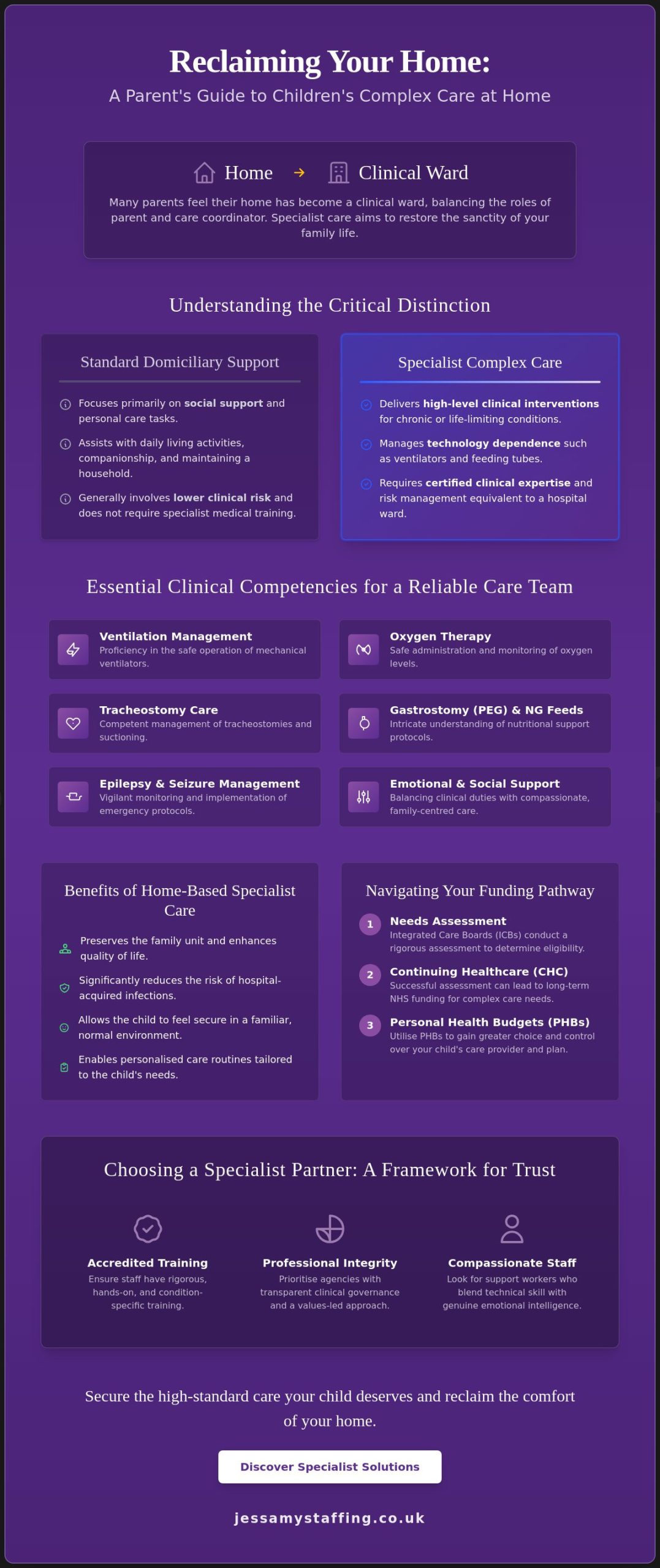
The distinction between standard and complex support lies in the level of risk and the necessity for technical proficiency. A complex care plan often involves managing technology dependence, such as mechanical ventilation, gastrostomy feeds, or tracheostomy care. We see these requirements most frequently in children living with conditions like Cerebral Palsy, Spinal Muscular Atrophy (SMA), and various rare genetic disorders. For these families, the home must become a sophisticated site of clinical excellence, managed by staff who possess both technical competence and emotional intelligence.
Identifying Complex Health Needs in Children
Recognising a child’s need for children’s complex care at home usually begins when a condition involves multiple organ systems or requires constant monitoring. Local authorities and Integrated Care Boards (ICBs) assess these needs through a rigorous framework to determine eligibility for Continuing Care funding. This assessment doesn’t just look at medical data; it considers the intensity and unpredictability of the child’s health. For many parents, this process follows a long, emotionally taxing journey from diagnosis to hospital discharge. It’s a period of transition where the relief of coming home is often tempered by the daunting reality of managing a “mini-hospital” in the living room.
The Benefits of Home-Based Specialist Care
The primary advantage of specialist home care is the preservation of the family unit. When a child receives care at home, they aren’t isolated from their siblings or parents by clinical walls. They can participate in family meals, enjoy their favourite films, and maintain a sense of normalcy that’s impossible in a residential setting. Beyond the emotional benefits, home care significantly reduces the risk of hospital-acquired infections amongst vulnerable children. By tailoring care routines to the child’s specific preferences and behaviour, we create an environment where they feel secure. This personalised approach ensures that clinical requirements never overshadow the child’s right to be a child first and a patient second.
Clinical Requirements and Specialist Staffing Skills
Clinical excellence is the non-negotiable foundation of children’s complex care at home. While the domestic setting provides comfort, the level of clinical oversight must match the standards of a hospital environment. Effective care delivery requires a workforce that possesses deep, condition-specific competencies tailored to the unique physiological needs of every child. This is particularly vital when managing technology dependence; support workers must be proficient in the operation of mechanical ventilators, the execution of safe suctioning techniques, and the administration of oxygen therapy. Each of these tasks carries significant clinical risk, demanding a level of precision that only comes through rigorous, hands-on training. Families and providers seeking to understand the full scope of clinical education required can find comprehensive guidance in this overview of paediatric complex care training in the UK, which details the PCCS Quality Standards and the specific skills needed for high-acuity interventions.
Nutritional support often forms a core component of the care plan, requiring an intricate understanding of Percutaneous Endoscopic Gastrostomy (PEG) and Nasogastric (NG) tube feeding protocols. Beyond mechanical tasks, staff must remain vigilant regarding neurological health. This includes comprehensive epilepsy management and the immediate implementation of emergency seizure protocols. These interventions are not merely checklist items; they are critical safeguards that protect the child’s stability and provide parents with the reassurance they need to rest.
The Role of the Paediatric Support Worker
A paediatric support worker acts as a vital bridge between high-level clinical nursing and compassionate social support. Their role is multifaceted, requiring them to manage complex medical needs whilst maintaining the emotional warmth of a family home. We prioritise values-led recruitment because technical skill alone is insufficient for sensitive domestic environments. Staffing solutions for children’s complex care at home must ensure that every professional entering a home is not only technically capable but also shares a commitment to the family’s well-being. For families seeking this balance, choosing a partner dedicated to socialcare training and development ensures that support workers remain at the forefront of clinical best practices.
Specialist Training Standards in the UK
Regulatory compliance in the UK is overseen by the Care Quality Commission (CQC), which sets stringent standards for the delivery of complex care. Training must encompass a broad spectrum of types of needs do children’s homes offer care for, including robust safeguarding and infection control measures. Competency-based care is the gold standard for paediatric safety, ensuring that every staff member has been individually assessed and verified as capable of performing specific clinical tasks for a specific child. This methodical approach ensures that the high register of care remains consistent, regardless of the complexity of the child’s condition. Families who want to understand how to evaluate the clinical governance standards of any prospective provider will find detailed guidance in the definitive guide to selecting a paediatric nursing agency in the UK, which outlines the essential benchmarks for CQC compliance and values-led recruitment.
Organising Your Home for Complex Care Delivery
Managing children’s complex care at home requires a methodical approach to spatial organisation. Your home must remain a place of refuge, yet it must also function as a safe clinical environment. This balance is achieved through the intentional integration of specialist equipment. Ceiling-track hoists, profiling beds, and monitoring stations should be positioned to maximise efficiency without obstructing the natural flow of family life. It’s often helpful to use discreet storage solutions for medical consumables, ensuring that clinical supplies are accessible but not visually dominant. We recommend creating a dedicated ‘staff space’ where professionals can record observations and take breaks. This designated area respects the boundaries of your family’s private life whilst providing the team with a professional base for their duties.
Effective care coordination relies heavily on transparency and precision. Robust communication logs and digital care planning tools ensure that every intervention is documented and every change in the child’s condition is communicated across the entire team. These digital records provide a single source of truth, reducing the risk of errors during shift handovers. By maintaining a meticulous log of medications, feed volumes, and seizure activity, you create a data-driven environment that supports better clinical outcomes and provides peace of mind for everyone involved.
Stabilising the Care Environment
Stability is the cornerstone of successful long-term care. When introducing new staff members to your child and their siblings, a phased approach is most effective. This allows the child to build trust at their own pace whilst you establish clear boundaries regarding house rules and personal space. You should clearly communicate expectations regarding the use of kitchen facilities, parking, and mobile phones from the outset. Maintaining a consistent rota is essential; continuity of care prevents the destabilisation of the child’s routine and fosters deeper professional relationships between the staff and your family.
Health and Safety at Home
The domestic setting presents unique challenges that require thorough, bespoke risk assessments. These assessments must cover everything from electrical safety for medical devices to clear emergency access routes for paramedics. You should also establish specific out-of-hours protocols to handle unexpected equipment failures or clinical escalations. Partnering with a professional support worker recruitment agency ensures that you have access to a dependable workforce with the capacity to cover emergencies. This workforce resilience is vital for maintaining the safety and integrity of your home care environment, especially during periods of staff illness or annual leave.
Navigating Funding and Personal Health Budgets (PHB)
Securing the financial means to sustain long-term clinical support is often the most daunting phase of the journey. For children’s complex care at home, funding typically shifts from local authority social care to NHS Continuing Care. This transition occurs when a child’s needs are primarily health-based rather than social. A Personal Health Budget (PHB) is the primary mechanism used by the NHS to grant families choice and control. It allows you to move away from a “one-size-fits-all” provision, giving you the authority to select the specific clinical support your child requires. By using a Direct Payment model, you can choose a specialist agency that aligns with your family’s values rather than accepting a generic provider assigned by the Integrated Care Board (ICB).
The right to a PHB applies to all children receiving continuing care, ensuring that the clinical rigor discussed in previous sections is paired with financial flexibility. This model empowers you to hire a workforce that is specifically trained for your child’s condition. It transforms the funding process from a bureaucratic hurdle into a tool for achieving a stabilised home environment. If you require assistance in coordinating clinical staffing through your direct payment, our team provides expert children’s complex care at home support to ensure your budget is utilised effectively and safely.
Applying for Continuing Care Support
The assessment process is led by a Multi-Disciplinary Team (MDT) that evaluates your child’s needs across various domains, including breathing, nutrition, and drug therapies. You must act as a firm advocate during these meetings; ensure every clinical nuance and social impact is documented. It’s also vital to plan for the future early. Once a young person reaches 18, they transition from paediatric continuing care to adult NHS Continuing Healthcare (CHC). This shift involves a different assessment framework, so early engagement with transition teams is essential to prevent any gaps in care delivery.
Managing Your Care Budget Effectively
Choosing a Specialist Partner for Children’s Complex Care
Selecting a provider for children’s complex care at home in Greater Manchester requires a meticulous evaluation of both technical infrastructure and cultural fit. It’s a decision that extends beyond mere proximity or availability; it’s about finding a partner that operates with the same level of clinical precision as a specialist hospital. Families must look for agencies that demonstrate a transparent commitment to accredited social care training and development. This ensures that every support worker isn’t just “experienced” in a general sense but is specifically competent in the life-sustaining interventions your child requires. When clinical safety is at stake, verified professional rigor is the only acceptable standard. Understanding what separates a truly specialist provider from a generic one is explored in depth in the definitive guide to choosing a support worker recruitment agency in 2026, which outlines the critical criteria families and commissioners should apply when evaluating any prospective partner.
A critical differentiator in the selection process is the availability of 24/7 emergency cover. Many generic agencies struggle to provide dependable workforce capacity during unscheduled crises or last-minute staff absences. For a child with complex needs, a gap in care isn’t just an inconvenience; it’s a significant clinical risk. A specialist partner must have the logistical infrastructure to respond rapidly to emergencies, ensuring that your home remains a safe and stabilised environment regardless of the time of day. This level of reliability is what transforms a care arrangement into a sustainable, long-term partnership. Commissioners and families alike can benefit from reviewing the key criteria for evaluating a paediatric nursing agency UK providers must meet to demonstrate genuine specialist capability and regulatory compliance.
The Jessamy Approach to Complex Care
We believe that high-quality care is built on the intersection of workforce intelligence and a deeply embedded culture of empathy. Our approach to children’s complex care at home is rooted in values-led recruitment, ensuring that every professional we supply possesses the emotional intelligence to work within a sensitive family setting. We don’t just provide staff; we provide a meticulously vetted clinical presence that respects your privacy whilst upholding the highest standards of safety. By offering 24/7 emergency care staffing UK, we provide families with the ultimate peace of mind, knowing that professional support is always accessible when it’s needed most.
Next Steps for Your Family
Moving from a hospital setting to a home-led care model is a significant transition that requires careful planning. To ensure a safe discharge, you should verify that your home is fully equipped, your funding is confirmed via the Integrated Care Board, and your care team has completed child-specific competency assessments. If you’re ready to explore how specialist staffing can support your child’s journey, you can request a consultation to discuss your specific requirements in Manchester. Selecting the right partner ensures that your child’s clinical safety is never compromised whilst your family’s well-being remains a primary focus.
Restoring Stability to Your Family Home
Managing a child’s clinical needs is a journey that requires both technical precision and emotional resilience. You’ve explored how a methodical approach to home organisation and a clear understanding of Personal Health Budgets can transform a state of crisis into a sustainable routine. The transition from hospital to home is most successful when clinical safety is integrated seamlessly into your family’s daily life. By prioritising competency-based care and professional rigor, you ensure that your child receives the highest standard of support without compromising the sanctuary of your living space.
As an accredited social care training provider, we’re dedicated to upholding these standards through a values-led recruitment process. Our 24/7 emergency staffing availability ensures that your child’s children’s complex care at home remains consistent and safe, regardless of the circumstances. We’re here to act as a stable partner in your child’s journey, providing the expertise and reliability your family deserves. Enquire about specialist children’s complex care staffing in Greater Manchester to learn how we can support your transition. You don’t have to carry the weight of care coordination alone; with the right partner, you can reclaim your role as a parent and watch your child thrive in the comfort of home.
Frequently Asked Questions
What exactly is considered ‘complex care’ for a child?
Complex care involves specialised clinical support for children with multi-organ involvement or technology dependence. It’s distinct from standard home care because it requires staff to manage life-sustaining interventions such as mechanical ventilation, tracheostomy maintenance, or enteral feeding. These needs often arise from chronic conditions, rare genetic disorders, or significant physical disabilities that require constant, high-level clinical oversight within the domestic environment.
Can I choose the specific support workers who come into my home?
Yes, you have a significant influence over the selection of your care team to ensure they’re a good cultural fit for your family. When arranging children’s complex care at home, professional agencies typically present candidates for you to interview. This collaborative approach ensures that the staff entering your private space not only possess the required clinical competencies but also respect your family’s boundaries and routines.
How do I apply for a Personal Health Budget (PHB) for my child?
You apply for a Personal Health Budget through your local Integrated Care Board (ICB) after your child’s eligibility for Continuing Care has been confirmed. The process begins with a holistic assessment of your child’s health and wellbeing needs. Once approved, you’ll work with a coordinator to develop a personalised care plan that outlines how the budget will be managed to achieve specific clinical outcomes.
What happens if our regular carer is unwell or cannot make their shift?
A specialist agency should provide 24/7 emergency cover to ensure your child’s safety is never compromised. Reliable providers maintain a robust workforce of trained professionals who can step in at short notice. It’s essential that these “bank” staff are already familiar with your child’s specific clinical protocols to prevent any destabilisation of the care routine during an unexpected absence.
Is complex care at home covered by the NHS?
Yes, children’s complex care at home is fully funded by the NHS if the child meets the criteria for Children and Young People’s Continuing Care. This funding is non-means-tested, meaning it’s based entirely on the child’s clinical requirements rather than the family’s financial situation. If the child’s needs are primarily social or educational, funding may be shared with the local authority.
How do I know if a support worker is properly trained for my child’s needs?
You should ask to see a record of their child-specific competency assessments, which must be signed off by a qualified nurse. It’s not enough for staff to have general experience; they must be verified as competent in the specific tasks your child requires, such as suctioning or seizure management. A principled agency will conduct regular audits and refresher training to ensure these high safety standards are maintained. Providers and families seeking to benchmark these standards can refer to the detailed framework outlined in this guide to pediatric complex care training UK professionals are expected to meet under current CQC requirements.
Can complex care be provided in a school setting as well as at home?
Yes, clinical support can often be extended to educational settings to ensure your child can safely access their learning. This is usually coordinated through a joint commissioning arrangement between the NHS and the local authority, often integrated into an Education, Health and Care (EHC) plan. This continuity ensures the child has a consistent level of expert care throughout their entire day.
What is the difference between palliative care and complex care?
Complex care focuses on the long-term clinical management of chronic conditions to achieve stability, whilst palliative care prioritises comfort and quality of life for children with terminal or life-limiting illnesses. Although there’s often an overlap in the clinical tasks performed, palliative care includes a heavier focus on symptom relief and holistic emotional support during end-of-life stages. Both require the same high register of professional rigor.