



What if the certificates your team worked so hard to earn are actually the very things putting your next CQC rating at risk? It’s a sobering thought for any provider, yet many organisations find themselves confused by the shifting landscape of awarding bodies and the fear of unrecognised qualifications. You likely already understand that high-quality accredited social care training UK is the foundation of safe practice, but the pressure to stay compliant whilst managing a busy workforce can feel overwhelming. We believe that professional development should offer you peace of mind, not another administrative headache.
In this 2026 guide, we’ll help you master the complexities of social care accreditation to ensure your team is compliant, competent, and professionally recognised. You’ll gain a clear understanding of the latest regulatory shifts, including the April 2026 launch of the new Level 3 and Level 5 diplomas. We’ll also examine how to leverage funding like the Learning and Development Support Scheme to build a resilient, skilled workforce. By the end of this article, you’ll have a robust roadmap for staff retention and audit readiness that prioritises both institutional excellence and human-centred care.
Key Takeaways
- Understand the critical distinction between mere attendance certificates and qualifications recognised by regulated awarding bodies to ensure your training budget is spent effectively.
- Evaluate the most effective routes for accredited social care training UK to ensure your workforce remains compliant with evolving CQC inspection criteria.
- Identify the essential qualification frameworks for 2026, including the updated Care Certificate standards and the new Level 3 and 5 Diplomas.
- Recognise how formal accreditation acts as a catalyst for staff retention by providing clear career development pathways that go beyond basic compliance.
- Discover how an integrated approach to staffing and development ensures that every support worker is ethically aligned and professionally prepared for complex care environments.
What is Accredited Social Care Training in the UK?
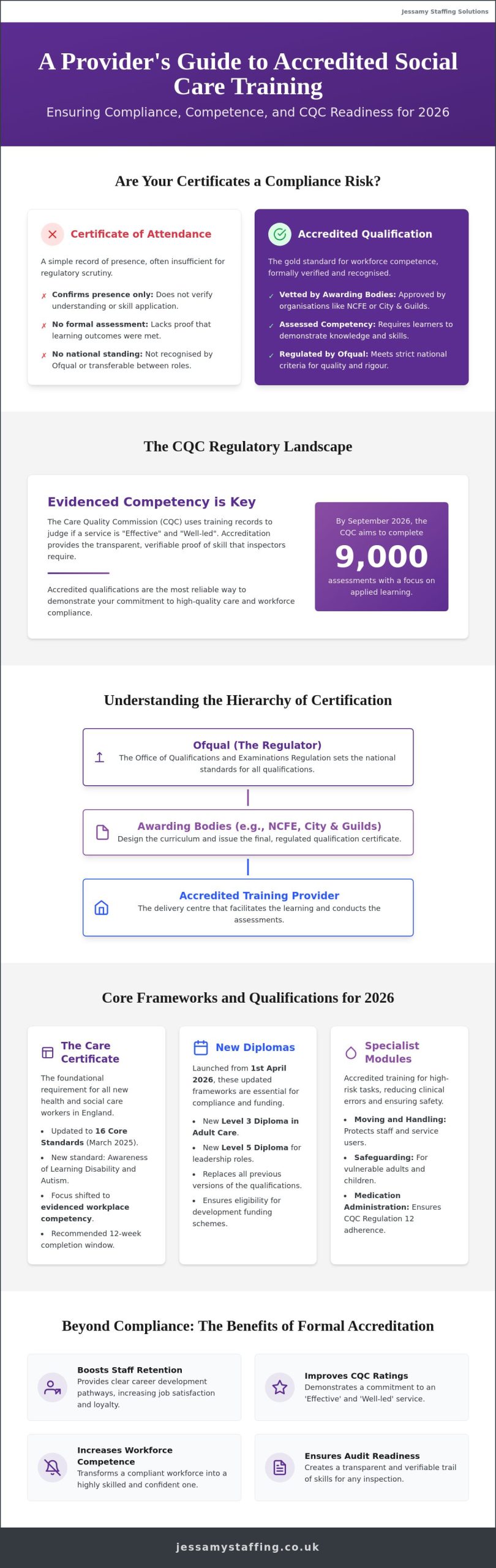
Accreditation isn’t just a badge of honour; it’s a rigorous assurance of quality. In the context of accredited social care training UK, this refers to learning programmes that have been formally vetted and approved by a regulated awarding body, such as NCFE or City & Guilds. These organisations ensure that every module, assessment, and learning outcome meets the strict criteria set by Ofqual, the Office of Qualifications and Examinations Regulation. Without this oversight, a training course is merely an internal workshop with no national standing or transferable value.
It’s vital to distinguish between a simple “certificate of attendance” and an “accredited qualification.” An attendance certificate confirms that a staff member was present in the room or logged into a webinar. It doesn’t, however, verify that they actually understood the material or can apply it safely in a clinical setting. Accredited qualifications require learners to demonstrate their knowledge through structured assessments. This distinction is where many providers fall short, often using the term “accredited” loosely to describe courses that haven’t undergone the necessary external scrutiny.
The Legal and Regulatory Context
The Care Quality Commission (CQC) places immense value on evidenced competency. Within the broader framework of Social care in the United Kingdom, the regulator uses training records to judge whether a service is “Effective” and “Well-led.” By September 2026, the CQC aims to complete 9,000 assessments, with an increased focus on how staff apply their learning rather than just the paperwork they hold. Accreditation serves as the gold standard for workforce compliance, providing a transparent trail of verified skill.
Awarding Bodies vs. Training Providers
Understanding the hierarchy of certification is essential for any care manager. An awarding body sets the curriculum and issues the final certificate, whilst the training provider is the delivery centre that facilitates the learning. To protect your budget and your staff, you should always verify a provider’s credentials on the national register of regulated qualifications. Choosing a partner that specialises specifically in the care economy ensures the training is grounded in the daily realities of support work and nursing. This alignment between theory and practice is what transforms a compliant workforce into a competent one.
Core Frameworks: The Care Certificate and Beyond
The landscape of social care is built upon a hierarchy of standards that ensure every interaction is safe, dignified, and effective. At the base of this structure sits the Care Certificate, a foundational requirement for all new health and social care workers in England. However, as the sector moves through 2026, the demand for accredited social care training UK has shifted from basic compliance to a more comprehensive model of continuous professional development. This progression ensures that staff don’t just meet the minimum entry requirements but actively grow their clinical and ethical capabilities.
For support workers, the industry standard remains the Level 2 and Level 3 Diplomas in Health and Social Care. It’s essential to note that as of 1 April 2026, a new Level 3 Diploma in Adult Care has been launched to replace previous versions. Providers must ensure they’re enrolling staff on these updated frameworks to remain eligible for funding through the Learning and Development Support Scheme. Beyond these core qualifications, specialist accredited modules provide the technical precision required for high-risk tasks, including:
- Moving and Handling: Accredited techniques that protect both the service user and the practitioner from musculoskeletal injury.
- Safeguarding: Advanced training that empowers staff to identify, report, and prevent the abuse of vulnerable adults and children.
- Medication Administration: Rigorous certification that reduces the risk of clinical errors and ensures adherence to CQC Regulation 12.
The Evolution of the Care Certificate in 2026
The Care Certificate now comprises 16 core standards, following the March 2025 addition of “Awareness of Learning Disability and Autism.” Whilst the recommended completion window remains 12 weeks for new starters, the focus has shifted towards evidenced workplace competency rather than simple knowledge tests. This foundational phase is merely the beginning of the journey. For those moving into specialist roles, training for complex care workers provides the necessary bridge between general support and high-acuity clinical assistance.
Higher-Level Accreditation for Specialists
Professional development doesn’t end at the support worker level. On 1 April 2026, a new Level 5 Diploma in Leading and Managing an Adult Care Service was introduced, setting a higher bar for registered managers. This level of accreditation is vital for maintaining the “Well-led” status during regulatory audits. Specialist pathways also extend to niche areas, such as accredited training for children’s complex care at home, where the intersection of clinical skill and family-centred empathy is paramount. By investing in these higher-level certifications, organisations naturally reduce their reliance on emergency healthcare staff cover, as their internal teams possess the expertise to manage escalating needs. Our approach to Socialcare Training & Development ensures that every professional is equipped to meet these evolving standards with confidence.
Why Accreditation Matters for Care Providers and Staff
Investment in accredited social care training UK is often viewed through the lens of compliance, but its true value lies in institutional stability and clinical safety. It acts as a shield against the two greatest threats to a care provider: clinical error and safeguarding failures. When a workforce is professionally certified, the likelihood of medication errors or physical harm is reduced. This isn’t just a moral imperative. It’s a financial one. Many insurers look favourably upon providers with a high percentage of accredited staff, which can lead to more competitive premiums and better coverage terms.
For those bidding on local authority contracts, accreditation is a non-negotiable asset. Demonstrating a team of qualified professionals elevates your bid, proving that your organisation prioritises quality over the bare minimum. This commitment to excellence is a key indicator during CQC inspections, directly supporting the “Well-led” and “Effective” ratings by proving that leadership invests in verified competence rather than just attendance. It transforms your service from a provider into a partner of choice for local health and social care commissioners.
The Employer Perspective: Building a Dependable Workforce
High staff turnover is the silent killer of care quality. Accredited pathways provide a clear career ladder, which significantly correlates with higher retention rates. When staff see a future within an organisation, they stay. This is particularly relevant when working with a support worker recruitment agency, as it simplifies the vetting process. A candidate with a regulated qualification is a known quantity. They bring a shared professional language and set of standards to the team, fostering a culture of care that is both resilient and empathetic.
The Staff Perspective: Career Longevity
From the employee’s view, accreditation changes the narrative of their career. It transforms support work from unskilled labour into a recognised profession. These qualifications are portable, allowing staff to move between different care settings across the UK whilst maintaining their professional standing. This sense of pride is essential for long-term commitment to the sector. Ultimately, accredited training empowers support workers to take on complex cases by providing the theoretical depth and practical validation required for high-acuity environments. It gives them the confidence to act with integrity in challenging situations, knowing their skills are backed by national standards.
Selecting an Accredited Training Provider in Greater Manchester
Selecting a partner for accredited social care training UK requires more than a cursory glance at a website. In the North West, the efficacy of a training programme is often determined by how well the curriculum translates to the specific operational challenges of our local boroughs. A provider’s track record with Greater Manchester healthcare organisations and care homes serves as a vital barometer for their reliability. You should seek out partners who don’t just deliver content but understand the local regulatory pulse and the demographic nuances of the people we support in our communities.
The delivery method is equally critical. Whilst online modules offer convenience, a blended approach or face-to-face sessions often yield better results for practical skills like moving and handling. Workplace-based assessments ensure that competency is verified in the actual environment where care is delivered. This practical validation is what separates a tick-box exercise from a genuine investment in safety. It’s also essential that your chosen trainers possess real-world social care experience within Manchester. Their ability to provide local context makes the learning far more resonant and applicable for your team.
Local Knowledge and Regional Compliance
Greater Manchester has a diverse population with varying health needs, requiring a workforce that is culturally competent and clinically prepared. Local providers are uniquely positioned to align training with these specific requirements, facilitating a more effective healthcare personnel supply UK. For residential care facilities in the region, on-site training sessions are particularly beneficial. They allow for team-wide learning that respects the rhythm of the home whilst ensuring every staff member is aligned with the same high standards of practice and ethical intelligence.
The Checklist for Care Managers
When evaluating a training organisation, transparency regarding the certification process is paramount. Ask about lead times for certificates and how the provider handles the transition to the new 2026 qualifications. You must verify that the curriculum incorporates the latest UK health and safety regulations, including the finalised Code of Practice for the Oliver McGowan Mandatory Training. It’s also vital to ensure the training is compatible with the rigorous standards expected by a supported living staffing agency. A provider that takes a values-led approach will always prioritise the dignity of the service user alongside technical proficiency. If you require a training partner that truly understands the Manchester care landscape, our Socialcare Training & Development team is here to support your workforce goals.
The Jessamy Approach: Integrated Training and Staffing
Professional development shouldn’t exist in a vacuum. At Jessamy, our staffing intelligence directly informs our training curriculum. Because we provide 24/7 emergency cover and support worker supply, we possess a real-time understanding of the clinical and ethical challenges faced on the frontline. This feedback loop ensures our accredited social care training UK is grounded in current practice rather than outdated theory. It’s this intersection of operational experience and educational rigor that allows us to build a more resilient workforce.
We believe that every professional must be fully prepared before their first shift. This “professionally prepared” standard means that our personnel don’t just hold the right certificates; they embody the values-led approach required for nursing and complex care. By supporting Greater Manchester facilities with both qualified personnel and bespoke staff development, we act as a stable, long-term partner in a volatile sector. Our commitment to safe, compassionate care is underpinned by continuous accreditation and a deep sense of duty to the individuals we support.
Bridging the Gap Between Training and Practice
Our training modules integrate practical workforce intelligence gathered from our daily operations across the North West. This is particularly beneficial for managers dealing with the pressure of emergency staffing, where there’s no room for technical or ethical ambiguity. We support the local care economy by providing personnel who are already socialised into a culture of high standards. This ensures that when a worker enters a new environment, they bring with them the competence and confidence required to maintain continuity of care without a steep learning curve.
Next Steps for Your Care Organisation
Ensuring your organisation remains audit-ready requires a proactive approach to professional development. You should begin by auditing your current staff training matrix for any accreditation gaps, particularly regarding the 2026 qualification updates mentioned earlier in this guide. If you’re unsure where to start, booking a consultation can help you design a bespoke programme that meets your specific service needs and local population demographics. We invite you to develop your workforce with Jessamy’s accredited training to ensure your team remains compliant, competent, and recognised as leaders in the field.
Future-Proofing Your Workforce Through Verified Excellence
Accreditation is no longer optional; it’s the bedrock of a safe and ethically sound care service. By embracing the 2026 updates to the Care Certificate and diploma frameworks, you ensure your team isn’t just compliant but truly competent. This commitment directly supports your CQC standing whilst providing your staff with the professional recognition they deserve. It’s about moving beyond basic induction to foster a culture of lifelong learning and clinical precision.
Navigating the landscape of accredited social care training UK requires a partner who understands the intersection of regulatory pressure and human need. Our integrated staffing and development model is built on this very foundation. With specialist paediatric and complex care educators, we deliver CQC compliance-focused training that prepares your team for the most demanding environments. We don’t just teach; we prepare professionals for the realities of the frontline.
If you’re ready to elevate your service standards, we’re here to guide you. Contact Jessamy Staffing for Accredited Social Care Training in Greater Manchester to begin your journey toward a more resilient workforce. Your commitment to high standards today is the legacy of care you build for tomorrow.
Frequently Asked Questions
What is the difference between accredited and non-accredited social care training?
Accredited training is formally recognised and vetted by a regulated awarding body, such as NCFE or City & Guilds, ensuring it meets national standards set by Ofqual. Non-accredited training is typically an internal “certificate of attendance” that hasn’t undergone external scrutiny. Whilst non-accredited courses can be useful for general knowledge, only accredited qualifications provide transferable credits and a verified benchmark of professional competency.
Is the Care Certificate a mandatory accredited qualification in the UK?
The Care Certificate is a foundational standard expected by the CQC for all new health and social care workers, but it isn’t a formal academic qualification. It consists of 16 standards that staff must be assessed on within their first 12 weeks of employment. Although not a legal “qualification,” providers must evidence that their team meets these standards to comply with Regulation 18 regarding staffing and training.
How can I verify if a social care training provider is officially accredited?
You can verify a provider’s status by checking the Register of Regulated Qualifications or asking for their centre number from a recognised awarding organisation. Legitimate providers of accredited social care training UK will be transparent about which body oversees their curriculum and assessments. Always cross-reference the provider’s name with the national database to ensure their certifications hold weight during a regulatory audit.
Does the CQC require all care home staff to have accredited training?
The CQC doesn’t mandate that every individual staff member holds an accredited diploma, but they do require that the workforce is “competent, skilled, and experienced.” In practice, having a team with accredited qualifications is the most effective way to prove compliance with the “Effective” and “Well-led” key lines of enquiry. Inspectors are increasingly focused on evidenced workplace competency rather than just completed attendance records.
Can accredited social care training be delivered online or must it be in-person?
Accredited training can be delivered through online, in-person, or blended learning methods, provided the assessment meets the awarding body’s strict criteria. For theoretical modules, online platforms offer excellent flexibility and tracking. However, for practical skills like moving and handling or medication administration, face-to-face assessments are usually required to verify that a staff member can safely apply their knowledge in a clinical setting.
How long does it typically take to complete an accredited Level 3 Diploma in Adult Care?
A Level 3 Diploma in Adult Care usually takes between 6 and 12 months to complete, depending on the learner’s previous experience and available study time. Since the updated version launched on 1 April 2026, there is a strong emphasis on collecting evidence of workplace competency. Learners must complete specific guided learning hours and demonstrate their skills in real-world scenarios to satisfy the awarding organisation’s requirements.
What are the benefits of using an accredited training provider in Greater Manchester?
Choosing a local provider ensures the training is grounded in the specific demographic needs and regional health priorities of the North West. Local partners can offer on-site assessments that minimise disruption to your service whilst providing a more personalised support structure. This regional expertise helps align your workforce with the standards expected by Greater Manchester local authorities and healthcare commissioners.
Are there grants available for accredited social care training in 2026?
Yes, several funding routes are available in 2026, including the Learning and Development Support Scheme (LDSS) and the Adult Education Budget. The LDSS provides ring-fenced funding for essential programmes like the Oliver McGowan Mandatory Training. Additionally, many providers of accredited social care training UK can help you access the Free Courses for Jobs scheme, which covers Level 3 qualifications for eligible adult learners.