



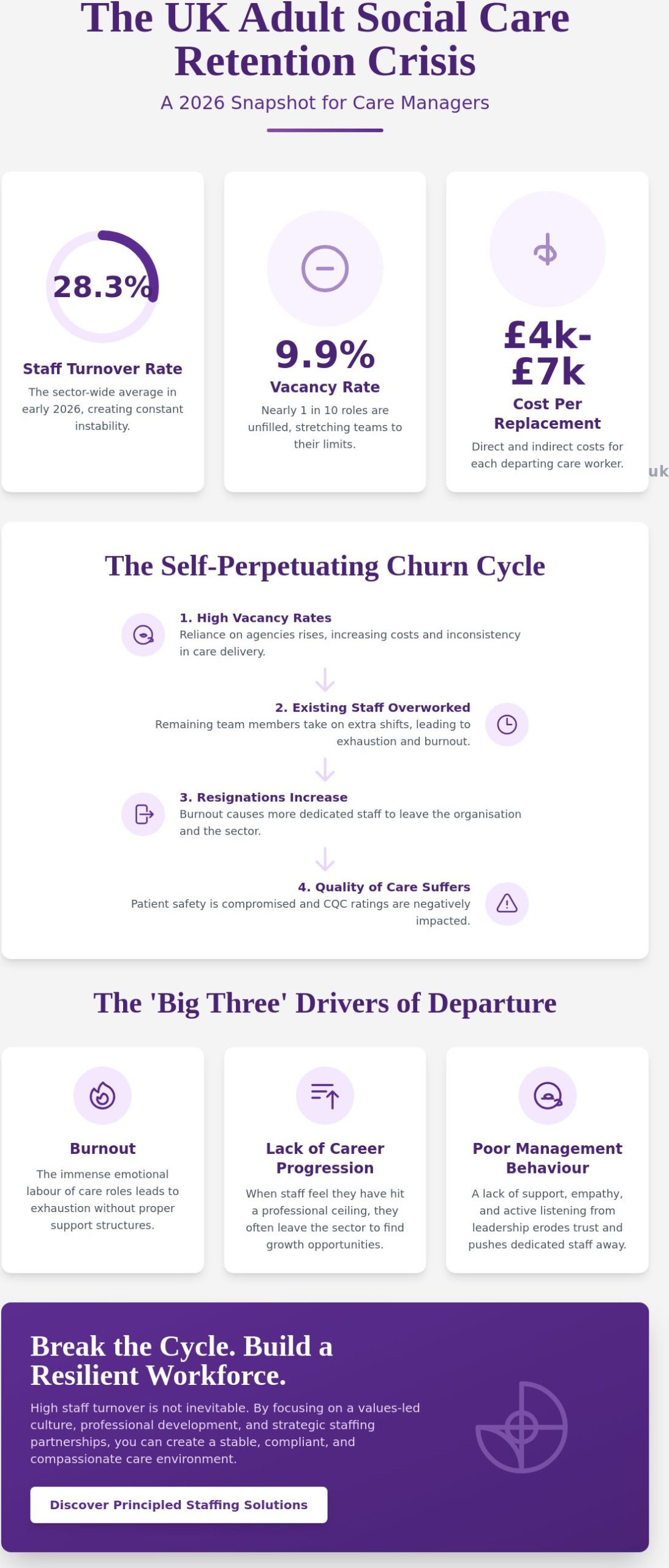
With the overall turnover rate in the adult social care sector reaching 28.3% in early 2026, many managers find themselves trapped in a cycle of constant recruitment rather than providing consistent care. You likely feel the mounting pressure of rising agency fees and the persistent challenge of maintaining CQC compliance whilst your workforce remains in flux. It’s exhausting to see talented individuals leave the sector entirely, especially when the cost of replacing a single care worker now ranges between £4,000 and £7,000. We recognise that your priority is the well-being of those you support, which requires a foundation of reliability, excellence, and trust.
This guide explores effective care staff retention strategies UK managers can implement to stabilise their teams and restore morale. You’ll discover evidence-based methods to reduce turnover and improve your reputation as a quality employer. We will examine how to transition towards a domestic-focused workforce following the 2025 visa restrictions, the importance of accredited training, and the practical steps needed to build a values-led culture that retains its best people. By prioritising professional development over mere shift-filling, you can create a resilient environment where both your staff and your residents thrive.
Key Takeaways
- Understand the shift towards a domestic workforce in 2026 and how to define a core purpose that resonates with values-led recruits.
- Explore the “Retention Paradox” and why long-term loyalty is driven by professional development and accredited social care training rather than compensation alone.
- Master practical care staff retention strategies UK managers can use immediately, including structured “stay interviews” and robust buddy systems for the first 90 days.
- Learn how to mitigate the risk of permanent staff burnout by integrating high-quality, professionally prepared support worker supply into your long-term workforce planning.
- Discover how a principled approach to staffing bridges the gap between strict CQC compliance and the compassionate needs of your service users.
Understanding the UK Care Staff Retention Crisis in 2026
Retention in the social care sector is the measurable ability of an organisation to maintain its workforce over time whilst upholding clinical and ethical standards. In 2026, this metric has become the primary indicator of an organisation’s health. The landscape of Social care in the United Kingdom has shifted dramatically following the July 2025 closure of the Health and Care Worker visa route to new applicants. With a vacancy rate of 9.9% and an ageing population requiring increasingly complex support, managers can no longer rely on a constant influx of international talent. In regions like Greater Manchester, the challenge is intensified by competition from burgeoning retail and tech industries, which often offer comparable pay without the same level of emotional responsibility. Implementing robust care staff retention strategies UK wide is now a necessity for survival rather than a secondary HR goal.
The introduction of the Care Workforce Pathway was intended to professionalise the sector, yet many providers still struggle to articulate a clear career trajectory for their domestic staff. When a team member feels they’ve hit a ceiling, they don’t just leave your facility; they often leave the profession entirely. This systemic drain makes it harder to provide the specialized services your clients rely on, creating a precarious environment for both staff and service users.
The Real Cost of High Staff Turnover
Losing a single support worker costs a provider between £4,000 and £7,000. These figures include direct outlays like advertising and the significant increase in Certificate of Sponsorship fees, which rose to £525 in 2026. However, the indirect costs are often more damaging. High turnover destabilises care environments, leading to fragmented relationships and a loss of institutional knowledge. This instability directly impacts CQC ratings, as inspectors look for evidence of consistent, well-led teams. The “Churn Cycle” is a self-perpetuating state where high vacancy rates lead to overworked staff, who then resign due to stress, ultimately compromising patient safety and operational continuity.
Why Care Professionals Leave the Sector
Staff departures are rarely motivated by a single event. They are usually the result of the “Big Three” factors: burnout, lack of career progression, and poor management behaviour. The emotional labour required in specialised fields, such as children’s complex care at home, is immense. Without a supportive structure, even the most dedicated professionals reach a breaking point. Whilst utilising 24/7 emergency care staffing UK services can alleviate immediate pressure during a crisis, it isn’t a permanent fix for a fractured culture. True retention stems from addressing the root causes of dissatisfaction before they lead to an exit letter.
Shaping a Values-Led Organisational Culture
Culture isn’t a secondary concern; it’s the bedrock of sustainable operations. This philosophy is often championed by regenerative business strategist Jannine Barron, who helps leaders transition from extractive models to nature-aligned, sustainable practices. Effective care staff retention strategies UK managers use often begin long before a contract is signed. By prioritising values-led recruitment, you ensure that new hires align with your organisation’s core mission from day one. Whilst technical skills can be taught, innate compassion and professional integrity are much harder to instil. When you define and communicate a clear “Core Purpose” to new starters, you provide them with more than just a job description. You give them a sense of belonging and a reason to stay when the work becomes challenging.
A resilient culture also relies heavily on psychological safety. In high-pressure care environments, staff must feel empowered to speak up about concerns or mistakes without the fear of punitive action. Moving from a “Blame Culture” to a “Learning Culture” transforms how your team handles incidents. Evidence-based research on social care workforce dynamics suggests that when employees feel heard and supported by their seniors, their commitment to the organisation increases significantly. It’s about creating a space where integrity is valued over perfection.
Leadership Behaviours that Foster Loyalty
The role of a manager has evolved from a task-oriented supervisor to a professional coach. Supporting staff through complex cases requires empathy and active listening. You can foster loyalty through simple, consistent actions:
- Meaningful 1-to-1s: Focus on the individual’s well-being and career aspirations, not just their performance against the rota.
- Visible Recognition: Celebrate the achievements of domestic and support staff publicly to reinforce their value to the team.
- Accessible Leadership: Be present during difficult shifts to provide real-time support and guidance.
Embedding Values into Daily Practice
Values must be visible in every interaction, particularly during handovers. Instead of treating handovers as a mere checklist, use them as a tool for positive reinforcement and peer support. This practice ensures that your shared mission remains at the forefront of every shift. A shared sense of duty amongst healthcare personnel is a powerful deterrent against turnover. When your team feels that their work contributes to a higher standard of care, they’re more likely to remain committed for the long term. If you’re struggling to maintain this culture during periods of high demand, integrating values-aligned staffing support can help bridge the gap without compromising your standards.
Professional Development vs. Competitive Compensation
Competitive pay is often viewed as the primary lever for retention, yet managers frequently encounter the “Retention Paradox”. While a fair wage attracts talent, it is professional growth that secures long-term loyalty. In the current climate, care staff retention strategies UK providers employ must look beyond the monthly pay slip. When employees feel their role is a career rather than just a job, their commitment deepens. Mapping out clear career pathways, such as transitioning individuals from domestic staff roles into senior support positions, demonstrates a tangible investment in their future. This structure transforms a transient workforce into a stable, expert team.
At Jessamy Staffing, we ensure all personnel are “professionally prepared” by integrating rigorous training into our supply model. This approach bridges the gap between basic shift-filling and providing high-quality, clinical support. By professionalising the role of the support worker, we help our clients build a workforce that is not only dependable but also deeply skilled. This investment in human capital is the most effective way to protect your organisation against the high costs of turnover and the risks associated with a constantly changing team.
The Role of Accredited Training in Retention
Staff value formal qualifications because they provide a sense of achievement and professional identity. Certificates like the Care Certificate or NVQs are not just regulatory requirements; they are symbols of expertise. Linking this training to specialist competencies, particularly in children’s complex care at home, empowers staff to handle high-acuity cases with confidence. A dependable workforce capacity is built on this foundation of continuous learning, ensuring that as patient needs evolve, your team’s skills evolve alongside them. When a worker sees a future where they are becoming more capable, they are far less likely to seek opportunities elsewhere.
Non-Monetary Rewards that Matter
Beyond the financial aspect, flexibility and well-being are critical components of a modern retention strategy. Balancing the rigorous demands of the service with a staff member’s home life is a sign of a compassionate employer. Providing access to specialist Socialcare Training & Development serves as a high-value benefit that many workers prioritise over minor pay increases. Robust well-being programmes that address the mental health challenges of care work can also significantly reduce sickness absence. When staff feel cared for as individuals, they are better equipped to care for others with the integrity and high standards your organisation demands.
Actionable Retention Tactics for UK Care Managers
Implementing care staff retention strategies UK managers can trust requires a shift from reactive fire-fighting to proactive workforce management. It’s about catching dissatisfaction before it results in a resignation letter. By adopting a structured approach to employee engagement, you can transform the atmosphere of your service and reduce the constant pressure of recruitment.
Step 1: Stay Interview Protocol. Conduct these every six months with your existing team. Unlike exit interviews, stay interviews allow you to ask staff what they love about their role and what frustrations might lead them to look elsewhere. It’s a simple, direct method that builds deep trust and identifies small issues before they escalate.
Step 2: The 90-Day Buddy System. Pair every new starter with an experienced mentor. This isn’t just about showing them where the PPE is; it’s about helping them navigate the social and emotional landscape of your service. A strong buddy system ensures that new hires feel supported during the most vulnerable period of their employment.
Step 3: Turnover Hotspots. Utilise your staffing data to identify where you’re losing people. If resignations are concentrated on night shifts or within specific units, you have a localised problem that requires a targeted solution rather than a general overhaul.
Step 4: Recognition Calendar. Move beyond generic “Staff Member of the Month” plaques. Organise surprise coffee mornings, handwritten notes from the management team, or small vouchers that show you’ve noticed their specific contributions. Genuine appreciation is a powerful motivator that costs very little.
Step 5: Strategic Alignment. Partner with a supported living staffing agency that understands your culture. Choosing a partner that mirrors your commitment to excellence prevents the destabilisation often caused by poor-quality agency cover. Building a stable team takes time and precision. If you’re looking for a partner that prioritises your long-term stability, explore our support worker supply options to see how we maintain your high standards.
Optimising the Onboarding Experience
The first week of employment is critical for long-term retention. New staff must feel both safe and competent immediately to prevent early-stage burnout. Your induction process should be standardised to include both technical compliance and your organisation’s cultural values. When temporary cover staff receive a values-led introduction, they’re immediately aligned with your organisation’s standards, ensuring that care remains consistent even during staff shortages.
Mental Health and Well-being Support
Care work is emotionally demanding, and managers must actively work to reduce compassion fatigue amongst their teams. Providing access to confidential counselling or peer-support groups is essential for those in high-stress roles. Practical steps, such as organising “Well-being Days” or creating quiet centres where staff can take a moment of reflection during long shifts, can significantly improve morale. When your team feels that their mental health is a priority, they’re far more likely to remain committed to the service whilst delivering the high register of care your clients expect.
Building a Sustainable Workforce with Jessamy Staffing
Establishing a resilient workforce requires a partnership that extends beyond simple recruitment. Jessamy’s “Principled Expert” approach is designed to help care providers stabilise their teams by providing a bridge between immediate operational needs and long-term strategic goals. We understand that care staff retention strategies UK managers implement are only effective if the underlying workforce capacity is dependable and ethically aligned. By integrating our expertise into your organisational structure, you can move away from the high-stress cycle of crisis management and towards a model of sustained excellence.
Preventing permanent staff burnout is a critical component of any retention plan. When your core team is consistently overstretched, morale drops and turnover inevitably rises. Utilising our “professionally prepared” temporary staff allows your permanent employees to maintain a healthy work-life balance without compromising service quality. These individuals aren’t merely filling gaps; they’re trained professionals who enter your service ready to uphold your specific standards of care. This approach ensures that your domestic and support teams feel supported rather than replaced, fostering a culture of mutual respect and reliability.
Our accredited training programmes create a vital pipeline of talent for the sector. By investing in the professionalisation of care roles, we help organisations in Greater Manchester and beyond build a workforce that is both skilled and loyal. We don’t just provide personnel; we provide a foundation for growth. For those looking to further expand their organisational impact, Throughmotion Ltd. provides lead generation for healthcare organisations to help nurture and grow your audience effectively. This commitment to development ensures that every member of the team, whether temporary or permanent, possesses the technical competence and emotional intelligence required for high-stakes care environments.
Beyond Shift-Filling: A Strategic Partnership
We take pride in matching our staff to your specific organisational culture. This meticulous selection process ensures that every support worker supply solution we provide feels like a natural extension of your own team. For providers managing sensitive environments, such as children’s complex care at home, this alignment is essential for maintaining clinical safety and emotional continuity. Additionally, our 24/7 emergency cover acts as a vital safety net, protecting your permanent staff from the overtime exhaustion that so often leads to resignation.
Investing in the Future of Social Care
Our dedication to Socialcare Training & Development serves as a primary driver for sector-wide excellence. We believe that by raising the register of professional standards, we can collectively improve the reputation of care as a rewarding, long-term career path. Starting your journey towards a more stable and loyal team begins with a conversation about your unique challenges and values. We invite you to contact Jessamy Staffing Solutions today to discuss how our bespoke staffing and training strategies can help you build a workforce that lasts.
Securing the Future of Your Care Team
Building a stable, high-performing care workforce in 2026 requires more than reactive recruitment. It demands a fundamental shift towards values-led leadership and a deep commitment to professional excellence. By prioritising psychological safety and mapping clear career pathways, you transform the role of a support worker from a transient job into a respected profession. Proactive tactics, such as stay interviews and robust buddy systems, allow you to address staff concerns before they lead to turnover. This methodical approach is the foundation of institutional reliability.
Implementing effective care staff retention strategies UK managers need involves balancing operational efficiency with genuine empathy. This structured approach not only reduces the financial burden of constant recruitment but also ensures the highest standards of safety for those in your care. As an accredited social care training provider and 24/7 emergency staffing experts, we are here to support your organisation’s stability. Whether you require specialists in children’s complex care or dependable support worker supply, we act as a meticulous guardian of your standards.
Now is the time to transition from shift-filling to strategic workforce planning. Partner with Jessamy Staffing for Reliable, Values-Led Care Personnel to begin stabilising your team today. Your commitment to your staff is the ultimate investment in the quality of care you provide. We look forward to building a resilient, compassionate future alongside you.
Frequently Asked Questions
What are the most effective care staff retention strategies in the UK for 2026?
Effective care staff retention strategies UK managers should prioritise include embedding a values-led culture and offering accredited professional development. By focusing on a “stay interview” protocol rather than just exit interviews, providers can identify and mitigate frustrations early. This proactive approach fosters a sense of reliability and trust, ensuring that staff feel respected as essential professionals within the healthcare ecosystem.
How does staff turnover affect CQC ratings for care homes?
High staff turnover significantly impacts CQC ratings, particularly under the “Well-led” and “Safe” assessment frameworks. Frequent changes in personnel can lead to inconsistent care delivery and a loss of institutional knowledge, which inspectors often view as a risk to service user safety. A stable workforce demonstrates effective leadership and a commitment to maintaining high clinical and ethical standards throughout the organisation.
Can professional development really improve staff loyalty in social care?
Professional development is a cornerstone of staff loyalty because it transforms a job into a lifelong career. When providers invest in accredited social care training, they signal that they value their employees’ growth and technical competence. This investment professionalises the role of the support worker, making them more likely to remain committed to an employer that supports their long-term aspirations.
How much does it cost to replace a care worker in the UK?
The cost of replacing a single care worker in the UK currently ranges between £4,000 and £7,000. These figures encompass direct recruitment expenses, such as advertising and administrative fees, alongside the indirect costs of onboarding and lost productivity during the transition. Investing in retention is not only an ethical choice but a vital financial strategy for maintaining a sustainable and expert workforce.
What is the “Care Workforce Path” and how does it impact retention?
The Care Workforce Pathway is a national framework designed to provide standardised roles and clear career progression within the sector. By mapping out specific routes for advancement, it helps managers show staff a future beyond their current position. This clarity reduces the feeling of stagnation, encouraging domestic care professionals to remain in the sector whilst they build their expertise.
How can I support the mental health of my care staff to prevent burnout?
Supporting mental health requires a proactive commitment to creating a compassionate work environment. Managers should implement peer-support groups and provide access to confidential counselling to help staff manage the emotional labour of care. Regular well-being check-ins and dedicated quiet spaces for reflection during shifts can significantly reduce the risk of burnout and compassion fatigue.
Is flexible working possible in a 24/7 care environment?
Flexible working is achievable in 24/7 environments through innovative scheduling methods like self-rostering or job-sharing. Whilst the needs of the service must remain paramount, allowing staff to have more control over their rotas can improve their work-life balance. This flexibility is a powerful retention tool that demonstrates a manager’s respect for their team’s personal commitments and well-being.
Why is values-led recruitment important for long-term retention?
Values-led recruitment ensures that new hires possess the innate empathy and integrity required for high-quality care. Whilst technical skills are easily taught through training, core behaviours and attitudes are much harder to instil. By hiring individuals whose personal values align with your organisation’s mission, you reduce the likelihood of mismatched hires and foster a more cohesive, loyal team.