



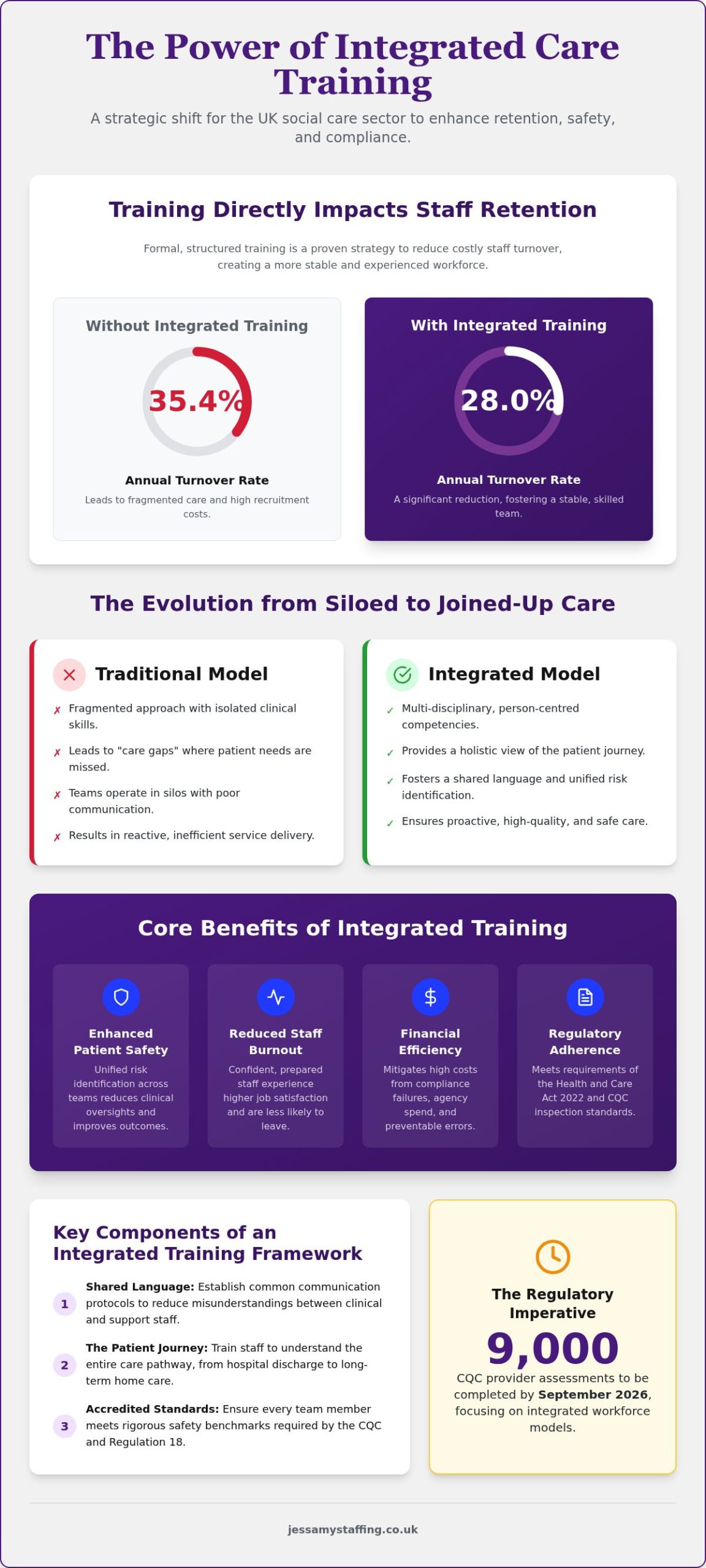
Care workers who receive formal, structured training see their turnover rates drop from 35.4% to 28.0%. This statistic highlights a fundamental truth for social care leaders: professional development is not just a compliance task, it’s a retention strategy. You likely feel the daily strain of fragmented communication between your clinical and support teams, whilst the pressure to meet the CQC’s target of 9,000 assessments by September 2026 adds a layer of persistent anxiety to your operations.
Discovering the strategic benefits of integrated care staff training allows you to bridge the gap between technical rigour and compassionate service. By moving away from siloed learning, you can foster a culture where every team member is professionally prepared to handle complex needs with confidence. This article explores how a unified training model secures essential funding through the Learning and Development Support Scheme (LDSS), ensures adherence to the Health and Care Act 2022, and transforms your workforce into a stable, high-performing safety net for your service users.
Key Takeaways
- Understand the essential shift from siloed clinical skills to the person-centred, multi-disciplinary competencies required for 2026.
- Discover the core benefits of integrated care staff training, specifically how unified risk identification across teams directly enhances patient safety and reduces staff burnout.
- Evaluate the financial logic of investing in integrated development to mitigate the high costs of fragmented care, compliance failures, and excessive agency spend.
- Learn the practical steps for implementing a robust training strategy, from conducting workforce competency audits to navigating the new LDSS funding landscape.
- Explore how partnering with an accredited provider ensures your personnel are professionally prepared to meet both institutional standards and the human needs of those in your care.
What is Integrated Care Training in the UK Care Sector?
Integrated care training represents a fundamental shift in how we prepare the social care workforce for the complexities of modern service delivery. Rather than focusing solely on isolated clinical tasks, this multi-disciplinary approach equips staff with a broader understanding of how different health and social care functions intersect. Since the legal establishment of Integrated Care Systems (ICSs) in 2022, the requirement for joined-up workforce development has moved from a recommendation to a regulatory necessity. It’s no longer enough for a support worker to understand their specific role in isolation; they must understand their place within the wider ecosystem of the patient’s journey.
The Care Quality Commission (CQC) now actively looks for evidence of integrated workforce models during their inspections. With a commitment to completing 9,000 provider assessments by September 2026, the pressure to demonstrate a cohesive training culture is significant. To understand the foundation of this model, one must ask: What is Integrated Care? At its core, it’s the seamless coordination of services around the individual. Integrated care training serves as the essential tool for achieving clinical and social synergy, ensuring that support workers and clinical staff operate as a single, informed unit.
The Evolution from Silos to Joined-Up Care
Traditional training models often treated clinical skills and social support as separate entities. This fragmented approach frequently results in “care gaps” where a patient’s complex needs fall between the cracks of different disciplines. For providers in Greater Manchester, where local integration is a priority, moving away from these silos is vital. One of the primary benefits of integrated care staff training is the elimination of these gaps by teaching personnel to see the person, not just the diagnosis. Modern training focuses on person-centred competencies, allowing staff to adapt their support based on the holistic needs of the individual whilst maintaining high clinical standards. This transition ensures that care is not just a series of tasks, but a continuous, supportive experience.
Key Components of an Integrated Training Framework
A successful framework relies on several core pillars that go beyond basic induction. These elements ensure that the workforce is both technically proficient and emotionally intelligent.
- Shared Language: Establishing common communication protocols ensures that support workers and clinicians use consistent terminology, reducing the risk of dangerous misunderstandings.
- The Patient Journey: Training helps staff understand the entire path across health and social care boundaries, from hospital discharge to long-term complex care at home.
- Accredited Standards: Utilising accredited social care training ensures that every team member meets the rigorous safety benchmarks required by the CQC and Regulation 18.
By focusing on these components, organisations ensure their personnel are professionally prepared for the frontline of integration. This approach doesn’t just improve compliance; it builds a more resilient workforce capable of delivering truly high-quality, safe care.
Core Benefits: Why Integrated Training is Essential for Care Providers
Strategic investment in workforce development is the cornerstone of a resilient care organisation. One of the primary benefits of integrated care staff training is the creation of a versatile workforce that can adapt to the shifting needs of service users. When staff are trained to work across disciplinary boundaries, they develop a more profound professional identity. They move beyond simple task completion to become active participants in a holistic care strategy. This sense of purpose is vital in a sector where the line between clinical requirements and social support is increasingly blurred.
Efficiency in social care isn’t just about speed; it’s about the precision of intervention. By understanding What is Integrated Care, providers can ensure their teams are equipped to deliver services that are both cost-effective and clinically sound. This joined-up approach significantly reduces the “cost of error” by preventing fragmented communication that leads to clinical oversights. When a support worker identifies a risk early, the resulting prevention of hospitalisation saves both lives and operational resources. It transforms the workforce from a collection of individuals into a cohesive safety net.
Elevating Patient Outcomes and Safety
Integrated training empowers staff to recognise early signs of clinical deterioration, a skill that’s vital for complex care delivery. Whether managing children’s complex needs at home or supporting adults with learning disabilities, a unified team ensures that medication management and risk assessments are consistent across every shift. This synergy directly reduces hospital readmissions. Home-based support becomes a reliable extension of clinical care rather than a separate, disconnected service. Personnel who are professionally prepared to spot subtle changes in behaviour or physical health can intervene before a crisis occurs, ensuring that safety standards remain uncompromised.
Workforce Morale and Professional Longevity
The human cost of high staff turnover is perhaps the greatest challenge facing the sector today. Data shows that care workers receiving formal, integrated training have a turnover rate of 28.0%, compared to 35.4% for those who don’t. This difference stems from the increased job satisfaction found in meaningful Continuing Professional Development (CPD). Staff value training that allows them to collaborate effectively with nurses and therapists, as it validates their expertise and reduces the isolation that often leads to burnout.
Cultivating an environment where excellence is the standard makes your organisation a preferred employer for high-quality candidates. Providing access to accredited social care training demonstrates a genuine commitment to your team’s professional longevity. This investment doesn’t just satisfy CQC Regulation 18; it builds a stable, compassionate workforce that is prepared for the long-term challenges of the 2026 care landscape. When staff feel competent and supported, they are more likely to remain with your organisation, providing the continuity of care that patients deserve.
Integrated Training vs. Traditional Models: Addressing the Objections
Small providers often view integrated training as a luxury they cannot afford. This perspective, whilst common, ignores the severe financial penalties associated with fragmented care. Traditional “tick-box” exercises might satisfy basic requirements, but they fail to address the root causes of operational friction. When staff operate in silos, the risk of clinical errors increases, leading to costly hospital readmissions and potential CQC compliance failures. Investing in the benefits of integrated care staff training is not merely an expense; it is a strategic safeguard against the high costs of agency reliance and service instability.
A values-led approach to development significantly simplifies the process of health and social care staff supply UK. When an organisation is known for its robust training culture, it attracts professionals who are committed to long-term excellence. This reduces the constant cycle of reactive hiring that plagues many services. Traditional models focus on what a worker must do; integrated models focus on how they should think and collaborate. This distinction is what separates an adequate service from an outstanding one.
Analysing the Return on Investment (ROI)
Financial resilience in 2026 requires a shift from short-term savings to long-term ROI. By reducing staff turnover, providers can save thousands in recruitment fees and induction costs for every role retained. A dependable care workforce capacity is especially critical in sensitive environments like children’s complex care, where consistency is as important as clinical competence. Furthermore, a CQC rating of “Requires Improvement” can devastate a provider’s reputation and bottom line. Integrated training serves as a proactive defence, ensuring that every team member is prepared to meet the 9,000 provider assessments scheduled for this year.
Overcoming Implementation Hurdles
Some managers fear that “over-training” staff makes them more attractive to competitors. In reality, the opposite is true. Professionals stay where they feel equipped to succeed and valued as experts. To manage the pressure of 24/7 rotas, many providers are now adopting a blended learning approach. This combines flexible online modules for theoretical knowledge with intensive, face-to-face sessions for practical skills. Specialist agencies play a vital role here, acting as a partner by providing personnel who are already professionally prepared through integrated training cultures. This ensures that even in times of emergency cover, the standard of care remains seamless and joined-up.
Implementing an Integrated Training Strategy in 2026
Transitioning from theoretical understanding to operational reality requires a structured roadmap. To fully realise the benefits of integrated care staff training, providers must move beyond sporadic workshops and towards a continuous development culture. This process begins with a comprehensive workforce competency audit. By identifying exactly where clinical and social knowledge is siloed, managers can target interventions that have the most significant impact on patient safety. It’s about finding the friction points between different teams and smoothing them through shared education.
Once gaps are identified, the next step involves partnering with an accredited training provider. In 2026, this choice is dictated by both quality and funding requirements, as only providers assured through the Quality Assured Care Learning Service (QACLS) remain eligible for Learning and Development Support Scheme (LDSS) claims. Organisations should then establish multi-disciplinary “learning hubs”. These are dedicated spaces where nurses and support workers share real-world insights, fostering mutual respect. Within these hubs, utilising specialised training for complex care workers ensures that staff are technically capable of managing high-acuity needs at home. Finally, success must be measured by monitoring patient outcomes and iterating the curriculum based on direct feedback from service users.
The Role of Accredited Training Programmes
Accreditation is non-negotiable in the current regulatory climate. It provides the necessary assurance that staff are not just completing courses but are developing the practical competence required by CQC Regulation 18. Modern training must also integrate with digital care planning systems. This ensures that the “soft” communication skills learned in training are reflected in the “hard” data recorded in daily care logs. When training and technology work in tandem, the result is a transparent and highly accountable service that protects both the patient and the provider.
Local Context: Integrated Care in Greater Manchester
Providers in Greater Manchester are uniquely positioned to lead this shift. The region’s commitment to integrated health and social care allows for deeper local partnerships that benefit both staff and patients. Success in this landscape often depends on finding a reliable support worker recruitment agency that prioritises training as much as placement. By aligning with partners who value “professionally prepared” personnel, Manchester providers can ensure their workforce is ready for the 9,000 CQC assessments scheduled for 2026. This regional synergy creates a more stable, competent, and compassionate care environment.
Ready to elevate your team’s performance? Explore our accredited social care training and development programmes today to build a more resilient workforce.
The Jessamy Way: Integrating Training into Expert Staffing
Jessamy Staffing Solutions operates at the intersection of institutional excellence and individual compassion. We recognise that the true benefits of integrated care staff training are only realised when that knowledge is applied directly at the point of care. Our approach ensures that every support worker and nurse we supply isn’t just a placeholder; they’re a professionally prepared expert ready for the “frontline of integration.” This preparation is vital for maintaining continuity in services that are often under extreme pressure, ensuring that the transition between staff members never compromises the quality of support.
Reliability in social care is often tested during unforeseen absences or sudden increases in patient acuity. The synergy between our accredited training and our 24/7 emergency care staffing provides a unique solution for providers. When you request emergency cover, you’re receiving personnel who’ve already been immersed in an integrated care culture. They arrive equipped with the communication skills and clinical awareness necessary to join a multi-disciplinary team without friction. This readiness is particularly critical in children’s complex care, where the vulnerability of the service user demands immediate and absolute competence from every professional involved.
Values-Led Recruitment Meets Rigorous Training
Training serves as the bedrock of our dependable care supply model. We don’t believe in “tick-box” compliance. Instead, we prioritise values-led development that empowers staff to make ethical, informed decisions in real-time. Our recruitment process identifies candidates with innate empathy, whilst our training provides the technical rigour they need to excel in complex environments. This combination ensures our personnel strengthen, rather than destabilise, sensitive care settings. It’s the Jessamy promise: a commitment to safety, integrity, and professional excellence in every placement we make.
Partnering for Success in Greater Manchester
As a specialist provider in Greater Manchester, we understand the specific nuances of the local integrated care landscape. We support care homes and domiciliary services across the region by providing a workforce that understands local standards and partnerships. A staffing partner that values training as much as you do is essential for long-term operational success and CQC readiness. We invite you to discuss how our bespoke training and staffing solutions can be tailored to the specific requirements of your facility, ensuring your team remains resilient, compliant, and compassionate through 2026 and beyond.
Securing the Future of Social Care Excellence
The transition toward a joined-up care model is a necessity for providers aiming to thrive in the 2026 regulatory environment. By moving away from fragmented, task-based learning, your organisation can foster a culture where clinical precision and human empathy coexist. We’ve explored how the benefits of integrated care staff training include enhanced patient safety, reduced operational friction, and a significant improvement in workforce retention. This strategic approach ensures that every team member is not only technically competent but also deeply aligned with the values of person-centred care.
Building a resilient service requires a partner that understands the intersection of rigorous standards and compassionate delivery. As an Accredited Social Care Training Provider and 24/7 Emergency Cover Specialists, we offer the local expertise needed to navigate the Greater Manchester care landscape. We’re here to help you bridge the gap between institutional requirements and the real-world needs of those in your care. Partner with Jessamy for Accredited Training and Expert Staffing to ensure your workforce remains professionally prepared for the challenges ahead. Together, we can create a safer, more stable future for the social care sector.
Frequently Asked Questions
What is the primary goal of integrated care staff training?
The primary goal is to create a unified workforce capable of delivering seamless, person-centred care across clinical and social boundaries. By breaking down traditional silos, this approach ensures that support workers and clinical staff share a common language and set of objectives. It focuses on the holistic needs of the individual rather than isolated tasks. This synergy directly leads to improved safety and a more cohesive experience for service users.
How does integrated training improve CQC ratings?
Integrated training helps providers meet CQC Regulation 18 by ensuring staff are suitably qualified and competent to meet complex needs. The CQC’s commitment to 9,000 assessments by September 2026 means inspectors are looking for evidence of active learning cultures. Demonstrating that your team can apply joined-up risk identification and communication protocols provides the tangible proof of safety and effectiveness required for “Good” or “Outstanding” ratings.
Can integrated training help with the current care recruitment crisis?
Offering high-quality development is a proven strategy for reducing high staff turnover. Data indicates that care workers who receive formal training have a turnover rate of 28.0%, which is significantly lower than the 35.4% seen amongst untrained staff. One of the key benefits of integrated care staff training is that it builds professional confidence and job satisfaction. This creates a culture of excellence that attracts and retains high-calibre candidates.
Is integrated care training mandatory for all social care staff?
Whilst “integrated care” is a methodology, many of its components are legal requirements. For example, the Oliver McGowan Mandatory Training on Learning Disability and Autism became a legal requirement for CQC-registered providers in September 2025. Additionally, the updated Care Certificate is the essential induction benchmark for all new entrants. Adopting an integrated framework ensures these mandatory elements are delivered within a broader, more effective context of collaborative practice.
What are the costs associated with implementing integrated training?
Implementation costs vary based on organisation size, but significant funding is available to offset these expenses. The Learning and Development Support Scheme (LDSS) provides up to £10 million for the 2026-27 financial year on a first-come, first-served basis. Using these funds for accredited social care training reduces the long-term financial burden of compliance failures and agency spend. It’s a strategic investment that pays for itself through improved operational efficiency.
How does integrated training differ for children’s complex care?
In children’s complex care, integrated training places a higher emphasis on the intersection of clinical procedures and paediatric developmental needs. Staff must be professionally prepared to manage high-acuity tasks, such as tracheostomy care, whilst maintaining a nurturing environment. The benefits of integrated care staff training in this context include better coordination between families, schools, and health professionals. This ensures the child’s safety and well-being remain at the centre of every intervention.
What role does digital technology play in integrated staff development?
Digital technology acts as the bridge between theoretical learning and daily practice. Tools like the Digital Staff Passport and digital care planning systems allow for real-time monitoring of competency and training completion. Blended learning approaches, which combine online modules with face-to-face practical sessions, are now standard for 2026. This technology ensures that workforce intelligence is used to identify skills gaps proactively, preventing staffing crises before they occur in busy care settings.
How often should integrated care training be refreshed?
Refresher cycles depend on specific regulatory requirements and the complexity of the care provided. Most statutory and mandatory modules require annual updates, whilst specialised clinical competencies may need more frequent assessment. The CQC emphasises a move towards competency over simple completion. This means managers should facilitate regular “learning hubs” or practical reviews to ensure staff can still apply their skills effectively in real-world, high-pressure situations.