



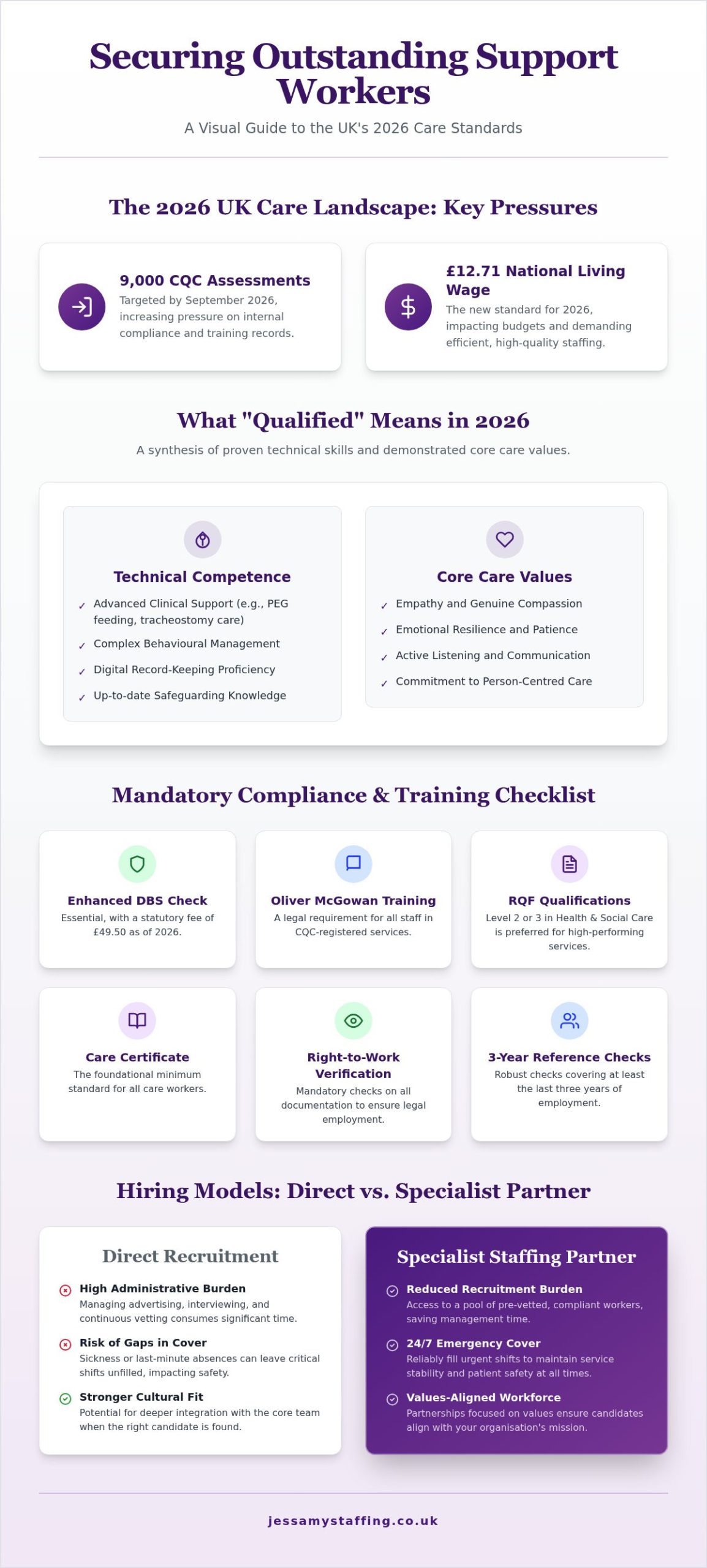
In 2026, the difference between a compliant care service and an outstanding one often rests on the reliability of a single, urgent shift. You likely recognise that staffing isn’t merely a matter of filling gaps on a rota; it’s about the delicate balance of technical competence and genuine empathy. Finding qualified support workers for hire UK-wide has become a significant challenge as the Care Quality Commission (CQC) targets 9,000 assessments by September 2026, placing unprecedented pressure on your internal compliance and training records.
We understand the anxiety that stems from high agency turnover and the constant need to verify enhanced DBS checks or mandatory Oliver McGowan training. This guide provides a clear pathway to securing vetted, values-led support workers who align with your organisation’s mission. We’ll explore the latest 2026 standards, from digital record-keeping targets to the new National Living Wage of £12.71, ensuring you build a stable, dependable workforce that meets every local authority standard whilst significantly reducing your recruitment burden.
Key Takeaways
- Identify the essential 2026 compliance standards, including mandatory Oliver McGowan training and advanced RQF qualifications, to ensure your service remains CQC-compliant.
- Streamline your search for qualified support workers for hire UK by implementing a values-based vetting process that prioritises both technical skill and emotional intelligence.
- Compare the operational advantages of direct recruitment versus specialist staffing partners to maintain consistent 24/7 emergency cover.
- Utilise a comprehensive five-point vetting checklist to mitigate recruitment risks and reduce the administrative burden on your management team.
- Discover how the integration of accredited social care training with staff supply fosters a more stable, dependable, and values-aligned workforce.
The Landscape of Support Worker Recruitment in the UK
In the complex ecosystem of Social care in the United Kingdom, the definition of a “qualified” worker has undergone a significant transformation. Historically, a qualification might have been viewed as a simple checklist of completed modules. By 2026, however, being qualified implies a synthesis of accredited technical proficiency and a demonstrated alignment with core care values. When searching for qualified support workers for hire UK providers must look beyond the initial DBS check to find individuals who possess the emotional resilience required for modern care settings. It’s about finding professionals who view care as a vocation, not just a shift.
The demand for these specialists has reached a critical point. As the population ages and the complexity of needs increases, the sector requires staff who can bridge the gap between clinical necessity and human dignity. This shift has moved recruitment away from simple certification towards a more nuanced, values-based model. Selecting staff based on their character ensures that the high standards of your organisation are maintained even during the most challenging shifts. Ultimately, finding the right staff is a matter of safety, not just capacity.
The Evolving Role of Support Staff
Current Challenges for Care Managers
Care managers currently face a volatile labour market shaped by post-2024 policy shifts and a persistent shortage of specialist talent. These gaps don’t just create administrative headaches; they directly impact service stability and patient outcomes. When a rota has a vacancy, the risk to safety increases exponentially. This reality has made 24/7 emergency cover a standard requirement rather than a luxury for most providers. Relying on a dependable partner for qualified support workers for hire UK ensures that capacity never comes at the expense of quality. Whether you’re based in Manchester or operating nationally, the need for a stable, dependable workforce has never been more pressing.
Defining “Qualified”: Training and Compliance Standards for 2026
To secure qualified support workers for hire UK providers must look beyond a basic CV. In 2026, the definition of “qualified” is anchored in the Care workforce pathway for adult social care, which sets a clear expectation for professional conduct and technical skill. Compliance is no longer a static achievement but a continuous process of development. At a minimum, every worker should hold the Care Certificate, yet high-performing services now prioritise candidates with RQF Level 2 or 3 in Health and Social Care to ensure a deeper understanding of clinical and emotional needs.
The regulatory environment has become more stringent. Completion of the Oliver McGowan Mandatory Training in Learning Disability and Autism is now a legal requirement for all CQC-registered providers. This ensures that every professional on your rota possesses the specific competency to support neurodivergent individuals safely. Continuous Professional Development (CPD) serves as the primary benchmark for quality, reflecting a worker’s commitment to staying current with evolving best practices. When vetting staff, look for evidence of accredited social care training that demonstrates practical competency rather than just attendance.
Mandatory Compliance and Vetting
There are several non-negotiables in the recruitment process. An Enhanced DBS check is essential, and as of 2026, the statutory fee for this remains £49.50. You must also verify right-to-work documentation and conduct robust reference checks that span at least the last three years of employment. Beyond these legal hurdles, a worker’s training portfolio must include up-to-date certifications in safeguarding, health and safety, and food hygiene. These core modules form the defensive line of your service, protecting both the service user and your organisation’s reputation.
Specialist Qualifications for Complex Care
Complex care requires a higher tier of expertise. Supporting a child with complex clinical needs at home involves a different skill set than working in an adult residential centre. Specialists must be trained in condition-specific care, such as advanced dementia support or physical disability management. Jessamy ensures that every professional in their supply chain undergoes rigorous training for complex care workers to meet these exact requirements. If you’re struggling to find staff who can manage these intricacies, exploring our bespoke staffing solutions can help bridge the gap between compliance and exceptional care.
Hiring Models: Direct Recruitment vs. Specialist Agencies
Choosing the right hiring model is a strategic decision that affects both your balance sheet and the quality of care delivered. Direct recruitment offers a sense of control, but it carries a heavy administrative burden that many providers underestimate. When looking for qualified support workers for hire UK organisations often find themselves trapped in a cycle of advertising and interviewing that drains management resources. Beyond the initial hire, you must manage payroll, pension contributions, and the continuous oversight of the DBS Update Service for every team member. The UK National Careers Service guide to care worker roles highlights the diverse entry routes into the profession, yet managing these varied backgrounds in-house requires significant oversight to ensure consistency.
A specialist staffing partner offers a different value proposition. By using an agency, you outsource the complexities of compliance and the risk of staffing gaps. This model is particularly effective for maintaining 24/7 emergency healthcare staffing, where the speed of response is critical to maintaining a safe environment. Instead of waiting weeks for a background check to clear, you gain immediate access to a pool of professionals who are already vetted and ready to work. This dependable capacity is vital during crisis periods or when your permanent team faces unexpected absences.
The Direct Hire Challenge
Direct hiring involves significant hidden costs. You aren’t just paying the National Living Wage of £12.71; you’re also funding the time spent on advertising, interviewing, and onboarding. There is also the persistent risk of “no-shows” which, in a direct-hire model, leaves you without an immediate backup. Managing the ongoing training matrix and ensuring every staff member meets the latest CQC standards for competency-based training is a massive administrative task. For many smaller providers, this burden can detract from the primary goal of service delivery.
The Specialist Agency Advantage
A specialist agency acts as a meticulous guardian of standards. By partnering with a dedicated support worker recruitment agency, you benefit from a pre-vetted pool of temporary social care workers who have already undergone accredited training. This approach ensures that every professional arriving at your service is a “Principled Expert” who understands both the technical requirements of the role and the human-centric values required for person-centred care. It provides a bridge between your institutional needs and the human needs of those you support, offering a level of reliability that direct recruitment often struggles to match. Using qualified support workers for hire UK-wide through an agency ensures your compliance remains robust whilst your administrative load stays light.
Vetting Checklist: How to Hire with Confidence
Hiring qualified support workers for hire UK requires a meticulous approach that prioritises both clinical safety and cultural alignment. A robust vetting process acts as your organisation’s first line of defence against service instability. It’s not enough to simply check a box; you must verify the integrity of every claim made by a potential candidate. This professional rigour ensures that the individuals entering your service possess the technical skill and emotional maturity required to uphold your high standards of care.
To maintain a secure and compliant environment, use this five-point vetting checklist for every new placement:
- Accredited Training Verification: Confirm the completion of the Care Certificate and mandatory Oliver McGowan training.
- DBS Update Service Status: Ensure the Enhanced DBS is not only current but also registered with the Update Service for real-time monitoring.
- Reference Integrity: Secure at least three years of employment history, specifically seeking feedback on the candidate’s reliability and conduct.
- Right to Work Documentation: Verify original identity documents and right-to-work status in accordance with the latest Home Office guidelines.
- Values-Based Competency: Assess the candidate’s ability to handle complex scenarios through the lens of person-centred care.
Values-Led Vetting
Technical skills can be taught, but genuine empathy is an inherent trait. When conducting interviews, ask open-ended questions that require candidates to describe how they’ve advocated for a service user’s dignity during a difficult shift. These responses reveal a candidate’s true integrity and help you match their personality to the specific needs of your service users. By prioritising values-led care recruitment, you naturally reduce long-term turnover, as staff who feel a vocational connection to their work are more likely to remain dependable members of your team.
Compliance Auditing for Managers
Managers must hold their staffing partners to the same high standards they apply to their permanent staff. This involves regular audits of compliance records to ensure that mandatory training refreshers, such as safeguarding and manual handling, are completed on schedule. Observing “shadow shifts” before a full placement allows you to see a worker’s behaviour in a real-world setting, providing a final layer of reassurance. Establishing clear feedback loops ensures that any performance issues are addressed immediately, maintaining a culture of excellence. If you require a partner that integrates these rigorous standards into every placement, our staffing and training services offer the dependable support your service deserves.
The Jessamy Approach: Values-Led Staffing and Training
Jessamy Staffing Solutions operates as a vital bridge between the rigid requirements of institutional compliance and the nuanced reality of human care. We recognise that a rota isn’t just a list of names; it’s a commitment to the well-being of vulnerable individuals. By providing qualified support workers for hire UK-wide, we prioritise a synergy of technical skill and emotional intelligence. Our approach is designed to strengthen care environments, ensuring that every professional we supply contributes to a culture of stability rather than destabilising your existing team through inconsistency.
Dependability is rooted in preparation. Unlike traditional recruitment models, we integrate accredited social care training and development directly into our supply chain. This means that every support worker arriving at your facility has been vetted through our own high standards of professional rigour. Whether it’s children’s complex care at home or adult residential support, our workers are equipped with the specific competencies required for 2026 standards. We don’t just fill gaps; we provide values-led partners who understand the gravity of their role and the importance of person-centred support.
Our Principled Expertise
We combine a high level of corporate authority with a compassionate service ethos. Our focus on 24/7 emergency care staffing ensures that no shift goes uncovered, regardless of the time or complexity. This rapid response capability is backed by a meticulous vetting process, ensuring that emergency cover doesn’t mean a compromise in quality. Our staff are trained to step into sensitive environments with a sense of duty and a calm, professional demeanour that instils confidence in both clients and service users. When you seek qualified support workers for hire UK, you’re looking for professionals who act as an extension of your own values.
Local Knowledge, National Standards
Our deep roots in the Greater Manchester care community provide us with a unique regional reliability. We understand the specific challenges faced by local care homes and supported living services in areas like Salford, Stockport, and Bolton. This Manchester-based expertise allows us to offer bespoke solutions that align with local authority expectations whilst maintaining national standards of excellence. To begin a values-led staffing partnership that prioritises the well-being of your service users, contact our team to discuss your specific requirements. We’re here to provide the stable, professional support your organisation needs to thrive in the years ahead.
Securing Your Future Workforce Standards
The care sector in 2026 demands more than mere capacity; it requires a sophisticated synthesis of technical skill and human empathy. By implementing a values-led vetting process and adhering to the latest CQC competency standards, you ensure your service remains both compliant and compassionate. Navigating the complexities of the modern labour market becomes significantly more manageable when you transition from a reactive hiring model to a proactive, principled partnership. Finding qualified support workers for hire UK providers can trust involves prioritising accredited training and a proven track record in specialist areas.
As an accredited social care training provider with a dedicated 24/7 emergency response team, we act as a meticulous guardian of your service standards. Our specialists in children’s complex care are ready to support your organisation’s most sensitive requirements whilst reducing your administrative burden. Partner with Jessamy Staffing Solutions for reliable, values-led support workers to strengthen your team today. Building a stable, dependable workforce is entirely within reach when integrity and expertise lead the way.
Frequently Asked Questions
What is the difference between a care assistant and a support worker in the UK?
A care assistant typically focuses on clinical and personal care within residential or hospital settings. In contrast, a support worker aims to foster independence and social inclusion for individuals with learning disabilities or mental health needs. Whilst their tasks overlap, the support worker’s role is often more community-based. This distinction is vital for providers seeking qualified support workers for hire UK-wide to ensure the right person matches the specific service goal.
How quickly can a recruitment agency provide emergency support worker cover?
Specialist agencies provide rapid response solutions that can often fill a vacancy within a few hours. Because our 24/7 emergency cover team maintains a pool of pre-vetted professionals, we can bypass the lengthy recruitment cycles associated with direct hiring. This speed is essential for maintaining safety during unexpected staff absences or sudden increases in patient complexity. It ensures your service remains stable and compliant without compromising on the quality of personnel.
What qualifications should I look for when hiring a support worker for complex care?
For complex care, you should prioritise candidates with RQF Level 3 in Health and Social Care and specific clinical competencies. These might include tracheostomy care, PEG feeding, or advanced manual handling. Since 2026 standards require proven competency, look for workers who’ve completed accredited social care training programmes. Ensuring your staff possess these specialist skills is a fundamental requirement for delivering safe, person-centred care in high-needs environments.
Are agency support workers fully vetted and DBS checked?
Every professional supplied by a reputable agency undergoes a rigorous vetting process, including an Enhanced DBS check. As of 2026, these checks are verified against the DBS Update Service to ensure real-time compliance. We also conduct thorough reference checks covering at least the last three years and verify right-to-work documentation. This meticulous approach provides peace of mind, knowing that every worker on your rota has met the highest safety standards.
How does values-led recruitment improve the quality of care?
Values-led recruitment identifies individuals whose personal ethics and empathy align with your organisation’s mission. By focusing on character alongside technical skill, you create a more stable workforce with significantly lower turnover rates. Workers who feel a vocational connection to their roles provide more consistent, person-centred support. This approach bridges the gap between institutional requirements and human needs, ultimately improving the lived experience of the service users in your care.
Can I hire support workers for 24/7 emergency cover in Manchester?
Yes, we provide comprehensive 24/7 emergency cover specifically tailored for the Greater Manchester care community. Our local presence allows us to respond quickly to requests from care homes and supported living facilities across the region. By accessing qualified support workers for hire UK through our Manchester-based hub, you benefit from staff who understand the local landscape. We ensure that regional reliability is paired with national standards of excellence for every shift.
What training is mandatory for support workers in 2026?
Mandatory training in 2026 includes the Care Certificate and the now legally required Oliver McGowan Mandatory Training in Learning Disability and Autism. Staff must also maintain up-to-date certifications in safeguarding, health and safety, and food hygiene. The CQC now emphasises demonstrated competency over simple attendance, meaning providers must keep a detailed training matrix. Regular refreshers ensure that your team remains compliant with the latest Health and Social Care Act regulations.
How do staffing agencies ensure the reliability of their personnel?
Staffing agencies ensure reliability by integrating accredited training with their supply chain. At Jessamy, we utilise performance audits and feedback loops to monitor the conduct of our personnel continually. We also encourage “shadow shifts” to ensure a worker’s a perfect fit for a specific environment before full placement. This methodical approach guarantees that every professional we provide acts as a dependable, principled partner in your service delivery.