

With 84% of adult social care providers currently struggling to fill vacancies, the traditional scramble to cover shifts has become a significant threat to both resident safety and your financial stability. You likely feel the daily pressure of rising agency costs and the constant anxiety that a compliance gap might surface during one of the CQC’s 9,000 planned assessments this year. Implementing a strategy for integrated staffing and training for care homes is no longer just an operational preference; it’s a necessity for maintaining continuity whilst managing the new £12.71 National Living Wage.
We understand the exhaustion that comes from the administrative burden of emergency recruitment and the desire for a more reliable, values-led team. This guide provides a strategic roundup of workforce solutions designed to reduce management burnout and ensure all personnel hold accredited qualifications. You’ll discover how to transition from reactive hiring to a proactive model that prioritises resident well-being and meets the rigorous standards of the 2026 regulatory environment, ensuring your facility remains both compliant and cost-effective.
Key Takeaways
- Evaluate the strengths and weaknesses of internal bank management versus traditional agency supply to determine the most sustainable workforce model for your facility.
- Learn how integrated staffing and training for care homes bridges the gap between recruitment and clinical competence, ensuring every shift is filled by a qualified professional.
- Move beyond basic compliance by implementing values-led vetting processes that prioritise resident well-being and long-term staff retention.
- Discover how to naturally integrate accredited social care training into your daily operations to meet evolving CQC standards and demonstrate staff competency.
- Gain insights into regional strategies for Greater Manchester to secure a reliable pool of support workers and domestic staff amidst national shortages.
Workforce Solutions for Care Homes: Navigating the 2026 Landscape
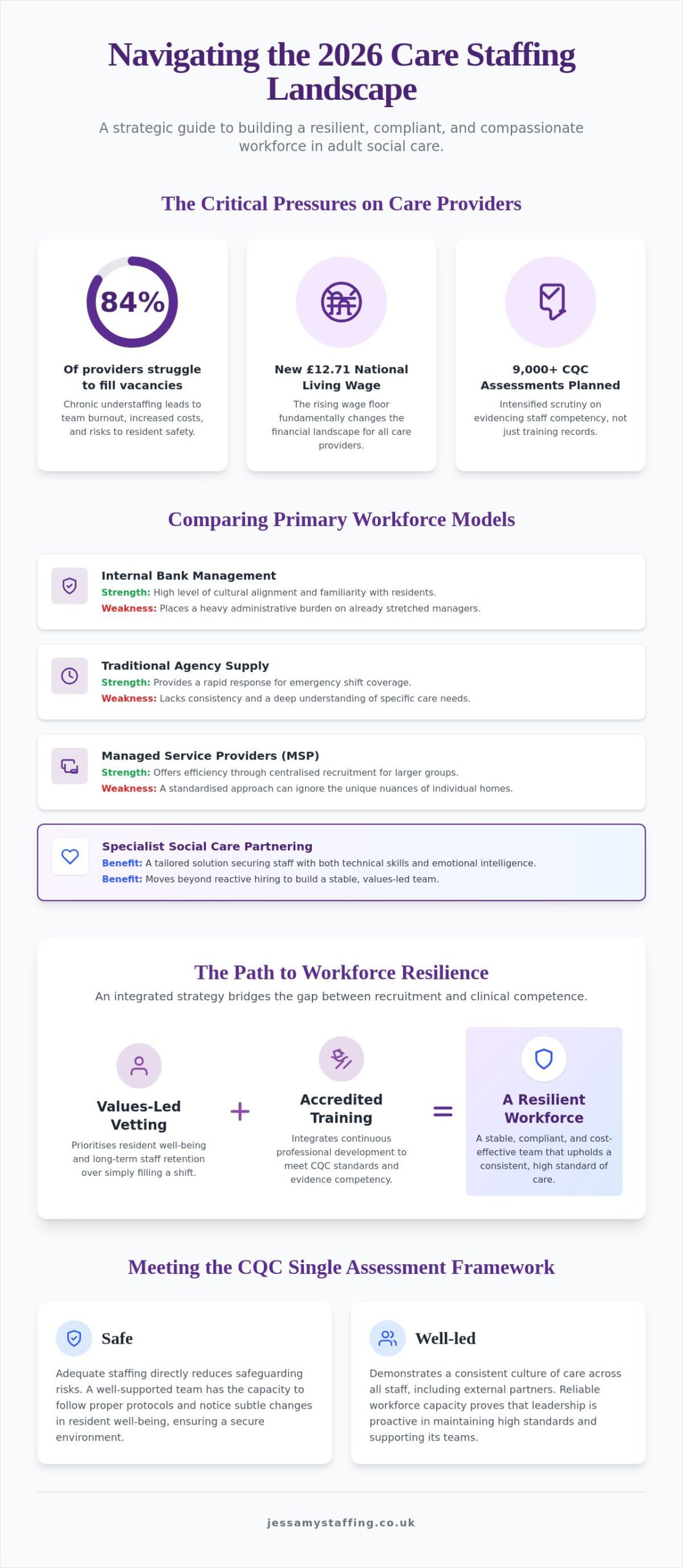
The social care sector has reached a critical juncture where traditional recruitment methods are failing to meet the complexities of modern service delivery. As of April 2026, the National Living Wage has risen to £12.71 per hour, fundamentally changing the financial landscape for care providers across the UK. Managing these budgetary pressures effectively is crucial; for care providers operating as small businesses, the financial planning resources provided by ASAP Solutions can help navigate such fiscal transitions. With 84% of adult social care providers reporting persistent difficulties in filling posts, the focus has shifted from merely finding staff to retaining a workforce that is both competent and compassionate. High turnover rates don’t just increase administrative costs; they erode the foundational trust between residents and those tasked with their care.
Effective workforce solutions in 2026 must go beyond the legacy approach of “warm body” recruitment. The Care Quality Commission (CQC) is intensifying its scrutiny, aiming for 9,000 assessments by September 2026, with a clear emphasis on evidencing actual staff competency rather than just ticking boxes on a training record. This regulatory shift necessitates a move toward integrated staffing and training for care homes. By aligning the recruitment process with continuous professional development, providers can ensure that every professional entering their facility is equipped to handle the unique challenges of the environment from their first hour on shift. Furthermore, ensuring your organisational oversight is robust is essential; Charlie Helps Associates provides the corporate governance and advisory support needed to navigate these regulatory complexities.
When defining the role of a caregiver in a professional setting, we must distinguish between basic assistance and the high-level clinical and emotional intelligence required in modern care homes. True workforce stability is achieved when staffing is treated as a strategic asset rather than a reactive emergency fix. This requires a transition to models that prioritise values-led recruitment and accredited training, ensuring that temporary and permanent personnel alike share the same high standards of practice.
The Impact of the Current Care Staffing Shortage
Chronic understaffing creates a damaging feedback loop that compromises staff morale and accelerates burnout. When teams are spread thin, the resulting exhaustion leads to further turnover, leaving managers in a constant state of crisis management. Relying on non-specialist recruitment firms often exacerbates this issue, as these agencies may lack a deep understanding of the ethical and clinical nuances of social care, leading to poor placements and wasted expenditure. Workforce resilience in 2026 is the capacity of a care provider to maintain safe, compliant staffing levels through a stable pool of professionals who possess both the accredited skills and the values-led commitment required by modern UK standards.
Regulatory Expectations and Workforce Capacity
The CQC’s Single Assessment Framework places significant weight on the “Safe” and “Well-led” domains, both of which are directly tied to staffing adequacy. It’s no longer enough to have the correct number of people on the rota; you must demonstrate that your workforce capacity allows for a consistent culture of care amongst all staff, including those provided by external partners. Dependable workforce capacity reduces the risk of safeguarding incidents by ensuring that personnel are never too rushed to follow proper protocols or notice subtle changes in a resident’s well-being. By integrating rigorous training with staffing supply, facilities can maintain a seamless standard of care that stands up to the most demanding inspections.
Comparing Primary Workforce Models for Care Facilities
Selecting the most effective workforce model is a strategic decision that directly impacts both resident safety and operational efficiency. Internal bank management offers high levels of cultural alignment; however, it places a heavy administrative burden on registered managers who are already stretched thin. Traditional agency supply provides a rapid response to emergencies, but it often lacks the consistency required for sensitive care environments. Managed Service Providers (MSP) offer efficiency through centralised recruitment for larger groups, yet this can sometimes lead to a standardised approach that ignores the nuances of individual care settings. Specialist partnering provides a more tailored solution. By collaborating with agencies that focus exclusively on social care, providers secure staff who possess both the technical skills and the emotional intelligence required for the role.
Temporary vs. Permanent Recruitment Strategies
Strategic use of temporary staff can strengthen a team by providing essential respite and preventing burnout among permanent employees. Partnering with a reputable support worker recruitment agency allows providers to fill immediate gaps whilst assessing potential candidates for long-term roles. This temp-to-perm arrangement serves as a practical trial period, ensuring that new hires are a genuine fit for the home’s specific culture before a permanent contract is signed. It’s a cost-effective way to build a resilient team without the risks associated with rushed permanent hiring.
Specialist Staffing for Complex Care Environments
Complex care environments require a higher degree of technical competence and emotional resilience than general residential settings. For instance, the protocols and clinical oversight involved in children’s complex care at home differ vastly from those required in an elderly residential unit. Specialist staffing ensures that personnel are matched to specific resident behaviours and clinical needs, such as dementia care or neurological support. Nursing homes, in particular, require workforce solutions that prioritise clinical precision and the ability to manage multifaceted care plans alongside daily domestic tasks.
The Hybrid Model: Integration of Training and Supply
The most resilient providers are now adopting a hybrid approach that prioritises professional development alongside personnel supply. Integrated staffing and training for care homes eliminates the friction often found during the onboarding of temporary staff. When a staffing partner also manages the accredited training of their personnel, they guarantee that every worker arrives on-site fully briefed and clinically prepared. This model ensures that high standards of care are maintained without interruption, regardless of the contract type. For those seeking a partner that prioritises these rigorous standards, exploring specialist staffing and training services can provide the necessary stability for your facility.
Essential Criteria for Evaluating Staffing Partners
Choosing a staffing partner is a decision that extends far beyond filling a gap on a rota; it’s about finding a meticulous guardian of your facility’s standards. In an era of increased regulatory scrutiny, you need more than a simple recruitment agency. You require a collaborator that understands the intersection of technical competence and human empathy. A partner that provides integrated staffing and training for care homes ensures that every individual entering your building is not only compliant on paper but also culturally aligned with your facility’s favourite care philosophies. This alignment is what transforms a temporary shift-fill into a seamless extension of your permanent team.
Rigorous compliance must be the baseline of any partnership. Whilst many agencies stop at basic DBS checks, the most reliable partners employ a values-led vetting process. This involves assessing a candidate’s history, professional references, and their inherent suitability for sensitive environments. Clinical competence is equally vital. Staff must be professionally prepared to handle complex care plans and specialized resident needs from the moment they arrive. Furthermore, the necessity of 24/7 emergency support cannot be overstated. A staffing crisis doesn’t follow a nine-to-five schedule, and having a responsive partner ensures resident safety is never compromised by an empty shift.
The Values-Led Recruitment Framework
Values-led recruitment is a strategic approach that prioritises a candidate’s character and ethical alignment over their technical CV alone. It’s a method that significantly improves resident outcomes by ensuring staff possess the natural empathy and integrity required for high-quality care. During the interview process, identifying these traits involves looking for evidence of compassionate decision-making and a genuine sense of duty. The long-term benefits are clear: when you hire for attitude and use integrated staffing and training for care homes to develop specific skills, you create a loyal, resilient workforce that is less prone to burnout and more committed to resident well-being. Understanding how to strategically source qualified agency care staff UK providers recommend can further strengthen this values-led approach by ensuring every temporary placement meets the same rigorous ethical and clinical benchmarks.
Compliance and Safety Checklists
Maintaining safety requires a constant, vigilant focus on mandatory training requirements. All personnel must hold up-to-date certifications in manual handling, safeguarding, and medication management. This rigorous standard must also apply to non-clinical roles. The importance of skilled domestic staff for care is often overlooked, yet they are essential for maintaining hygiene standards and preventing infection outbreaks. Understanding the strategic role of domestic staff for healthcare facilities in meeting the National Standards of Healthcare Cleanliness 2025 is increasingly critical for providers seeking to demonstrate a truly comprehensive approach to CQC compliance. Finally, ensure all personnel have a clear understanding of CQC Quality Statements. Staff should be able to demonstrate how their daily actions contribute to a safe, effective, and well-led service, providing inspectors with clear evidence of a high-standard culture.
Strategic Implementation: Building Workforce Resilience in Greater Manchester
Building a resilient workforce in Greater Manchester requires a nuanced understanding of the regional labour market and the specific pressures facing North West care providers. Whilst national vacancy trends provide a broad context, local implementation must address the high demand for talent in urban centres like Manchester and Salford. Transitioning from reactive crisis management to a stable workforce plan involves shifting the perspective on emergency staffing. Instead of viewing temporary cover as a last resort, proactive managers utilise it as a strategic tool to maintain safety and morale whilst long-term, values-led recruitment strategies take root. This approach ensures that resident care remains uninterrupted, even during periods of peak demand or unexpected absence.
Success in this landscape depends on moving beyond the traditional silos of recruitment and professional development. By adopting a model of integrated staffing and training for care homes, providers can create a more versatile and loyal team. This integration ensures that every professional, whether permanent or temporary, operates under the same high standards of clinical excellence and ethical conduct. A stable workforce isn’t built overnight; it’s the result of methodical planning that prioritises the well-being of the staff as much as the safety of the residents.
Integrating Training and Development
Accredited training serves as the essential backbone of a dependable workforce, providing the technical foundation for safe practice. When facilities offer clear career pathways and professional growth opportunities, they foster a sense of loyalty that significantly reduces staff turnover. This investment in personnel transforms a job into a career, attracting individuals who are committed to the long-term success of the home. Continuous professional development ensures that staff remain proficient in the latest clinical protocols, which directly reduces the likelihood of clinical errors and safeguarding incidents. This commitment to excellence through integrated staffing and training for care homes provides the reassurance that families and regulators expect.
Local Support for Manchester Care Homes
Manchester care providers benefit significantly from partnering with a local 24/7 emergency care staffing UK specialist. Regional expertise allows for a more responsive service, as local partners understand the specific demographic challenges and regulatory expectations within the Greater Manchester People and Culture Strategy. Building a community of care amongst local providers and agencies encourages the sharing of best practices and creates a more robust support network. This local focus ensures that your facility is never left vulnerable, providing a steady supply of vetted professionals who are already familiar with the region’s high standards. To secure your facility’s future with a partner that understands the Manchester landscape, contact our specialist staffing team today for a consultation.
Jessamy Staffing Solutions: Integrating Rigorous Standards with Compassionate Care
Jessamy Staffing Solutions operates at the vital intersection of operational excellence and human empathy. Our unique model addresses the systemic challenges of the social care sector by providing a comprehensive solution that combines integrated staffing and training for care homes. We don’t merely supply personnel; we cultivate a workforce that is technically proficient and ethically aligned with the highest standards of care. This approach ensures that every support worker or domestic staff member we provide is ready to contribute positively to your facility’s culture from their first shift. It reduces the friction often associated with temporary staffing. Standards matter.
By positioning ourselves as a principled expert and a stable, long-term partner, Jessamy Staffing Solutions helps care home managers move away from the stress of emergency shift-filling. Our focus remains on the well-being of the end-user. We ensure that residents receive care from professionals who are not only vetted but also continuously developed. This commitment to quality allows our clients to face CQC inspections with confidence. They know their workforce capacity is backed by rigorous, accredited training. Integrity defines our approach.
Our Commitment to Quality and Ethics
We prioritise professional rigour alongside human-centric warmth because technical skill without compassion is insufficient for modern social care. The Jessamy Staffing Solutions guarantee ensures that all personnel are safe, competent, and dependable. Our own domiciliary service, Jessamy Platinum Homecare, achieved a “GOOD” rating in its first CQC inspection on 16 November 2022, demonstrating our internal commitment to the standards we expect from the staff we supply to others. In one Manchester-based care home, our intervention resolved a chronic staffing crisis by replacing inconsistent agency use with a dedicated pool of values-led support workers. This resulted in a measurable improvement in resident continuity and staff morale.
- Values-Led Vetting: We go beyond standard DBS checks to ensure ethical alignment and empathy.
- Accredited Development: All staff receive Socialcare Training & Development as part of our core offering.
- 24/7 Reliability: Our 24/7 Emergency Cover ensures your facility is never left vulnerable during peak demand.
How to Get Started with a Personalised Workforce Plan
Every care facility has unique requirements. Our process begins with a detailed consultation to assess your specific needs. We evaluate your current workforce gaps, compliance requirements, and resident profiles to create a tailored personnel strategy. This ensures a seamless integration of Jessamy Staffing Solutions staff into your existing teams, maintaining a unified culture of care. Whether you require support worker supply or specialised domestic staff, our methodical approach guarantees transparency and thoroughness throughout the partnership. Integrated staffing and training for care homes is the foundation of a resilient service. Contact our Greater Manchester centre today to discuss your requirements and discover how we can strengthen your facility’s workforce resilience for 2026 and beyond. Partner with our specialist staffing team today to secure your facility’s future.
Securing Your Facility’s Future Through Strategic Workforce Excellence
The 2026 social care landscape demands a transition from reactive crisis management to a sustainable, ethical staffing model. By prioritising values-led recruitment and rigorous clinical standards, you protect both your residents and your professional reputation against increasing regulatory pressure. We’ve explored how regional expertise in Greater Manchester and a shift toward integrated staffing and training for care homes provide the stability necessary to manage rising operational costs whilst ensuring absolute continuity of care.
Achieving this level of excellence requires a partner that acts as a meticulous guardian of your standards. Jessamy Staffing Solutions offers a comprehensive solution through our values-led recruitment process and our status as an accredited social care training provider. Whether you require domestic staff, support worker supply, or 24/7 emergency cover, our methodical approach ensures your facility remains safe and well-led at all times. Partner with Jessamy Staffing Solutions for dependable workforce solutions and restore the essential balance between operational efficiency and human empathy in your home. Your commitment to high standards deserves a partner that shares your sense of duty.
Frequently Asked Questions
What are the main types of workforce solutions for care homes?
Internal bank management, traditional agency supply, and specialist partnering are the primary models used within the sector. Specialist partners often provide the most effective integrated staffing and training for care homes by aligning personnel supply with accredited professional development. This ensures that even temporary staff are fully prepared for the specific clinical and ethical requirements of your facility from their first shift.
How does values-led recruitment improve care home safety?
Values-led recruitment improves safety by prioritising candidates with the inherent empathy and integrity required for sensitive care environments. By vetting for character alongside technical skill, providers significantly reduce the risk of safeguarding incidents and ensure a higher standard of resident well-being. This methodical approach creates a more stable, trustworthy team that is less prone to the behavioural inconsistencies often found in generalist recruitment.
Can workforce solutions help with CQC compliance?
Robust workforce solutions are essential for meeting CQC requirements under the “Safe” and “Well-led” domains of the Single Assessment Framework. Evidencing staff competency through accredited training and rigorous vetting allows managers to demonstrate that they have sufficient, qualified personnel to meet resident needs. A dependable staffing partner ensures that all personnel records are audit-ready, reducing the administrative burden during regulatory inspections.
What should I look for in a care home staffing agency in Manchester?
When selecting a partner in Manchester, prioritise agencies with a deep understanding of the North West labour market and local regulatory expectations. Look for a provider that offers 24/7 emergency cover and has an established presence in the region. This local context ensures they can respond rapidly to shifts whilst maintaining a community-focused approach to care delivery that aligns with regional health strategies.
How quickly can emergency care staffing be deployed?
Emergency care staffing can be deployed rapidly through 24/7 response centres to cover unexpected absences or sudden increases in resident needs. Reliable partners maintain a pool of vetted professionals who are ready to step into shifts at short notice. This immediacy is vital for maintaining safe staffing levels and preventing the permanent team from becoming overwhelmed by excessive workloads or emergency shift-filling duties.
Is it better to use temporary staff or permanent recruitment for care homes?
A hybrid approach is often the most effective strategy for modern care facilities seeking both stability and flexibility. Whilst permanent recruitment provides long-term continuity, temporary staff offer the essential capacity needed to manage fluctuating occupancy levels or staff leave. Utilising a temp-to-perm model allows you to assess a professional’s suitability for your home’s unique culture before making a long-term contractual commitment.
How does staff training impact workforce stability?
Consistent staff training significantly improves workforce stability by creating clear career pathways and increasing employee confidence in their daily practice. When staff feel professionally supported and competent in their roles, they are more likely to remain loyal to the organisation. This investment in integrated staffing and training for care homes reduces turnover and ensures a higher, more consistent standard of care for all residents.
What is the cost of implementing a managed workforce solution?
The cost of implementing a managed workforce solution varies based on the volume of staff required and the clinical complexity of the care being provided. Rather than focusing solely on hourly rates, providers should consider the long-term return on investment achieved through reduced agency spend and lower internal recruitment costs. A structured partnership provides greater budget predictability whilst ensuring that all personnel meet the required clinical and ethical standards.