



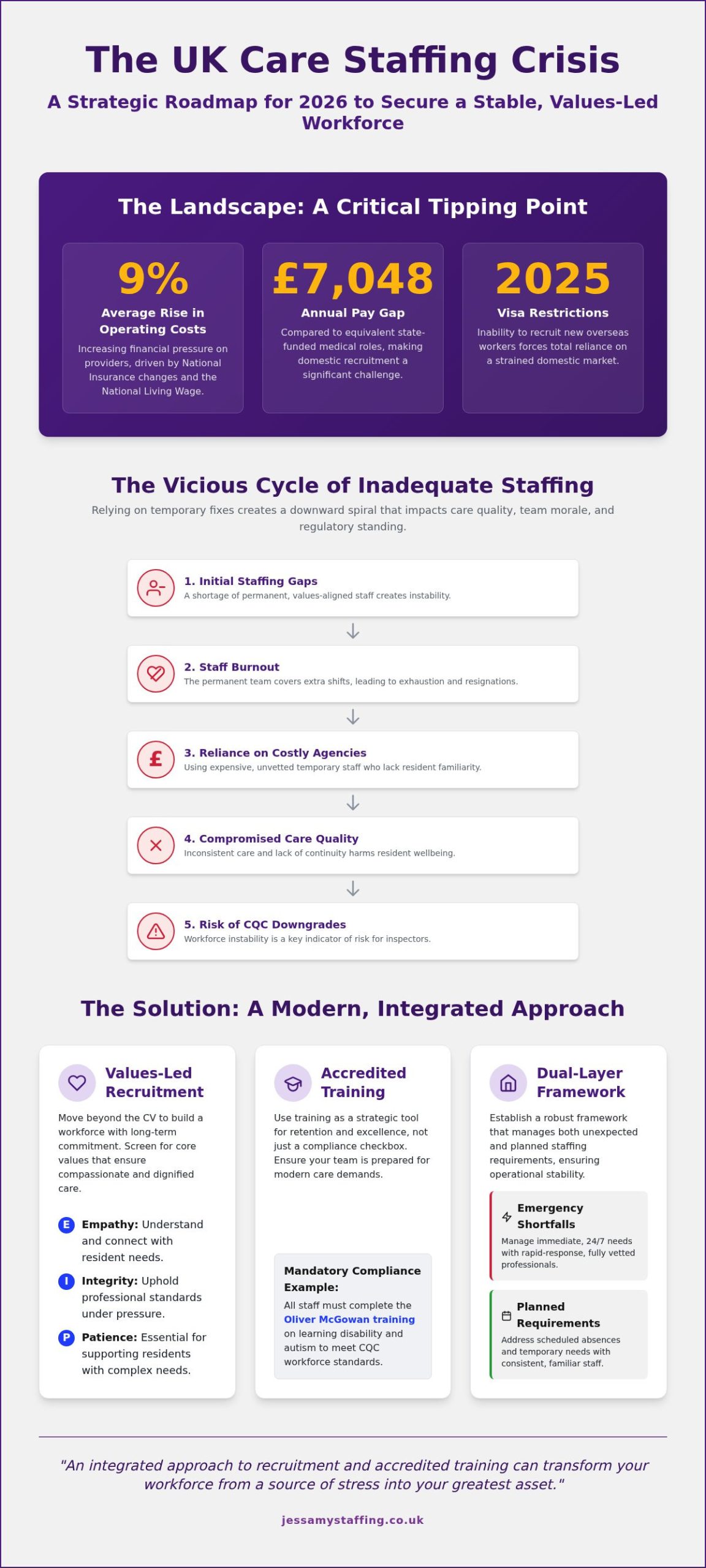
The traditional method of hiring just to fill a rota gap is no longer enough to sustain a safe and compliant care environment. As operating costs for providers have risen by an average of 9% over the last year, the pressure to fill care home staffing gaps UK wide has reached a critical tipping point. You’ve likely experienced the frustration of paying for expensive agency staff who don’t understand your residents’ specific needs, or watched your permanent team struggle with burnout due to constant understaffing. It’s a cycle that threatens both your operational stability and your CQC standing.
We understand that your priority is providing high-quality care whilst maintaining a sustainable business. This guide provides a strategic roadmap for 2026 to help you secure dependable, values-led personnel who are fully prepared for the rigours of modern social care. You’ll discover how an integrated approach to recruitment and accredited training can transform your workforce from a source of stress into your greatest asset. We’ll examine the latest regulatory changes, including the mandatory Oliver McGowan training, and provide actionable steps to reduce your reliance on unreliable temporary fixes.
Key Takeaways
- Identify why traditional recruitment methods are failing and how to strategically fill care home staffing gaps UK wide using a more robust, forward-looking approach.
- Transition from basic compliance to excellence by prioritising values-led recruitment that focuses on empathy, integrity, and a genuine sense of duty.
- Establish a dual-layer staffing framework that effectively manages both immediate 24/7 emergency shortfalls and planned temporary requirements.
- Utilise accredited social care training as a strategic tool to improve staff retention, boost professional confidence, and ensure resident safety.
- Leverage the advantages of integrated staffing partnerships that combine local expertise in Greater Manchester with a high-level commitment to operational standards.
The Landscape of Care Home Staffing Gaps in the UK (2026)
The UK social care sector faces a structural shift in 2026. While the government confirmed a £13.3 million funding package for learning and development, providers are grappling with the long-term effects of the 2025 visa restrictions. The inability to recruit new overseas care workers has forced a total reliance on the domestic market, where a £7,048 annual pay gap compared to equivalent state-funded medical roles persists. This disparity makes it increasingly difficult to fill care home staffing gaps UK wide through traditional job board postings or standard recruitment drives.
A staffing gap is rarely just a missing name on a rota. It’s often a deficit in specific competencies or a lack of alignment with a home’s core values. When providers focus solely on headcounts, they risk inviting instability into their care environments. A comprehensive Social care in England overview reveals that the system’s complexity requires more than just “bodies in buildings”; it demands professionals who understand the intersection of clinical safety and human dignity. Without these elements, the quality of life for residents inevitably declines.
The True Cost of Understaffing in Care Facilities
Financial stability is directly tied to workforce consistency. With operating costs rising by 9% due to National Insurance changes and the £12.71 National Living Wage, care homes cannot afford the churn associated with poor recruitment. Relying on high-cost, unvetted agency workers often leads to a cycle of diminishing returns. This is The High Cost of Understaffing in Care Facilities, where the financial burden of emergency fees is compounded by the hidden toll on permanent staff. When a core team is forced to cover extra shifts, burnout becomes inevitable, leading to further resignations and a compromised standard of care.
Regulatory Pressures and Workforce Capacity
The Care Quality Commission (CQC) has intensified its focus on workforce capability as a primary indicator of safety. Inspectors now look beyond simple ratios, examining whether staff have completed mandatory requirements like the Oliver McGowan training on learning disability and autism. Failure to demonstrate a dependable care workforce capacity can lead to immediate downgrades. In the context of 2026 UK regulations, workforce capacity is the measure of a provider’s ability to deploy staff who possess the specific skills, legal certifications, and values required to meet the individual needs of residents safely and consistently. To fill care home staffing gaps UK providers must ensure their teams are not just present, but professionally prepared to meet these rigorous standards.
Beyond the CV: Why Values-Led Recruitment is Non-Negotiable
A curriculum vitae confirms qualifications, but it rarely captures the character required for high-stakes care environments. While credentials provide a baseline of competence, they cannot quantify the compassion required for end-of-life care or the patience needed for residents with sensory impairments. To effectively fill care home staffing gaps UK wide, providers must look beyond the list of past employers and focus on the individual’s internal compass. A values-led professional treats their role as a vocation, ensuring that the human element of care remains intact even during the busiest shifts.
Identifying these traits requires a recruitment process that looks beneath the surface of experience. As noted in social care key facts and figures, the increasing complexity of resident needs requires a workforce that is emotionally resilient. Identifying empathy and integrity during the hiring process involves behavioural interviewing techniques that reveal how a candidate reacts under pressure. By screening for these core values, facilities can fill care home staffing gaps UK with professionals who offer long-term commitment rather than just a temporary presence, significantly reducing the risk of ‘destabilisation’ in sensitive settings.
Empathy as a Technical Requirement
Soft skills are the primary tools for managing de-escalation and providing emotional support in dementia care. In 2026, the sector recognises that a support worker’s ability to build trust is just as important as their ability to follow a clinical care plan. This emotional intelligence directly correlates with resident satisfaction and safety. When staff share the facility’s mission, they provide a level of continuity that prevents the disruption often caused by a rotating door of uninvested personnel. Empathy, therefore, should be viewed as a non-negotiable technical requirement for any professionally prepared candidate.
The Jessamy Staffing Solutions Approach to Safe Recruitment
We maintain that high standards start with meticulous vetting. Our recruitment framework prioritises the well-being of the end-user, ensuring every professional is both technically competent and ethically aligned. This methodology is detailed in The Definitive Guide to Choosing a Support Worker Recruitment Agency in 2026. By focusing on candidates who prioritise duty and integrity, we help providers build teams that are resilient and compassionate. If you are looking to strengthen your workforce with individuals who embody these principles, partnering with Jessamy Staffing Solutions ensures your facility remains a safe and welcoming environment for all residents.
Strategic Frameworks for Filling Urgent and Long-Term Gaps
The operational landscape of 2026 demands a shift from reactive firefighting to a structured, dual-layer staffing strategy. While values-led recruitment provides the foundation for your culture, a robust framework ensures that your facility remains safe during both expected transitions and unforeseen crises. To effectively fill care home staffing gaps UK providers should distinguish between immediate emergency requirements and planned temporary supply. This distinction allows management to maintain high standards of care without the chaos often associated with last-minute rota changes.
Proactive workforce planning involves more than just nursing and support worker rotas. Integrating domestic staff into your strategic framework is a highly effective way to improve facility standards whilst freeing up clinical teams to focus on resident well-being. When domestic and housekeeping roles are consistently filled by professionally prepared personnel, the pressure on the wider team is significantly reduced. This holistic approach ensures that every facet of the care environment, from cleanliness to clinical safety, is managed with precision and care.
Managing the Last-Minute Shift Crisis
A failed night shift or a sudden illness can jeopardise resident safety in minutes. When a staff member fails to arrive, managers need a clear, immediate protocol to mitigate risk. A standard emergency checklist should include:
- Immediate assessment of resident-to-staff ratios to identify high-risk areas.
- Verification of the specific skills required for the vacant shift, such as dementia care or complex care competencies.
- Contacting a reliable partner for 24/7 Emergency Care Staffing UK services.
- Updating the handover notes to ensure the incoming emergency worker is fully briefed on resident needs.
Rapid response times are essential. In Greater Manchester and across the UK, having an out-of-hours partner who understands the local regulatory environment is the difference between a managed incident and a CQC reportable event.
Building Workforce Stability with Temporary-to-Permanent Models
Temporary staffing shouldn’t be viewed as a temporary fix; it’s an opportunity to evaluate cultural fit. By utilising a temporary-to-permanent model, you can observe how a support worker interacts with residents and integrates with your core team before making a long-term commitment. This reduces the financial and operational risks associated with direct hiring. Partnering with a single, consistent agency rather than multiple ad-hoc providers ensures that the personnel sent to your facility already understand your specific protocols and values. This consistency is vital for maintaining a stable, dependable workforce capacity that residents can trust.
The Crucial Role of Accredited Training in Workforce Retention
Training represents the psychological bridge between merely occupying a position and delivering excellence in care. While the government’s funding package for 2026/27 provides the necessary financial framework, the true value of education lies in the confidence it instils in the workforce. In an environment where providers must fill care home staffing gaps UK wide, the pressure to deploy staff quickly is immense. However, staff who receive accredited training are significantly more likely to remain in their positions. Competence breeds resilience; when a support worker feels fully equipped to handle complex scenarios, their job satisfaction increases and the risk of burnout diminishes.
Social care training and development must evolve beyond traditional classroom learning to incorporate practical workforce intelligence. By aligning staff development with the specific needs of a facility, providers can ensure their teams are prepared for real-world challenges. This methodical approach ensures that personnel are not just available, but are strategically prepared for the unique pressures of their assigned environment. When staff feel supported by a robust educational framework, they’re less likely to seek employment in equivalent roles in the public healthcare sector, providing the continuity that residents rely upon.
Specialist Training for Complex Care Environments
High-acuity settings and paediatric support require a level of precision that standard inductions cannot provide. For those providing children’s complex care at home, the training requirements are particularly rigorous, involving specialised clinical procedures and communication techniques. Jessamy Staffing Solutions uniquely integrates this accredited training into its recruitment model to ensure every professional we supply is ready for immediate, safe delivery. You can explore these requirements in our Training for Complex Care Workers in 2026. This integration of learning with placement is what creates a truly dependable workforce.
Continuous Professional Development (CPD) in Social Care
Educational investment is a powerful tool for fostering a genuine culture of care. When staff see a clear path for progression through Continuous Professional Development (CPD), they view their role as a long-term career. In 2026, the standard for professionally prepared personnel is defined as an individual who possesses both mandatory certifications and a demonstrated commitment to ongoing skill acquisition in their specialist field. This investment pays dividends in reduced turnover and improved resident safety scores. To learn how our integrated model can support your team’s development, consider our Socialcare Training & Development services.
Partnering for Stability: Integrated Staffing Solutions in Greater Manchester
Localised expertise is the final piece of the workforce puzzle. While national trends provide a broad context, the specific operational challenges within Greater Manchester require a partner who understands the local healthcare landscape. From navigating regional transport links that affect shift punctuality to understanding the specific CQC focus areas for North West providers, local insight ensures that staffing solutions are both practical and resilient. A truly effective way to fill care home staffing gaps UK facilities face is through a partner that understands these local nuances and can respond with precision.
An integrated staffing and training model removes the friction between hiring and performance. When your staffing provider also manages accredited training, the result is a workforce that is already aligned with your quality standards before they step through your doors. This synergy reduces the administrative burden on care home managers, allowing them to focus on resident outcomes rather than chasing compliance certificates. Jessamy Staffing Solutions acts as a stable, long-term partner by bridging the gap between high-level institutional requirements and the human-centric needs of every resident.
Local Support for Manchester Care Homes
The advantage of 24/7 local support cannot be overstated. When an emergency arises at 3:00 am, having a partner based in Greater Manchester ensures a rapid response that national call centres often struggle to match. We have seen facilities move from a state of constant crisis to one of workforce stability by simply switching to a model that prioritises local, values-led personnel. This transition is explored further in our Strategic Guide to Healthcare Personnel Supply in the UK, which outlines how to build a dependable team in a competitive market.
Securing Your Facility’s Future
Choosing a values-led agency is a fundamental commitment to resident safety. To ensure your facility is prepared for the challenges of 2026, we recommend a thorough audit of your current staffing provision. Consider whether your current partners prioritise empathy as much as compliance, and whether they offer the 24/7 emergency cover necessary for true peace of mind. To begin this process, you can undertake a bespoke staffing and training audit with our team to identify hidden gaps in your workforce capacity.
A stable workforce is the foundation of a high-performing care home. By integrating professional training with values-based recruitment, you can fill care home staffing gaps UK wide whilst elevating the standard of care provided to your residents. If you are ready to move beyond temporary fixes and secure a dependable future for your facility, Contact Jessamy Staffing for Reliable Solutions today.
Securing Operational Excellence for 2026 and Beyond
The care sector in 2026 requires a definitive departure from traditional, volume-based hiring. As we’ve explored, the most resilient facilities are those that prioritise values-led recruitment and integrate accredited training into their core operational strategy. By moving away from reactive firefighting and adopting a dual-layer approach to workforce planning, you can protect your CQC standing and significantly enhance resident safety. A stable team is built on the intersection of professional competence and human empathy.
Secure Your Care Home’s Workforce with Jessamy Staffing Solutions
Building a dependable, values-led team is a journey of continuous improvement, and we’re here to support you every step of the way.
Frequently Asked Questions
How can I fill care home staffing gaps quickly during an emergency?
To fill care home staffing gaps UK providers should maintain a partnership with a 24/7 emergency cover specialist that offers guaranteed rapid response times. This allows you to secure professionally prepared support workers or nursing staff the moment a shift failure occurs. Having a pre-vetted out-of-hours partner ensures that resident safety and legal staffing ratios are never compromised during a crisis.
What are the most effective strategies for care home staff retention in 2026?
Retention in the current climate depends on a combination of values-led recruitment and robust educational investment. Providing clear paths for Continuous Professional Development (CPD) helps staff feel valued and reduces the likelihood of them leaving for equivalent NHS roles. When you foster a culture of care through accredited training, you build a resilient team that’s better equipped to handle the emotional demands of the sector.
Why is values-led recruitment important for health and social care?
Values-led recruitment identifies intrinsic traits such as empathy, integrity, and a sense of duty that a standard CV cannot capture. These attributes are essential for maintaining a calm and dignified environment for residents, particularly those with complex needs. By hiring for character first, you reduce the risk of workplace destabilisation and ensure that every new team member is naturally aligned with your home’s ethical standards.
What is the role of accredited training in filling the care skills gap?
Accredited training provides the technical competence required to handle high-acuity care and complex clinical scenarios. It ensures that all personnel meet the latest legal requirements, including the mandatory Oliver McGowan training and the 16 standards of the updated Care Certificate. This rigorous approach to learning bridges the gap between basic compliance and the high-level expertise needed to deliver safe, effective care.
How does the CQC view the use of agency staff in care homes?
The CQC focuses on the competency and induction of agency staff rather than the mere fact of their employment. Inspectors expect providers to demonstrate that all temporary personnel are professionally prepared and possess the specific skills required for your resident group. Using a consistent, high-quality agency partner helps maintain service continuity, which is a key indicator of a well-led and safe facility.
Can I find 24/7 emergency care staffing specifically in Greater Manchester?
Yes, specialised 24/7 emergency cover is available for care homes across Greater Manchester to manage urgent shift shortfalls. Local support is advantageous because it ensures faster arrival times and a deeper understanding of the regional healthcare landscape. We provide support worker and nursing supply throughout the area, ensuring that Manchester providers have a dependable local partner for both planned and emergency requirements.
What is the cost of understaffing in a typical UK care home?
Understaffing carries both direct financial burdens and significant hidden costs, such as increased agency fees and the expenses associated with permanent staff burnout. With operating costs for providers rising by an average of 9% in the last year, the financial instability caused by high staff turnover is more acute than ever. Furthermore, the risk of a CQC downgrade due to inadequate staffing ratios can lead to long-term reputational and financial damage.
How do I choose the right support worker recruitment agency?
You should choose an agency that prioritises values-led screening and integrates accredited social care training into their supply model. It’s vital to audit their vetting processes to ensure they meet the highest safety standards and provide 24/7 emergency support. A reliable partner acts as a bridge between your operational requirements and human needs, offering long-term stability rather than just a temporary headcount.