



Imagine the sudden arrival of a CQC inspector on a busy Tuesday morning, only to find that your latest agency hire is missing a verified overseas police check or an updated digital right-to-work record. It’s a scenario that keeps many care managers awake at night, especially as the fear of an “Inadequate” rating remains a constant shadow over the social care sector. You likely feel the exhaustion of manual paperwork and the anxiety of potential credential fraud whilst trying to maintain a safe, compassionate environment for those in your care. Using a robust compliance checklist hiring temporary care staff UK is no longer just a box-ticking exercise. It’s a fundamental act of protection for your residents and your professional reputation.
We promise to provide you with a comprehensive, plug-and-play framework that ensures every new hire meets the rigorous standards required in 2026. This article previews the critical shifts in the Employment Rights Act 2026, the mandatory Oliver McGowan training protocols, and the essential digital verification steps for British and Irish citizens. By following this methodical guide, you can achieve faster onboarding and the peace of mind that comes from knowing your facility is perpetually audit-ready and safe.
Key Takeaways
- Master the transition to the 2026 CQC sector-specific frameworks to ensure your temporary staffing remains fully aligned with the latest inspection criteria.
- Implement a digital-first compliance checklist hiring temporary care staff UK to verify identity and DBS Update Service status with absolute accuracy.
- Authenticate clinical competencies by verifying Core Skills Training Framework alignment and mandatory Oliver McGowan training through official awarding body portals.
- Protect your facility from legal risks by correctly managing IR35 tax status and the 12-week Agency Worker Regulations qualifying period.
- Shift from manual paperwork to a digital audit trail that provides real-time access to staff profiles and ensures you’re always ready for unannounced inspections.
Understanding the Regulatory Landscape for Care Staffing in 2026
Compliance in social care is the silent infrastructure of safety. It’s the intersection where legal duty meets the moral obligation to protect vulnerable individuals. For a Registered Manager, a compliance checklist hiring temporary care staff UK isn’t merely a set of administrative hurdles; it’s a vital tool for clinical excellence. This regulatory landscape is rooted in the Care Standards Act 2000, which established the fundamental requirements for quality and safety that still inform our modern standards.
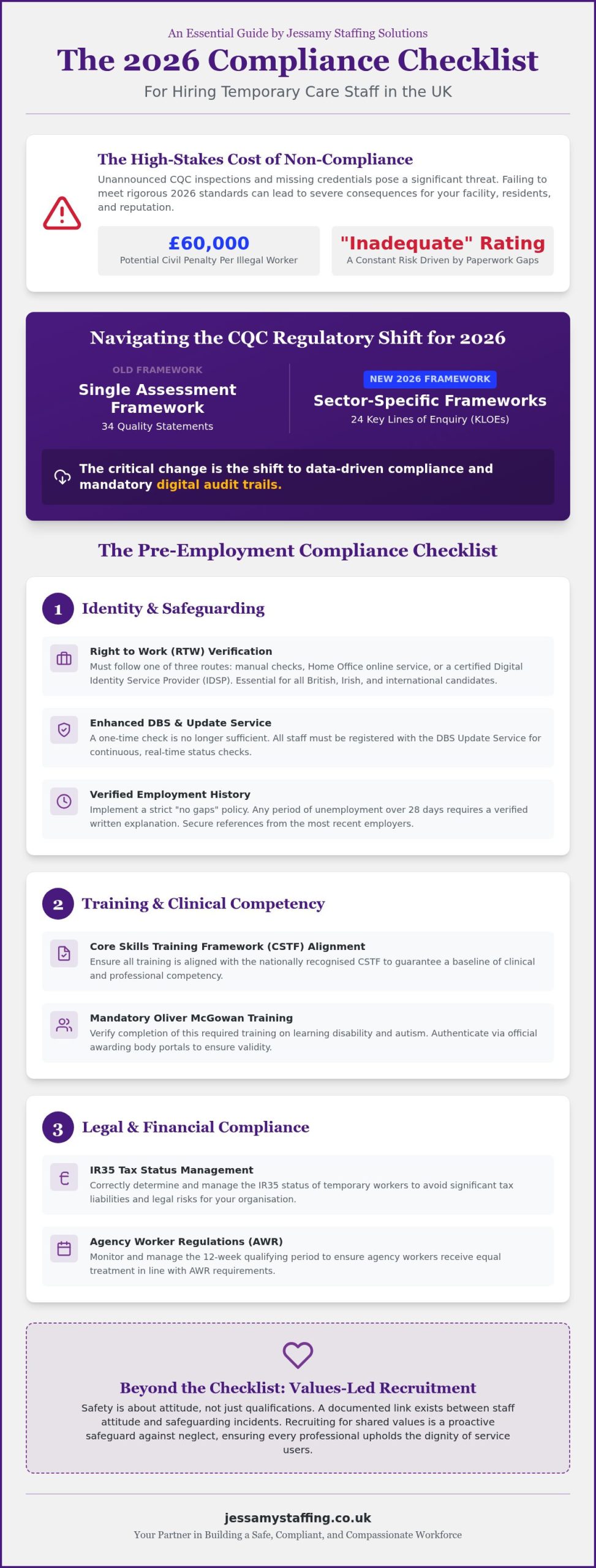
By late 2026, the Care Quality Commission (CQC) is expected to transition from the Single Assessment Framework to sector-specific frameworks. This evolution replaces the previous 34 Quality Statements with 24 Key Lines of Enquiry (KLOEs). Under this new regime, “good enough” paperwork is no longer a viable strategy. Missing signatures or gaps in employment history are frequently the primary drivers behind downgraded ratings, as they signal a lack of oversight. Registered Managers must remember that whilst they may outsource the supply of staff, they cannot outsource their legal liability. You remain personally accountable for the safety and suitability of every individual who enters your facility.
The Shift Toward Data-Driven Compliance
The CQC is increasingly prioritising digital evidence for workforce monitoring. They aim to publish reports for at least 9,000 assessments across all sectors by September 2026. This high volume of oversight means that real-time document accessibility is crucial during inspections. Inspectors will no longer wait for you to retrieve dusty paper files from a locked office. They expect to see secure, cloud-based compliance portals that offer an immediate, transparent view of staff credentials. Moving to a digital system ensures that your evidence is always current, organised, and ready for an unannounced visit. This digital transformation is also evident in other healthcare areas; for instance, you can visit Healthya to learn how digital solutions are supporting the UK pharmacy sector.
Why Values-Led Recruitment Matters for Safety
Safety is as much about attitude as it is about qualifications. Values-led recruitment goes beyond a standard DBS check to assess the underlying principles of the candidate. There’s a direct, documented link between staff attitude and safeguarding incident rates. When staff members share your organisation’s core values, they’re more likely to act with the integrity required to prevent harm. Values-led recruitment acts as a proactive safeguard against institutional neglect by ensuring that every professional possesses the intrinsic empathy required to uphold the dignity of service users. It’s about finding individuals who view care as a vocation, not just a shift.
The Pre-Employment Compliance Checklist: Identity and Safeguarding
Establishing a foundation of trust begins with absolute certainty regarding a worker’s identity and background. A robust compliance checklist hiring temporary care staff UK must prioritise these non-negotiable safeguarding measures before any personnel enters a care setting. In 2026, the complexity of these checks has increased, moving beyond simple document collection to sophisticated digital verification. Failing to meet these standards doesn’t just risk a CQC downgrade; it carries a civil penalty of up to £60,000 per worker for illegal employment.
Right to work verification remains a critical pillar of this process. For international candidates, you must ensure they meet the specific Health and Care Worker visa requirements, including valid sponsorship codes and restricted hours where applicable. As of October 2026, a new Code of Practice applies to all employment, requiring managers to use one of three permitted routes: manual document checks, the Home Office online service, or a certified Digital Identity Service Provider (IDSP). Simultaneously, an Enhanced DBS check is no longer a one-time event. The 2026 standard requires all temporary staff to be registered with the DBS Update Service, allowing for real-time status checks of their certificate for a £16 annual fee.
Employment history must be scrutinised with a “no gaps” rule. Any period of unemployment exceeding 28 days requires a written explanation and, where possible, evidence to support the claim. Verified references from the most recent employer and a previous healthcare role are essential to confirm clinical behaviour and professional conduct. If you find the manual verification of these details exhausting, partnering with a specialist in support worker supply can ensure these rigorous standards are met before a staff member is even proposed for a shift.
Safeguarding and the Barred List
Safeguarding checks must be proactive rather than reactive. Adult and Child Barred List checks should be performed every 12 months to ensure no new restrictions have been placed on a worker’s ability to practice. For professionals who have lived outside the UK for 12 months or more within the last 10 years, an Overseas Police Check is mandatory. This certificate of good conduct is a vital supplement to the UK DBS, providing a global view of the individual’s history. When reviewing references, be alert for inconsistencies in dates or vague descriptions of duties, as these often signal underlying performance or safeguarding concerns.
Digital Identity Verification in 2026
The industry has moved away from physical document copies in favour of digital attribute sharing under the Digital Identity and Attributes Trust Framework (DIATF). This shift helps prevent the use of sophisticated AI-generated document fraud, which has become increasingly common. Ensure your staffing partner uses accredited IDSPs to verify British and Irish passports. These tools use biometric technology to match a live person to their document, providing a level of security that manual checks simply cannot replicate. Always verify that digital certificates are shared through secure, encrypted portals rather than standard email to maintain GDPR compliance.
Verifying Training and Clinical Competency for Temporary Personnel
Clinical competency is the bridge between a worker’s presence and a resident’s safety. Whilst identity checks confirm who a person is, verifying their skills ensures they can perform their duties without risk. This verification is a core component of CQC Regulation 18, which mandates that providers deploy enough suitably qualified and competent staff. Your compliance checklist hiring temporary care staff UK must therefore go beyond reviewing a list of titles and delve into the substance of the training itself. To maintain a safe environment, follow these five essential verification steps:
- Step 1: Verify CSTF alignment. Ensure the worker’s statutory and mandatory training aligns with the Core Skills Training Framework (CSTF), which covers 11 core subjects. In 2024, NHS England reported that 89% of NHS organisations had declared alignment to this standard.
- Step 2: Authenticate certificates. Don’t accept PDFs at face value; utilise awarding body portals to authenticate digital certificates and prevent the use of fraudulent credentials.
- Step 3: Conduct practical assessments. Moving and handling or basic life support cannot be verified through theory alone. Ensure your agency has conducted or witnessed a physical competency assessment within the last 12 months.
- Step 4: Audit specialist training. For complex needs such as PEG feeding or tracheostomy care, verify that the training was delivered by a qualified clinical lead and includes a signed competency sign-off.
- Step 5: Document local induction. Every temporary worker requires a site-specific induction. This must be documented to prove they understand your facility’s fire exits, emergency protocols, and specific resident needs.
Mandatory vs. Accredited Training
The danger of unaccredited online certificates is a significant vulnerability during a CQC audit. Many low-cost providers offer “awareness” courses that lack the depth required for clinical safety. This is why Jessamy’s social care training sets a higher benchmark for temporary staff by focusing on accredited, role-appropriate learning. Since the Oliver McGowan Code of Practice came into force on September 6, 2025, you must also ensure every staff member has received the mandatory training on learning disability and autism. Minimum annual refresher requirements for 2026 now strictly enforce these standards to ensure knowledge remains current.
Specialist Competency for Children’s Complex Care
Specific compliance hurdles exist for pediatric home care staffing, where the margin for error is non-existent. You must verify pediatric-specific safeguarding and life support training that is distinct from adult care standards. It’s not enough for a worker to be technically proficient; they must demonstrate child-centric values and the emotional intelligence required to support families in their own homes. Verifying these specialist competencies ensures that the highest standards of clinical safety and human empathy are maintained for the most vulnerable service users.
Beyond the Worker: Vetting Your Staffing Agency’s Compliance Framework
A comprehensive compliance checklist hiring temporary care staff UK is only as strong as the agency’s internal governance. Whilst individual worker vetting is vital, the overarching framework of your staffing partner provides the ultimate safety net for your facility. An agency with weak internal controls can inadvertently expose you to financial, legal, and reputational risks. You must ensure that your partner operates with the same professional rigor and ethical standards that you demand of your own permanent team.
Managing the Agency Worker Regulations (AWR) is a primary concern for long-term temporary placements. After a 12-week qualifying period in the same role, temporary workers are entitled to the same basic employment and working conditions as if they’d been recruited directly. Your agency should provide transparent tracking of these timelines to ensure you remain compliant with parity pay and holiday entitlements. Similarly, IR35 and off-payroll working rules require absolute clarity. Ensure your agency provides a Status Determination Statement (SDS) where necessary and assumes full responsibility for the correct tax status of all placements to prevent backdated HMRC liabilities.
Beyond financial and tax compliance, protecting the physical infrastructure of your care facility is a vital part of risk management; you can explore Commercial Property Insurance with WS Insurance Brokers to ensure your assets are secure.
Protecting your organisation also requires verifying the agency’s insurance indemnity and data protection protocols. Confirm that they hold appropriate Public and Employers Liability limits, typically expected to be at least £10 million in the healthcare sector. Furthermore, their GDPR compliance must be impeccable. They handle sensitive medical and personal records that, if breached, could lead to severe penalties and a loss of trust. If you require a partner that prioritises these high-level governance standards, consider our staffing services for a reliable, compliant solution.
Financial and Ethical Compliance
Ethical recruitment is a cornerstone of modern care. You should check for modern slavery statements within the agency’s supply chain to ensure workers aren’t being exploited. Be particularly cautious of agencies that utilise non-compliant umbrella companies, which often use “loan schemes” or other tax-avoidance tactics that could leave you indirectly liable. A principled agency will offer complete transparency in pay rates and holiday pay accrual, ensuring that the professionals entering your home are treated with the respect and fairness they deserve.
Regional Standards in Greater Manchester
For providers in the North West, aligning with the Greater Manchester Integrated Care Board (ICB) workforce standards is essential. These local authority frameworks often have specific requirements for temporary staff that go beyond national minimums. Utilising local healthcare personnel supply ensures that the staff provided are familiar with regional safeguarding protocols and local authority reporting structures. This regional expertise doesn’t just improve compliance; it significantly enhances response times during emergency staffing shortages, ensuring your facility remains safely staffed at all times.
Implementing a Robust Compliance Audit Trail with Jessamy Staffing
Maintaining a compliance checklist hiring temporary care staff UK shouldn’t be a source of constant stress for care managers. At Jessamy Staffing, we’ve transformed this administrative burden into a seamless, automated audit trail. By integrating compliance checks into our core recruitment workflow, we ensure that every professional proposed for a shift has already cleared every regulatory hurdle. This isn’t just about meeting minimum standards; it’s about providing a level of transparency that instils total confidence during unannounced inspections.
Our clients benefit from real-time access to digital compliance passports. Instead of waiting for email attachments or physical folders, you can view a worker’s full profile, including their verified training certificates, DBS Update Service status, and right-to-work attributes, at the touch of a button. This digital-first approach eliminates the risk of human error and ensures your facility’s records are always up to date. It allows you to focus on clinical delivery whilst we act as the meticulous guardian of your staffing standards.
Selecting the right support worker recruitment agency is a strategic decision that impacts the safety and well-being of your residents. We prioritise clinical rigor over sheer volume, understanding that one poorly vetted individual can compromise years of hard work. By choosing a partner that invests in accredited social care training and values-led recruitment, you’re building a resilient workforce that can adapt to the most complex care requirements.
24/7 Rapid Response with 100% Compliance
Our 24/7 emergency cover is built on a “Last-Minute Shift” compliance protocol that never takes shortcuts. Even when you need a support worker within the hour, our system ensures that only fully compliant personnel are available for selection. We believe that emergency cover should never mean a compromise in vetting standards. The Jessamy guarantee means you receive professionals who aren’t just available, but are also safe, compassionate, and fully prepared to uphold your facility’s reputation, even in a crisis.
Your Next Steps to a Safer Workforce
Securing your facility’s future begins with an honest assessment of your current staffing files. We recommend conducting a thorough gap analysis to identify any missing documentation or expired training amongst your current temporary personnel. Once identified, set up a compliance review meeting with your providers to discuss their vetting frameworks. If you’re looking for a more robust solution, contact Jessamy Staffing today for a compliance-led staffing audit. We’ll help you build a workforce that is not only safe but also perfectly aligned with the clinical and ethical standards of your organisation.
Elevating Your Clinical Safety Standards
Adopting a rigorous compliance checklist hiring temporary care staff UK is no longer a secondary task; it’s a fundamental pillar of modern care management. By embracing digital identity verification and ensuring every professional meets the 2026 CQC requirements, you protect the dignity of your residents and the integrity of your organisation. Clinical safety relies on the intersection of technical competence and human empathy, which is only achievable through meticulous vetting and accredited training.
As an Accredited Social Care Training Provider specialising in Greater Manchester care staffing, Jessamy Staffing acts as your principled partner in excellence. We provide 24/7 emergency rapid response without ever compromising our values-led recruitment process. Our mission is to bridge the gap between institutional requirements and the human need for safe, compassionate care. It’s time to move beyond the anxiety of unannounced inspections and embrace the peace of mind that comes from a truly robust audit trail.
Secure your care facility with our compliance-led staffing solutions and ensure your team is always prepared for the future of social care. You’ve worked hard to build a high standard of service; let us help you protect it with unwavering reliability and professional rigor.
Frequently Asked Questions
What are the 2026 CQC requirements for temporary staff files?
The 2026 CQC requirements prioritise digital evidence and real-time accessibility. Under the new sector-specific frameworks, providers must demonstrate that temporary staff files contain verified right-to-work data, up-to-date training records, and clear evidence of local induction. This shift to 24 KLOEs means inspectors expect a more streamlined, data-driven approach to workforce monitoring. Maintaining a compliance checklist hiring temporary care staff UK is essential to avoid downgrades during these assessments.
How often should a DBS check be updated for agency care workers?
Agency care workers should ideally be registered with the DBS Update Service, which allows for real-time monitoring. Whilst the official requirement for an Enhanced DBS check remains every three years in some settings, best practice in 2026 dictates an annual status check for all temporary personnel. This provides a continuous safeguard against new criminal records, ensuring that the professionals entering your facility always meet the highest safety standards without the delay of a full re-application.
Is a digital copy of a Right to Work document sufficient for an audit?
A simple digital scan or photograph is insufficient for a CQC audit or Home Office inspection. To meet the legal standard, digital Right to Work checks must be conducted via a certified Digital Identity Service Provider (IDSP) for British and Irish citizens or the Home Office online checking service for others. Failing to follow these specific routes leaves your facility liable for significant civil penalties, as the burden of proof for document authenticity rests solely with the employer.
What is the difference between mandatory and accredited care training?
Mandatory training covers the essential legal requirements for any care role, such as fire safety and infection control. Accredited training, however, is validated by a recognised awarding body to ensure the content meets rigorous national standards. Whilst mandatory modules fulfil basic compliance, accredited courses provide the depth of knowledge required for clinical excellence. Choosing staff with accredited credentials ensures that their skills are transferable and verified against the latest industry benchmarks.
How do I verify the clinical competency of a temporary support worker?
Clinical competency is verified through a combination of accredited training certificates and signed practical assessments. You should request evidence of face-to-face training for high-risk tasks like moving and handling or medication administration. For complex care, ensure a clinical lead has signed off on the worker’s specific skills, such as PEG feeding or tracheostomy care. This two-tier approach ensures the worker possesses both the theoretical knowledge and the physical skill required for safe practice.
What are the risks of hiring temporary staff from a non-specialist agency?
Hiring from non-specialist agencies often results in a lack of clinical oversight regarding staff vetting. Generalist recruiters may not understand the nuances of the compliance checklist hiring temporary care staff UK, potentially overlooking specific pediatric requirements or mandatory training like the Oliver McGowan protocols. This oversight increases the risk of placing personnel who lack the specific competencies needed for complex care settings, which can directly lead to safeguarding incidents and regulatory non-compliance.
How does the Agency Workers Regulation (AWR) affect my care home budget?
The AWR mandates that after 12 weeks in the same role, a temporary worker is entitled to equal treatment regarding basic pay and working conditions. For care home budgets, this often results in an increase in hourly rates to match the pay scales of permanent employees. It is vital to track these 12-week qualifying periods meticulously to ensure your financial forecasts remain accurate and that you are meeting your legal obligations regarding parity pay and holiday entitlements.
Can I use temporary staff for children’s complex care in Greater Manchester?
Temporary staff can be utilised for children’s complex care, provided they possess pediatric-specific qualifications and enhanced safeguarding training. In Greater Manchester, it is particularly beneficial to use a specialist agency that aligns with the Integrated Care Board (ICB) workforce standards. This ensures that the staff provided are not only clinically competent in pediatric care but also familiar with local authority reporting structures and regional safeguarding protocols, maintaining safety for the most vulnerable service users.