



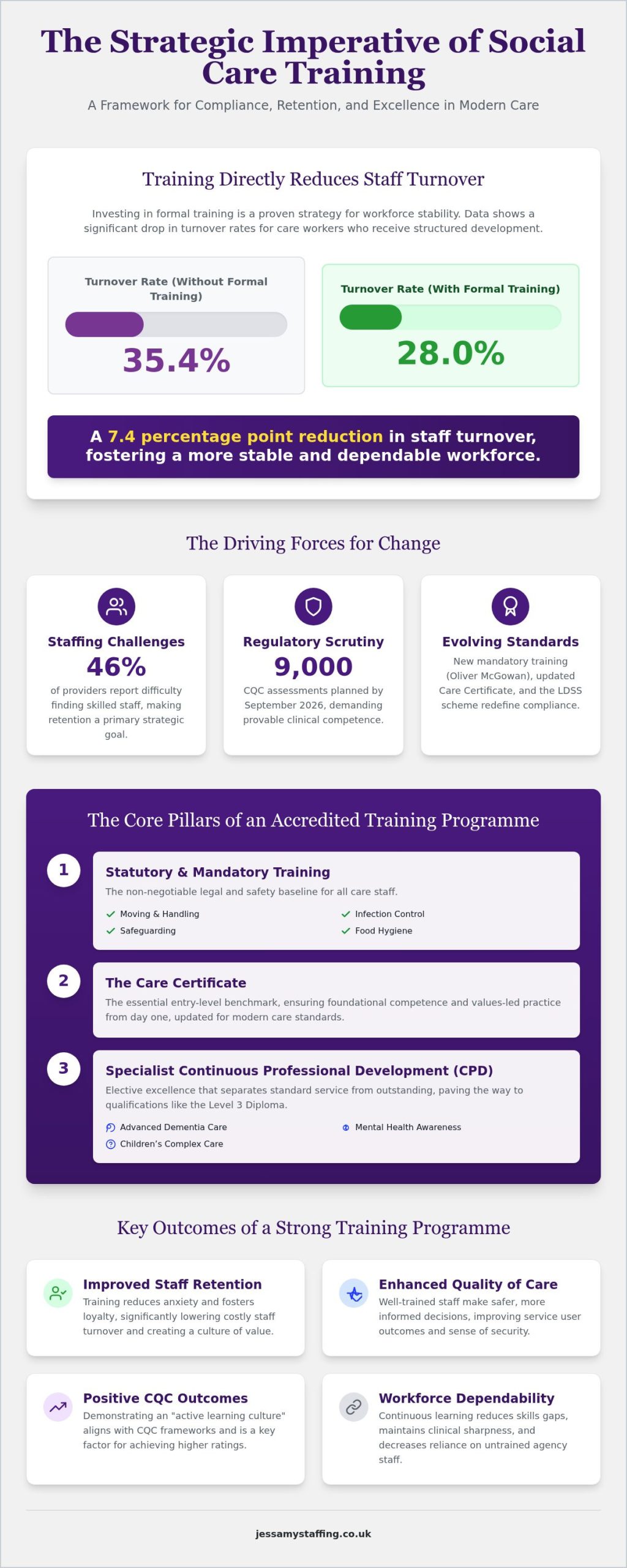
Did you know that care workers who receive formal training are significantly more likely to remain in their roles, with turnover rates dropping from 35.4% to 28.0%? In a sector where 46% of providers report difficulty finding skilled staff, robust social care training and development isn’t just a regulatory checkbox; it’s the foundation of a stable, high-quality service. As the Care Quality Commission (CQC) aims to complete 9,000 assessments by September 2026, the pressure to demonstrate clinical competence and compassionate care has never been higher.
You likely understand the exhaustion of balancing emergency shift cover whilst trying to keep your team’s certifications up to date. This guide provides a comprehensive framework for modernising your approach to workforce growth, ensuring your team remains compliant with the latest Learning and Development Support Scheme (LDSS) requirements and the updated Care Certificate standards. We’ll explore the transition to the new Level 3 Diploma, the mandatory Oliver McGowan training, and how to build a dependable workforce that consistently achieves excellence in every inspection.
Key Takeaways
- Learn why social care training and development has evolved into a strategic necessity for staff retention and long-term service stability in 2026.
- Identify the core pillars of accredited training that balance technical clinical competence with the essential human-centric values required for modern care.
- Discover how specialist development for children’s complex care at home can bridge the gap between rigorous clinical standards and emotional support.
- Understand the link between continuous learning and workforce dependability, reducing your reliance on untrained temporary staff.
- Explore how aligning your training programmes with the latest CQC frameworks can lead to improved ratings and a more resilient care environment.
Why Social Care Training and Development is Critical in 2026
Social care is no longer a sector where “on-the-job learning” suffices as a standalone strategy. In 2026, social care training and development must be viewed as a continuous professional development (CPD) journey that begins at induction and evolves with every clinical advancement. The UK care economy has shifted toward a model where technical expertise is inseparable from emotional intelligence. This evolution ensures that care providers don’t just meet standards but actively elevate them, creating a safer environment for everyone involved.
The Evolving Regulatory Environment
As of July 2026, the legislative framework has tightened considerably. The full implementation of the updated Care Certificate and the mandatory Oliver McGowan training has redefined the baseline for safe practice. Providers must now navigate the Learning and Development Support Scheme (LDSS), which has replaced older funding models like the Workforce Development Fund. Basic compliance is now viewed by the Care Quality Commission (CQC) as the bare minimum; inspectors look for evidence of “active learning cultures” where staff demonstrate real-world application of their skills. Professional rigor in 2026 care standards is the meticulous application of evidence-based clinical skills tempered by a profound respect for the individual’s dignity.
High-quality training correlates directly with positive CQC outcomes because it empowers staff to make safer, more informed decisions under pressure. Beyond the data, there’s a vital human-centric element. When a support worker is well-trained, the quality of life for the service user improves. This is particularly true in understanding the care workforce and its impact on vulnerable individuals; a confident carer provides a sense of security that an untrained worker simply cannot replicate. This sense of safety is the ultimate goal of any care intervention.
Staff Retention and the “Value of Investment”
A common misconception persists that investing in staff makes them more attractive to competitors. The reality in 2026 is quite the opposite. Data shows that care workers who receive comprehensive training have a turnover rate of 28.0%, compared to 35.4% for those who don’t. In regions like Greater Manchester, clear career progression pathways have become a primary tool for reducing churn. When employees feel professionally prepared, they experience less anxiety and a greater sense of purpose. Prioritising social care training and development creates a culture of loyalty, as staff feel valued and supported in their professional growth. This psychological safety is a powerful deterrent against the high staff turnover that often plagues the sector.
The Core Pillars of Accredited Social Care Training
Building a high-standard care environment requires more than just goodwill; it demands a structured, multi-layered approach to social care training and development. This professional architecture is composed of three distinct levels: statutory mandatory training, the foundational Care Certificate, and specialist continuous professional development (CPD). Whilst technical proficiency is vital for safety, a truly effective programme integrates “values-led” training. This ensures that every clinical action is underpinned by the empathy and respect that service users deserve. By treating training as an ongoing journey rather than a one-off event, organisations can cultivate “workforce intelligence,” using data-driven insights to identify skills gaps before they impact the quality of care.
Mandatory Training vs. Elective Excellence
Statutory requirements form the non-negotiable baseline for any care setting. Essential modules such as Moving and Handling, Safeguarding, Infection Control, and Food Hygiene ensure that the workforce operates within a safe legal framework. However, elective excellence is what separates a standard service from an outstanding one. Elective courses, such as advanced dementia care or mental health awareness, add significant competitive value to an organisation. Regular refresher training is the heartbeat of this system, maintaining dependable workforce capacity and ensuring that clinical skills remain sharp and ready for deployment in high-pressure environments. For those seeking to enhance their team’s capabilities, exploring accredited social care training provides a clear benchmark for international best practices.
The Role of the Care Certificate
The Care Certificate serves as the essential entry-level benchmark for those new to the sector. Following the March 2025 update, the certificate now encompasses 16 standards, including a vital focus on learning disability and autism awareness. Implementing these standards amongst a diverse, multi-generational workforce requires a nuanced approach. It involves respecting the life experience of seasoned staff whilst insisting on the modern, evidence-based practices required in 2026. This level of rigour is a hallmark of a high-quality support worker recruitment agency, where the transition from trainee to competent professional is managed with meticulous care. When training is delivered with this level of precision, it creates a workforce that is not only compliant but deeply dependable. If you are looking to strengthen your team’s foundation, you may find our Socialcare Training & Development programmes provide the professional rigour your organisation requires.
Specialist Development for Complex Care Environments
Complex care environments represent the most demanding tier of the sector, where the margin for error is virtually non-existent. In these settings, social care training and development must transcend basic compliance to reach a level of clinical excellence usually reserved for hospital wards. There’s a common industry concern that complex care is too risky for agency staff to manage effectively. However, this risk is mitigated through a culture of extreme training rigour. When a support worker is equipped with the exact technical skills and emotional resilience required for a specific case, they become a seamless extension of the existing care team rather than a liability.
Bespoke training is the cornerstone of this approach. It isn’t sufficient to have a general understanding of complex needs; support workers must receive instruction tailored specifically to the individual service user. This involves understanding the person’s unique communication methods, their daily routines, and the specific nuances of their clinical equipment. By focusing on the overlap where clinical skills meet emotional intelligence, we ensure that the care provided is as compassionate as it is competent. This level of precision is what allows for the safe delivery of care in even the most sensitive environments.
Training for Pediatric Complex Care
Providing children’s complex care at home involves a unique set of challenges that go beyond medical tasks. Whilst staff must be proficient in tracheostomy care, PEG feeding, and ventilation management, they must also respect the sanctity of the family home. The objective is to strengthen the domestic environment, allowing the child to thrive amongst their loved ones without the clinical presence feeling intrusive. Staff are trained to be “invisible experts” who maintain high safety standards whilst supporting the family’s natural rhythm and privacy.
Clinical Governance and Oversight
Specialist training cannot exist in a vacuum; it requires the anchor of rigorous clinical governance. This oversight is typically led by Registered Nurses who supervise the ongoing competency assessments of support workers. This hierarchical approach ensures that every member of the team is held to a high professional standard. Continuous monitoring and regular audits of training for complex care workers ensure that skills don’t just meet the current requirement but evolve as the service user’s needs change. This level of oversight provides the reassurance that institutional clients and families need to feel confident in their care partners.
Building a Dependable Workforce Through Continuous Learning
A dependable care workforce is not created by chance; it is the deliberate outcome of a robust social care training and development strategy. When training is integrated into the very fabric of recruitment, it ensures that every person stepping into a care setting is already familiar with the high standards expected of them. This is particularly vital when dealing with last-minute shift cover. An untrained temporary worker can inadvertently introduce risk, but a professionally prepared support worker acts as a stabilising force. By ensuring that emergency-ready personnel have already undergone rigorous competency checks, providers can maintain continuity of care even during unexpected staff shortages.
The transition from “temporary staff” to “dependable capacity” depends entirely on the depth of the initial preparation. When workers feel professionally prepared for the specific environment they are entering, their performance remains consistent, and their anxiety levels decrease. This sense of readiness is the bridge between mere compliance and true clinical competence. By prioritising continuous learning, organisations can build a resilient team that remains calm and effective, even when faced with the most challenging emergency shifts.
Integrating Training with Staffing Solutions
Traditional recruitment models often separate the hiring process from professional development. In 2026, the most effective staffing agencies operate as training providers, ensuring that their personnel are not just available, but capable. This dual role allows for a “professionally prepared” pool of staff who can be deployed at a moment’s notice. Having access to 24/7 emergency care staffing UK is only a solution if those staff arrive with the technical proficiency to handle the specific needs of the environment. When the agency and the training provider are one and the same, the quality of care remains consistent regardless of the time of day or the urgency of the request.
The Impact of Workforce Intelligence
Workforce intelligence is the sophisticated application of staff skills to specific service needs. It moves beyond simply counting heads to understanding the depth of expertise within a team. For providers in Manchester, this means conducting regular audits of staff skills to ensure that every local requirement, from specialist dementia support to complex paediatric care, is covered. This level of oversight allows for a more agile response to changing demands. Data-driven training prevents understaffing crises by identifying future skills gaps months before they manifest as operational failures. This proactive approach ensures that the right person is always in the right place, equipped with the right knowledge.
If you require a team that is both clinically competent and immediately available, our Support Worker Supply services provide the dependable workforce capacity your organisation needs to thrive.
Partnering with Jessamy for Professional Care Development
Jessamy Staffing Solutions operates at the intersection of regulatory precision and human-centric warmth. Our social care training and development programmes are designed to do more than satisfy a CQC inspector; they are built to instil confidence in your workforce and comfort in your service users. We act as a meticulous guardian of standards, ensuring that every professional we supply or train is equipped to meet the technical and emotional demands of modern care. By choosing a partner with a deep-rooted focus on Greater Manchester, you gain access to local expertise and a 24/7 support network that understands the specific challenges of the region’s care landscape.
The Jessamy Training Model
Our approach is defined by a blend of accredited curriculum and practical, values-led intelligence. We don’t believe in generic, one-size-fits-all modules. Instead, we prepare staff for the realities of sensitive and complex environments. Key benefits of our training model include:
- Accredited programmes tailored to children’s complex care at home.
- Continuous competency assessments overseen by Registered Nurses to ensure clinical safety.
- A focus on emotional intelligence and dignity-based care alongside technical skills.
For partners in Greater Manchester, our 24/7 emergency readiness means that even in a crisis, you are supported by professionals who have been trained to our exacting standards. This methodical approach to social care training and development ensures that your service remains stable, safe, and professionally prepared for any eventuality.
Next Steps for Care Managers
The first step toward elevating your care standards is a thorough audit of your current workforce capabilities. Identifying skills gaps early allows for a proactive approach to development rather than a reactive response to an inspection or a staffing incident. We encourage care managers to arrange a consultation to align their training requirements with their broader health and social care staff supply UK strategy. This integrated approach ensures that your staffing and training goals work in harmony to produce the best possible outcomes for your service users.
Our commitment to excellence and integrity is unwavering. We believe that by investing in the professional growth of care workers, we are ultimately investing in the dignity and well-being of the vulnerable individuals they serve. Partnering with Jessamy means choosing a stable, long-term ally dedicated to the success of your organisation and the safety of your community. To begin your journey toward a more dependable workforce, contact our team today to discuss our bespoke Socialcare Training & Development solutions.
Securing the Future of Excellence in Social Care
Professional growth is the cornerstone of a resilient and compassionate care sector. As we have explored, high-quality social care training and development is far more than a compliance obligation; it’s a strategic investment in staff retention and service user safety. By establishing robust pillars of learning and embracing specialist complex care expertise, providers can navigate the 2026 regulatory landscape with absolute confidence. A workforce that’s both clinically competent and emotionally intelligent doesn’t just meet standards; it consistently exceeds them.
Building this dependability requires a partner who understands the intersection of technical rigor and human warmth. Whether you’re addressing skills gaps or preparing for a CQC inspection, having access to 24/7 emergency staffing readiness and accredited training programmes ensures your organisation remains stable and secure. Discover our accredited social care training and staffing solutions to see how we can support your commitment to integrity and high standards. Let’s work together to create a future where excellence in care is the universal standard for every individual.
Frequently Asked Questions
What are the mandatory social care training requirements in the UK for 2026?
Mandatory training for 2026 includes the Oliver McGowan Mandatory Training on Learning Disability and Autism, which is a legal requirement under the Health and Care Act 2022. Providers must also ensure staff are competent in statutory areas such as safeguarding, moving and handling, and infection control. The updated Care Certificate, which now features 16 standards, remains the essential induction benchmark for all new entrants to the sector.
How often should social care staff undergo refresher training?
Refresher training intervals depend on the specific discipline, but many statutory subjects require annual updates to maintain clinical safety. Moving and handling and basic life support typically demand yearly practical assessments to ensure skills remain current. Other areas, such as safeguarding or food hygiene, are often refreshed every three years. Regular updates are vital for maintaining a dependable workforce that remains compliant with the latest CQC expectations.
Is eLearning enough for CQC compliance in social care?
eLearning alone is rarely sufficient for full CQC compliance, particularly for roles involving physical interventions or complex clinical tasks. Whilst digital modules are excellent for theoretical knowledge, practical skills like manual handling require face-to-face competency assessments. The CQC prioritises “active learning cultures” where staff can demonstrate real-world application. A blended approach to social care training and development is the most reliable way to ensure both safety and compliance.
What is the difference between the Care Certificate and a Level 2 Diploma?
The Care Certificate is an induction standard designed for new staff, whereas a Level 2 Diploma is a formal, nationally recognised qualification. The certificate covers 16 fundamental standards of care and is typically completed within the first 12 weeks of employment. In contrast, the Level 2 Diploma involves a more in-depth study of care principles and serves as a significant milestone in a professional’s career progression within the sector.
Can agency staff be as well-trained as permanent care employees?
Agency staff can be exceptionally well-trained if they are sourced from a provider that integrates professional development into their recruitment model. At Jessamy, we ensure our personnel undergo the same rigorous accredited training as permanent employees, including specialist modules for complex environments. This approach transforms temporary staff into a dependable extension of your team, providing emergency-ready support workers who are fully prepared to deliver high-standard care immediately.
How does social care training impact staff retention rates?
Comprehensive training significantly improves retention by fostering professional confidence and a sense of value amongst the workforce. Data from 2024 indicates that the turnover rate for trained care workers is 28.0%, compared to 35.4% for those who haven’t received formal development. When staff feel professionally prepared for their roles, they experience less work-related anxiety and a stronger sense of purpose. Investing in social care training and development is a proven strategy for reducing churn.
What specialist training is required for children’s complex care at home?
Children’s complex care at home requires specialist clinical training in procedures such as tracheostomy management, PEG feeding, and mechanical ventilation. Because these roles occur within a family home, training also emphasises emotional intelligence and the ability to maintain a child’s dignity whilst providing intensive clinical support. All such training must be backed by rigorous clinical governance and overseen by Registered Nurses to ensure the highest standards of safety are met.
Where can I find accredited social care training in Greater Manchester?
Accredited training that meets 2026 standards is available through specialist providers like Jessamy Staffing Solutions, with a dedicated focus on the Greater Manchester region. We offer programmes that are fully aligned with the latest CQC frameworks and the Learning and Development Support Scheme (LDSS). Our local expertise ensures that training is relevant to the specific needs of Manchester’s care landscape, providing a stable foundation for both individual carers and institutional clients.