



A clean care home is far more than a visual standard; it’s a clinical necessity that directly impacts resident safety and your regulatory standing. When domestic teams lack the specialised training required for healthcare environments, the risk of infection control failures increases, often leading to stressful CQC inspections and compromised resident dignity. Securing skilled domestic staff for care is not simply a recruitment task; it’s a strategic investment in the safety and warmth of your facility.
We understand that managing high staff turnover whilst trying to maintain meticulous hygiene standards is a constant challenge for care providers. You deserve a domestic team that feels like a natural extension of your wider care staff, showing genuine empathy for residents and taking pride in their essential role. This guide outlines how to identify and integrate high-calibre professionals who enhance operational safety and reduce management pressure. We’ll examine the intersection of compliance, technical skill, and compassionate service to help you create a truly welcoming environment for everyone in your care.
Key Takeaways
- Understand why domestic roles in care settings require a transition from general housekeeping to specialised clinical support to protect resident safety.
- Learn how to identify skilled domestic staff for care by verifying essential healthcare-specific certifications and rigorous COSHH compliance.
- Establish a robust reference framework for auditing staffing agencies, focusing on thorough DBS checks and right-to-work verification.
- Discover strategies for implementing reliable domestic support in Greater Manchester to overcome regional staffing shortages and ensure rapid coverage.
- Explore how the integration of accredited training and recruitment services fosters a domestic team that balances technical excellence with genuine empathy.
The Vital Role of Skilled Domestic Staff for Care Environments
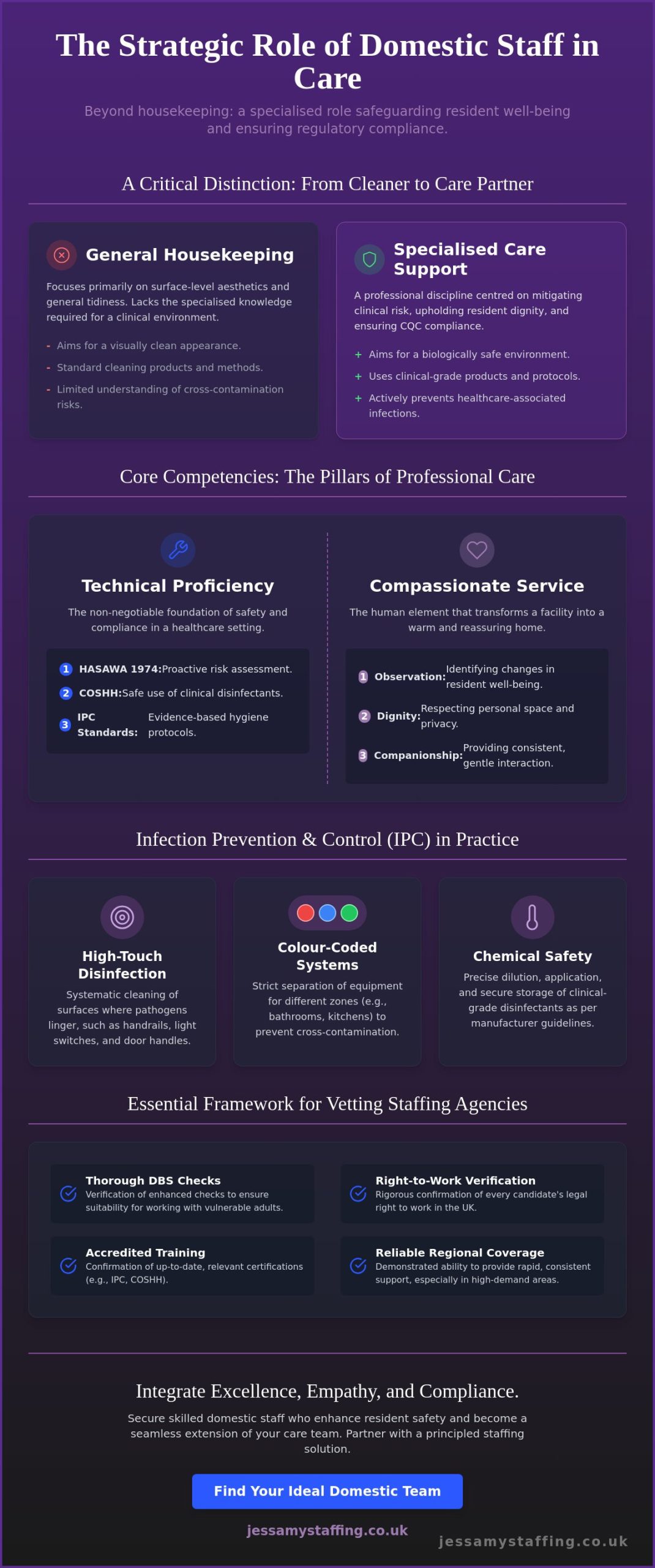
Skilled domestic staff for care are not merely cleaners; they are specialised professionals trained to operate within the strict clinical and social parameters of a healthcare setting. While general housekeeping focuses on aesthetics, domestic support in a care environment prioritises the mitigation of clinical risk and the preservation of resident dignity. This distinction is critical for providers. A facility’s cleanliness is often the first metric by which families judge the quality of care, and it remains a primary focal point during CQC inspections. Beyond meeting regulatory standards, a well-maintained environment creates a “therapeutic space” that fosters a sense of safety and belonging for vulnerable individuals.
Beyond Cleaning: The Domestic Worker as a Care Partner
Domestic staff often have more frequent, low-pressure interactions with residents than clinical teams. This unique position allows them to act as vital care partners who support emotional wellbeing through steady companionship. In dementia settings, “soft skills” such as patience and active listening are as essential as technical competence. A domestic worker might be the first to notice a resident’s sudden change in mood or a physical decline. Because they operate in the background of various home care services and residential settings, they are perfectly placed to identify potential safeguarding concerns that others might miss. Their presence should be reassuring, providing a consistent human connection that respects the resident’s private space as their home, not just a ward.
Infection Prevention and Control (IPC) Standards
Maintaining hygiene in a post-pandemic landscape requires a rigorous adherence to evidence-based protocols. Skilled domestic staff for care understand that “clean” is a biological standard, not just a visual one. They are trained in the following essential practices:
- High-touch disinfection: Meticulous cleaning of handrails, light switches, and door handles where pathogens frequently linger.
- Colour-coded systems: Strict use of specific equipment for different areas, such as bathrooms and kitchens, to prevent cross-contamination.
- Chemical safety: Correct dilution and application of clinical-grade disinfectants according to manufacturer guidelines.
By strictly following these procedures, domestic teams serve as a primary defence against healthcare-associated infections (HCAIs). This technical precision ensures the environment remains safe for residents with compromised immune systems, directly contributing to lower hospital readmission rates and better overall health outcomes within the facility. When domestic staff are integrated into the wider care strategy, they become a cornerstone of operational safety and resident health. Understanding the full strategic value of domestic staff for healthcare facilities is essential for providers seeking to treat cleanliness as a clinical discipline rather than a background task.
Core Competencies and Training for Domestic Personnel
Operational excellence in a care setting is built on a foundation of rigorous, role-specific training. For skilled domestic staff for care, technical proficiency must be paired with an acute awareness of the legal frameworks that govern residential environments. The Health and Safety at Work Act (HASAWA) 1974 remains the cornerstone of these requirements, mandating that all staff take reasonable care for the health and safety of themselves and others. In a care home, this translates to a proactive approach to risk assessment, ensuring that every cleaning task is performed without creating hazards for frail or confused residents.
Control of Substances Hazardous to Health (COSHH) regulations carry heightened significance within this sector. It isn’t merely about knowing which chemicals to use; it’s about the secure storage and precise application of clinical-grade disinfectants in a home where residents may have cognitive impairments. A professional domestic worker understands the catastrophic risks of leaving a cleaning trolley unattended or failing to follow dilution ratios. To maintain these high standards, we recommend that providers prioritise accredited social care training and explore digital health and safety management tools such as be-safetech.com to ensure their workforce is both dependable and fully compliant with the latest 2026 safety benchmarks.
Professional certifications serve as a badge of reliability for your facility. In 2026, essential credentials for domestic personnel include Level 2 or 3 Certificates in Cleaning and Support Services, alongside specialised modules in Infection Prevention and Control (IPC). These training requirements for homecare workers and residential staff ensure that every team member can navigate the complexities of a modern care environment with confidence and precision.
Technical Skills and Safety Protocols
Modern care environments utilise sophisticated industrial cleaning equipment that requires specific operational knowledge to prevent accidents. Domestic staff must be proficient in the safe handling of clinical waste and the management of laundry in infectious environments, following strict segregation protocols. They also play a vital role in fire safety. Because they move throughout the entire building, they’re often the first to spot a blocked fire exit or a faulty electrical appliance. Their training must include a clear understanding of evacuation procedures, ensuring they can assist clinical staff effectively during an emergency.
Communication and Behavioural Standards
A domestic worker’s technical skill is only half the requirement; their ability to communicate with residents is equally vital. Training in professional boundaries and resident confidentiality under GDPR is non-negotiable. When working amongst residents with challenging behaviours or complex needs, staff must use strategies like de-escalation and active listening to maintain a calm atmosphere. They must also understand the clear reporting lines that integrate them into the wider care team. If a domestic worker notices a resident is unusually withdrawn, they need the confidence to report this observation to the nursing staff immediately. If you’re looking to strengthen your team with professionals who value this intersection of skill and empathy, you can find support through specialised staffing solutions tailored to your facility’s needs.
Evaluating a Domestic Staffing Agency: A Reference Framework
Selecting a recruitment partner is a decision that carries significant weight for the safety and reputation of your facility. A high-quality agency acts as a meticulous guardian of standards, ensuring that skilled domestic staff for care are not only technically proficient but also ethically aligned with your organisation’s values. At Jessamy, we’ve established the “Jessamy Standard,” a rigorous vetting framework that moves beyond simple background checks to assess a candidate’s genuine empathy and professional integrity. This approach ensures that every individual placed within a care environment is prepared for the unique emotional and clinical demands of the role.
Efficiency in recruitment shouldn’t come at the cost of thoroughness. Care managers must verify that an agency conducts Enhanced DBS checks, which currently carry a government fee of £49.50, and prioritises candidates registered with the DBS Update Service (£16 per year) for real-time monitoring. Furthermore, with legislative changes under the Finance Bill 2025-26, it’s vital to partner with agencies that demonstrate full tax compliance. From April 2026, end clients can be held jointly liable for unpaid payroll taxes if their staffing providers use non-compliant umbrella companies. A values-led agency provides this transparency, offering peace of mind that your workforce is both legally and ethically sound. For a broader view of how integrated staffing and training for care homes can address these compliance pressures, our strategic roundup for 2026 outlines the key workforce solutions available to providers.
Compliance and Rigorous Recruitment
Hygiene continuity is a non-negotiable requirement in healthcare. If a domestic worker is absent, the risk of infection spread doesn’t wait for the next shift. This is why 24/7 emergency care staffing must include domestic support as a core component. When evaluating a potential partner, use this checklist to ensure they meet the necessary benchmarks:
- Does the agency provide 24/7 emergency cover for domestic roles to prevent hygiene lapses?
- Can they evidence a robust right-to-work and reference history for every candidate?
- How do they align their training with the Skills for Care workforce development frameworks?
- What specific protocols do they have for vetting the clinical awareness of their domestic personnel?
Value-for-Money vs. Low-Cost Providers
The allure of low-cost staffing often masks significant hidden expenses. Poor-quality domestic support frequently leads to “re-cleaning” costs, where clinical staff must step away from resident care to fix hygiene errors. Even more critically, an infection outbreak caused by substandard cleaning can lead to costly facility lockdowns and regulatory fines. Investing in skilled domestic staff for care provides a clear return on investment by reducing the need for constant management supervision. Trained professionals strengthen the care environment, integrating seamlessly with nursing teams to maintain a calm, safe, and welcoming home for residents. By choosing quality over a bargain—whether in staffing or when sourcing essential supplies from TopShop—you protect both your operational budget and the wellbeing of those you serve.
Implementing Skilled Domestic Support in Greater Manchester
The Greater Manchester care economy operates within a complex framework of regional devolution and integrated health initiatives. Providers in this area face specific workforce pressures, often competing with other sectors for reliable personnel whilst striving to meet the high standards set by local authorities. In this environment, the provision of skilled domestic staff for care must be handled with local precision. Whether your facility is situated in the heart of the city or in the surrounding boroughs of Salford, Stockport, or Bolton, understanding the regional landscape is essential for maintaining hygiene continuity. A local approach ensures that domestic teams are not only technically prepared but also culturally aligned with the North West’s community-focused care values.
Local Workforce Intelligence
Leveraging a Manchester-based staffing partner offers significant benefits in terms of rapid response and geographic reliability. Local agencies possess a deeper understanding of the regional transport infrastructure and the specific challenges faced by facilities in different Greater Manchester boroughs. This intelligence is particularly valuable for emergency out-of-hours cover, where a quick deployment can prevent a minor hygiene lapse from becoming a clinical risk. For example, facilities participating in the WorkWell program in Greater Manchester, which runs until March 2026, benefit from domestic staff who understand the broader regional mission of supporting residents with health issues. This shared local purpose helps improve hygiene ratings and ensures that every cleaning task supports the facility’s overall reputation for excellence.
Operational Integration Strategies
Integrating agency domestic staff into an existing Manchester-based team requires a methodical onboarding strategy. Whilst these professionals arrive with accredited training, they must be quickly oriented to site-specific protocols, such as the location of clinical waste stores and the nuances of your facility’s layout. We recommend a structured orientation that introduces staff to your permanent nursing team, fostering a culture of mutual respect and clear communication. This ensures that every worker, regardless of their contract type, feels part of the “Jessamy Way” of principled, values-led care. If you are looking to strengthen your facility’s environment with local experts, you can request domestic staffing support that aligns perfectly with your operational needs.
The Jessamy Approach: Principled Domestic Staffing Solutions
The Jessamy Approach is defined by a deliberate balance between professional rigor and human-centric warmth. We believe that skilled domestic staff for care are fundamental to the safety and dignity of any healthcare facility. Our philosophy rejects the notion of domestic work as a peripheral service; instead, we position it as a clinical necessity. By acting as a bridge between institutional requirements and the personal needs of residents, we ensure that our personnel are not just workers, but meticulous guardians of your facility’s standards. This commitment to excellence is what transforms a standard cleaning service into a stable, long-term partnership built on integrity and mutual trust.
Every individual we place is developed into a Principled Expert. This means they possess the technical precision required for infection control whilst maintaining the approachable, empathetic demeanor necessary for a care home. We don’t believe in the high-volume, generalist approach that often leads to high turnover and inconsistent standards. By focusing on a high register of professional conduct and a deep sense of duty, we supply domestic personnel who integrate seamlessly into your existing team, reducing the burden on your management and enhancing the lived experience of your residents. For a comprehensive overview of how the strategic deployment of domestic staff for healthcare facilities is reshaping compliance and safety standards in 2026, our dedicated resource outlines the key considerations for UK providers.
Why We Prioritise Domestic Excellence
Our commitment to safe, values-led recruitment ensures that every candidate is professionally prepared before they step onto your site. We integrate accredited training directly into our recruitment process, moving beyond basic compliance to foster genuine emotional intelligence. This unique approach ensures our domestic teams can navigate the complexities of dementia care or complex health needs with empathy and skill. This dedication to quality is mirrored across all our services, including our supported living staffing solutions, where the same standards of professional rigor apply. We don’t just fill shifts; we supply experts who understand that their role is vital to the facility’s overall health and safeguarding success.
Securing Your Workforce Capacity
Securing reliable capacity shouldn’t be a source of management stress or operational risk. We’ve designed our systems to provide seamless access to our pool of specialised talent, ensuring you’re never left without essential cover. For Manchester care providers, our 24/7 booking system offers a rapid response to staffing gaps, ensuring that hygiene standards never falter during an emergency or unexpected absence. Whether you require long-term stability or immediate skilled domestic staff for care, getting started with Jessamy is a straightforward process focused on your specific operational needs. We invite you to partner with a team that values the intersection of efficiency and empathy. Together, we can maintain a clean, safe, and welcoming environment that truly respects the dignity of every resident in your care.
Elevating Facility Standards through Strategic Partnerships
Maintaining a safe and dignified environment requires more than just routine cleaning; it demands a team that understands the clinical and emotional weight of their role. We’ve explored how accredited training and rigorous compliance frameworks transform domestic personnel into vital care partners. By prioritising technical precision alongside genuine empathy, you protect your residents and your regulatory standing simultaneously. This strategic approach ensures your facility remains a sanctuary of health and respect.
Securing skilled domestic staff for care is the final piece in the puzzle of operational stability. As an Accredited Social Care Training provider and 24/7 Emergency Cover specialists, we utilise a values-led recruitment methodology to provide personnel who are meticulously prepared for the challenges of modern care. You deserve a partner that values the intersection of efficiency and humanity as much as you do.
Secure your skilled domestic staff today with Jessamy Staffing and take the next step toward a cleaner, safer, and more compassionate environment. We look forward to supporting your commitment to excellence.
Frequently Asked Questions
What is the difference between a general cleaner and skilled domestic staff for care?
Skilled domestic staff for care differ from general cleaners through their specialised training in clinical hygiene and infection control. Whilst a general cleaner focuses on visual aesthetics, a skilled worker prioritises the mitigation of biological risks and the preservation of resident dignity. They operate as a clinical asset, understanding the nuances of healthcare environments and the specific needs of vulnerable individuals who reside within them.
Do domestic workers in care homes require a DBS check?
All domestic workers in care homes must undergo an Enhanced DBS check because their roles involve regular contact with vulnerable adults. This is a non-negotiable regulatory requirement in the United Kingdom. We ensure our personnel are vetted to the highest standards, with many registered on the DBS Update Service to allow for real-time compliance monitoring. This rigorous screening process provides essential reassurance to both facility managers and families.
How does domestic staff training impact CQC ratings?
Comprehensive training for domestic staff directly influences CQC ratings, particularly under the “Safe” and “Well-led” key lines of enquiry. When staff can demonstrate a deep understanding of infection prevention and control (IPC) and COSHH regulations, it provides evidence of a robust safety culture. Meticulous hygiene standards and well-documented training records are fundamental to achieving an “Outstanding” rating during inspections and maintaining high quality standards.
Can you provide emergency domestic cover in Greater Manchester at short notice?
We provide 24/7 emergency domestic cover across Greater Manchester, ensuring that hygiene standards never falter during unexpected absences. Our local presence allows for rapid response times in boroughs such as Salford, Stockport, and Bolton. This service is designed to maintain operational continuity, preventing staffing gaps from compromising clinical safety or the daily comfort of your residents during peak periods or sudden sickness.
What specific COSHH training do your domestic staff receive?
Our personnel receive specialised COSHH training focused on the safe storage, dilution, and application of clinical-grade disinfectants. This includes a thorough understanding of Material Safety Data Sheets (MSDS) and the specific risks associated with using hazardous substances in residential settings. We prioritise technical precision to ensure that every cleaning task is performed safely, protecting both the staff member and the residents who may have complex health needs.
How do domestic staff support residents with dementia or complex needs?
Domestic staff support residents with dementia by employing “soft skills” such as active listening and gentle communication. They are trained to respect the resident’s room as a private home rather than a clinical ward. By maintaining a calm and predictable presence, they help reduce anxiety and foster a sense of security, acting as an empathetic extension of the wider care team whilst performing their essential duties.
Is it better to hire permanent domestic staff or use an agency?
The choice depends on your facility’s specific needs for flexibility and consistency. While permanent staff offer long-term stability, using a specialised agency provides immediate access to skilled domestic staff for care who are already vetted and trained. This reduces the administrative burden of recruitment and training whilst ensuring you have reliable 24/7 cover to manage peak demands or emergency absences without compromising your facility’s hygiene standards.
What are the typical duties of a domestic worker in a supported living setting?
In a supported living setting, a domestic worker’s duties include deep cleaning, laundry management, and supporting residents with basic meal preparation. They play a crucial role in maintaining a safe, welcoming environment that promotes independence. Additionally, they act as an extra pair of eyes, reporting any changes in a resident’s behaviour or potential safeguarding concerns to the supervisor immediately to ensure holistic care delivery.