



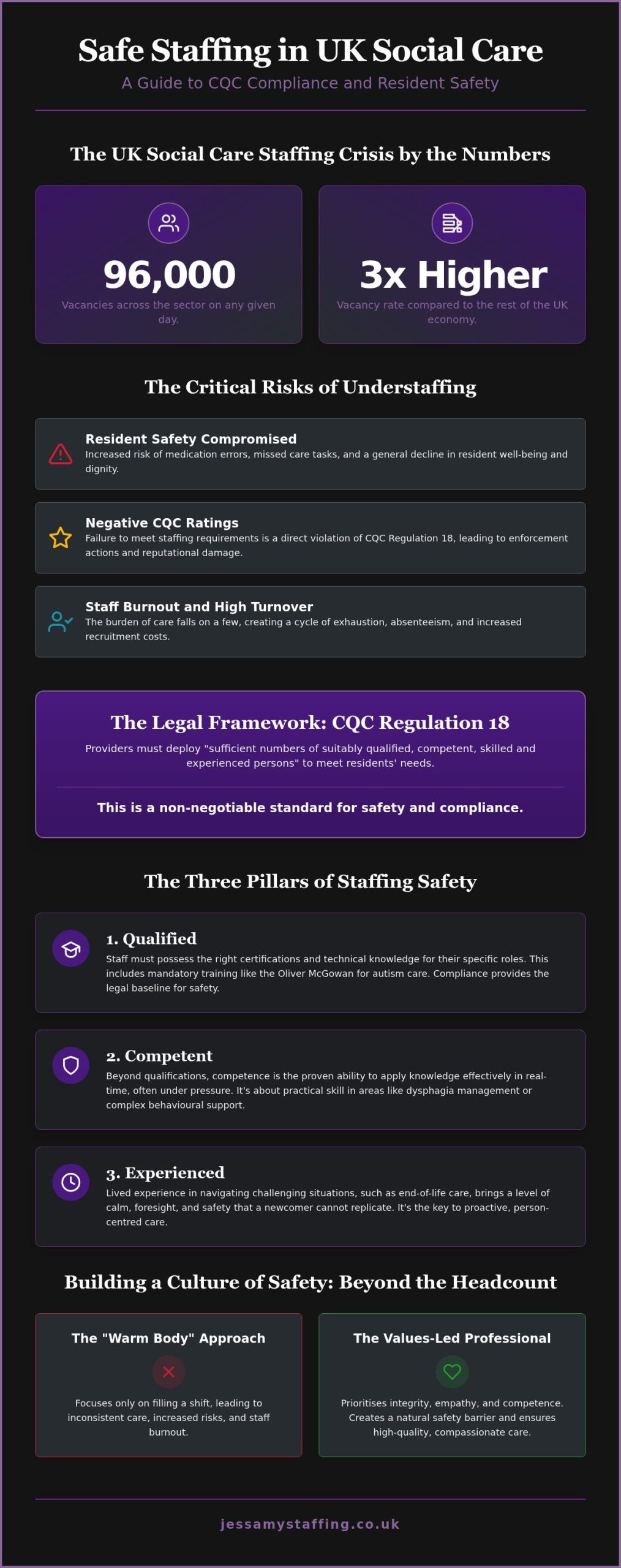
With roughly 96,000 vacancies across the sector on any given day, the adult social care vacancy rate is now three times higher than the rest of the UK economy. For providers, this isn’t just a statistic; it’s a daily battle against the risks of understaffing in care homes UK that threatens both resident safety and CQC ratings. You’re likely all too familiar with the weight of a last-minute shift cancellation or the anxiety of wondering if temporary staff truly share your home’s core values.
We recognise that maintaining high standards whilst balancing a tight budget and shifting regulations feels like an uphill struggle. This 2026 guide provides a clear framework for calculating safe staffing levels, ensuring you remain compliant with the latest CQC assessment frameworks and the Health and Social Care Act. We’ll explore how to move beyond simple numbers to focus on workforce competency, helping you mitigate operational risks and secure a reliable partnership for emergency cover.
Key Takeaways
- Understand how to align your workforce with CQC Regulation 18 by balancing raw numbers with specific skills and values-led behaviour.
- Identify the critical risks of understaffing in care homes UK and implement a competency-based model to protect your residents and your rating.
- Master a practical framework for calculating staffing hours based on resident dependency levels, ensuring you always maintain a safe operational buffer.
- Leverage accredited social care training to build a culture of safety, especially when managing children’s complex care at home or high-needs environments.
- Learn how a partnership with a principled staffing expert can provide reliable 24/7 emergency cover and professionally prepared personnel.
Understanding Safe Staffing in Social Care: Beyond the Regulatory Minimum
Safe staffing is rarely about a static ratio or a fixed headcount. Instead, it’s a dynamic equilibrium where the volume of personnel meets the specific clinical needs and emotional requirements of residents. In the context of Social Care in the UK, safety represents the intersection of three critical components: sufficient numbers, specialised skills, and values-led behaviour. When these elements are absent, the risks of understaffing in care homes UK escalate from administrative concerns to genuine threats to resident dignity and clinical safety.
True safety begins with “professional preparedness.” This concept moves beyond a staff member simply being present; it ensures they possess the technical competence and the emotional intelligence to deliver high-quality care. A lack of preparedness often results in skipped care tasks, medication errors, and a decline in service user well-being. By prioritising a workforce that’s both qualified and compassionate, providers can mitigate these risks and uphold the highest standards of care delivery.
The Legal Framework: Regulation 18 and the Health and Social Care Act
Compliance isn’t optional. Under the Health and Social Care Act 2008 (Regulated Activities) Regulations 2014, Regulation 18 mandates that providers must deploy “sufficient numbers of suitably qualified, competent, skilled and experienced persons.” The Care Quality Commission (CQC) treats this regulation as a non-negotiable standard within their assessment framework. Failing to meet these requirements can lead to severe enforcement actions, including fixed penalty notices, conditions on registration, or even criminal prosecution in extreme cases.
To navigate these requirements, managers must maintain a meticulous evidence trail. This documentation should reflect how staffing levels are determined based on resident dependency and how the provider manages the risks of understaffing in care homes UK during periods of high absence or emergency. It’s not enough to be safe; you must be able to prove your methodology for safety.
Why Safe is More Than Just a Headcount
A fundamental distinction exists between a “warm body” in a uniform and a truly competent professional. Relying on the former often leads to staff burnout, as the burden of care falls disproportionately on a few capable individuals. This exhaustion creates a cycle of high turnover and increased safeguarding risks. At Jessamy Staffing Solutions, our philosophy centres on values-led care. We believe that recruitment should focus on integrity and empathy as much as technical ability. This approach creates a natural safety barrier, ensuring that even during challenging shifts, the core principles of dignity and respect remain at the forefront of every interaction.
The Three Pillars of Staffing Safety: Qualified, Competent, and Experienced
Safety in social care rests on more than just meeting a quota. It’s built upon three foundational pillars: technical qualification, practical competence, and lived experience. When any of these pillars crumble, the risks of understaffing in care homes UK become acute, leaving residents vulnerable and providers exposed to regulatory scrutiny. High-quality care requires a workforce that isn’t just present, but professionally prepared to handle the nuances of person-centred support.
The CQC Regulation 18 on Staffing is explicit. It requires staff to be “suitably qualified” for their specific roles. This means a support worker isn’t just a generalist; they must possess knowledge tailored to the people they support. For instance, staff working with individuals with autism must now meet the legal requirements of the Oliver McGowan Mandatory Training, which became final in September 2025. Experience in sensitive environments is equally non-negotiable. A professional who has navigated complex behavioural challenges or end-of-life care brings a level of calm and safety that a newcomer cannot replicate.
Defining Suitability: Compliance vs. Competence
Compliance provides the legal baseline, but competence ensures daily safety. While the updated 2025 Care Certificate offers a robust 16-standard induction framework, it’s merely the beginning. Competence is the proven ability to apply that knowledge in real-time, often under pressure. Managers must assess staff against specific service user needs, such as dysphagia management or stoma care, rather than relying on a generic training certificate. Regular, high-quality supervision acts as the bridge between theoretical knowledge and safe practice, ensuring that standards never slip.
The Role of Values-Led Recruitment in Patient Safety
Technical skill alone cannot prevent a safeguarding incident if the underlying care values are absent. We believe that integrity and empathy are non-negotiable safety features. When selecting a support worker recruitment agency, managers should look beyond the database size and scrutinise the vetting process. At Jessamy Staffing Solutions, our recruitment process is intentionally rigorous, focusing on finding individuals who view care as a duty of the heart, not just a shift on a rota.
To assess the culture fit of temporary staff, managers should consider this brief checklist during induction:
- Does the individual demonstrate active listening during handover?
- Do they show immediate respect for the resident’s personal space and preferences?
- Are they proactive in seeking clarification on specific care plans?
Ensuring your team is professionally prepared is a constant task. If you’re struggling to maintain these standards during peak periods, our social care training and development programmes can help bridge the gap between basic compliance and clinical excellence.
Assessing and Maintaining Safe Staffing Levels in Practice
Calculating the precise number of staff required to ensure safety is a sophisticated exercise in risk management. Since UK regulations don’t prescribe fixed ratios, the responsibility falls on providers to develop a robust framework based on resident dependency levels. A common approach involves categorising residents into low, medium, or high-dependency groups, then assigning specific care hours to each. For instance, a high-dependency resident might require six or more hours of direct care daily, whilst those with lower needs might require three. This calculation must include a built-in buffer to account for unexpected incidents, staff sickness, or sudden changes in resident health. Without this contingency, the risks of understaffing in care homes UK become a mathematical certainty rather than a possibility.
Managing the 24/7 nature of care requires a strategy that remains effective during unsociable hours. Night shifts and weekends often present the greatest challenge, as reduced management presence can lead to slower response times during a crisis. Utilising a reliable partner for 24/7 emergency care staffing UK ensures that these vulnerable periods are protected by professionally prepared personnel who can step in at short notice.
Risk-Based Staffing Models vs. Fixed Ratios
Rigid staff-to-resident ratios offer simplicity but often fail to account for the actual complexity of care. A risk-based approach is far more effective. It considers not just the number of residents, but the “acuity” of their needs and the physical environment of the facility. For example, a care home spread across multiple floors or one with long, winding corridors requires more staff to maintain safe observation levels than a modern, open-plan centre. By adjusting staffing in real-time based on these environmental factors, managers can proactively mitigate the risks of understaffing in care homes UK before they impact service delivery.
Managing Emergency Gaps: The Impact of Rapid-Response Cover
Last-minute gaps are more than just an administrative headache; they are a direct threat to the stability of the care environment. When a shift remains unfilled, the remaining team is stretched thin, leading to fatigue and a higher likelihood of errors. In Greater Manchester, the geographical spread of facilities means you need an emergency partner with local knowledge who can deploy staff rapidly across the city region. Selecting a provider that understands the local landscape ensures that help arrives when it’s needed most, preventing a temporary gap from escalating into a full-scale safety crisis.
Building a Culture of Safety Through Professional Development
Professional development is a proactive shield against the risks of understaffing in care homes UK. When a team feels competent and supported, they are far better equipped to maintain high standards of care, even during periods of high operational pressure. A culture of safety isn’t built through policy alone; it’s forged through the continuous growth and clinical preparedness of every staff member on the floor. By investing in accredited training, providers can transform a reactive staffing model into a stable, high-performing environment where safety incidents are significantly reduced.
Specialist care environments require a level of expertise that goes beyond basic induction. For example, providing children’s complex care at home demands specific clinical competencies and an understanding of paediatric-specific safeguarding. When staff possess these niche skills, they operate with a level of confidence that prevents the hesitation often linked to clinical errors. This expertise doesn’t just improve resident outcomes; it creates a sense of professional pride that naturally improves staff retention and service stability.
Integrating Accredited Training into Workforce Planning
Utilising a staffing partner that functions as an accredited socialcare training provider offers a distinct advantage in the modern Care Economy. It ensures that every support worker or domestic staff member is “professionally prepared” before they ever set foot in your facility. This dual approach bridges the gap between recruitment and clinical excellence, providing a dependable workforce that understands the nuances of regulatory compliance. Jessamy integrates training with recruitment to ensure every professional we deploy is not just a worker, but a meticulously prepared guardian of care standards.
Protecting Staff Well-being to Ensure Service Continuity
Staff exhaustion is a primary driver of clinical errors and safeguarding oversights. When personnel are consistently stretched thin, the cognitive load becomes unsustainable, leading to burnout and high turnover. Maintaining safe staffing levels is a fundamental requirement for protecting the mental health of your workforce. A supportive environment encourages staff to speak up about safety concerns without fear of reprisal, creating a transparent culture where risks are identified and mitigated in real-time. If you are looking to strengthen your team with values-led professionals, our specialist care staffing solutions provide the reliable support needed to maintain these essential standards.
Strategic Staffing Solutions: How Jessamy Staffing Solutions Guarantees Safety
Jessamy Staffing Solutions operates as a Principled Expert within the Greater Manchester care sector. We act as a meticulous guardian of standards, bridging the gap between institutional requirements and the human needs of those in care. Our approach is designed specifically to mitigate the risks of understaffing in care homes UK by providing a stable, long-term partnership rather than a mere transactional service. By combining operational excellence with a compassionate delivery model, we ensure that safety remains the primary focus of every shift we cover.
Our role extends beyond simple recruitment. We serve as a stable bridge for local healthcare organisations, ensuring that when emergency gaps arise, they are filled by individuals who share a commitment to high-quality care. This dedication to integrity and duty allows care managers to focus on their primary mission, confident that their staffing levels are supported by a partner who values excellence as much as they do.
Our Rigorous Compliance and Vetting Process
Safety is built on a foundation of trust and transparency. Every professional in our network undergoes a comprehensive vetting process that exceeds standard industry requirements. This includes mandatory Enhanced DBS checks and thorough reference verification to ensure a history of integrity and reliability. However, our commitment goes further than paperwork. We ensure all personnel are professionally prepared through our own accredited socialcare training and development programmes before they are deployed. This preparation means our staff arrive ready to integrate into your team, understand your specific protocols, and maintain the continuity of care. We also maintain a continuous feedback loop, monitoring staff performance and resident outcomes to ensure our high standards are consistently met.
Specialist Support for Children’s Complex Care and Supported Living
Specialist environments, particularly those involving children’s complex care at home, require a unique blend of technical precision and emotional intelligence. Paediatric home care carries specific safety requirements that generic staffing models often overlook. Jessamy strengthens these sensitive environments by providing personnel who are specifically trained in complex clinical needs and paediatric safeguarding. Instead of destabilising a service with unfamiliar faces, we offer a consistent presence that builds trust with families and young service users alike.
Our 24/7 emergency cover serves as a vital safety net for healthcare organisations across Greater Manchester. We invite local care managers to discuss their bespoke staffing requirements and discover how a principled approach to recruitment can transform their service delivery. Whether you need domestic staff or specialist support workers, we are here to ensure your facility remains a safe, high-quality environment for all. By choosing a partner that prioritises professional preparedness, you can effectively manage the risks of understaffing in care homes UK and uphold the highest standards of clinical safety.
Securing the Future of Care Excellence in Greater Manchester
Maintaining safe staffing levels is a continuous commitment to the dignity and safety of every resident. We’ve examined how moving beyond static ratios to a dynamic, risk-based model ensures full compliance with CQC Regulation 18. By prioritising professional preparedness and values-led recruitment, your facility can effectively mitigate the risks of understaffing in care homes UK. A resilient workforce isn’t just a regulatory necessity; it’s the heartbeat of a stable and compassionate care environment.
As an accredited social care training provider and specialist in 24/7 emergency cover, we’re dedicated to supporting your operational success. Our rigorous compliance and vetting standards mean every professional we supply is ready to uphold your reputation for excellence. Whether you require support worker supply or domestic staff, we act as your principled partner in care. Contact Jessamy Staffing Solutions today for reliable, values-led care staffing in Greater Manchester. Together, we can ensure that high standards of care remain a constant, no matter what challenges the future holds.
Frequently Asked Questions
What is CQC Regulation 18 and why is it important for safe staffing?
Regulation 18 is a statutory requirement under the Health and Social Care Act 2008. It mandates that providers must deploy sufficient numbers of suitably qualified, competent, and experienced staff. This is the cornerstone of safe care because it ensures residents receive support from professionals capable of meeting their needs. Failing to meet this standard is a primary cause of CQC downgrades and represents one of the most significant risks of understaffing in care homes UK.
How do you calculate safe staffing levels in a residential care home?
Safe staffing levels are calculated through a dynamic risk-assessment framework rather than a fixed ratio. Managers should categorise residents by their dependency levels and assign specific care hours accordingly. This process must also account for the physical layout of the building and the “acuity” of resident needs. A robust calculation includes a contingency buffer to manage unexpected absences, ensuring that the risks of understaffing in care homes UK are mitigated even during peak demand.
What are the risks of using unverified agency staff for emergency cover?
Using unverified staff poses severe safeguarding and clinical risks. Without rigorous vetting, there is no guarantee that a worker possesses the integrity or technical skill required for a sensitive care environment. This can lead to medication errors, poor manual handling, and a breakdown in resident dignity. Incompetent temporary staff also place an unfair burden on your permanent team, increasing the likelihood of burnout and destabilising the overall quality of your service delivery.
How does staff training directly impact service user safety?
Training translates theoretical knowledge into practical safety. When staff undergo accredited social care training, they develop the technical competence to identify early signs of deterioration and respond effectively to emergencies. This is particularly vital in specialist areas like children’s complex care at home, where niche skills are required. A well-trained workforce operates with precision and confidence, which reduces the frequency of clinical errors and ensures that service user dignity is always protected.
Can I meet safe staffing requirements with a temporary workforce?
Yes, safe staffing requirements can be met with temporary staff, provided the recruitment partner prioritises quality over volume. The key is ensuring that temporary personnel are professionally prepared and share your organisation’s values. By partnering with a principled expert that provides its own training, you can integrate temporary workers seamlessly into your team. This approach maintains high standards whilst providing the flexibility needed to cover sickness or sudden increases in resident dependency.
What should I look for in a support worker recruitment agency in 2026?
Look for an agency that operates as a guardian of standards rather than a simple database. In 2026, a reliable partner should offer accredited training, 24/7 emergency availability, and a values-led recruitment process. They must demonstrate a deep understanding of current CQC assessment frameworks and possess a strong local presence in Greater Manchester. This ensures they can deploy staff who are not only qualified but also familiar with the specific operational needs of your facility.
How does Jessamy Staffing ensure its personnel are professionally prepared?
We ensure professional preparedness by functioning as an accredited social care training provider. Every individual in our network undergoes a rigorous vetting process, including Enhanced DBS checks and reference verification. Before their first shift, staff receive training tailored to their roles, ensuring they understand the latest regulatory requirements. We also maintain a continuous feedback loop with our clients, allowing us to monitor performance and ensure our personnel consistently meet our high standards of integrity.
Is 24/7 emergency cover available for specialist complex care in Manchester?
Jessamy Staffing Solutions specialises in providing 24/7 emergency cover across Greater Manchester, including for children’s complex care at home. Our rapid-response model is designed to fill critical gaps in sensitive environments where consistency and skill are paramount. We understand that complex care requires more than just a presence; it requires specialised competency. Our local knowledge and dedicated team ensure that help arrives quickly, providing a reliable safety net for healthcare organisations during crisis periods.