



A care home’s reputation for excellence is often won or lost in the quiet details of its environment, yet housekeeping is frequently the first department to suffer when staffing crises hit. Finding reliable emergency domestic staff for care homes UK managers can trust is no longer just a logistical hurdle; it’s a fundamental requirement for resident safety and regulatory standing. You know that a single missed shift or an undertrained temporary worker doesn’t just lead to a messy corridor. It compromises infection control protocols and risks the dignity of those in your care.
Maintaining consistent cleanliness shouldn’t be a source of constant managerial stress. This guide shows you how to secure high-quality, compliant domestic staff who are fully prepared to uphold the rigorous standards of the 2026 CQC Single Assessment Framework. We’ll explore the essential strategies for managing last-minute gaps without sacrificing the operational excellence your facility is known for, ensuring your home remains a safe and pristine environment for every resident.
Key Takeaways
- Understand how domestic staff serve as the foundation of resident dignity and infection control within a multidisciplinary care team.
- Master the 2026 CQC Single Assessment Framework requirements for hygiene to ensure your facility remains safe and compliant.
- Discover the strategic advantages of utilising emergency domestic staff for care homes UK to mitigate the risks of last-minute shift cancellations and high turnover.
- Identify the essential competencies for housekeeping personnel, including the updated Care Certificate and the emotional intelligence required for complex care environments.
- Learn how a values-led approach to recruitment and accredited training can provide a reliable bridge between operational efficiency and compassionate care.
The Vital Role of Domestic Staff for Care Homes in 2026
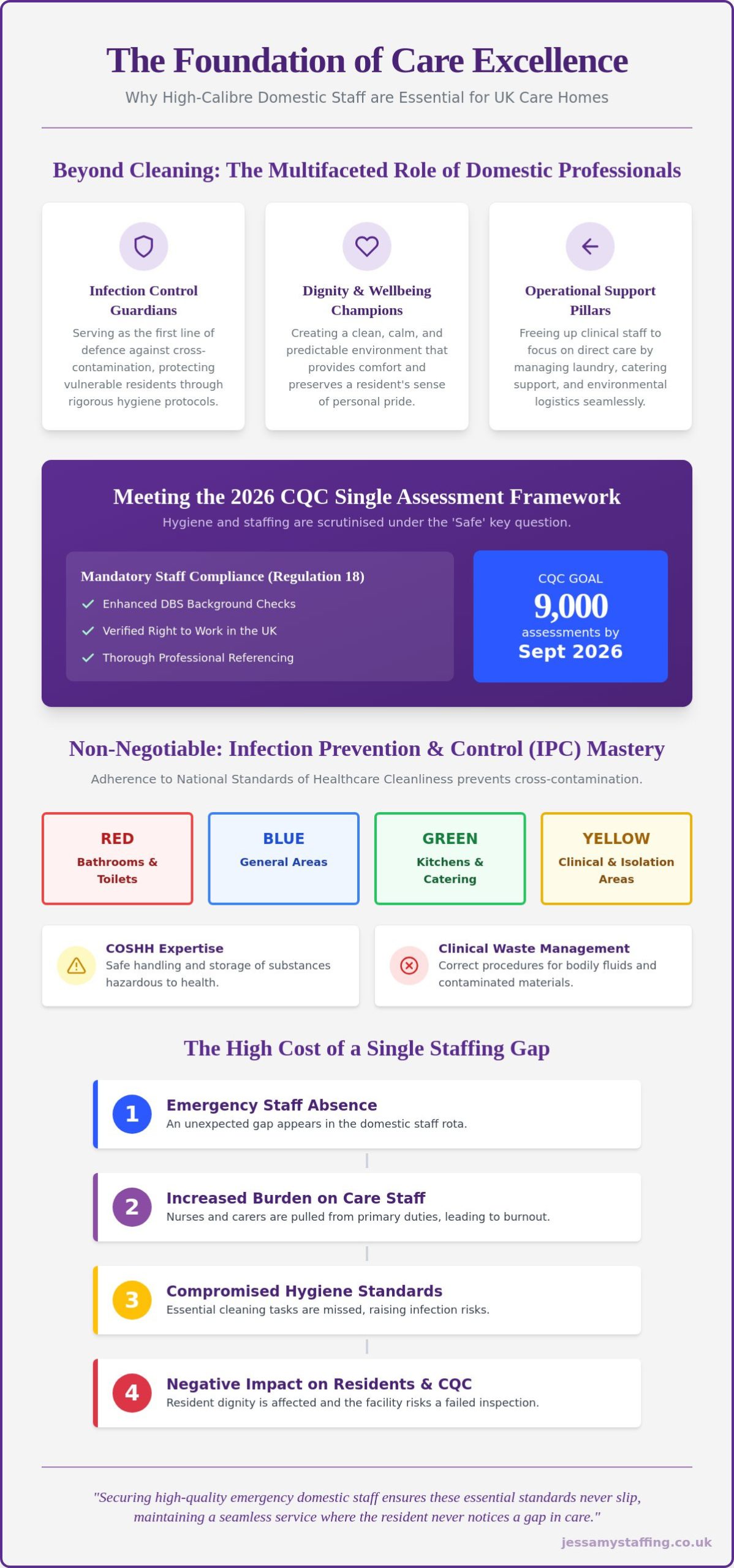
The modern domestic worker is far more than a background figure responsible for floor maintenance. Within the complex framework of the UK social care system, these professionals are integral members of a multidisciplinary team. They provide the environmental foundation upon which clinical and emotional care is built. In 2026, the distinction between basic cleaning and professional environmental management has become a defining factor for successful facilities. A home’s reputation is inextricably linked to its atmosphere. A pristine environment signals a culture of meticulous attention and high standards that reassures families and regulators alike.
Impact on Resident Wellbeing and Dignity
Living in a shared environment can often lead to heightened anxiety amongst elderly residents, particularly those navigating cognitive decline. A clean, well-ordered space provides a sense of predictability and calm that is essential for mental wellbeing. Domestic staff often act as the most consistent social touchpoints for residents during the day. Their interactions, though brief, offer vital opportunities for engagement and companionship. By maintaining a home-from-home feel whilst adhering to rigorous clinical hygiene standards, domestic teams ensure that a resident’s living space remains a place of personal pride rather than just a clinical unit. This balance is delicate. It requires staff who understand that their work is about people, not just surfaces.
The Operational Backbone of the Care Facility
When a facility lacks adequate support, the burden of housekeeping often shifts onto nursing and care staff. This directly impacts their ability to provide direct resident care and can lead to rapid burnout. Efficient domestic teams manage the intricate logistics of laundry and catering support, allowing the wider care team to remain focused on their primary duties. This is where the need for emergency domestic staff for care homes UK becomes critical. Without a reliable backup plan for staff absences, the entire operational rhythm of the home can falter.
Domestic staff are the guardians of the care environment, ensuring that the physical space remains a sanctuary of safety and respect for those who live within it. Securing high-quality emergency domestic staff for care homes UK ensures that these essential standards never slip, even during unexpected staffing shortages. It is about maintaining a seamless service where the resident never notices a gap in care. Reliability in this department is the silent engine of a well-led care home.
Compliance, Infection Control, and CQC Standards
Compliance in a care setting is the invisible shield that protects both residents and providers. Under the CQC Single Assessment Framework, cleanliness and infection control are scrutinised under the ‘Safe’ key question. With the CQC aiming to complete 9,000 assessments by September 2026, the pressure on managers to maintain impeccable hygiene standards has never been higher. Every member of the team must be fully compliant with CQC Regulation 18 on Staffing, ensuring they have the skills and knowledge to perform their roles safely. This includes rigorous background checks such as Enhanced DBS, Right to Work verification, and thorough referencing before any individual enters your facility.
Infection Prevention and Control (IPC) Mastery
Adhering to the National Standards of Healthcare Cleanliness is a non-negotiable requirement in 2026. Domestic staff must be masters of Infection Prevention and Control (IPC) protocols. This includes the strict application of colour-coded cleaning systems: red for bathrooms, blue for general areas, green for kitchens, and yellow for clinical spaces. This system is vital to prevent cross-contamination. Staff must also be expertly trained in COSHH (Control of Substances Hazardous to Health) and the safe management of clinical waste and bodily fluid spillages. When you require emergency domestic staff for care homes UK, you can’t afford to skip these technical competencies. It’s about ensuring every shift is covered by someone who understands the clinical gravity of their work.
Regulatory Documentation and Audit Trails
Audits are the evidence of your excellence. Without accurate cleaning logs and robust audit trails, even the most pristine home can fail an inspection. Domestic personnel must understand their obligations under the Health and Safety at Work Act, ensuring that every action is documented and every risk is mitigated. For managers looking for a broader health and social care staff supply UK strategy, integrating these domestic compliance standards into your overall workforce plan is essential. It’s about creating a culture where safety is documented and verifiable. If you’re struggling to maintain these rigorous records during a staffing gap, seeking professional domestic staffing support can ensure your compliance remains unbroken. Emergency domestic staff for care homes UK should arrive ready to slot into your existing audit systems without delay.
Navigating Staffing Shortages: Temporary vs Permanent Solutions
Striking the correct balance between a permanent in-house team and temporary support is a primary challenge for modern care managers. While a dedicated internal domestic team offers familiarity and long-term loyalty, the inherent rigidity of this model can leave a facility vulnerable during periods of high turnover or unexpected absence. In the current social care climate, relying solely on an in-house rota often leads to gaps that compromise both hygiene and safety. A strategic partnership with a support worker recruitment agency provides the elasticity required to maintain high standards regardless of internal fluctuations.
The decision to engage external help shouldn’t be a reactive panic but a proactive component of your workforce planning. When a domestic assistant calls in sick at short notice, the impact is immediate. Common areas lose their lustre, laundry piles up, and the risk of cross-contamination increases. Accessing emergency domestic staff for care homes UK ensures that these critical tasks are never deferred. This rapid response is particularly vital when considering the financial implications of understaffing. While agency rates are a visible cost, the hidden expenses of a burnt-out permanent team, potential CQC fines, and a tarnished reputation are far more damaging to a home’s viability.
The Flexibility of Agency Support
Temporary staffing solutions offer a level of agility that permanent contracts cannot match. During winter months or seasonal peaks, the availability of 24/7 emergency care staffing prevents manager burnout by removing the need to cover shifts personally or coerce existing staff into overtime. Many managers also utilise temporary roles as a “temp-to-perm” trial period. This allows you to evaluate a worker’s technical competence and cultural fit within your specific care environment before committing to a long-term contract. It’s a pragmatic way to build a high-quality team without the risks associated with traditional recruitment.
Maintaining Continuity of Care
Integrating temporary domestic staff into your existing team requires a methodical approach. Continuity is preserved when agency workers are treated as valued colleagues rather than just “fillers.” Providing a brief, structured induction regarding your facility layout and specific resident needs ensures they can work independently and effectively from the first hour. The most successful facilities develop a relationship with a consistent agency partner. By working with a provider who understands your care home’s unique culture and expectations, you ensure that the emergency domestic staff for care homes UK sent to your door are already aligned with your high standards of resident dignity and operational excellence.
Key Qualities to Look for in Domestic Care Personnel
Technical cleaning skills like dusting and vacuuming are necessary, but in 2026, they represent only the baseline. High-quality emergency domestic staff for care homes UK must possess a principled mindset that bridges the gap between hygiene and humanity. These individuals understand that every action they take, from mopping a corridor to handling personal laundry, directly affects a resident’s health and sense of dignity. They act as meticulous guardians of your home’s standards, even during the most pressured shifts.
Compliance remains the second pillar of excellence. Since the full implementation of the updated Care Certificate in July 2025, domestic workers are expected to demonstrate a sophisticated understanding of care standards. This now includes mandatory awareness of learning disability and autism. In addition, the Oliver McGowan Mandatory Training is a legal requirement under the Health and Care Act 2022. Any professional entering your facility should arrive with these competencies already verified. This ensures they can slot into your team without creating a training or supervision burden for your senior staff.
Values-Led Recruitment in Housekeeping
Empathy is just as vital as technical proficiency in a residential care setting. When assessing candidates, look for individuals who view their role as a compassionate service to the vulnerable. Strong communication skills are essential, as domestic staff often spend significant time in resident rooms. They must be able to interact with residents with warmth and respect, maintaining professional boundaries whilst providing a friendly presence. Reliability and physical stamina are also non-negotiable, as the role requires consistent effort to keep a busy facility running smoothly.
Specialist Training Requirements
Specific training elevates a worker from a general cleaner to a healthcare-grade professional. Essential training modules include:
- Dementia Awareness: Understanding how to work safely and respectfully around residents who may experience confusion or distress.
- Safe Moving and Handling: Essential for the safe transport of heavy laundry carts and the operation of industrial cleaning equipment.
- Fire Safety and Evacuation: Ensuring every member of the team knows their specific role in protecting residents during an emergency.
Finding personnel who embody these traits at short notice is a significant hurdle for many managers. You can hire trained domestic staff who meet these rigorous standards through our accredited social care training programmes. Securing emergency domestic staff for care homes UK who are already aligned with these values ensures your facility maintains its operational excellence without compromise.
Expert Domestic Staffing Solutions in Greater Manchester
Jessamy Staffing Solutions operates as a dedicated partner to care providers across the North West, offering a stable bridge between institutional requirements and human needs. We understand that the Greater Manchester care economy faces distinct pressures, from high occupancy rates in busy urban centres like Salford and Trafford to the specific demographic needs of residents in Stockport and Wigan. Providing emergency domestic staff for care homes UK managers can rely on is our core mission. Our 24/7 emergency cover acts as a vital safety net. It ensures that no facility is left vulnerable during a staffing crisis, protecting both your operational rhythm and your residents’ wellbeing.
Reliability is the cornerstone of our service. By maintaining a local pool of professionals who are already familiar with the region’s healthcare landscape, we provide a rapid response that national agencies often struggle to match. Our personnel arrive ready to work, underpinned by accredited social care training that aligns with the latest 2026 regulatory standards. This commitment to professional rigour allows you to focus on clinical leadership, knowing that the environmental management of your home is in expert hands. We act as meticulous guardians of your standards, ensuring that every shift is covered by someone who values integrity as much as efficiency.
A Partner in Local Care Excellence
Our recruitment process is intentionally rigorous. We don’t just supply domestic workers; we provide values-led professionals who understand the care economy. Every candidate undergoes a thorough compliance check, including Enhanced DBS and Right to Work verification, tailored to current Home Office requirements. For residential and nursing homes in Greater Manchester, this means having access to dependable capacity at a moment’s notice. We focus on bridging the gap between technical cleaning requirements and the human warmth necessary for a supportive living environment. This local expertise allows us to support your facility with staff who truly understand the community they serve.
How to Get Started with Jessamy Staffing Solutions
Requesting cover is a straightforward and transparent process. Whether you require a single shift filled due to seasonal illness or a longer-term temporary solution to manage high turnover, we work closely with you to customise staffing levels. We prioritise your specific clinical needs, ensuring our emergency domestic staff for care homes UK slot seamlessly into your existing team. Our methodical approach reduces managerial stress and guarantees that your standards of cleanliness and resident dignity remain unbroken. We are a stable, long-term partner that prioritises the success of your organisation as much as the comfort of your residents.
You can secure reliable domestic staff for your care home today by contacting our Manchester-based team. We are ready to provide the professional support you need to maintain excellence in every department.
Securing Environmental Excellence in Your Care Home
Maintaining a pristine environment is a non-negotiable standard that directly impacts resident health and your home’s regulatory standing. We’ve explored how professional housekeeping acts as the front line of infection control, particularly within the 2026 CQC framework. By prioritising values-led recruitment and specialised training, you ensure that every member of your team contributes to a culture of dignity and safety. It’s about creating a physical space that reflects the high quality of care your residents deserve.
Staffing gaps shouldn’t compromise these vital standards. Accessing emergency domestic staff for care homes UK managers can trust provides the resilience needed to navigate unexpected absences without stress. Jessamy Staffing supports facilities with 24/7 emergency cover across Greater Manchester, providing personnel who are fully prepared through our accredited social care training programmes. Our meticulous approach ensures that temporary support slots seamlessly into your existing operations, maintaining the continuity your residents rely on.
Partner with Jessamy Staffing for Reliable Domestic Personnel to benefit from a recruitment process that values integrity and professional rigour. You have the tools to build a robust, compliant, and compassionate domestic team that stands as a testament to your commitment to excellence. Your facility remains in safe hands, regardless of the challenges the shift rota may bring.
Frequently Asked Questions
What are the main duties of emergency domestic staff in a care home?
Emergency domestic staff are responsible for maintaining high standards of hygiene and environmental safety through thorough cleaning, laundry management, and waste disposal. They ensure that resident rooms and communal areas remain pristine, whilst also supporting the catering team with basic kitchen duties. Their primary focus is to uphold infection control protocols and provide a comfortable, dignified living environment for all residents.
Do domestic staff in care homes need an Enhanced DBS check?
Yes, all personnel working in a care home environment must hold a valid Enhanced DBS check before they can begin their duties. This is a mandatory legal requirement because the role involves working in a regulated setting with vulnerable adults. We ensure that every individual we supply has undergone rigorous background screening to provide managers with complete peace of mind regarding resident safety.
Can domestic staff help with resident care tasks?
No, domestic staff roles are strictly non-clinical and do not include personal care tasks such as washing, dressing, or administering medication. Their remit is focused entirely on environmental maintenance and support services. However, they are trained to interact with residents with empathy and are often a vital point of social contact, reporting any observed changes in resident wellbeing to the nursing team.
How much does it cost to hire agency domestic staff for a care home?
The cost of hiring emergency domestic staff for care homes UK depends on several factors, including the timing of the shift and the level of urgency. Agency rates must account for the 2026 National Living Wage of £12.71 per hour, alongside costs for accredited training, insurance, and recruitment. It’s best to request a tailored quote to understand the specific investment required for your facility’s needs.
What training should domestic workers have for infection control?
Domestic workers should be fully trained in COSHH (Control of Substances Hazardous to Health), the correct use of PPE, and the safe management of clinical waste. They must also be proficient in using colour-coded cleaning systems to prevent cross-contamination between different areas of the home. This technical training is essential for meeting the “Safe” criteria under the CQC Single Assessment Framework.
Is 24/7 cover available for domestic roles in Greater Manchester?
Yes, we provide 24/7 emergency cover specifically tailored for the Greater Manchester care sector. This service is designed to support managers during staffing crises, ensuring that essential housekeeping and laundry tasks are never neglected. Whether you face a midnight cancellation or a weekend shortfall, our local team is available to maintain your home’s operational standards around the clock.
How quickly can Jessamy Staffing provide emergency domestic staff?
We pride ourselves on a rapid response and aim to provide emergency domestic staff for care homes UK within hours of receiving a request. Our established pool of local personnel in Greater Manchester allows us to mobilise trained staff quickly to fill unexpected gaps. This speed of service is vital for preventing the build-up of laundry or hygiene issues that could compromise resident care.
What is the difference between a housekeeper and a domestic worker in care?
In many care settings, these terms are used interchangeably, though a housekeeper may sometimes have additional responsibilities such as managing stock levels or supervising a small team. A domestic worker generally focuses on the practical execution of cleaning and maintenance tasks across the facility. Both roles are equally fundamental to the health, safety, and dignity of the residents within the care environment.