



Your child’s bedroom should never feel like a sterile hospital ward, even when 24-hour clinical care is a medical necessity. We understand that inviting a professional into your private space is a profound act of trust that requires more than just a DBS check. It’s often exhausting to manage a revolving door of staff who fail to grasp your family’s unique rhythm or routine. When you are recruiting specialist support workers for children’s care, the primary objective is to find a professional who offers more than just technical competence. You need someone who prioritises clinical safety whilst protecting the sanctity of your home life.
This article provides a clear roadmap for securing paediatric support that balances rigorous clinical excellence with a compassionate, values-led approach. You’ll learn how to build a stable, long-term care team that reduces anxiety during those critical night shifts and preserves your family’s privacy. We’ll examine the latest 2026 regulatory updates, including the Children’s Wellbeing and Schools Act, and demonstrate how a principled recruitment strategy can finally bring you the lasting stability your child deserves.
Key Takeaways
- Understand the distinction between basic assistance and specialist complex support, focusing on the need for life-sustaining clinical interventions and emotional advocacy.
- Identify the non-negotiable clinical competencies, such as tracheostomy care and suctioning, required when recruiting specialist support workers for children’s care.
- Evaluate why a regulated agency is often safer than private hiring, especially when it’s necessary to have 24/7 emergency cover in place for your child.
- Learn how to establish clear household boundaries that ensure your home remains a sanctuary while functioning as a high-standard clinical environment.
- Access local Greater Manchester expertise to secure a stable care team that’s supported by regular hands-on competency assessments and local supervision.
Defining the Role of Children’s Complex Care Support Workers
A specialist support worker for children with complex needs isn’t merely a caregiver; they’re a clinical guardian and an emotional anchor within the home. This role is specifically designed for children living with life-limiting, long-term, or complex medical conditions that require constant monitoring and expert intervention. Unlike general care, this discipline involves life-sustaining clinical tasks, such as ventilation management or enteral feeding, alongside dedicated emotional advocacy. When recruiting specialist support workers for children’s care, it’s essential to look for a professional who understands that their presence is meant to enable the child to thrive in a familiar environment whilst providing necessary relief to the wider family unit. Effective strategies for recruiting specialist support workers for children’s care must prioritise this blend of technical skill and personal character. Success in this field requires a sophisticated synthesis of paediatric healthcare knowledge and the high-level emotional intelligence needed to operate sensitively within a private family residence.
Complex Care vs. Standard Support Work
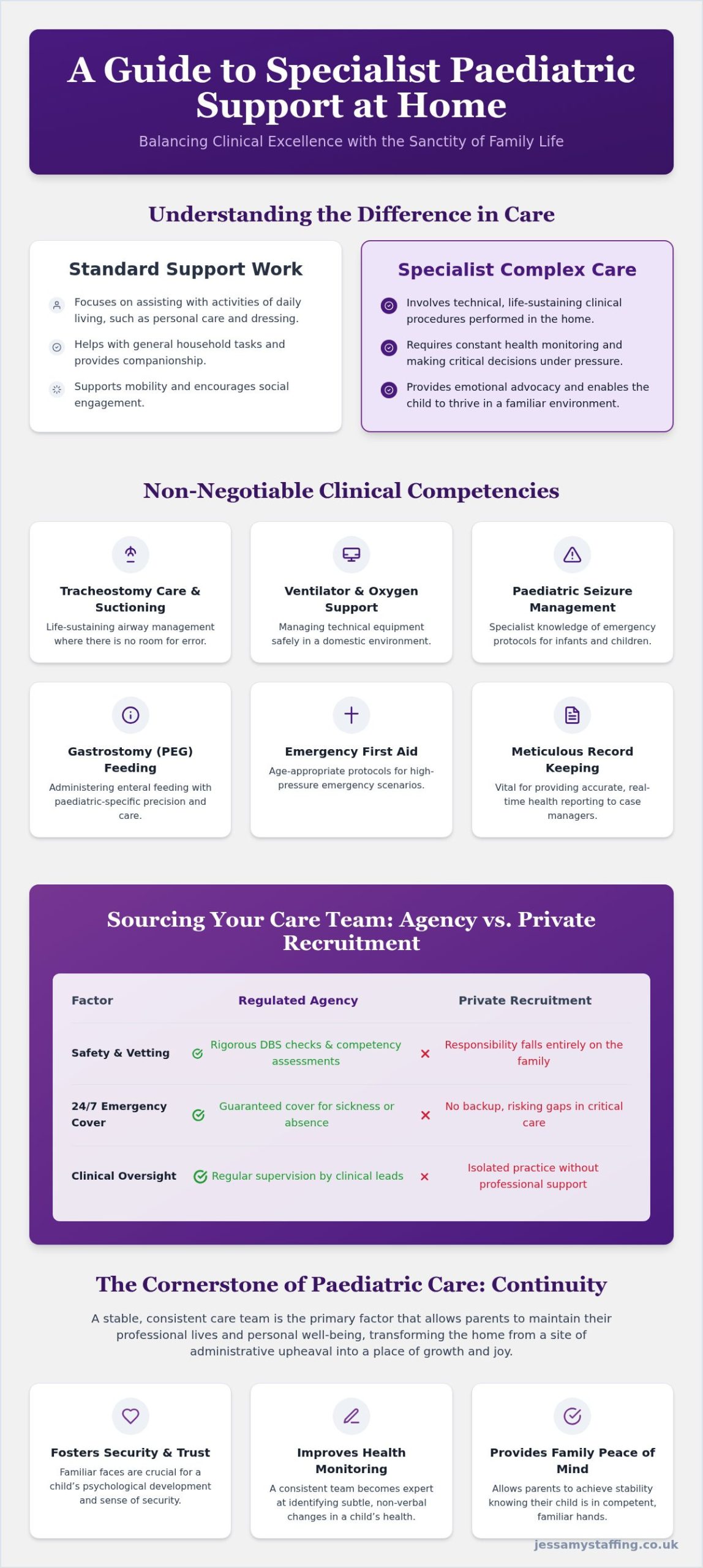
Standard support work typically centres on assisting with activities of daily living, such as personal care, dressing, or mobility. In contrast, complex care involves technical clinical procedures that would traditionally be performed in a hospital setting, such as tracheostomy care or seizure management. Paediatric roles demand an even more nuanced approach, focusing on developmental milestones and play-based engagement strategies similar to the holistic approach of a child life specialist. Specialist workers must manage significantly higher levels of clinical accountability, providing meticulous real-time health reporting and making critical decisions under pressure. They don’t just follow a care plan; they actively interpret a child’s changing physiological needs throughout a shift.
The Vital Importance of Care Continuity
Stability is the cornerstone of effective paediatric care. Familiar faces are crucial for a child’s psychological development, as they foster a sense of security and trust that a rotating cast of staff cannot provide. A consistent team becomes expert at identifying subtle, non-verbal changes in a child’s health, such as a slight change in skin tone or a specific cry, that an unfamiliar worker might overlook. Beyond the clinical benefits, staff consistency is the primary factor that allows parents to maintain their professional lives and personal well-being. Knowing that a competent, familiar professional is managing their child’s complex needs provides the peace of mind necessary for family stability. This continuity ensures that the home remains a place of growth and joy, rather than a site of constant administrative upheaval.
Essential Clinical Competencies and Specialist Training
Clinical competence in a home setting requires a level of autonomy that hospital-based roles often lack. When recruiting specialist support workers for children’s care, verification of skills must move past simple certification. It demands rigorous, hands-on competency assessments conducted by qualified clinical leads. Proficiency in airway management, specifically tracheostomy care and suctioning, is typically a non-negotiable requirement for children with respiratory dependencies. These interventions are life-sustaining. There’s no room for error or hesitation when a child’s breathing is at stake.
Specialist knowledge must also extend to paediatric seizure management and emergency first aid specifically tailored for infants. The physiological differences between adults and children mean that emergency protocols must be precise and age-appropriate. Comprehensive training for complex care workers serves as the ultimate safeguard for patient safety, ensuring that every professional enters your home fully prepared for both routine care and high-pressure scenarios.
Specialist Clinical Interventions at Home
Managing a child’s health at home involves technical equipment that must be integrated safely into a domestic environment. This includes monitoring ventilator support and oxygen therapy whilst ensuring the household remains a home, not a ward. Support workers must also be adept at managing Gastrostomy (PEG) feeding and stoma care with paediatric-specific precision. Meticulous clinical records are vital for case managers, ensuring that the latest government recruitment priorities for care workers are met through high-standard professional practice.
The ‘Jessamy Way’: Values-Led Behaviours
Technical skill is secondary to empathy, patience, and a genuine sense of duty. While a worker must know how to operate a ventilator, they must also know how to navigate family dynamics with professional rigour whilst respecting the sanctity of your home. We prioritise workers who understand that they’re guests in a private space first and clinicians second. Values-led care is the intersection of clinical excellence and compassionate human support. Our approach to Support Worker Supply ensures that every individual is vetted for these essential human traits before they ever reach your doorstep.
Sourcing Quality Staff: Agency vs. Private Recruitment
Choosing the right recruitment pathway is a decision that defines the stability of your child’s home environment. Direct recruitment provides total control over selection, yet it introduces significant legal, payroll, and administrative burdens that can easily overwhelm a family already managing complex medical needs. In contrast, professional agencies provide a pre-vetted, compliant workforce with built-in contingency for staff sickness. Partnering with a support worker recruitment agency that prioritises compliance ensures that the safety of your child is never compromised by administrative shortcuts. When recruiting specialist support workers for children’s care, you must evaluate an agency’s capacity to provide a genuine 24/7 emergency response. Life-sustaining care cannot wait for office hours to resolve a last-minute shift gap.
Rigorous Compliance and Safeguarding Checks
Safeguarding is the foundation of any paediatric care team. For these sensitive roles, Enhanced DBS checks and exhaustive professional referencing are non-negotiable requirements. We verify ‘Right to Work’ status and clinical qualifications to ensure all personnel strictly meet CQC and Ofsted standards. Jessamy Staffing ensures all personnel are professionally prepared through a structured compliance framework. This rigorous process adheres to the Clinical Homecare Career and Competence Framework, which sets the national benchmark for knowledge and skill in domestic clinical settings.
Mitigating Burnout and Ensuring Emergency Cover
Complex care is inherently high-pressure, and staff burnout is a real risk to care continuity. Managing this requires a strategic approach to shift rotation and consistent emotional support for the workers involved. Access to 24/7 emergency care staffing is essential for life-sustaining care regimes, providing a safety net when sickness or emergencies occur. Clinical handovers must be seamless to prevent any drop in the quality of care during staff changes. In Greater Manchester, our local presence allows us to provide frequent on-site supervision, ensuring that the standards of care remain high and that the family’s routine is respected at all times.
Integrating Care Workers into the Family Home
Successful integration begins with acknowledging a fundamental truth: your home is a sanctuary first and a workplace second. When recruiting specialist support workers for children’s care, the focus often dwells on clinical qualifications, yet the ability to blend into a family’s unique ecosystem is equally vital. Establishing clear household expectations during the initial placement phase prevents the friction that often leads to high staff turnover. It’s about creating a partnership where the worker supports the child without encroaching on the family’s sense of normalcy. Fostering a culture of transparent communication allows minor misunderstandings to be resolved before they escalate into significant issues. Professionals who understand this balance ensure that care feels like a support system rather than an intrusion.
Establishing Professional Boundaries and Privacy
Maintaining the mental well-being of parents and siblings requires clearly defined ‘family-only’ spaces. It’s vital to agree on policies regarding the use of kitchen facilities, parking, and common areas during the first week of a new placement. Managing the professional-personal balance requires a worker who can provide high-level clinical care whilst remaining unobtrusive during private family moments. These unwritten rules are the foundation of a long-term, stable care environment. If you’re looking for professionals who respect your family’s privacy whilst delivering excellence, explore our dedicated Children’s Complex Care at Home services.
The Shadowing and Induction Process
The psychological importance of a shadowing period cannot be overstated for a child’s sense of security. New staff should observe existing routines and family preferences before assuming full responsibility for clinical interventions. This gradual transition of tasks from parents to support workers builds mutual confidence and ensures the child feels safe with a new face. During this phase, recruiting specialist support workers for children’s care involves assessing how well a candidate interprets specific non-verbal cues and personal ‘likes’ that aren’t found in a medical chart. A worker who takes the time to understand these nuances becomes an expert in the child’s unique health profile much faster than one who relies solely on written notes. This meticulous approach to induction is what transforms a clinical requirement into a harmonious household routine.
Specialist Paediatric Staffing in Greater Manchester
Local expertise is the defining factor in providing responsive paediatric care. Jessamy Staffing Solutions remains deeply committed to providing safe, values-led personnel across the Greater Manchester region, ensuring that families in our community have access to the highest standards of clinical support. When recruiting specialist support workers for children’s care, the advantage of a local agency cannot be overstated. Proximity allows for faster emergency response times and more frequent on-site supervision, which are critical for maintaining clinical safety. Providing children’s complex care at home that is tailored to the Manchester healthcare landscape requires a deep understanding of regional resources. We maintain a collaborative approach with local case managers and Integrated Care Boards (ICBs) to ensure that care packages are both compliant and deeply personal. This regional focus means we understand the specific thresholds for intervention used by local authorities, allowing for a more seamless integration of services.
Our Accredited Training and Development
Professional development is a pillar of our service. Our Manchester-based staff undergo rigorous, in-house, accredited training programmes that keep them at the forefront of paediatric clinical guidelines. This isn’t just about technical skill. Our training prepares staff for the emotional and clinical complexities of the ‘Jessamy Staffing Solutions approach’, ensuring they can handle high-pressure situations with grace. We integrate the latest 2026 statutory guidance, including ‘Working Together to Safeguard Children’, into our core curriculum. By investing in our workforce, we guarantee that every professional entering a home is not only competent but also emotionally prepared for the unique dynamics of family-based care. This commitment to education ensures that our staff remain the most capable guardians of your child’s well-being.
Next Steps for Families and Case Managers
Securing the right support starts with a detailed specialist consultation to assess your child’s specific care requirements. We don’t just assign staff; we meticulously match the right personality and skill set to your family’s unique environment. This ensures long-term stability and a harmonious household where the child can truly thrive. For those in Greater Manchester, our 24/7 support line is always available for immediate staffing enquiries or emergency cover. Recruiting specialist support workers for children’s care shouldn’t be a source of stress for parents. We act as a principled bridge between clinical requirements and human needs, providing the reliable personnel your family needs to maintain stability and peace of mind.
Securing a Stable Future for Your Child’s Care
Establishing a reliable care team is a meticulous process that requires a balance of clinical scrutiny and emotional intelligence. We’ve explored how accredited specialist clinical training and a deep respect for the sanctity of the home are essential for long-term success. When recruiting specialist support workers for children’s care, your primary focus must remain on the intersection of medical safety and family stability. This ensures that your child thrives in an environment that remains a home first and a workplace second. It’s about finding professionals who understand the weight of their responsibility whilst respecting your family’s unique rhythm.
Our local Greater Manchester expertise ensures that you’re never navigating these complex challenges alone. By partnering with Jessamy Staffing, you gain access to 24/7 rapid-response emergency cover that protects your child’s routine from unexpected disruptions or staff sickness. It’s entirely possible to maintain a rigorous clinical environment whilst preserving your family’s privacy and normal daily life. Secure specialist care for your child-contact Jessamy Staffing today. You deserve the peace of mind that comes from a stable, expert team dedicated to your family’s well-being.
Frequently Asked Questions
What qualifies as ‘complex care’ for a child in the UK?
Complex care refers to support for children with chronic health conditions requiring life-sustaining clinical interventions rather than just social support. This includes dependencies on medical technology such as mechanical ventilators, tracheostomies, or enteral feeding via PEG tubes. It also encompasses severe neurological conditions and profound disabilities. The goal is to manage these medical complexities safely within a domestic setting while promoting the child’s developmental progress and family stability.
Do children’s complex care support workers need to be qualified nurses?
Support workers don’t need to be registered nurses to provide complex care, but they must demonstrate rigorous clinical competence. Whilst nurses often oversee the care plan, support workers are trained to perform specific clinical tasks safely. When recruiting specialist support workers for children’s care, we ensure they possess the technical skills required for procedures like suctioning or gastrostomy care, verified through hands-on assessments by qualified clinical leads.
How do you ensure the safeguarding of children in their own homes?
Safeguarding is maintained through a multi-layered approach that begins with an Enhanced DBS check and exhaustive professional referencing. We ensure every worker understands the ‘Working Together to Safeguard Children’ statutory guidance. Regular on-site supervision and clinical audits in Greater Manchester provide ongoing oversight. This ensures that the home remains a safe environment where professional boundaries are respected and the child’s well-being is the absolute priority at all times.
What happens if a support worker is sick at the last minute?
If a worker is unwell, our 24/7 emergency cover provides immediate contingency to prevent gaps in your child’s care. We maintain a pool of professionally prepared staff who can step in at short notice. This rapid-response capability is essential for life-sustaining care regimes where a missed shift could compromise safety. Our Manchester-based team manages these logistics so that families don’t have to face the stress of staffing shortages alone.
Can I choose which support workers are part of my child’s care team?
Families are encouraged to play an active role in selecting their care team to ensure a positive personality fit. We facilitate a matching process where you can meet potential workers before they begin shadowing shifts. This collaborative approach is vital because the worker will be part of your household’s daily life. Finding someone who respects your family’s routine is just as important as their clinical ability to manage complex medical needs.
What clinical tasks can a support worker legally perform under supervision?
Support workers can legally perform various invasive clinical tasks once they’ve been formally assessed as competent by a registered professional. This includes tracheostomy care, oral and nasopharyngeal suctioning, and administering medication via gastrostomy tubes. They can also monitor ventilator settings and manage complex seizure protocols. Every task must be clearly documented within the child’s personalised care plan and reviewed regularly to ensure ongoing safety and compliance.
Is specialist paediatric home care funded by Continuing Healthcare provisions or personal health budgets?
Specialist paediatric home care is frequently funded through Continuing Healthcare provisions or Personal Health Budgets. Local Integrated Care Boards assess eligibility based on the child’s primary health needs. Once funding is agreed, families can often choose their own provider to deliver the care. We work closely with Manchester-based case managers and local authorities to ensure that the transition from hospital to home is financially and operationally seamless.
What specific training do Jessamy support workers receive for paediatric cases?
Jessamy staff receive accredited social care training that’s specifically tailored for paediatric complex care environments. This includes modules on infant emergency first aid, seizure management, and the use of medical equipment such as ventilators. Beyond technical skills, we focus on the ‘Jessamy Way’, which emphasises empathy and professional boundaries. This ensures that recruiting specialist support workers for children’s care results in personnel who are both clinically expert and emotionally prepared.