

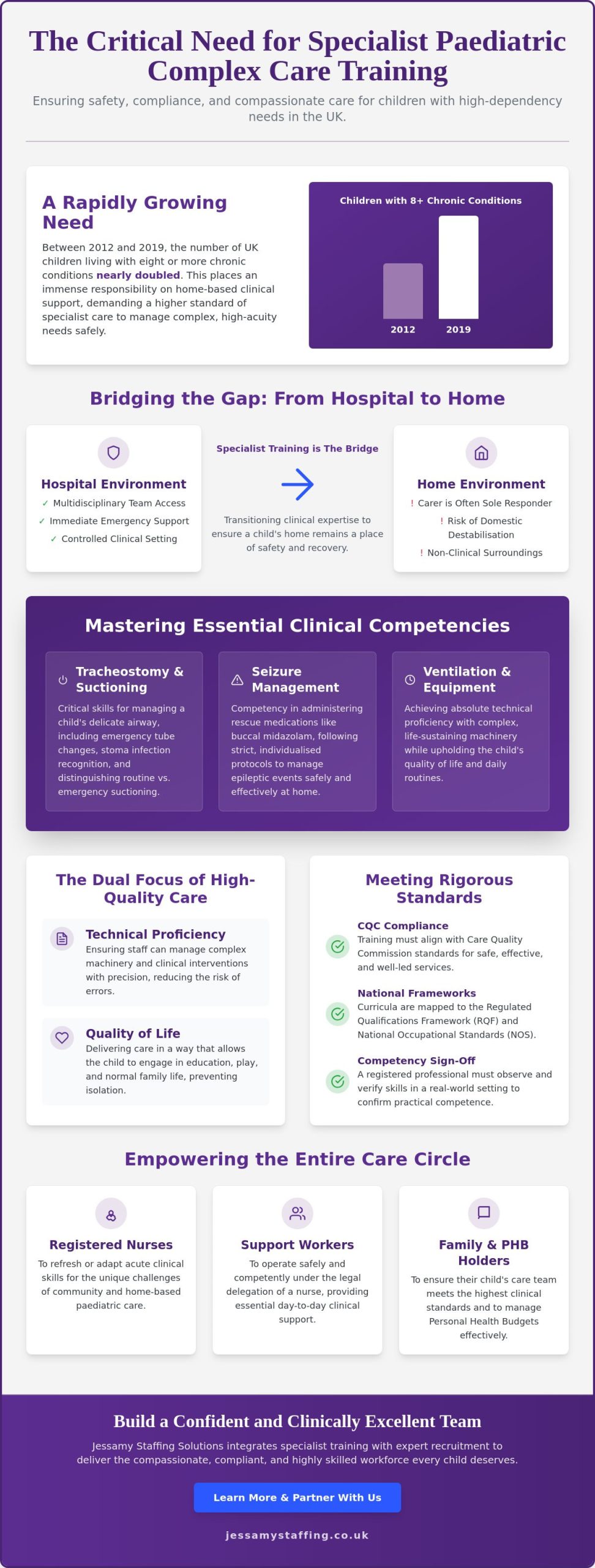
Between 2012 and 2019, the number of children in the UK living with eight or more chronic conditions nearly doubled, placing an immense responsibility on those providing home-based clinical support. It’s understandable that many providers feel a sense of trepidation regarding clinical errors or the difficulty of meeting rigorous CQC standards. You want a workforce that’s not only compliant but also deeply confident in their ability to manage high-acuity needs. Specialist pediatric complex care training UK serves as the essential bridge between technical necessity and the compassionate, stable environment every child deserves.
In this guide, we’ll explore how targeted clinical education ensures safety and adherence to the latest 2026 legislative reforms. We’ll examine the standards required to achieve clinical excellence, from the PCCS Quality Standards to the specific skills needed for complex interventions. By the end, you’ll understand how a robust training framework reduces staff turnover and delivers the improved patient outcomes that are the heartbeat of our profession.
Key Takeaways
- Identify the core clinical competencies required to manage high-dependency needs, including the precise requirements for tracheostomy and ventilation care.
- Understand how specialist pediatric complex care training UK transitions clinical expertise from hospital settings into the sensitive environment of a child’s family home.
- Learn to distinguish between basic awareness and robust, competency-based training to ensure full compliance with CQC and national healthcare standards.
- Discover why balancing technical proficiency with a values-led, family-centred approach is essential for preventing the destabilisation of the domestic environment.
- Explore the “professionally prepared” model for bridging the gap between recruitment and clinical excellence through integrated specialist staffing solutions.
What is Paediatric Complex Care Training in the UK?
Pediatric complex care training UK is a highly specialised branch of healthcare education designed to equip professionals and carers with the skills needed to support children with high-dependency needs. Unlike standard paediatric care, this training focuses on managing life-limiting or life-threatening conditions that require constant clinical monitoring. It acts as the essential bridge between acute hospital settings and the domestic environment, ensuring that a child’s home remains a place of safety and recovery rather than a source of clinical risk. The training isn’t merely about following a manual; it’s about developing the clinical judgment necessary to keep a child stable in a non-clinical setting.
Historically, children with such intensive needs remained for long periods in a hospital environment specializing in the care of critically ill infants and young people. However, current UK policy prioritises keeping families together, leading to a significant shift towards children’s complex care at home. Whilst general paediatric nursing provides a strong foundation, it’s often insufficient for the unique challenges of a home setting. In a hospital, a clinician has immediate access to a multidisciplinary team and emergency crash teams. At home, the carer is often the sole individual responsible for managing life-sustaining equipment, making specialised preparation a non-negotiable requirement for safety.
The core objective of this training is dual-focused. Staff must achieve absolute technical proficiency with complex machinery whilst simultaneously upholding the child’s quality of life. It isn’t enough to simply keep a child stable; the care must be delivered in a way that allows the child to engage with their education, play, and family life. This requires a sophisticated understanding of how clinical interventions affect a child’s daily routine and overall well-being.
The Legal and Regulatory Framework
Compliance in this sector is rigorous and necessary. Training must align with Care Quality Commission (CQC) standards to ensure services are safe, effective, and well-led. This involves mapping curricula to the Regulated Qualifications Framework (RQF) and National Occupational Standards (NOS). A critical component of this framework is the “competency sign-off.” Classroom learning provides the theory, but a registered professional must observe and verify the practitioner’s skills in a real-world setting before they’re deemed competent to practice independently. This ensures that theoretical knowledge translates into safe, practical application.
Who Requires This Specialist Training?
This education is essential for a broad spectrum of individuals dedicated to high-acuity care:
- Registered nurses who need to refresh or adapt their skills for community-based paediatric environments.
- Support workers and personal assistants who operate under the legal delegation of a nurse to provide day-to-day clinical support.
- Family members and unpaid carers, particularly those managing Personal Health Budgets (PHBs) who want to ensure their child’s care team meets the highest clinical standards.
Essential Clinical Competencies for Specialist Paediatric Staff
Clinical excellence in high-acuity environments is built upon a foundation of technical mastery and rigorous safety protocols. To ensure safety in a domestic setting, pediatric complex care training UK must align with the Career and Competence Framework, which outlines the specific skills required for children with multi-faceted needs. This training moves beyond basic first aid, focusing on the precision required to manage life-sustaining equipment whilst maintaining a stable home environment. When staff are equipped with these competencies, the risk of clinical error is significantly reduced, providing peace of mind for both families and healthcare managers.
Tracheostomy care and suctioning represent some of the most high-stakes interventions in paediatric care. Because a child’s airway is significantly narrower and more delicate than an adult’s, even minor blockages can lead to rapid deterioration. Training must encompass emergency tube changes, the recognition of stoma infections, and the critical distinction between routine and emergency suctioning. Practitioners must also be adept at seizure management, including the administration of rescue medications like buccal midazolam, following strict individualised protocols to prevent status epilepticus.
Advanced Respiratory Support
Specialist training focuses heavily on paediatric ventilator settings and the nuances of non-invasive ventilation (NIV). Staff must be competent in emergency troubleshooting, such as responding to high-pressure alarms or power failures. A vital skill in the home setting is the mastery of both “wet” and “dry” suctioning techniques, tailored to the child’s specific secretions. Because many children with complex needs are non-verbal, training emphasises recognising subtle physiological signs of respiratory distress, such as increased work of breathing or changes in oxygen saturation levels monitored via pulse oximetry.
Nutrition and Gastrostomy Care
Enteral feeding through PEG, PEJ, or NG tubes requires meticulous site management to prevent displacement and infection. Training involves calculating precise paediatric feed rates and managing various pump technologies to ensure the child receives optimal nutrition for growth. Beyond the technicalities, staff learn to integrate feeding schedules into the child’s daily routine, including school life, to minimise disruption. For providers seeking to upskill their workforce in these areas, our socialcare training & development programmes offer a structured pathway to clinical competency.
Adhering to the PCCS Quality Standards (6th Edition) published in October 2021 ensures that care remains evidence-based. As the health needs of children become increasingly complex, with those living with multiple chronic conditions nearly doubling in recent years, these technical competencies form the essential baseline for any high-quality care package.
Beyond Technical Skills: The Importance of Values-Led Training
Technical proficiency is the foundation of safety, yet clinical skill alone is insufficient for successful home-based support. If a practitioner possesses technical expertise but lacks empathy, they risk destabilising the delicate balance of a family’s domestic life. Pediatric complex care training UK must therefore integrate values-led principles to ensure that clinical interventions don’t overshadow the child’s right to a normal upbringing. A family’s home is a sanctuary, not a hospital ward; respecting physical and emotional boundaries is just as critical as managing a ventilator.
Family-centred care requires a shift in perspective where the parents are recognised as experts in their own child’s life. Training in Positive Behaviour Support (PBS) is essential here, as it provides staff with the tools to understand a child’s communication through their behaviour, especially when they’re non-verbal or in distress. Additionally, robust safeguarding training specifically tailored for children with disabilities is a non-negotiable requirement. These children are statistically more vulnerable, and staff must be trained to identify subtle indicators of harm whilst maintaining a supportive, trusting relationship with the family. Families navigating children’s complex care recruitment UK will find that prioritising values-led training from the outset is one of the most effective ways to build a stable, long-term care team.
Academic frameworks, such as those explored in the Queen’s University Belfast MSc Programme, emphasise that high-level care requires a blend of clinical mastery and social awareness. This dual focus ensures that practitioners can manage high-acuity needs without clinicalising the home environment. By prioritising these “soft” skills, providers create a more sustainable and harmonious care package for everyone involved.
The Child at the Centre of Care
Effective training encourages staff to see the child first, rather than the diagnosis or the medical equipment attached to them. Promoting independence and play is vital, as these are the primary ways children learn and grow. Child-centred care is a methodology that prioritises the child’s developmental needs alongside clinical safety. To learn how specialised soft play environments can support this, read more. When a care team values the child’s personality and preferences, the clinical tasks become part of a supportive background rather than the sole focus of the day.
Building Resilience in Care Teams
Working in paediatric end-of-life or high-acuity care takes a significant emotional toll on staff. Values-led training addresses this by incorporating clinical supervision and peer support as standard practice. This approach not only prevents burnout but also improves dependable care workforce capacity by ensuring staff feel valued and emotionally equipped for their roles. When practitioners are resilient and well-supported, they’re better positioned to provide the steady, reliable care that families depend on during their most challenging moments.
Evaluating Training Standards: A Guide for Healthcare Managers
Selecting a provider for pediatric complex care training UK requires a meticulous approach that goes beyond comparing price points. For a healthcare manager, the primary objective is to mitigate clinical risk whilst ensuring the workforce feels genuinely prepared for high-acuity cases. A robust audit of a potential training partner should focus on three pillars: clinical authority, evidence-based curricula, and the rigour of the assessment process. When these elements are aligned, the result is a service that doesn’t just tick a compliance box but actually saves lives.
It’s vital to distinguish between “awareness” and “competency-based” training. Awareness courses provide a theoretical overview, which is a useful starting point but insufficient for delegated clinical tasks. Competency-based training requires the practitioner to demonstrate their skills in a practical setting under expert observation. This distinction is the difference between a staff member knowing what a ventilator does and being able to safely manage a circuit change during an emergency. Managers must ensure that their training providers offer this level of depth to avoid the dangers of surface-level knowledge.
Many organisations utilise “Train the Trainer” models to manage costs and internalise expertise. Whilst efficient, these models must be backed by ongoing clinical oversight from a Registered Nurse or a qualified clinical lead. Without this, there’s a significant risk of knowledge dilution, where small errors in technique are passed down through the team over time. Regular clinical audits of the trainers themselves are essential to maintain the high standards required for paediatric care. Complementing this with a thorough approach to vetting pediatric home care staff in line with 2026 CQC Regulation 19 standards ensures that clinical competence and good character are assessed together from the outset.
Accreditation and Certification
When reviewing credentials, look for CPD accreditation that’s recognised by major UK healthcare bodies. Certificates must have clear expiry dates, usually 12 months for high-risk clinical skills, and reflect the most recent 2026 guidelines. Investing in accredited social care training UK ensures your organisation remains compliant with CQC Regulation 18, which mandates that staff receive appropriate support, training, and professional development to carry out their duties safely.
The Competency Sign-Off Process
A classroom session is merely the first step in the journey toward clinical excellence. For paediatric complex care, a Registered Nurse must conduct on-site, case-specific assessments to verify that a staff member can apply their learning to a specific child’s unique needs. This process must be documented with precision to satisfy CQC inspections and insurance requirements. If you’re looking to elevate your team’s standards through expert-led education, explore our Socialcare Training & Development programmes designed for clinical excellence.
Addressing the cost of high-quality training is often a hurdle for managers, yet the return on investment is found in the drastic reduction of clinical incidents. High staff turnover is frequently driven by a lack of confidence and the fear of making a critical error. When staff feel clinically competent and well-supported, they’re far more likely to remain in their roles, providing the continuity of care that is the heartbeat of a successful paediatric care package.
The Jessamy Approach: Integrating Training with Specialist Staffing
Jessamy Staffing Solutions operates on the principle that clinical competence and recruitment are fundamentally inseparable. For many healthcare managers, the primary frustration isn’t merely finding staff; it’s the difficulty of finding professionals who are immediately ready for the high-stakes environment of a high-acuity paediatric case. We bridge this gap by ensuring every individual we supply has undergone comprehensive pediatric complex care training UK through our dedicated training academy. This integrated approach ensures that when we provide specialist paediatric care staffing, the professionals arriving at a family’s door are truly “professionally prepared” for the task at hand.
Our local presence in Greater Manchester allows us to deeply understand and support the regional care economy. We don’t act as a distant recruitment agency; we’re an active partner in the local healthcare ecosystem. By maintaining these high standards for our own workforce, we raise the baseline of quality across the North West. We invite managers and families to partner with a values-led agency that views safe, competent service delivery as its primary, non-negotiable duty. This reliability is what allows institutional clients to trust our support worker supply for even the most challenging cases.
Our Rigorous Recruitment and Training Pipeline
Selection begins with much more than a standard background check. We select staff based on a unique blend of clinical aptitude and a genuine “culture of care” that respects the dignity of the individual. Our internal social care training and development programmes are designed to upskill our workforce continuously, ensuring they remain at the forefront of clinical best practices. Before any staff member enters a sensitive home environment, they must embody the role of a “Principled Expert.” This means they’re as knowledgeable about the latest pediatric complex care training UK standards as they are empathetic toward the families they support.
Partnering for Safe Paediatric Home Care
The rigour of our training standards directly strengthens the delivery of children’s complex care at home. Families require a partner who can manage a ventilator or a tracheostomy with absolute precision whilst respecting the sanctity of the domestic setting. To support this, we provide 24/7 emergency cover and long-term staffing solutions that offer families the stability they deserve. Contact Jessamy Staffing today to discuss your paediatric training or staffing requirements and discover how our commitment to clinical excellence can support your organisation.
Cultivating Clinical Confidence in Paediatric Care
Achieving clinical excellence requires more than just meeting a regulatory baseline. It demands a workforce that balances technical mastery with a profound respect for the family’s home environment. By prioritising competency-based assessments and values-led support, providers ensure that children with high-acuity needs receive safe, stable, and compassionate care. Specialist pediatric complex care training UK is the vital mechanism that transforms a group of professionals into a cohesive, life-sustaining team.
At Jessamy Staffing, we provide CQC-compliant staffing models and CPD-accredited training modules led by expert clinical educators with real-world paediatric experience. We’re dedicated to helping you build a workforce that’s both technically proficient and emotionally resilient. Whether you’re a healthcare manager seeking to upskill your team or a family looking for dependable support, we’re here to guide you through every clinical requirement with rigor and empathy.
Enquire about our Paediatric Complex Care Training and Staffing today to begin your journey toward clinical excellence. Together, we can ensure every child receives the meticulous care and the quality of life they deserve.
Frequently Asked Questions
What is the difference between paediatric complex care and general childcare?
Paediatric complex care focuses on managing life-limiting or life-threatening conditions that require clinical intervention, whilst general childcare centres on developmental milestones and social support. Complex care involves the use of medical equipment such as ventilators or enteral feeding tubes. It requires staff to have specific clinical training to handle high-acuity needs that go far beyond the scope of traditional nursery or nanny roles.
How long does paediatric complex care training take to complete?
The duration of pediatric complex care training UK varies depending on the specific clinical modules required for a child’s care package. Initial theoretical classroom sessions typically span between one and five days. However, the process isn’t truly complete until a Registered Nurse performs a practical competency sign-off in the home environment, which may take several weeks of supervised practice to ensure absolute safety.
Is paediatric complex care training mandatory for home care workers in the UK?
Yes, it’s mandatory for any staff member performing clinical tasks delegated by a Registered Nurse. Under CQC Regulation 18, healthcare providers must ensure that their workforce is appropriately trained and competent to carry out their roles safely. Failure to provide specific training for complex interventions like tracheostomy care would be a significant breach of safety standards and national healthcare regulations.
Can parents and family carers attend these specialist training courses?
Parents and family members are welcome and encouraged to attend these specialist training courses. This is particularly beneficial for those managing Personal Health Budgets who wish to ensure they possess the same clinical confidence as their professional care team. Providing families with these skills helps to reduce anxiety and empowers them to manage their child’s high-dependency needs with greater independence.
How often should paediatric clinical competencies be reassessed?
Clinical competencies must be reassessed at least every 12 months to ensure that staff maintain their proficiency. More frequent reviews are necessary if a child’s medical condition changes or if new equipment is introduced into the care plan. Regular reassessment prevents the dilution of clinical knowledge and ensures that every intervention remains aligned with the latest evidence-based safety protocols.
What specific equipment is covered in paediatric complex care training?
Training covers a comprehensive range of life-sustaining equipment tailored to the child’s individual requirements. This includes the management of ventilators, cough assist machines, and suction units for respiratory support. It also encompasses the safe use of enteral feeding pumps for gastrostomy care and pulse oximeters for monitoring oxygen saturation, ensuring staff can troubleshoot equipment failures effectively in a home setting.
Does Jessamy Staffing provide training for external organisations in Greater Manchester?
We provide specialist training for external healthcare organisations across Greater Manchester through our Socialcare Training & Development service. This allows other providers to benefit from our rigorous clinical standards and expert-led curricula. By upskilling the wider regional workforce, we help to improve the overall quality and safety of paediatric care within the local community and the broader care economy.
How do you ensure training stays up to date with the latest NHS guidelines?
Our clinical leads conduct regular reviews of all curricula to ensure they align with the latest PCCS Quality Standards and NHS England frameworks. This ensures our pediatric complex care training UK reflects current clinical evidence and legislative changes, such as the 2026 social care reforms. We maintain a proactive relationship with industry bodies to ensure our training materials are never outdated or clinically irrelevant.