



What if your temporary staffing strategy was actually the strongest link in your clinical safety chain, rather than the weakest? Most care providers across Greater Manchester feel a familiar tightening of anxiety when a sudden rota gap appears. You’re likely all too aware of the delicate balance between the urgent need for personnel and the non-negotiable requirement for high-quality, compassionate care. The fear that a last-minute hire might disrupt the stability of a vulnerable individual is a heavy burden for any service manager to carry.
We understand that maintaining excellence during a staffing crisis feels like an uphill battle. This guide will show you how to master the complexities of hiring temporary support workers for learning disabilities UK without compromising on your service’s core values. You’ll learn how to secure rapid access to vetted personnel who don’t just fill a space, but actively contribute to a positive care environment. We’ll explore the practicalities of ensuring clinical safety and regulatory compliance, providing a clear roadmap to keep your CQC ratings secure whilst delivering the seamless continuity your service users deserve.
Key Takeaways
- Identify the operational tipping point where temporary support transitions from an expense to a vital safeguard for clinical safety and team stability.
- Understand the non-negotiable 2026 compliance standards, from DBS checks to CQC vetting, ensuring your service remains inspection-ready at all times.
- Master the integration of temporary support workers for learning disabilities UK into your existing teams, prioritising values-led continuity for your service users.
- Learn how to implement rapid induction protocols and structured handovers to ensure temporary staff are clinically prepared for every shift.
- Compare the administrative and financial realities of internal bank management against the reliability of 24/7 emergency cover in the Greater Manchester region.
Navigating Staffing Shortages: When to Hire Temporary Support Workers
The social care landscape in 2026 is defined by a persistent tension between rising service user complexity and a constrained labour market. For providers in Greater Manchester and across the country, managing a rota is no longer just an administrative task; it’s a core component of clinical risk management. Relying on temporary support workers for learning disabilities UK allows services to maintain high standards of care during periods of volatility, ensuring that the individual’s needs always remain the priority. It isn’t merely about filling a gap; it’s about sustaining the integrity of the care environment when internal resources are stretched.
Strategic use of temporary personnel provides a necessary buffer for your permanent team. It’s about more than just filling a slot. It’s about protecting your staff from the compounding exhaustion that leads to burnout and high turnover. When your core team is stretched thin, the quality of interaction suffers and the risk of clinical errors increases. By integrating vetted temporary professionals during seasonal peaks or planned leave, you preserve the emotional resilience and physical energy of your permanent workforce.
Identifying Critical Gaps in Your Rota
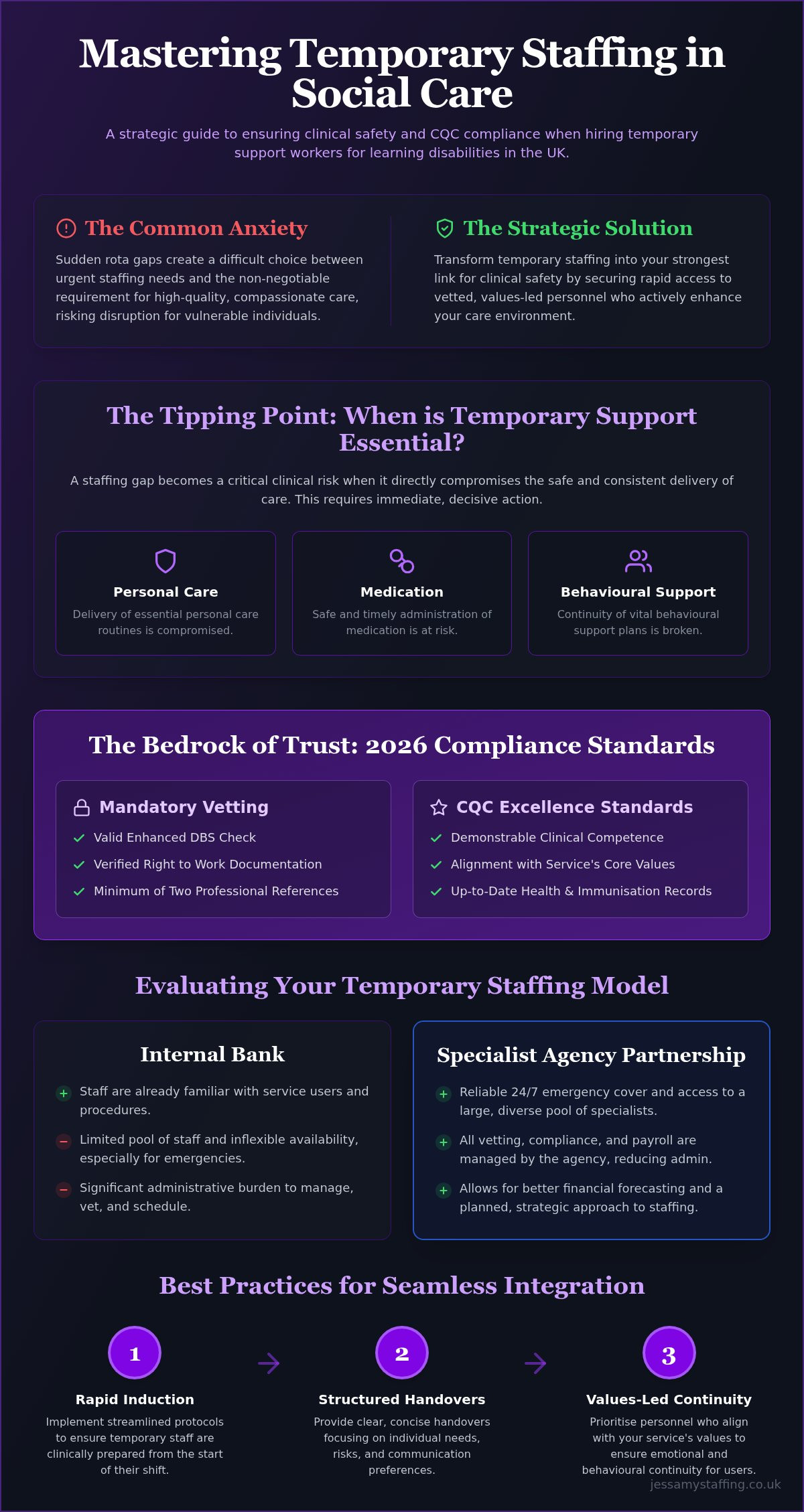
Distinguishing between a “desirable” shift cover and an “essential” one requires a rigorous assessment of service user risk profiles. If a gap compromises the delivery of personal care, medication administration, or behavioural support, it has reached a tipping point of clinical necessity. Understaffing doesn’t just create stress; it creates an environment where incidents are more likely to occur and safety is compromised. According to 2026 standards, a safe staffing ratio is defined as the minimum number of qualified personnel required to meet the specific acuity and safety needs of every service user at all times. For immediate crises where these ratios are threatened, accessing 24/7 emergency care staffing UK is the most effective way to restore operational stability and ensure safety.
The Impact of Understaffing on Care Quality
The Care Quality Commission (CQC) continues to focus on how staffing levels directly correlate with the “Safe” and “Well-led” domains of their inspection framework. A history of unfilled shifts or excessive overtime is often viewed as a red flag for poor leadership. Maintaining clinical standards whilst managing high turnover requires a proactive approach to recruitment. There is a distinct difference between “agency-heavy” rotas, which result from reactive panic, and “strategically-supported” rotas that use temporary support workers for learning disabilities UK as a planned extension of the team. Reactive spending on unplanned agency cover often results in inflated costs that drain budgets without improving outcomes. Conversely, a partnership model allows for better financial forecasting and ensures that every pound spent on staffing contributes directly to the stability of the care environment.
Essential Compliance Standards for Temporary Care Staff in 2026
Compliance in the social care sector is the bedrock of trust between a provider and the families they serve. In 2026, the non-negotiable standards for hiring temporary support workers for learning disabilities UK extend far beyond a standard background check. Ensuring that every individual has a valid Enhanced DBS, verified Right to Work documentation, and a minimum of two professional references is the bare minimum for regulatory safety. However, the current CQC framework places a higher premium on the “Well-led” and “Safe” domains, requiring providers to demonstrate that their temporary personnel are not only legally cleared but clinically competent and ethically aligned with the service’s values.
Technical compliance ensures safety, but values-led recruitment ensures quality of life. For individuals with learning disabilities, continuity of care relies on staff who possess emotional intelligence and a genuine sense of duty. This human-centric approach prevents the destabilising “revolving door” feeling that often occurs in sensitive care environments. Additionally, verified immunisation records and up-to-date occupational health assessments are essential safeguards, particularly when staffing environments with high clinical vulnerability or complex physical needs.
Mandatory Training and Accredited Qualifications
Possession of the Care Certificate remains the baseline, but complex environments like children’s home care demand specialised expertise. It’s vital that staff are trained in areas such as positive behaviour support and dysphagia management before they step onto a shift. You can find more detail in our training for complex care workers guide, which outlines the current professional development expectations. Accredited training transforms a staff member from a mere presence into a professional capable of upholding the highest clinical standards.
Rigorous Vetting: Beyond the Basic DBS
A basic DBS check is a snapshot in time; it doesn’t measure current clinical competency. Rigorous vetting must include practical assessments of a worker’s ability to handle real-world scenarios. At Jessamy Staffing Solutions, we integrate our accredited social care training directly into our recruitment model, ensuring that every worker is professionally prepared for the specific challenges of your service. When reviewing staff profiles, look for red flags such as unexplained gaps in employment or training records that haven’t been refreshed within the last twelve months. If you’re struggling to maintain these high standards during a recruitment gap, consider how a values-led staffing partner can reinforce your existing compliance protocols.
Agency vs. Internal Bank: Evaluating Your Temporary Staffing Model
Choosing between an internal bank and an external partner is a decision that impacts both your balance sheet and your service quality. Whilst an internal bank may appear more cost-effective on the surface, the true “all-in” expenditure often tells a different story. You must account for the ongoing cost of recruitment, accredited training, National Insurance, and the significant administrative time required to manage rotas and compliance records. For many providers, the hidden burden of maintaining an internal personnel pool can detract from frontline management duties, creating a secondary layer of operational stress.
Specialist agencies provide a level of scalability that internal banks often struggle to match, particularly when responding to 24/7 emergency needs in real-time. When you hire temporary support workers for learning disabilities UK through a dedicated partner, you are not just buying a shift cover; you are investing in a pre-vetted, clinically prepared professional. This model allows your service to remain agile, scaling support up or down without the long-term financial risk of permanent overheads or the logistical nightmare of an empty bank during a local sickness outbreak.
Cost-Benefit Analysis of Agency Support
A rigorous cost-benefit analysis must look beyond the hourly rate. Consider the value of rapid-response availability in Greater Manchester, where a single unfilled shift can lead to a safeguarding incident or a negative CQC inspection outcome. Agencies absorb the costs of holiday pay, sick pay, and professional development, providing a fixed-cost solution that simplifies financial forecasting. This strategic approach reduces both financial volatility and the regulatory risks associated with understaffed shifts, allowing you to focus on the quality of care delivery rather than rota logistics.
Ensuring Values-Led Continuity in Care
Maintaining a “one team” feel is entirely possible when working with the right partner. The key lies in choosing a support worker recruitment agency that prioritises personality matching alongside technical skill. By aligning the temperament of temporary support workers for learning disabilities UK with your specific service user demographic, you ensure that care remains compassionate and human-centric. This localised approach fosters a sense of partnership where temporary staff feel like a natural extension of your permanent team, rather than a separate entity, reinforcing a consistent care culture for your service users.
Best Practices for Onboarding and Managing Temporary Workers
Successful integration of temporary support workers for learning disabilities UK hinges on the first sixty minutes of their arrival. A well-structured onboarding process doesn’t just improve efficiency; it serves as a critical safeguard for service user well-being. When a temporary professional enters your facility, they must feel equipped to provide care that is indistinguishable from your permanent team. This requires a methodical approach to information sharing and clinical oversight from the very start of the shift. Clear clinical briefings at the start of each handover ensure that temporary staff are fully aware of any recent changes in care plans or behavioural triggers.
Creating a Seamless Integration Process
A “Rapid Induction” pack is an indispensable tool for busy managers. This document should provide essential information within the first thirty minutes, including fire safety protocols, emergency contact numbers, and high-level service user profiles. In complex care environments, shadowing protocols are equally vital. Allowing a temporary worker to observe a routine before taking the lead ensures they understand the specific nuances of a service user’s communication style and personal preferences. This level of detail prevents the distress that can occur when routines are disrupted. For more guidance on managing these transitions, see our advice on choosing the right supported living staffing agency for your specific service needs.
Performance Monitoring and Feedback
Clinical safety is maintained through consistent performance monitoring and transparent feedback loops. Utilising detailed shift reports allows you to track care quality and incident management in real-time, providing a clear audit trail for CQC inspections. These reports shouldn’t be mere tick-box exercises; they ought to provide genuine insight into the day’s interactions and any challenges faced. If a concern arises, the agency plays a pivotal role in professional discipline and retraining, acting as your partner in maintaining high standards. Conversely, recognising excellence is just as important. When temporary support workers for learning disabilities UK perform exceptionally, providing that feedback to the agency encourages continuity and builds a pool of familiar faces who understand your service culture. If you need a partner that prioritises these rigorous standards, you can request compliant support workers here to strengthen your team.
Jessamy Staffing Solutions: Reliable Temporary Support in Greater Manchester
Jessamy Staffing Solutions operates as a principled partner for care providers across the North West. We recognise that the provision of temporary support workers for learning disabilities UK is not a mere logistical exercise but a vital contribution to clinical safety. Our model is built upon the integration of accredited social care training with a rigorous, values-led recruitment process. This ensures that every professional we supply is not only technically competent but also ethically aligned with the sensitive nature of the environments they enter. By prioritising the intersection of efficiency and empathy, we position ourselves as a stable, long-term partner for your organisation.
Our approach is grounded in the belief that staffing should never be a source of instability. Instead, it should be a mechanism for maintaining the high standards your service users deserve. We provide personnel who are professionally prepared for the complexities of modern social care, from supported living environments to residential facilities. This commitment to excellence is what allows us to bridge the gap between institutional requirements and human needs, acting as a meticulous guardian of standards for every client we serve.
24/7 Emergency Cover and Specialist Support
Our 24/7 emergency cover acts as the essential backbone for local services, providing a rapid response when stability is most threatened. Whether your facility requires qualified support worker supply, domestic staff, or specialist children’s complex care at home, our response model is designed for immediate impact. We don’t just fill gaps; we strengthen care environments by providing dependable workforce capacity that respects the dignity of the service user. This commitment to reliability allows managers to maintain operational excellence even during unforeseen staffing crises. Our personnel are professionally prepared to step into complex care roles, ensuring that clinical standards are upheld from the moment they arrive on site.
Why Local Expertise Matters in Social Care
Local expertise is fundamental to the integrity of social care delivery in the North West. Having deep roots in the Greater Manchester care economy allows us to understand the specific pressures faced by local authorities and private providers alike. Jessamy Staffing Solutions acts as a bridge between institutional requirements and human needs, projecting the image of a meticulous guardian of standards. By choosing a partner with local knowledge, you gain more than just a staffing solution; you gain a collaborator dedicated to the long-term success of your organisation and the well-being of those in your care. To ensure your service is protected, the next step is to register for our emergency cover, allowing us to provide the rapid, values-led support your service users deserve.
Building a Resilient Care Strategy for 2026
Mastering the complexities of temporary staffing is about more than just filling a rota; it’s about safeguarding the clinical excellence and continuity that your service users rely on. By prioritising rigorous compliance and values-led onboarding, you transform a potential vulnerability into a strategic asset. You’ve seen how the right approach to hiring temporary support workers for learning disabilities UK ensures that high-quality care remains uninterrupted, even during the most challenging staffing shortages. It’s a commitment to standards that protects your permanent team’s resilience and maintains your service’s reputation with the CQC.
As a Greater Manchester specialist and accredited training provider, Jessamy Staffing Solutions is dedicated to reinforcing your care environment with professionally prepared personnel. Whether you require planned assistance or our 24/7 emergency cover, we act as a meticulous guardian of your service standards. Don’t let staffing gaps compromise the quality of your care delivery. Secure Reliable Temporary Support for Your Manchester Service Today and ensure your facility remains a beacon of stability and compassion for those you support.
Frequently Asked Questions
How quickly can you provide temporary support workers in Greater Manchester?
We provide support workers through our 24/7 emergency cover model, often responding to urgent requests within hours. Our established presence across Greater Manchester allows us to mobilise personnel rapidly to address sudden rota gaps or clinical crises. We understand that time is critical when service user safety is at stake, so our recruitment and logistics teams are structured to ensure workforce capacity is restored as quickly as possible.
What compliance documents should I expect from a staffing agency in 2026?
You should expect a comprehensive compliance pack for every worker. This includes a valid Enhanced DBS check, verified Right to Work documentation, and a minimum of two professional references. In 2026, CQC standards also require up-to-date accredited training records and occupational health assessments. We ensure all temporary support workers for learning disabilities UK have their documents verified and refreshed annually to maintain the highest levels of clinical and regulatory safety.
Can I request the same temporary worker for continuity of care?
Yes, we actively encourage requesting the same personnel to maintain continuity of care for your service users. For individuals with learning disabilities, familiarity with a support worker’s communication style and personality is essential for their well-being. We work closely with our clients to build a pool of regular temporary staff who understand your facility’s specific culture and routines, fostering a sense of stability and partnership within your permanent team.
Are your temporary support workers trained in complex care for children?
Our personnel are specifically trained to support sensitive environments, including children’s complex care at home. We integrate accredited social care training with our recruitment process to ensure staff are professionally prepared for high-acuity needs. This training covers essential areas such as positive behaviour support and specialised clinical tasks. We recognise that paediatric care requires a unique blend of technical competence and emotional intelligence to support both the child and their family.
What is the minimum shift length for temporary care staff in the UK?
Minimum shift lengths typically range from four to six hours, depending on the specific requirements of the service and the complexity of the care provided. This duration ensures that temporary staff have sufficient time to receive a thorough clinical briefing, integrate with the team, and provide meaningful support to service users. Longer shifts are often preferred to maintain the rhythm of the care environment and reduce the frequency of handovers.
How does Jessamy Staffing Solutions ensure staff are truly “values-led”?
We ensure our staff are values-led by incorporating ethical assessments into our recruitment and accredited training models. We look for individuals who demonstrate empathy, integrity, and a genuine sense of duty during the selection process. By pairing professional capabilities with human-focused outcomes, we recruit personnel who prioritise the dignity of the end-user. This approach ensures that our temporary support workers for learning disabilities UK act as compassionate partners rather than just shift fillers.
Do you provide emergency cover for night shifts and bank holidays?
Our 24/7 emergency cover is fully operational every day of the year, including night shifts, weekends, and bank holidays. We recognise that staffing crises don’t only happen during office hours, so our rapid response team is always available to secure your rota. This constant availability provides Manchester providers with the reassurance that workforce capacity can be restored at any time, ensuring clinical safety is never compromised by the calendar.
What happens if a temporary worker is not a good fit for our service?
If a temporary worker is not a suitable fit, we encourage immediate feedback to our management team. We take professional discipline seriously and will work with you to understand the specific concerns, whether they relate to clinical competency or cultural alignment. Our role as a partner is to ensure your service standards are met, so we will provide a replacement as quickly as possible whilst addressing any retraining needs for the individual involved.