



In a supported living environment, a clean floor or a nutritious meal isn’t merely a domestic task; it’s a fundamental pillar of safeguarding and resident dignity. You probably recognise that hiring domestic staff for supported living services requires a delicate balance of technical precision and profound empathy. It’s frustrating when high turnover or inconsistent hygiene standards begin to impact your CQC ratings and the overall morale of your care team.
We understand that you need more than just a cleaning or catering solution. You require a partnership built on integrity and meticulous standards. This guide shows you how to secure reliable, compliant, and values-led personnel who enhance the safety of your environment. We will examine the latest 2026 DBS compliance costs, the impact of the Supported Housing (Regulatory Oversight) Act 2023, and strategies for integrating domestic workers seamlessly into your clinical framework in Greater Manchester. By aligning operational excellence with human-centric care, you can ensure your facility remains a safe and welcoming space for every resident.
Key Takeaways
- Understand why domestic personnel are vital for maintaining infection control and achieving high CQC ratings through consistent hygiene and catering standards.
- Navigate the legal requirements of hiring domestic staff for supported living services, including the necessity of Enhanced DBS checks and rigorous Right to Work verification.
- Evaluate the cost-efficiency and operational flexibility of specialist agency staffing compared to the administrative burden and hidden costs of direct recruitment.
- Identify how accredited training and values-led recruitment ensure that non-clinical staff possess the empathy required for sensitive care environments.
- Learn how to mitigate operational risks using 24/7 emergency cover to ensure your facility remains safe, clean, and fully compliant at all times.
The Essential Role of Domestic Care Staff in UK Healthcare
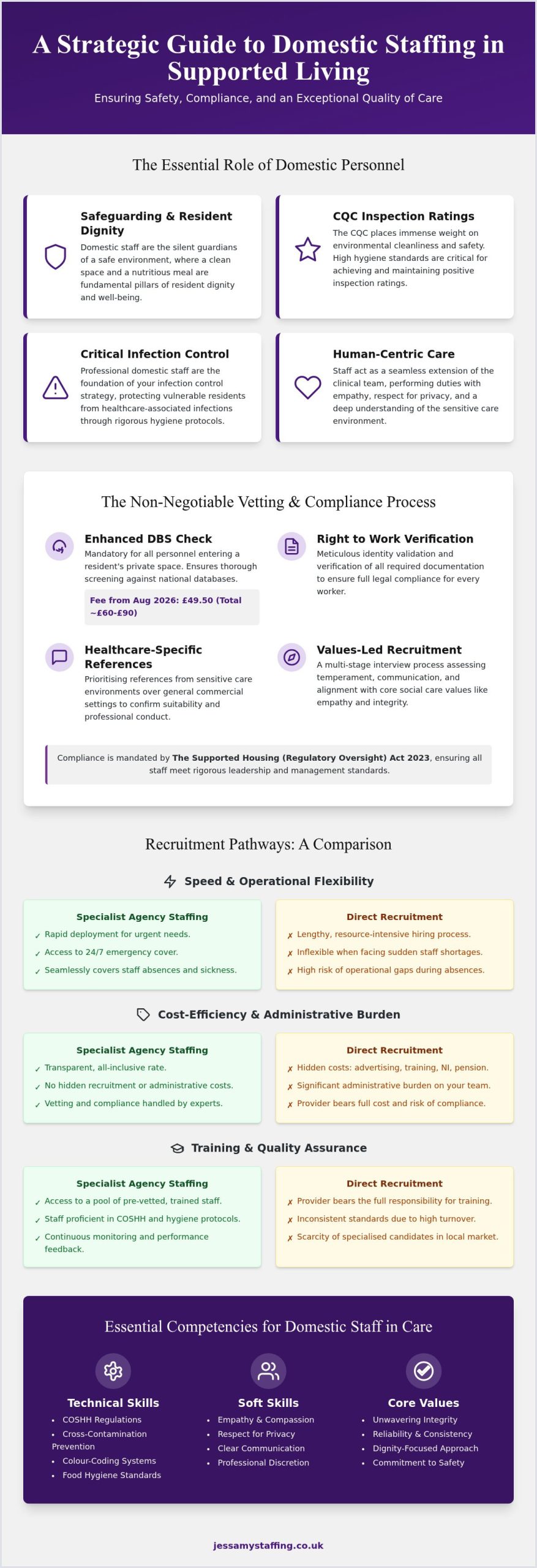
Domestic care staff are the silent guardians of safety and dignity within a care setting. Whilst their titles often include cleaners, cooks, or laundry assistants, their impact extends far beyond basic maintenance. These professionals are responsible for environmental hygiene, nutritional support, and the management of personal effects. In the context of What is Supported Living?, these roles become even more pivotal as they directly influence the independence and quality of life for individuals with complex needs.
When you are hiring domestic staff for supported living services, you aren’t just filling a rota; you’re securing the foundation of your infection control strategy. The Care Quality Commission (CQC) places immense weight on the cleanliness and safety of the environment. Inadequate hygiene isn’t simply an aesthetic failure; it’s a direct threat to resident health that can lead to poor inspection ratings and regulatory intervention. Professional domestic staff understand that their work is a core safeguarding function that protects vulnerable residents from healthcare-associated infections.
Beyond Cleaning: The Value of Specialised Training
Effective domestic work in a care environment requires a high level of technical competency. Staff must be proficient in Control of Substances Hazardous to Health (COSHH) regulations and understand the rigorous colour-coding systems used to prevent cross-contamination. However, technical skill is only half of the requirement. Domestic staff often spend significant time amongst residents, making soft skills and empathy essential. Whether they are preparing a meal or cleaning a private room, they must do so with a deep respect for the resident’s privacy and dignity, acting as a seamless extension of the clinical care team.
Domestic Staffing in Greater Manchester: Local Demand
The North West currently faces unique challenges regarding ancillary staff shortages. In Greater Manchester, the high demand for supported living services has placed a strain on the local workforce capacity. This scarcity often leads to inconsistent standards if providers rely on general recruitment rather than specialised healthcare staffing. Local expertise is vital for maintaining operational standards. Having access to a rapid-response domestic team that understands the Manchester care landscape ensures that your facility never faces a lapse in hygiene or catering, even during unexpected staff absences or emergency peaks.
Compliance and Vetting: Ensuring Safety in the Care Sector
Vetting is not a box-ticking exercise. It is a comprehensive shield that protects the most vulnerable members of our society from harm. When you are hiring domestic staff for supported living services, the recruitment process must be as rigorous as that for clinical personnel. Every domestic worker, from catering assistants to housekeepers, must undergo an Enhanced DBS check. As of August 2026, the government fee for an Enhanced DBS check is £49.50, though processing through umbrella bodies typically brings the total cost to between £60 and £90. This investment ensures that those entering a resident’s private living space have been thoroughly screened against national databases.
Legislative compliance forms the backbone of safe staffing. The Supported Accommodation (England) Regulations 2023 mandate that providers ensure all staff have the appropriate skills and qualifications to maintain the leadership and management standard. This includes meticulous identity verification and Right to Work documentation. Beyond the paperwork, we prioritise healthcare-specific references. A candidate’s history in a general commercial setting may not reflect their ability to maintain the high register of professional conduct required in a sensitive care environment. Values-led recruitment allows us to identify individuals who possess the inherent empathy and integrity necessary for these roles.
The Jessamy Standard: Vetting and Compliance
Our Manchester-based recruitment team follows a strict, multi-stage interview process that goes beyond technical ability. We assess temperament, communication skills, and a candidate’s alignment with the core values of the social care sector. This ensures all personnel are professionally prepared to work amongst vulnerable adults and children before they ever step foot in your facility. To maintain these high standards, we utilise continuous monitoring and performance feedback loops. If you require vetted personnel who integrate seamlessly with your clinical team, you can partner with Jessamy Staffing Solutions for reliable domestic solutions.
Safeguarding Training for Non-Clinical Personnel
Domestic staff are often the “eyes and ears” of a facility. Because they perform routine duties in private spaces, they are frequently the first to recognise subtle behaviour changes or signs of concern in a resident. It’s essential that these workers receive foundational safeguarding training. They must understand the facility’s reporting hierarchy and feel confident in their duty to escalate observations to the clinical lead. By integrating domestic staff into your safety culture, you create a more robust safeguarding environment where every team member is empowered to protect resident wellbeing.
Agency vs. Direct Recruitment: A Comparison for Care Providers
Choosing between direct recruitment and an agency partnership is a strategic decision that shapes the operational resilience of your facility. Whilst direct hiring might appear cost-effective on the surface, the hidden expenses often accumulate rapidly. Advertising vacancies, conducting interviews, and performing the rigorous background checks required for the care sector demand significant time from senior management. When you are hiring domestic staff for supported living services directly, your organisation also carries the full burden of staff turnover and the continuous need for retraining.
Professional agencies offer a layer of quality control that is difficult to replicate internally. They manage the complexities of compliance and accredited training on your behalf, ensuring that every worker is ready to contribute from day one. This shift from a transactional staffing model to a long-term partnership allows care providers to focus on their primary mission: resident wellbeing. By outsourcing the recruitment and vetting process, you gain a dependable workforce that is already aligned with the high standards expected by the CQC.
Cost-Effectiveness and Operational Efficiency
Utilising an agency significantly reduces the administrative pressure on care home coordinators. Instead of managing complex rotas and chasing references, managers can rely on a streamlined supply of pre-vetted personnel. One of the most critical advantages is the availability of 24/7 emergency cover. This ensures that essential services like catering and laundry never experience downtime due to staff sickness or holiday leave. Agencies provide ready-to-work staff, eliminating the typical three-to-four-week onboarding delay associated with independent recruitment.
Managing Last-Minute Domestic Staffing Crises
Understaffing in hygiene-critical departments like the laundry or kitchen can quickly destabilise a service. A single absence in a small domestic team can lead to a backlog that compromises infection control or disrupts resident meal times. Rapid-response domestic cover is essential for preventing these operational failures. When a crisis occurs, having a partner who provides 24/7 Emergency Care Staffing UK: Reliable Rapid-Response Solutions is vital. This immediate support ensures that hiring domestic staff for supported living services remains a proactive safeguarding measure rather than a reactive scramble, maintaining the safety and dignity of the environment at all times.
How to Choose the Right Domestic Care Staff Agency
Selecting a recruitment partner is a high-stakes decision that directly affects your facility’s operational safety. A generic recruitment agency often lacks the specialised knowledge required to navigate the nuances of a clinical environment. When you are hiring domestic staff for supported living services, you need a partner that understands the specific hygiene standards and safeguarding protocols mandated by the CQC. They should speak the language of the care sector, demonstrating a clear grasp of how non-clinical roles support clinical outcomes.
Meticulous vetting is only the first step. You must also evaluate an agency’s commitment to continuous professional development. Ask whether their domestic personnel have undergone accredited social care training that includes food safety, infection control, and COSHH regulations. Beyond technical certificates, look for a values-led recruitment process. Personnel who display genuine empathy and respect for resident dignity are essential for maintaining the human-centric atmosphere of a supported living home. This intersection of efficiency and empathy is what defines a truly principled staffing partner.
Questions to Ask Your Potential Staffing Partner
Before entering a long-term partnership, it’s vital to challenge a provider on their operational capabilities. Use these targeted questions to assess their suitability for your specific needs:
- How do you handle emergency domestic cover during night shifts or weekends? Reliable agencies should offer 24/7 emergency cover to ensure your facility remains clean and compliant at all times.
- What specific accredited training do your domestic staff receive before placement? Ensure the training is relevant to the UK health and social care sector, rather than just general commercial cleaning.
- Can you provide domestic staff with experience in children’s complex care environments? If your facility specialises in paediatric care, the domestic team must be prepared for the unique sensitivities of that setting.
The Importance of Local Knowledge in Greater Manchester
Geography plays a critical role in staffing reliability. A Manchester-based agency possesses an intimate understanding of the local care landscape and the specific challenges facing North West providers. They understand the local commute patterns and can supply staff who are familiar with the regional standards of excellence. This local expertise ensures that staff arrive on time and are ready to integrate into your team without the friction often found with national, non-specialist firms. For a deeper look at selecting the right partner, read The Definitive Guide to Choosing a Support Worker Recruitment Agency in 2026.
Choosing a partner who prioritises integrity and high standards will protect your organisation’s reputation and the wellbeing of your residents. If you’re looking for a reliable team to support your facility, you can explore our domestic staffing solutions to find the right fit for your service.
Jessamy Staffing Solutions: Your Partner for Professional Domestic Solutions
At Jessamy Staffing Solutions, we recognise that non-clinical roles are the foundation of a safe and welcoming care environment. Our approach to hiring domestic staff for supported living services is built on the belief that every team member should be a meticulous guardian of standards. We act as a principled bridge between your institutional requirements and the high-quality human care your residents deserve. By choosing a partner that prioritises both technical competence and emotional intelligence, you ensure your facility remains a sanctuary of dignity and health.
Our commitment to excellence is reflected in our rigorous selection process. We don’t simply fill vacancies; we provide professionally prepared personnel who are ready to integrate into your existing clinical framework. This focus on reliability and integrity allows you to maintain consistent hygiene and catering standards, protecting both your residents and your organisation’s reputation. Our Greater Manchester team is dedicated to providing bespoke solutions that reflect the unique needs of your service.
Integrated Training and Recruitment
The Jessamy model is defined by the seamless integration of accredited social care training into our recruitment process. We develop a competent and dependable workforce by ensuring all staff understand the complexities of the care sector before their first placement. This preparation is especially vital for those working in supported living and complex care settings. Every domestic worker we supply is trained to strengthen your facility’s operational standards, ensuring they provide support that enhances rather than destabilises sensitive care environments.
Emergency Cover and Long-Term Support
Operational continuity is non-negotiable in the healthcare sector. We provide 24/7 emergency cover for domestic, nursing, and support staff to ensure that no shift goes unfilled and no hygiene standard is compromised. This rapid-response capability is a cornerstone of our long-term partnerships with healthcare organisations across Greater Manchester. For a broader perspective on effective workforce management, you may consult our Strategic Guide to Healthcare Personnel Supply in the UK for 2026.
Our Greater Manchester office is ready to help you develop a domestic staffing solution tailored to your specific requirements. Whether you need immediate emergency support or a permanent addition to your domestic team, we provide the stability and expertise necessary for operational success. Contact us today to discuss how our values-led recruitment and accredited training can enhance the safety and dignity of your supported living environment.
Securing the Future of Your Care Environment
Maintaining a safe and dignified space for residents is a continuous commitment that extends to every corner of your facility. As established, effective domestic support is a core component of safeguarding and CQC compliance; it’s never just about cleaning. By prioritising rigorous vetting and specialised training, you protect your organisation from operational risks whilst ensuring residents receive the high register of care they deserve. Hiring domestic staff for supported living services requires a partner who understands that hygiene and catering are fundamental to positive clinical outcomes.
Jessamy Staffing Solutions acts as your principled expert in Greater Manchester, providing 24/7 emergency cover and a values-led recruitment process. As an accredited social care training provider, we ensure our personnel are professionally prepared for the unique sensitivities of your environment. You don’t have to manage the burden of recruitment alone. We’re here to help you build a stable, compliant, and compassionate team that supports your mission every day. Enquire about our professional domestic care staff today to strengthen your service with reliable personnel.
Frequently Asked Questions
What is the difference between domestic care staff and general cleaners?
Domestic care staff operate within a clinical framework, requiring specialised training in infection control and safeguarding. Unlike general cleaners, they must balance technical tasks with the empathy needed for sensitive environments. They understand healthcare-specific regulations like COSHH and the importance of resident dignity. Their role is integrated into the wider care team to support overall resident wellbeing. This specialised focus ensures that the environment remains a safe and therapeutic space for every individual.
Do domestic care staff need a DBS check in the UK?
Yes, all domestic personnel working in supported living must undergo an Enhanced DBS check. This is a legal requirement because these individuals have access to private living areas and work amongst vulnerable adults or children. As of August 2026, the government fee for this check is £49.50. This meticulous screening ensures that every staff member entering a resident’s home has been thoroughly vetted against national safeguarding databases, prioritising the safety of the service users.
Can an agency provide domestic staff for 24/7 emergency cover?
Specialist agencies like Jessamy Staffing Solutions provide 24/7 emergency cover to prevent operational downtime. This is vital for maintaining hygiene and catering standards during unexpected staff absences or last-minute crises. Having access to a rapid-response team ensures that your facility remains safe and compliant at all times. This service is particularly beneficial for facilities in Greater Manchester that require reliable, vetted personnel at short notice. It provides peace of mind that essential services will never lapse.
What training should a domestic worker in a care home have?
A domestic worker should possess accredited training in food safety, infection control, and COSHH regulations. In a supported living context, they also require foundational safeguarding knowledge and fire safety training. Beyond technical skills, values-led training is essential to ensure they interact respectfully with residents. Hiring domestic staff for supported living services through an accredited provider ensures that personnel are professionally prepared for the unique challenges of the healthcare sector, contributing to a culture of excellence.
How quickly can a domestic care staff agency fill a vacancy?
Specialist agencies can often fill domestic vacancies within hours through their 24/7 emergency cover models. Because agencies maintain a pool of pre-vetted and trained personnel, they bypass the lengthy onboarding delays of direct recruitment. This rapid turnaround is essential for hygiene-critical departments like laundry or catering, where a single absence can disrupt the entire facility. It ensures that your service remains stable and your high standards of cleanliness are never compromised by staffing gaps.
Is it better to hire domestic staff through an agency or directly?
Agency recruitment is often superior for care providers due to the reduced administrative burden and increased flexibility. Agencies manage the complexities of Enhanced DBS checks, Right to Work documentation, and accredited training on your behalf. Whilst direct hiring might seem cheaper initially, the hidden costs of advertising and high turnover can be significant. Hiring domestic staff for supported living services through an agency provides a scalable, compliant, and reliable workforce solution that adapts to your changing needs.
Do domestic staff also provide personal care to residents?
No, domestic staff do not provide personal care such as assistance with washing, dressing, or medication. Their responsibilities are focused on environmental hygiene, catering, and laundry management. However, they must be trained to recognise signs of concern or behaviour changes whilst performing their duties. If they notice anything unusual, they are required to report it to the clinical lead as part of the facility’s integrated safeguarding hierarchy, acting as the eyes and ears of the team.
How does an agency ensure the quality of their domestic personnel?
Quality is maintained through a combination of rigorous values-led recruitment and continuous performance monitoring. Agencies use multi-stage interview processes to assess both technical competency and emotional intelligence. Accredited training programmes ensure that all staff are up to date with the latest healthcare standards and regulations. Regular feedback loops with clients allow the agency to address any issues promptly, ensuring that every worker continues to meet the high register of professionalism and integrity expected in the care sector.