



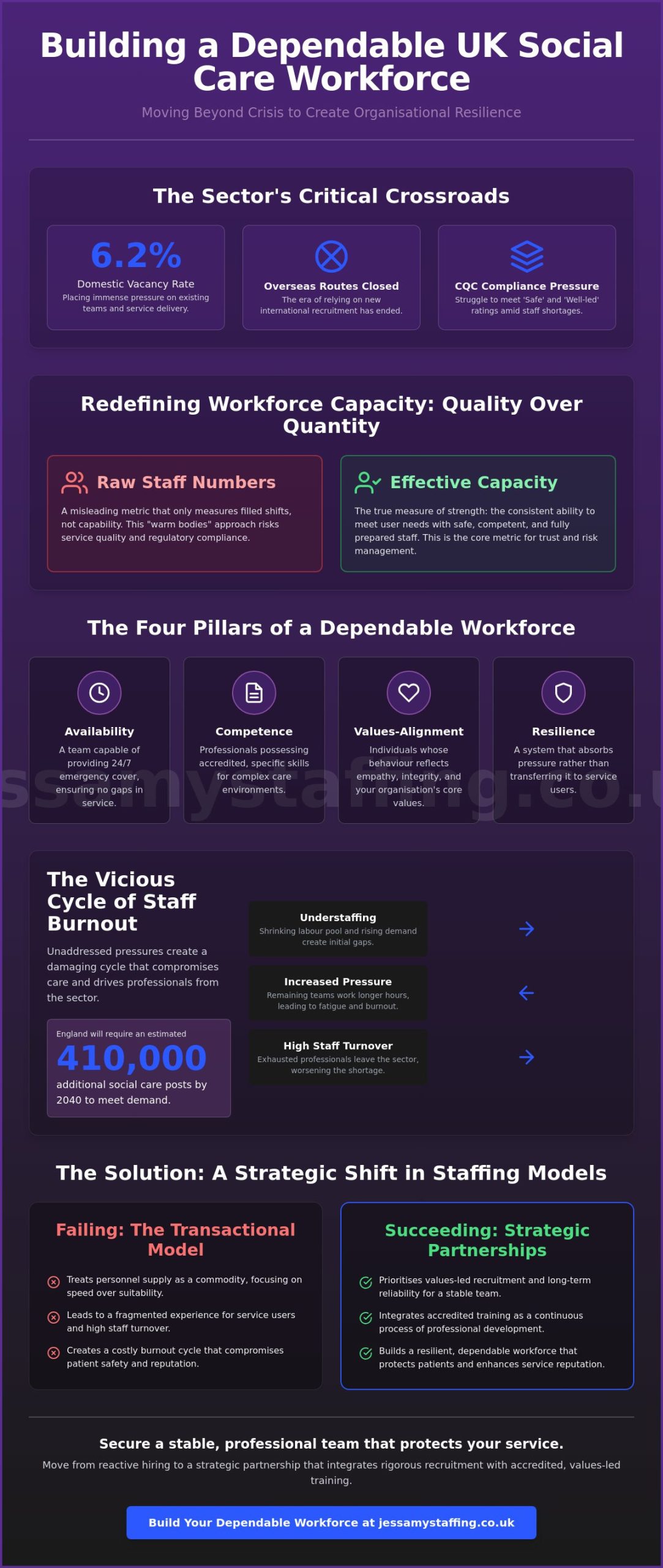
The era of relying on international recruitment to fill immediate gaps has ended, leaving social care providers at a critical crossroads. With the closure of new overseas sponsorship routes and a domestic vacancy rate of 6.2 per cent, maintaining dependable care workforce capacity is no longer just an operational goal; it’s a test of organisational resilience. You likely feel the weight of rising wage costs, with the National Living Wage reaching £12.71, whilst simultaneously striving to meet CQC safe staffing levels without compromising on the quality of support.
We recognise that the constant cycle of staff turnover and the pressure of securing 24/7 emergency cover can be exhausting. It’s difficult to find professionals who don’t just fill a shift but truly share your organisation’s values. This guide promises to show you how to move beyond reactive hiring by integrating rigorous recruitment with accredited, values-led training. We’ll explore the impact of the 2026 Fair Pay Agreement developments and practical methods to secure a stable, professional team that protects both your patients and your service reputation.
Key Takeaways
- Understand the vital distinction between raw staff numbers and effective capacity to ensure every team member is truly prepared for the complexities of modern care.
- Recognise the structural drivers of the sector’s burnout cycle and implement strategies that protect your team’s well-being whilst maintaining operational excellence.
- Discover how accredited social care training acts as a primary tool for building a dependable care workforce capacity that consistently exceeds regulatory expectations.
- Evaluate the benefits of moving from transactional agency models towards strategic staffing partnerships that prioritise values-led recruitment and long-term reliability.
- Learn how an integrated approach to training and personnel supply ensures that your organisation remains resilient, even during 24/7 emergency cover requirements.
Defining Dependable Care Workforce Capacity in the Modern UK Sector
True organisational strength doesn’t stem from a full roster; it grows from the reliability of every individual on that list. In the current landscape of Social care in England, we define dependable care workforce capacity as the consistent ability to meet service user needs with safe, competent staff. It’s a measure of trust. It ensures that when a vulnerable individual requires support, the professional arriving at their door is prepared, authorised, and capable of delivering high-standard care without hesitation.
We must distinguish between raw numbers and effective capacity. A filled shift is merely a statistic, but effective capacity represents the volume of workers who are actually trained for the specific task at hand. In 2026, dependability has become the core metric for risk management. With the domestic vacancy rate sitting at 6.2 per cent and international recruitment routes restricted, providers can’t afford the luxury of ‘warm bodies’ who lack specialised skills. Workforce stability is now directly linked to CQC ‘Safe’ and ‘Well-led’ ratings. Regulators increasingly look beyond the rota to see if the personnel supply is resilient enough to maintain safety during peak demand or unexpected absences.
The Four Pillars of Workforce Reliability
To build a truly resilient system, providers should focus on four distinct areas of dependable care workforce capacity. Availability is the first requirement; you need a team capable of providing 24/7 emergency cover to prevent service gaps. Competence follows, ensuring workers possess the specific skills for complex care environments. Values-alignment is equally vital. We look for individuals whose behaviour reflects the favourite traits of the profession: empathy, integrity, and patience. Finally, resilience ensures the system doesn’t destabilise when a single shift goes unfilled. A resilient workforce absorbs pressure rather than transferring it to the service user.
Why Traditional Recruitment Models are Failing
The trap of transactional staffing has caught many organisations off guard. This model treats personnel supply as a commodity, focusing on speed over suitability. It often ignores long-term service quality, leading to a fragmented experience for the client. When workers feel like temporary fixes rather than valued professionals, turnover amongst staff inevitably rises. This churn creates a burnout cycle that compromises patient safety and damages an organisation’s reputation. Moving towards 2027, the sector requires a more holistic, integrated approach where recruitment and training are viewed as a single, continuous process of professional development.
The Drivers of Capacity Crises in UK Social Care
The UK’s demographic shift is relentless, and it’s placing unprecedented pressure on the sector. By 2040, England will require an estimated 410,000 additional social care posts to meet the needs of an ageing population. This isn’t just a numbers game; it’s a surge in demand for highly specialised support, particularly for Children’s Complex Care at Home and elderly residents with multiple comorbidities. When this rising demand meets a shrinking domestic labour pool, the burnout cycle begins. Understaffing forces remaining teams to work longer hours, causing the very fatigue that leads to further exits from the profession.
In regions like Greater Manchester, these challenges are amplified by local economic factors. Providers often face intense competition from the retail and hospitality sectors, where roles may offer similar pay without the emotional and physical demands of care. Transport links between boroughs can also create logistical barriers, making it difficult for staff to reach service users consistently. Proactive workforce planning is the only way to mitigate these regional pressures. Relying on ’emergency-only’ thinking is a costly mistake. Procrastination in recruitment leads to high-frequency spot-purchasing of temporary staff, which is significantly more expensive than building a stable, long-term dependable care workforce capacity through strategic partnerships. Understanding how to secure a reliable health and social care staff supply UK wide is essential for providers looking to move beyond reactive hiring and build lasting operational resilience.
Regulatory Pressures and Compliance Risks
CQC inspections have evolved to focus heavily on workforce capability and the robustness of training records. Inspectors aren’t merely checking if a shift is filled; they’re assessing whether the person on duty has the specific competence to manage the risks present. Using poorly prepared personnel in sensitive settings isn’t just a safety hazard; it’s a threat to your organisation’s registration. This reality has elevated workforce planning to a board-level priority, as the link between staffing stability and ‘Safe’ or ‘Well-led’ ratings becomes undeniable.
The Mismatch Between Training and Operational Needs
A significant skills gap persists across the industry. Many workers hold basic certificates but lack the practical intelligence required for complex, high-pressure environments. One-size-fits-all training often fails when applied to children’s complex care or specialised dementia support. When staff feel ill-equipped to handle their daily responsibilities, their confidence wanes. Without a clear path for professional development and specialised training, talented individuals often seek opportunities in other sectors, further depleting the dependable care workforce capacity you’ve worked hard to build.
Building Capability through Accredited Social Care Training
Training serves as the primary tool for organising a team into a high-functioning unit. It transforms individual potential into a collective strength, providing the structural framework that supports a service’s daily operations. By investing in accredited programmes, providers can standardise care quality across both temporary and permanent teams, ensuring that a service user’s experience doesn’t fluctuate based on the rota. This consistency is the bedrock of dependable care workforce capacity, as it removes the uncertainty often associated with varied skill levels amongst staff.
Specialised training is particularly powerful in unlocking niche capacity. For instance, providing advanced education in pediatric complex care allows an organisation to manage higher-acuity cases with confidence. When workers are equipped with specific clinical and emotional skills, the pool of available, competent staff grows. This proactive approach to development ensures that the organisation isn’t just reactive but is actively building a workforce that can handle the most demanding environments. It’s about ensuring that every hour of care delivered is backed by verified competence.
Staff retention remains one of the greatest challenges in the sector, yet Continuing Professional Development (CPD) offers a proven solution. CPD signals to staff that they are valued assets rather than interchangeable parts. When professionals see a clear path for growth and feel more confident in their roles, they are less likely to join the 23.6 per cent turnover rate currently seen across the sector. A workforce that feels supported in its learning is a workforce that stays. Understanding the full scope of frontline roles, including what is expected of a healthcare assistant in 2026, helps providers set accurate training benchmarks and career development pathways for their teams.
From Compliance to Excellence: The Training Spectrum
Mandatory training provides the baseline for safety, yet specialist development is what drives excellence. Whilst compliance ensures you meet the minimum legal standards, values-led training influences behaviour, encouraging staff to act with the empathy and integrity that patients deserve. To achieve this, it’s essential to partner with a support worker recruitment agency that operates its own accredited training centre. This integration ensures that every worker arriving at your facility has already been vetted for both technical skill and cultural fit.
The ROI of a Professionally Prepared Workforce
The financial benefits of a well-trained team are substantial. A professionally prepared workforce reduces the need for constant, costly re-induction of temporary staff who may not understand your specific protocols. It also significantly lowers the risk of safeguarding incidents, protecting the organisation from the legal and reputational costs that follow such events. Workforce capability is the intersection of skill, will, and organisational support. By prioritising training, you’re not just filling gaps; you’re building a sustainable foundation for dependable care workforce capacity that lasts.
Strategic Staffing Models for Long-Term Reliability
Strategic staffing isn’t about filling holes; it’s about building a foundation. The ‘Agency-Only’ model often prioritises speed over suitability, leading to a revolving door of unfamiliar faces. In contrast, a ‘Partnership’ model aligns the personnel provider with your long-term goals. This collaborative approach ensures that the provider understands your specific requirements for dependable care workforce capacity, treating their staff as an extension of your own rather than a temporary fix. It’s a shift from transactional hiring to relational investment.
We believe that technical skill is only half the requirement. Values-led recruitment acts as a vital filter, ensuring that every professional shares the core principles of dignity, integrity, and respect. This alignment is what transforms a temporary staff member into a dependable asset who can handle the nuances of complex care without constant supervision. When a worker’s personal values mirror those of your organisation, their behaviour remains consistent even under the pressure of 24/7 emergency cover.
When evaluating a supported living staffing agency, consider this essential checklist:
- Are their training programmes accredited and updated for 2026 standards?
- Do they demonstrate a deep understanding of local compliance and CQC requirements?
- Can they provide evidence of a rigorous vetting and values-alignment process?
- Is their billing transparent, with a clear ‘no-surprises’ policy?
- Do they offer seamless 24/7 emergency cover to ensure service continuity?
Evaluating Your Staffing Partners
Local knowledge is particularly crucial for Greater Manchester providers. A partner who understands the specific demographic challenges and transport links of the region is better equipped to manage logistics and ensure punctuality. This regional expertise, combined with a commitment to transparent communication, builds the trust necessary for a long-term partnership. You need a firm that doesn’t just promise numbers but delivers professionals who are ready for the unique demands of your local community.
Integrating Temporary Staff into Your Culture
Integrating temporary personnel into your culture requires intentional onboarding. Agency staff should feel like part of the team from the moment they arrive. Providing clear briefings and welcoming them into your communication loops improves their performance and job satisfaction. When 24/7 emergency care staffing UK is managed this way, it feels like a natural extension of your core team. Using feedback loops to refine the quality of personnel supply ensures that your dependable care workforce capacity remains high over the long term.
If you are ready to secure your team’s future with a partner who values quality as much as you do, explore our comprehensive staffing solutions today.
The Jessamy Approach: Integrating Training and Personnel Supply
At Jessamy Staffing Solutions, we position ourselves as a Principled Expert within the UK care economy. We understand that a roster of names is insufficient; what providers truly require is a dependable care workforce capacity that is both technically proficient and emotionally intelligent. Our model is built on the foundation that personnel supply and professional development are inseparable. By operating our own in-house accredited training centre, we ensure that every professional we deploy is not just vetted, but ‘professionally prepared’ for the specific rigours of your environment.
This integrated approach is particularly vital in high-stakes settings such as children’s complex care at home. In these sensitive domestic spaces, the intersection of clinical excellence and compassionate behaviour is non-negotiable. We don’t merely fill shifts; we provide continuity of care that respects the unique dynamics of a family home. Our 24/7 emergency response capability ensures that providers across Greater Manchester and beyond are never left vulnerable, providing a safety net that operates with the same rigour as your core team.
Values-Led, Rigorously Vetted
Our recruitment process extends far beyond the standard DBS check. We utilise a values-led filtering system to find individuals who demonstrate the empathy and integrity essential for the profession. This meticulous approach allows us to maintain a stable bank of staff ready for immediate deployment across Manchester. The Jessamy guarantee is simple: we provide safe, compliant, and professionally prepared personnel who are ready to make a positive impact from their very first hour on duty. We act as a bridge between your institutional requirements and the human needs of those you support.
A Stable Partner for Sensitive Environments
We support a diverse range of clients, from residential care homes and supported living facilities to private families, with equal dedication. Being deeply embedded in the Manchester care community allows us to act as a local partner who understands your specific operational pressures. We value the intersection of efficiency and empathy, positioning ourselves as a long-term ally in your quest for excellence. If you’re looking to strengthen your organisation’s resilience and secure your dependable care workforce capacity, contact Jessamy Staffing today to discuss your specific requirements.
Future-Proofing Your Care Delivery Standards
Building a resilient team in 2026 requires more than just filling gaps on a rota. It demands a strategic shift towards ‘effective capacity’ where every professional is both technically skilled and deeply aligned with your organisation’s core values. By prioritising accredited training and moving away from transactional staffing models, you protect your service from the burnout cycle and ensure long-term stability for those in your care.
Maintaining a dependable care workforce capacity is a continuous commitment to quality, safety, and operational excellence. As values-led recruitment specialists and an accredited social care training provider, Jessamy Staffing Solutions acts as a meticulous guardian of your standards. We offer the reassurance of 24/7 emergency cover guaranteed, ensuring your service remains seamless and compliant even during unexpected crises.
It’s time to move beyond reactive hiring and embrace a partnership that values the well-being of the end-user as much as the success of your organisation. Secure your workforce capacity with Jessamy Staffing Solutions and experience the peace of mind that comes with a professionally prepared team. We’re ready to help you build a workforce that truly reflects the high standards of your service.
Frequently Asked Questions
What is the difference between workforce capacity and workforce capability?
Workforce capacity refers to the sheer volume or number of workers available to fill your rotas, whilst capability describes the specific skills and professional competence those workers possess. High capacity ensures your shifts are covered, but without capability, those staff may lack the expertise required for complex tasks. Balancing both is essential for maintaining a safe, high-quality service that meets modern regulatory standards and user expectations.
How does the CQC measure dependable care workforce capacity?
The CQC assesses dependable care workforce capacity through the ‘Safe’ and ‘Well-led’ key lines of enquiry, focusing on whether staffing levels are consistently sufficient to meet people’s needs. Inspectors look for evidence of robust contingency planning and check that staff have the correct training to perform their roles safely. It’s about ensuring reliability in care delivery rather than simply having enough people present on the day.
Why is values-led recruitment important for temporary care staff?
Values-led recruitment ensures that temporary staff share your organisation’s commitment to dignity and respect, even if they aren’t permanent employees. This approach filters for individuals whose natural behaviour aligns with the highest professional standards. It reduces the risk of cultural friction and ensures that service users receive consistent, compassionate support regardless of whether the worker is from your permanent team or a personnel supply partner.
Can accredited training really reduce staff turnover in social care?
Accredited training is a powerful tool for improving retention by providing staff with clear paths for professional development and increasing their confidence. When workers feel professionally prepared and valued, they’re less likely to leave the sector. Investing in their skills signals a commitment to their career, which helps lower the 23.6 per cent turnover rate currently seen across the UK social care workforce.
What should I look for in a 24/7 emergency care staffing agency?
You should prioritise agencies that offer verified 24/7 emergency cover and have a deep understanding of local compliance requirements. Look for partners who manage their own accredited training centres to ensure every worker is ready for immediate deployment. Transparent communication and a proven track record in your specific service area, such as children’s complex care, are also essential indicators of a reliable partner.
How can I improve staff retention amongst my support workers?
Improving retention involves creating a supportive environment where staff feel heard and professionally empowered. Providing regular Continuing Professional Development (CPD) and clear career progression opportunities can significantly increase job satisfaction. Additionally, ensuring that staffing levels are managed effectively to prevent burnout is crucial. A stable, well-supported team is more likely to remain committed to your organisation and its service users over the long term.
What are the risks of understaffing in a complex care environment?
Understaffing in complex environments significantly increases the risk of safeguarding incidents and medical errors, directly compromising patient safety. It also triggers a burnout cycle where remaining staff become fatigued, leading to further exits and a decline in service reputation. Maintaining a dependable care workforce capacity is the only way to mitigate these risks and ensure that high-acuity needs are met with the necessary precision.
How does Jessamy Staffing ensure its personnel are professionally prepared?
We utilise our in-house accredited training centre to vet and develop every member of our team before they are deployed. This ensures that our support worker supply meets rigorous technical and clinical standards. By integrating training with recruitment, we guarantee that our staff don’t just fill a shift but arrive with the specific competence and values-alignment required for sensitive care settings, including children’s complex care at home.