



The standard of care you provide is only as robust as the knowledge you carry into every shift. For many dedicated professionals, CPD for social care workers UK often feels like a regulatory hurdle rather than a pathway to excellence. You’re likely balancing demanding hours with the pressure to stay compliant, whilst wondering if your efforts truly reflect your deep commitment to the sector. It is natural to feel a sense of confusion regarding the distinct requirements across England, Scotland, Wales, and Northern Ireland, particularly when clarity on accredited training feels out of reach.
This guide serves as a bridge between these complex institutional requirements and your personal career goals. You will discover how to navigate the 2026 professional development landscape, enhance your specialist skills, and accelerate your progress within the UK social care sector. We provide a meticulous breakdown of the latest regulatory shifts, including the focus on peer reflection and continuous learning models. By the end of this article, you’ll have a clear, actionable plan to integrate high-quality learning into your schedule, ensuring your professional growth remains as steadfast as your duty of care.
Key Takeaways
- Navigate the 2026 regulatory landscape with precision, ensuring your practice remains fully compliant with the latest Social Work England and CQC expectations.
- Identify the most effective strategies for CPD for social care workers UK to balance mandatory requirements with the pursuit of high-competency specialist skills.
- Implement the 70-20-10 learning model to transform everyday workplace challenges into structured, reflective professional development opportunities.
- Utilise digital tools and portable portfolios to record your learning journey seamlessly, ensuring your credentials remain accessible throughout your career.
- Unlock advanced career pathways by specialising in high-stakes areas such as children’s complex care and 24/7 emergency staffing solutions.
Understanding CPD for the UK Social Care Workforce
Professional excellence in the social care sector is not a static achievement. It is a continuous commitment to growth that ensures the safety and well-being of the most vulnerable individuals in our society. In 2026, Continuing Professional Development (CPD) remains the cornerstone of high-quality service delivery. While many discussions focus strictly on registered social workers, the broader social care workforce, including support workers and healthcare assistants, must also prioritise their learning. Effective CPD for social care workers UK involves a structured approach to learning that goes beyond basic compliance. It is about refining technical skills whilst nurturing the emotional intelligence required for complex care environments.
Safety is the primary driver for professional growth, especially within 24/7 emergency cover and children’s complex care. In these high-stakes settings, a lapse in knowledge can have immediate consequences. Regular learning ensures that staff remain proficient in the latest safeguarding protocols and clinical techniques. This level of dedication directly impacts your standing with a support worker recruitment agency. Agencies like Jessamy Staffing Solutions look for professionals who demonstrate a proactive attitude towards their own development. This signals reliability, integrity, and a high sense of duty to the end-user.
CPD vs. Mandatory Training: Knowing the Difference
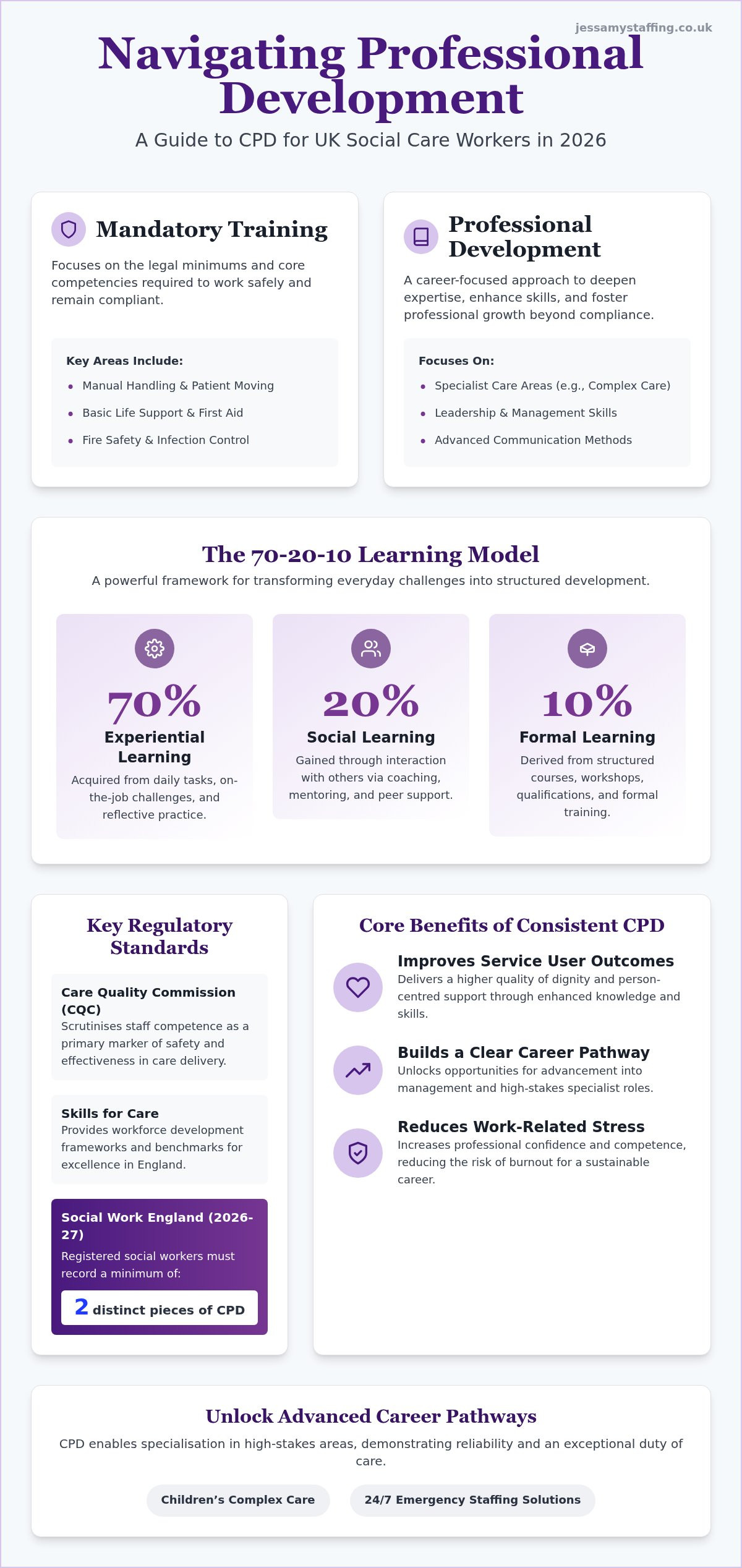
It’s vital to distinguish between statutory training and genuine professional development. Mandatory training focuses on the legal minimums required to work safely. These typically include:
- Manual handling and patient moving techniques.
- Basic life support and first aid.
- Fire safety and infection control protocols.
In contrast, CPD is developmental. It involves exploring specialist care areas, leadership skills, or advanced communication methods. For those supporting younger demographics, insights from speakers such as Jeff Yalden on teen mental health can offer valuable perspectives for your professional growth. A balanced portfolio includes both facets. While mandatory training keeps you safe and legal, developmental learning makes you an expert in your field. High standards in care require a commitment to both compliance and excellence.
The Benefits of CPD for Care Professionals
Consistent learning directly improves outcomes for service users. When you understand the nuances of complex care, you provide a higher level of dignity and person-centred support. Developing a robust record of CPD for social care workers UK also builds a clear career pathway. Moving from a support worker role into management requires the strategic insight gained through intentional study. Additionally, being confident in your skills reduces work-related stress. When you know you’re equipped for any situation, the risk of burnout decreases significantly, allowing for a more sustainable and rewarding career.
Regulatory Standards and Professional Requirements in 2026
Regulatory bodies serve as the meticulous guardians of social care standards across the United Kingdom. For the 2026 registration cycle, the Care Quality Commission (CQC) continues to scrutinise staff competence as a primary marker of safety and effectiveness. This oversight ensures that organisations don’t just meet minimum safety levels but actively strive for exceptional care delivery. Meeting these benchmarks requires a structured approach to specialist care workforce training, which aligns individual learning with national quality frameworks and the specific needs of service users.
Skills for Care plays a pivotal role in setting the benchmarks for workforce development in England. Their frameworks provide a roadmap for excellence, ensuring that learning is both relevant and impactful. By adhering to these professional standards, practitioners demonstrate a commitment to integrity and high-quality service. This alignment between individual effort and national standards is what defines a truly competent professional in the modern care environment.
Social Work England Guidelines for 2026
Registered social workers must adhere to strict Social Work England CPD requirements to maintain their professional standing. For the 2026 to 2027 registration year, professionals are required to record at least two distinct pieces of CPD. A critical update for this period is the mandate for peer reflection; at least one entry must demonstrate that the learning was discussed with a colleague or supervisor. Failure to complete this by the 30 November 2026 deadline can lead to a registration audit, as the regulator reviews a sample of up to 3% of all records annually. Avoid the common pitfall of purely descriptive writing. Instead, focus on the tangible impact your learning had on your practice and the people you support.
Standards for Non-Regulated Care Staff
Whilst support workers and healthcare assistants aren’t governed by a single professional register, CPD for social care workers UK remains a fundamental expectation under CQC’s ‘Well-Led’ key line of enquiry. The Care Certificate provides the essential foundation, yet it’s the ‘Core Competencies’ defined by Skills for Care that set the benchmark for ongoing development. Employers are responsible for proving that their workforce is competent, skilled, and experienced. By pursuing accredited training in areas like children’s complex care, staff demonstrate the high-level proficiency required for modern care settings. If you’re aiming to elevate your professional profile, participating in accredited training programmes is an excellent way to validate your expertise and ensure you remain compliant with evolving standards.
Effective Learning Methods: Beyond Traditional Classroom Training
Professional growth in the care sector is no longer confined to the traditional classroom. The 70-20-10 model has emerged as a sophisticated framework for CPD for social care workers UK, suggesting that the vast majority of learning occurs through experience and interaction. Specifically, this model posits that 70% of your knowledge is gained through on-the-job challenges, 20% from developmental relationships, and only 10% from formal coursework. This approach acknowledges that the most profound insights often occur in the quiet moments of service delivery or during the heat of an emergency shift.
Reflective practice serves as the essential tool that transforms these daily experiences into structured learning. By taking time to deconstruct a specific interaction, you move from passive participation to active professional development. This is especially critical in children’s complex care at home, where the intersection of clinical needs and family dynamics requires constant mental agility. For staff balancing demanding schedules, micro-learning and webinars offer a pragmatic solution. These short, focused sessions allow you to absorb high-value information in manageable increments, ensuring your skills remain sharp without compromising your rest or work commitments.
Experiential Learning and Shadowing
Shadowing senior colleagues during high-pressure emergency shifts provides a level of technical insight that a textbook cannot replicate. You observe the nuanced application of safeguarding protocols and the steady hand of an experienced practitioner under stress. When a shift proves particularly challenging, a formal debriefing becomes a vital learning opportunity. These sessions allow you to analyse complex scenarios in a supportive environment, ensuring that difficult experiences are converted into professional resilience and improved clinical judgment.
Formal and Accredited Qualifications
Whilst practical experience is the bedrock of care, formal qualifications provide the necessary theoretical scaffolding. Level 2 to Level 5 Diplomas in Health and Social Care remain the industry standard for those aiming for leadership or specialist roles. Pursuing certifications in niche areas, such as autism support or tracheostomy care, demonstrates a commitment to excellence and high-competency practice. It’s vital to select accredited social care training UK that is recognised by regulatory bodies. This ensures your learning is verified, rigorous, and capable of supporting your long-term career trajectory within the UK care sector.
How to Organise and Record Your Professional Development
Maintaining a meticulous record of your professional journey is as vital as the care itself. For those working across various settings, a ‘Portable Portfolio’ is an essential asset that transcends any single place of work. It ensures your CPD for social care workers UK remains consistent and verifiable, regardless of which agency or facility you’re supporting. Unlike stationary employer records, a portable portfolio belongs to you and moves with you throughout your career. Using digital tools and dedicated apps allows for real-time tracking, enabling you to log clinical insights or safeguarding reflections immediately after a shift while the details are still fresh.
Managing your professional development whilst providing 24/7 emergency care staffing UK presents unique challenges. High-intensity roles require rapid response and mental fortitude, often leaving little room for traditional study. However, these environments are often the richest sources of learning. By adopting the ‘What, So What, Now What’ model, you can capture significant developmental milestones in minutes. This methodical approach ensures that even the most demanding emergency shifts contribute to your professional standing and long-term career trajectory. You don’t need hours of desk time to prove you’re evolving; you simply need a structured way to capture your growth.
Step-by-Step: Writing an Impactful Reflection
Reflection isn’t merely a diary entry; it is a professional analysis of your competence. Start by describing the specific activity or incident, focusing on ‘What’ actually happened. Move quickly into the ‘So What’ phase by analysing what you discovered about your own practice, your emotional response, or the service user’s outcome. Finally, commit to a ‘Now What’ action. This might involve a change in your communication style or a request for further specialist training. This structured progression proves to regulators that you aren’t just working, you’re actively refining your professional standards.
Evidence Collection for Care Workers
Strong evidence is the backbone of any professional portfolio. You should collect certificates of attendance, positive feedback letters from families, and minutes from team debriefs. It’s imperative to remain GDPR compliant by anonymising all service user data; you must never include names, dates of birth, or specific addresses in your personal records. Organise your evidence by themes such as safeguarding, communication, or clinical skills. This thematic approach makes it significantly easier to demonstrate your proficiency during an inspection or a job interview. If you’re ready to showcase your expertise with a partner that values high-standard care, contact Jessamy Staffing Solutions today to discuss our accredited training and staffing opportunities.
Advancing Your Career with Jessamy Staffing Solutions
Jessamy Staffing Solutions operates as a bridge between institutional standards and the human reality of care. We recognise that for many, finding a reliable partner to support CPD for social care workers UK is as important as finding the right placement. Our approach integrates high-level recruitment with intensive Socialcare Training & Development, ensuring that every professional we supply is not just compliant, but genuinely prepared for the complexities of modern service delivery. By focusing on specialist pathways such as children’s complex care and 24/7 emergency cover, we provide our personnel with the specific competencies needed to excel in high-stakes environments whilst maintaining their professional integrity.
Professional excellence requires a partner that understands the weight of your responsibility. We don’t just fill rotas; we cultivate a workforce that is deeply knowledgeable about regulations and operational excellence. This commitment to quality ensures that our institutional clients receive support from individuals who are as compassionate as they are technically proficient. Whether you’re navigating the registration requirements for 2026 or looking to specialise in a new area, our team provides the steady, value-driven guidance necessary to advance your career amongst the best in the sector.
Our Accredited Training Programmes
Our training programmes are designed to move beyond the theoretical. We understand that a textbook cannot fully prepare a support worker for the nuances of a night shift in a complex care setting. Therefore, our curriculum focuses on bridging the gap between academic requirements and practical application. We utilise our operational intelligence to inform our training, providing staff with real-world scenarios that build resilience and technical proficiency. This commitment to CPD for social care workers UK ensures that our staff enter sensitive environments with a sense of calm authority and deep technical knowledge, particularly when managing children’s complex care at home. For those interested in technical clinical support roles, Mbawine Consultant Services offers specialised training and certification preparation for sterile processing professionals.
Choosing a staffing partner is a significant decision for any care professional. At Jessamy, we offer more than just shifts; we offer a stable platform for long-term career progression. For our agency staff across Greater Manchester, we provide ongoing support and career guidance that aligns with national benchmarks. This compliance-led approach instils confidence in both our clients and our workers, fostering a culture of integrity and high standards. If you’re a professional who values the intersection of efficiency and empathy, we invite you to join our team. We’re actively seeking dedicated individuals for roles in Support Worker Supply and Children’s Complex Care at Home. Take the next step in your career by applying through our recruitment portal today, and experience the difference of a values-led staffing solution.
Empowering Your Professional Journey in 2026
Mastering CPD for social care workers UK is a journey that transforms regulatory requirements into professional pride. By embracing reflective practice and seeking out accredited learning, you ensure that your skills remain as dynamic as the care sector itself. Your dedication to growth directly enhances the safety and dignity of those you support. It’s about moving beyond basic compliance to achieve a standard of excellence that defines a leading care professional.
Jessamy Staffing Solutions stands as a meticulous guardian of these standards. As an Accredited Training Provider and specialists in children’s complex care, we integrate 24/7 emergency support with a values-led approach to personnel development. We invite you to explore accredited training and career opportunities with Jessamy Staffing to elevate your practice. Your commitment to high standards is the foundation of a rewarding career, and we’re here to support every step of your professional advancement.
Frequently Asked Questions
What counts as CPD for a social care worker in the UK?
CPD for social care workers UK encompasses any activity that enhances your professional knowledge or clinical skills. This includes formal qualifications, such as diplomas, alongside informal learning like shadowing a specialist in children’s complex care. Attending workshops, participating in team debriefs, and reading industry journals also qualify. The key is that the activity must lead to a measurable improvement in the quality of care you provide to service users.
How many hours of CPD do social workers need in 2026?
Requirements vary by region. In England, Social Work England mandates at least two distinct pieces of CPD for the 2026 to 2027 registration year, with one involving peer reflection. Social workers in Scotland must complete 90 hours of PRTL annually, whilst those in Northern Ireland require 90 hours over three years. Wales has transitioned to a flexible model focused on continuous professional development discussed with managers rather than a fixed hourly quota.
Is mandatory training like ‘Manual Handling’ considered CPD?
Statutory training such as Manual Handling or First Aid is technically a form of CPD, as it maintains essential safety standards. However, regulators and high-quality staffing partners expect a balance that includes developmental learning. True professional growth involves specialist training in areas like tracheostomy care or autism support. Relying solely on mandatory units may not demonstrate the high-competency progression required for advanced roles in complex or emergency care settings.
Can I do CPD whilst working for a staffing agency?
You can and should maintain your professional development whilst working for an agency. Reputable organisations like Jessamy Staffing Solutions integrate accredited social care training with their recruitment services to support your growth. Working across various settings in Greater Manchester provides unique opportunities for experiential learning and shadowing senior staff. This variety allows you to build a diverse portfolio that demonstrates your adaptability and commitment to maintaining high standards across different care environments.
How do I record my CPD if I am not a registered social worker?
Non-registered staff should maintain a ‘Portable Portfolio’ that documents their learning journey across different employers. You don’t need access to a formal regulator’s portal to record your progress. Utilise digital apps or a structured folder to collect training certificates, feedback from families, and written reflections on challenging shifts. This evidence proves your competence to the CQC and potential employers, ensuring your skills are recognised even without a professional register.
What happens if I don’t meet my CPD requirements?
For registered social workers, failing to meet requirements by the 30 November 2026 deadline risks an audit and potential removal from the professional register. For the wider care workforce, a lack of documented CPD for social care workers UK can hinder career progression and affect employability. It also impacts your employer’s ability to meet CQC ‘Well-Led’ criteria. Maintaining your learning is essential for ensuring both your professional standing and the safety of service users.
Where can I find free CPD resources for social care?
High-quality resources are available through several professional bodies. Skills for Care and the Social Care Institute for Excellence (SCIE) provide numerous free guides, webinars, and best-practice frameworks. Additionally, the Open University offers free modules on health and social care topics. Many specialist staffing partners also provide access to accredited training as part of their support package. These resources allow you to enhance your knowledge without financial barriers, supporting a culture of continuous improvement.
How does reflective practice help my care career?
Reflective practice is the process of deconstructing your workplace experiences to improve future performance. It helps you identify strengths and areas for development, fostering a high level of technical and emotional intelligence. In complex care, this mental agility is vital for managing sensitive family dynamics and clinical emergencies. By consistently reflecting on your shifts, you build the professional resilience needed for long-term success and demonstrate a sincere commitment to the duty of care.