



The healthcare assistant is far more than a supporting role; they’re the moral and operational backbone of the UK’s entire care system. You might feel overwhelmed by the subtle distinctions between a nursing assistant and a support worker, or perhaps you’re concerned about meeting the rigorous compliance standards required in 2026. It’s a demanding 24/7 environment that requires a rare blend of technical precision and genuine empathy. We understand that the weight of these responsibilities, coupled with complex regulations, can feel daunting.
This guide provides the clarity you need to approach this career path with confidence, whether you’re looking to enter the profession or seeking to hire the highest calibre of staff. You’ll gain a comprehensive understanding of the 2025/2026 NHS pay scales, where Band 2 roles now start at £24,465, and the mandatory 16 standards of the Care Certificate. We’ll preview the specific compliance steps, including the latest English language visa requirements and the new focus on learning disability awareness, to ensure you’re fully prepared for the realities of modern care delivery.
Key Takeaways
- Distinguish the specific clinical and personal care responsibilities that define the modern healthcare assistant role in contrast to other support positions.
- Familiarise yourself with the mandatory compliance requirements, including the recently updated standards of the Care Certificate.
- Discover the technical and emotional competencies required to manage clinical observations whilst upholding the highest standards of patient dignity.
- Map out a clear trajectory for professional development, identifying the transition from entry-level practice to specialised or registered nursing roles.
What is a Healthcare Assistant? Defining the Vital Role in 2026
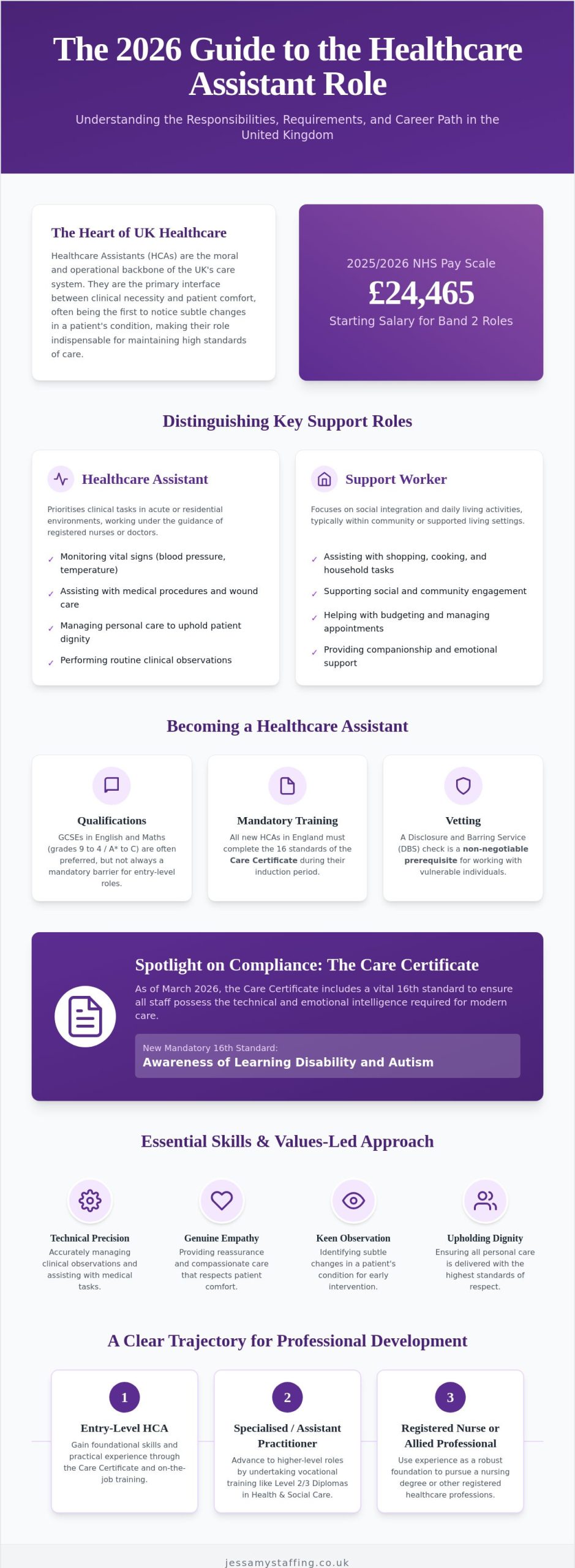
The healthcare assistant serves as the primary interface between clinical necessity and patient comfort. In 2026, this role has evolved into a sophisticated position that demands both technical competence and profound emotional intelligence. Whilst they work under the direct guidance of registered nurses or doctors, HCAs are often the first to notice subtle changes in a patient’s condition. Their presence ensures that bedside care is not merely a task, but a continuous process of observation and reassurance.
Understanding the distinction between an HCA and a support worker is essential for both applicants and providers. Support workers often focus on social integration and daily living activities within community settings. Conversely, a healthcare assistant prioritises clinical tasks such as monitoring vital signs, assisting with medical procedures, and managing personal care in acute or residential environments. This clinical focus makes the HCA an indispensable asset in maintaining patient safety and operational flow.
Alternative Job Titles and Sector Variations
Terminology often shifts depending on the specific healthcare setting. In NHS hospitals, you’ll frequently encounter titles such as Nursing Assistant or Nursing Auxiliary. Within private residential settings, the term Care Assistant is more prevalent. Despite these variations, the core duty remains the same: providing dignified, hands-on support. Each setting requires a unique application of these skills, whether it’s in a surgical ward or a private supported living environment.
The environment dictates the specific skills required for the role. An HCA on a surgical ward might focus on post-operative monitoring and wound care. In contrast, those working in mental health settings prioritise therapeutic engagement and risk observation. For those looking to advance their clinical responsibilities, understanding the Assistant Practitioner scope of practice illustrates how these foundational skills can evolve into higher-level healthcare roles.
The Importance of HCAs in the UK Care Economy
The UK’s healthcare infrastructure relies heavily on the steady supply of skilled assistants. With an ageing population where nearly 1 in 5 people are over 65, the demand for dependable care workforce capacity has never been higher. HCAs provide the consistent presence required to maintain 24/7 safety standards in residential facilities, ensuring that residents are never left without professional oversight and support.
Their contribution is equally vital for the well-being of the wider medical team. By managing routine observations and personal care, HCAs prevent staff burnout amongst registered nurses, allowing them to focus on complex clinical decision-making. This collaborative dynamic is the only way to sustain high standards of care across the sector. This role also serves as a critical foundation for those pursuing nursing or social care careers, offering a practical training ground that builds resilience and technical knowledge.
Entry Requirements and Accredited Training for Aspiring HCAs
Entry into the profession is accessible yet strictly regulated to ensure patient safety. Whilst many employers prefer candidates with GCSEs in English and Maths at grades 9 to 4 (A* to C), these aren’t always absolute barriers for entry-level positions. The focus often lies on personal values and a demonstrable willingness to learn. Every new healthcare assistant in England must complete the Care Certificate during their induction period. As of March 2026, this includes the vital 16th standard regarding Awareness of Learning Disability and Autism, ensuring all staff possess the technical and emotional intelligence required for modern care.
Practical experience remains a significant asset in a competitive job market. Previous work in domestic staff roles or voluntary experience in community centres provides a foundational understanding of service and reliability. For a detailed breakdown of these expectations and the skills required by the NHS, the official Healthcare Assistant job profile offers an authoritative overview of the core competencies. Beyond academic qualifications, a standard check from the Disclosure and Barring Service (DBS) is a non-negotiable prerequisite for working with vulnerable individuals.
Vocational Routes and Apprenticeships
Level 2 and 3 Diplomas in Health and Social Care are the primary vocational qualifications for those seeking a structured career path. These programmes provide a balanced blend of theoretical knowledge and workplace assessment. T-Levels have also emerged as a robust modern alternative, offering a technical qualification equivalent to three A-Levels. In regions like Greater Manchester, local healthcare trusts and private providers frequently offer apprenticeship pathways. These allow you to earn a wage whilst studying, providing a direct and supported route into the workforce.
Accredited Social Care Training and Development
Professional growth doesn’t end with the initial induction. Continuous learning is the hallmark of a committed professional and a requirement for maintaining high standards of care. Investing in healthcare staff training and development ensures that care remains evidence-based and compliant with the latest regulations. Specialist modules in dementia care, infection control, and safe moving and handling are essential for those looking to progress into senior roles. If you’re ready to advance your skills or require a highly trained workforce, our social care training and development services provide the accredited foundation needed for excellence.
The Daily Responsibilities: From Hospitals to Private Care Homes
The daily life of a healthcare assistant is defined by a dual commitment to clinical accuracy and human compassion. Their work begins with the most fundamental aspects of patient well-being, specifically personal care. This involves assisting with washing, dressing, and toileting whilst meticulously maintaining the patient’s dignity. It isn’t just about hygiene; it’s about providing a sense of normalcy in often distressing circumstances. These interactions also provide the perfect opportunity for the assistant to observe any physical changes that might require medical attention.
Clinical monitoring is another cornerstone of the role. A healthcare assistant must take temperatures, pulse, respirations, and weight with absolute precision. These metrics are the early warning signs of recovery or deterioration. According to the National Careers Service guide to HCAs, accurately recording these data points is a vital responsibility that supports the wider medical team. This technical work is balanced with essential administrative duties, such as updating patient records and reporting subtle shifts in behaviour to registered nurses.
Nutritional support requires both patience and technical skill. Many patients or residents face feeding difficulties, requiring the assistant to provide direct help during mealtimes. They ensure that hydration and caloric intake meet the specific requirements of the care plan. It’s a task that demands a calm demeanour and a steady hand, ensuring the individual feels supported rather than rushed.
Working in a Hospital Environment
Hospital wards are fast-paced and unpredictable. Assistants here support doctors during examinations and manage the sterilisation of equipment to maintain a safe environment. The work is often intense, especially when providing emergency healthcare staff cover. Given the physical demands of such roles, many professionals explore Equine and human sports therapy and livery services to maintain their own physical health and manage their equestrian commitments during busy periods. In these settings, the ability to adapt to new wards and diverse patient needs is essential for operational success.
HCAs in Care Homes and Supported Living
In residential settings, the rhythm changes to focus on long-term well-being and community. The healthcare assistant provides vital emotional support, helping residents navigate the challenges of ageing or disability. Mobility is a primary focus. Using specialist hoisting equipment safely is a daily reality. Maintaining a stable and values-led team is equally critical; the challenges of residential care home staff supply directly affect the consistency of support residents receive day to day. In supported living, the objective is to help residents maintain their independence whilst providing a reliable safety net of professional care.
Specialist Complex Care at Home
Domiciliary care presents unique challenges, particularly regarding children’s complex care at home. Providing one-to-one support in a domestic environment requires a high level of sensitivity. You become a vital part of the family’s support system. Success in this area depends on building long-term relationships with families whilst maintaining clear professional boundaries to ensure the integrity of the care provided.
Essential Skills and the Values-Led Approach to Patient Care
Success in this role is not merely a product of clinical training; it’s the result of a deeply held commitment to ethical practice. A healthcare assistant must possess a specific set of attributes that allow them to function effectively within high-pressure environments. Empathy and compassion are the primary tools for providing comfort during distressing clinical situations. It’s about more than being kind. It’s about the professional ability to de-escalate anxiety through a calm and steady presence. This emotional intelligence must be paired with observational rigor. Noticing a subtle shift in a patient’s pallor or a slight change in their breathing pattern can be the difference between a routine shift and a medical emergency.
Communication skills are equally vital for maintaining safety. You’ll need to liaise effectively with patients, their families, and multi-disciplinary teams. Clear, concise reporting ensures that clinical observations are acted upon immediately. Resilience is the bedrock of this profession. Staying calm and professional during 12-hour emergency shifts requires significant mental fortitude. If you’re an employer seeking to build a team with these specific attributes, our staffing solutions ensure you’re connected with professionals who embody these core values.
The Intersection of Technical Skill and Human Warmth
Values-led recruitment is the most effective way to ensure a safe environment for vulnerable individuals. It prioritises integrity and a sense of duty above basic task completion. This approach helps staff balance professional distance with the need for a reassuring presence. You must be able to provide intimate personal care whilst maintaining the patient’s dignity and your own professional boundaries. Integrity is the silent guardian of care standards. It ensures that even when working alone, every procedure is followed with meticulous attention to detail.
Compliance and Ethical Standards
Adhering to Care Quality Commission (CQC) standards is a daily requirement for every task performed. These regulations aren’t just bureaucratic hurdles; they’re the framework that protects both the patient and the practitioner. Understanding patient confidentiality and the Data Protection Act is non-negotiable. You’ll handle sensitive information daily, and its protection is a legal and moral obligation. Reporting safeguarding concerns must be immediate and transparent. A principled expert knows that their primary duty is the safety of the individual, which requires a proactive approach to identifying and reporting potential risks or neglect.
Career Progression and the Benefits of Agency Staffing Solutions
The role of a healthcare assistant is far from a static position; it’s a vital launchpad into the broader medical and social care landscape. Many professionals use the foundational skills gained at the bedside to progress into senior roles such as a Senior HCA or an Assistant Practitioner. For those with long-term clinical ambitions, this experience serves as an ideal precursor to university-level training for Registered Nurses, Midwives, or Allied Health Professionals. Specialisation offers another rewarding trajectory. You might choose to focus your expertise in midwifery support, where you can discover Ninja Mama and their range of postpartum recovery products, or perhaps mental health wards or paediatric care, tailoring your career to the patient groups you feel most passionate about.
Choosing to work with an agency like Jessamy Staffing Solutions provides a unique advantage for those seeking diverse clinical experience. Rather than being confined to a single ward or facility, agency professionals move between various environments, from acute hospitals to residential care homes. This variety builds a robust professional profile and enhances clinical adaptability. Agencies play a critical role in the sector by providing 24/7 emergency care staffing UK, ensuring that patient safety is never compromised by sudden workforce shortages. This model also offers flexible shift patterns, allowing you to balance professional development with personal commitments.
Advancing Your Career in the Care Sector
Accredited training programmes are the most effective way to accelerate your promotion prospects within the care sector. By completing advanced modules in specialised care, you demonstrate a commitment to professional excellence that sets you apart in the job market. Some individuals eventually transition from frontline HCA duties to roles within a specialist support worker recruitment agency, using their practical knowledge to help others find the right placements. Leadership opportunities are also prevalent within care home management, where a background in direct patient care provides the empathy and operational insight required to lead a team effectively.
Why Facilities Rely on Agency HCAs
Healthcare facilities often face the challenge of managing last-minute sickness or unexpected spikes in patient numbers. In Greater Manchester, residential centres and hospitals rely on agency partnerships to provide emergency shift cover at short notice. This isn’t just about filling a gap in a rota; it’s about the peace of mind that comes from using rigorously vetted, values-led personnel. A dependable residential care home staff supply strategy is essential for maintaining the high standards required in supported living and residential care. By partnering with a principled expert in staffing, organisations ensure that every shift is covered by a professional who understands the intersection of efficiency and empathy. For a broader strategic perspective on sourcing compliant staff, our guide to recruitment for social care providers outlines the most effective solutions for navigating workforce challenges in 2026.
Building a Resilient Future in UK Healthcare
The landscape of UK care continues to shift, but the fundamental need for skilled, compassionate professionals remains constant. Mastering the technical requirements of the 2026 Care Certificate and understanding the clinical nuances of bedside monitoring are essential steps for any aspiring healthcare assistant. This role is not just a career choice; it’s a commitment to upholding the highest standards of dignity for those most in need. By combining accredited training with genuine empathy, you contribute to a system that prioritises safety and human-centric care.
Navigating these responsibilities requires a partner who understands the intersection of operational excellence and human integrity. As an accredited social care training provider and values-led recruitment specialist in Greater Manchester, we provide the stability your organisation needs. Whether you require 24/7 emergency staffing cover or are looking to advance your own career through professional development, we are here to support you. Partner with Jessamy Staffing Solutions for Reliable Healthcare Personnel to ensure your care delivery remains both safe and sincere. Your dedication to the sector is the foundation of a healthier, more compassionate society.
Frequently Asked Questions
What is the average salary for a healthcare assistant in 2026?
In 2026, the median salary for a healthcare assistant in the UK typically ranges between £25,000 and £29,000 per annum. While NHS roles are governed by the Agenda for Change pay scales—with Band 2 starting at £24,465—private sector compensation can vary. Agency professionals often access higher hourly rates, particularly when providing essential cover for unsociable hours or emergency shifts within Greater Manchester.
Do I need a degree to become a healthcare assistant?
No, you don’t need a university degree to enter this profession. The role is accessible through vocational pathways such as the Care Certificate and Level 2 or 3 Diplomas in Health and Social Care. Most providers prioritise your personal values and emotional intelligence over academic history, although a functional grasp of literacy and numeracy is required for accurate clinical record-keeping.
Can I work as a healthcare assistant without previous experience?
Yes, it’s possible to secure a position as a trainee without prior clinical experience. Many organisations, including Jessamy Staffing Solutions, value a “care-first” attitude and provide the necessary accredited training to ensure you meet industry standards. Having a background in domestic staff roles or voluntary community work can also demonstrate the reliability and compassion required for the role.
What is the difference between a healthcare assistant and a support worker?
While both roles involve helping vulnerable people, a healthcare assistant usually works in clinical settings like hospitals, focusing on medical observations such as pulse and temperature. A support worker typically operates in community or residential social care settings. Their primary goal is to help individuals with learning disabilities or mental health needs manage their daily lives and achieve greater independence.
What are the typical working hours for an HCA?
Typical working hours follow a 24/7 shift-rota pattern to ensure continuous patient safety. Full-time contracts usually involve 37.5 to 40 hours per week, including early mornings, nights, and weekends. Working through an agency provides greater flexibility, allowing you to select shifts that align with your personal commitments whilst ensuring local facilities have the dependable workforce they require.
Is a DBS check mandatory for all healthcare assistants?
Absolutely. An enhanced Disclosure and Barring Service (DBS) check is a non-negotiable legal requirement for anyone engaged in regulated activity with vulnerable adults or children. This ensures that every individual entering a care environment is suitable for the responsibility. At Jessamy Staffing Solutions, we manage a meticulous compliance process to ensure all personnel meet these essential safeguarding and ethical standards.