

An ‘Inadequate’ CQC rating often begins long before an inspector walks through your doors; it starts with the single document missing from a temporary worker’s file. You likely feel the weight of this responsibility every time an emergency shift needs filling, balancing the urgent need for support with the uncompromising demand for patient safety. It is exhausting to spend hours auditing agency documents when your focus should be on the people in your care. We understand that peace of mind is not a luxury in healthcare; it is a prerequisite for excellence.
By adopting a strategy of compliance led healthcare staffing, you can transform your vetting process from a source of anxiety into a robust shield for your facility. This article provides a definitive 2026 checklist to help you navigate the shift toward data-driven staffing and state-level regulations whilst ensuring every professional you hire meets the highest standards of integrity. You will discover how to streamline your audits and secure reliable, high-quality personnel who are prepared for the scrutiny of any inspection.
Key Takeaways
- Define the proactive methodology of compliance-led staffing as a bridge between legal requirements and high-quality clinical outcomes.
- Master a comprehensive pre-employment checklist designed to verify worker documentation and identify digital fraud with precision.
- Identify the critical differences between accredited and unaccredited training to maintain a culture of continuous safeguarding.
- Utilise compliance led healthcare staffing to navigate complex Agency Worker Regulations (AWR) and mitigate long-term regulatory risks.
- Learn how to vet potential staffing agencies by looking beyond price to uncover hidden compliance gaps and insurance liabilities.
What is Compliance-Led Healthcare Staffing?
Compliance-led staffing is a proactive methodology for workforce management that prioritises clinical safety and quality over the mere act of filling a vacancy. It represents a fundamental shift in how care managers view their temporary workforce. Instead of seeing a staffing gap as a problem to be solved with any available body, this approach views every recruitment decision as an opportunity to protect the service. By adopting a strategy of compliance led healthcare staffing, providers ensure that every professional entering their facility has been vetted through a lens of both legal rigour and clinical excellence.
At its core, this methodology exists at the vital intersection of legal mandates and patient safety. Whilst basic checks such as Enhanced DBS disclosures and Right to Work verifications are the foundation, they’re only the beginning. True excellence involves aligning with the broader principles of Regulatory compliance to ensure every action, from document verification to shift allocation, serves the well-being of the service user. This rigorous vetting is your primary safeguard against “Inadequate” CQC ratings, as it provides a transparent, auditable trail of professional accountability.
The Pillars of Regulatory Compliance
The framework of a compliant workforce rests on three distinct pillars. First are the statutory requirements, which are the non-negotiable elements of UK healthcare law. These include up-to-date immunisation records, professional registrations, and verified references. Second is clinical competency. It’s not enough for a worker to be available; they must be demonstrably capable of performing the specific tasks required in a high-pressure environment. Finally, values-led alignment ensures that staff share the ethical standards of your organisation, which significantly reduces the risk of safeguarding incidents amongst vulnerable populations.
Why Compliance Matters Beyond Legalities
The impact of meticulous vetting extends far beyond avoiding legal penalties. It directly influences patient dignity and the standard of care delivered on the front line. When temporary staff are professionally prepared and fully compliant, they integrate more seamlessly into existing teams. This reduces the friction that often leads to staff burnout amongst your permanent workforce. Furthermore, maintaining high standards protects your organisation’s reputation amongst local authorities and families, positioning you as a stable and reliable provider in a competitive sector. Quality care is never accidental; it is the deliberate result of a commitment to integrity.
The Essential Pre-Employment Compliance Checklist
A staffing file is far more than a collection of digital documents; it’s a legal shield that protects your residents and your reputation. Implementing compliance led healthcare staffing requires a meticulous eye for detail during the pre-employment phase. You aren’t just looking for a signature. You’re looking for an unbroken chain of accountability. In a digital age where sophisticated forgeries are increasingly common, your verification protocols must be robust enough to withstand intense CQC scrutiny. This means moving beyond a cursory glance at a passport and adopting a rigorous audit framework that treats every document as a vital piece of the safety puzzle.
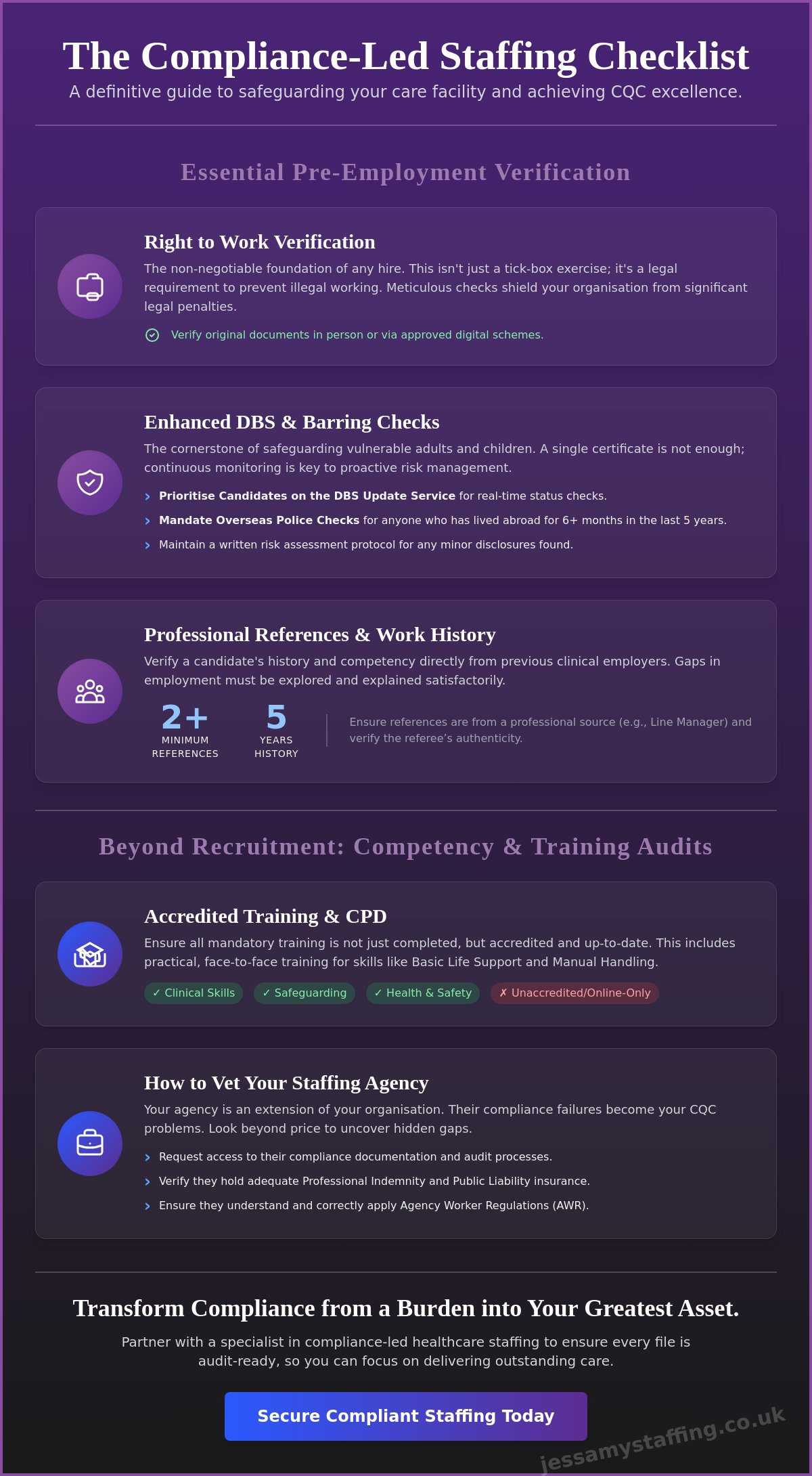
Whilst UK-specific regulations are paramount, many global healthcare organisations look to broader frameworks, such as the OIG General Compliance Program Guidance, to understand the universal principles of fraud prevention and document integrity. For your facility, this starts with a comprehensive list of non-negotiables: valid Right to Work documentation, a minimum of two verified professional references, and a clear, enhanced criminal record check. If you find the administrative burden of these checks overwhelming, partnering with a specialist in support worker supply can ensure your files are always audit-ready and fully compliant.
Vetting and Barring: The DBS and Beyond
The Enhanced DBS check remains the cornerstone of safeguarding, but it’s only effective if it’s current. You should prioritise candidates on the DBS Update Service, allowing for real-time status checks rather than relying on a certificate that may be months old. For staff who have lived or worked abroad for more than six months in the last five years, overseas police checks are essential to bridge the gap in their UK history. When minor disclosures do appear, your organisation must have a written risk assessment protocol. This demonstrates that you’ve considered the nature of the offence and the safety of your service users, rather than simply ignoring the data.
Identity and Professional Credibility
Modern identity verification (IDV) should align with the high standards set by NHS Employers, utilizing digital tools to check for inconsistencies in document metadata or font alignment. Beyond identity, you must validate professional registrations directly with the source, such as the NMC for nurses or the HCPC for therapists, rather than accepting a printed certificate. Finally, don’t overlook health fitness declarations. Ensuring that staff are both physically and mentally fit for the demanding nature of care work is a statutory requirement that directly impacts the quality of support provided. A truly prepared worker is one whose credibility is proven, not just assumed. For a deeper look at how these principles apply specifically to residential settings, our guide on sourcing reliable care home agency staff provides a comprehensive 2026 vetting checklist tailored to care home managers.
Beyond Recruitment: The Training and Competency Audit
Recruitment completes the file, but training sustains the service. A robust audit of staff competency is the difference between a worker who is technically compliant and one who is clinically safe. Within the framework of compliance led healthcare staffing, training is never a ‘tick-box’ exercise. It is a continuous investment in quality. You must distinguish between accredited training and unaccredited modules; the CQC increasingly scrutinises the source of education to ensure it meets the Skills for Care Core Skills Training Framework. Following American Staffing Association best practices, we recognise that credentialing must be paired with ongoing validation to mitigate clinical risk.
To maintain these high standards, Jessamy Staffing integrates comprehensive Socialcare Training & Development directly into every worker’s compliance profile. This ensures that when an auditor asks for proof of competency, the evidence is both immediate and undeniable. This proactive approach allows care managers to focus on service delivery rather than chasing certificates.
The Core Skills Framework
The foundation of safe practice lies in the Core Skills Framework. Moving and Handling training must involve practical, face-to-face assessments. Online-only modules are often insufficient for CQC standards and fail to prepare staff for the physical realities of the role. Similarly, Safeguarding Adults and Children requires specific level-based training, ranging from Level 1 to Level 3, depending on the worker’s specific responsibilities. Basic Life Support (BLS) is another non-negotiable that demands an annual practical refresher. These aren’t just suggestions; they are the essential guardrails that prevent workplace injuries and ensure rapid response during medical emergencies.
Specialist Complex Care Training
For more technical environments, general training isn’t enough. When vetting staff for children’s complex care at home, you must verify specific competencies such as tracheostomy care or peg-feeding. In supported living environments, behavioural support and de-escalation training are vital for maintaining a calm and safe atmosphere for all residents. Finally, medication administration requires rigorous competency sign-offs. We don’t just check if a worker has a certificate. We ensure they understand the local protocols for error prevention. This level of detail is what transforms a staffing agency into a genuine clinical partner.
Navigating Regulatory Risks and Safeguarding Standards
Managing the legal intricacies of temporary labour requires more than just a filing cabinet; it demands a deep understanding of how employment law intersects with clinical safety. The Agency Worker Regulations (AWR) are a prime example, requiring care managers to ensure pay and working condition parity for staff after 12 weeks in a role. Neglecting these details creates significant financial and legal exposure for your facility. However, the most profound risk is a lapse in safeguarding. Safeguarding shouldn’t be viewed as a one-off training session or a certificate on a wall; it must be an active, continuous culture. When you embrace compliance led healthcare staffing, you’re acknowledging that every interaction between a worker and a service user is an opportunity to uphold that culture of protection.
Transparency is the bedrock of a principled partnership between a facility and an agency. When an incident occurs, the staffing agency must provide immediate, documented support for your internal investigations. This accountability is particularly critical when managing the inherent risks of 24/7 emergency care staffing. Speed must never come at the expense of standards. Even in a 3:00 AM crisis, the professional arriving at your door must be as thoroughly vetted and prepared as a long-term placement. Maintaining this level of consistency ensures that emergency cover remains a reliable solution rather than a regulatory liability.
CQC Inspection Readiness
Confidence during a CQC inspection is built on the immediate accessibility of your data. You should be able to present agency staff files that map directly to the “Safe” and “Well-Led” Key Lines of Enquiry (KLOEs) without hesitation. A “live” compliance dashboard, updated in real-time by your provider, demonstrates a level of oversight that inspectors value highly. It shows that you aren’t just reacting to staffing gaps but are actively managing the integrity of your workforce. This proactive stance turns a high-pressure audit into a showcase of your operational excellence.
The Role of Professional Conduct
Professionalism is a visible indicator of clinical safety that patients and families notice immediately. From uniform standards to interpersonal behaviour, the conduct of temporary staff reflects your facility’s core values. A worker who arrives in the correct attire and follows established protocols instils confidence amongst permanent staff and residents alike. We advocate for a robust “feedback loop” where performance is monitored and discussed openly between the facility and the agency. This ensures that any deviations from excellence are addressed swiftly before they become regulatory concerns. To ensure your facility is protected by these rigorous standards, you can contact our team to secure compliant cover.
Partnering for Excellence: How to Vet a Staffing Agency
Selecting a staffing partner is one of the most consequential decisions a care manager will make. It requires moving beyond a simple comparison of hourly rates to a deep evaluation of clinical and operational integrity. When you engage in compliance led healthcare staffing, you’re looking for a partner who views their workforce with the same sense of duty that you do. Before signing a service level agreement (SLA), you should ask an agency director direct questions about their internal audit frequency and how they handle worker non-compliance. A truly transparent partner will welcome your request to “audit the auditor” through a spot-check of their personnel files.
It’s vital to recognise that “cheap” staffing is rarely a bargain. Lower rates often hide significant risks, such as inadequate insurance cover or cut corners in the vetting process. These hidden liabilities only surface during a crisis or a CQC inspection; at which point the cost to your reputation far outweighs any initial savings. Precision in choosing a supported living staffing agency involves verifying that the provider understands the specific behavioural and clinical needs of your residents, rather than just providing a generalist worker.
Greater Manchester Local Expertise
Local knowledge is an often-overlooked component of a reliable staffing strategy. A Manchester-based agency offers more than just proximity; it provides a deep understanding of the specific workforce pressures within the North West care sector. This regional expertise allows for more responsive 24/7 emergency cover, as the agency is intimately familiar with the geography and the local talent pool. By building a dependable workforce capacity through a trusted local partnership, you ensure that your facility remains resilient against the unpredictable nature of healthcare demands.
Conclusion: The Jessamy Standard
At Jessamy Staffing Solutions, we act as a meticulous guardian of standards for every client we serve. We believe that compliance led healthcare staffing is the only way to transition from the stress of crisis management to the stability of strategic staffing. Our commitment to professional rigour ensures that every professional we supply is prepared to uphold your facility’s reputation and provide exceptional care. We invite you to move away from high-volume, low-quality recruitment and instead partner with a firm that prioritises integrity above all else. Secure your service’s future by choosing a partner dedicated to excellence.
Securing the Future of Your Care Service
Mastering the complexities of regulatory change requires a deliberate shift from reactive hiring to a principled methodology. By implementing a rigorous pre-employment checklist and ensuring all staff have access to accredited training, you move beyond mere shift-filling to genuine service protection. Reliability in healthcare is built on the foundation of transparency and an unwavering commitment to clinical excellence. Adopting a strategy of compliance led healthcare staffing ensures that your facility is always prepared for the scrutiny of a CQC inspection whilst maintaining the highest standards of patient dignity.
As an accredited Social Care Training Provider, we offer a values-led recruitment methodology that prioritises integrity over volume. Whether you require long-term support or a 24/7 emergency rapid response in Greater Manchester, we act as a meticulous guardian of your operational standards. Secure your care service with our compliance-led staffing solutions. Contact Jessamy Staffing today. You don’t have to face the pressures of regulatory auditing alone; with a dedicated partner, excellence becomes your standard operational reality.
Frequently Asked Questions
What documents should be in a compliant healthcare staff file?
A compliant file must contain an Enhanced DBS disclosure, verified Right to Work documents, and at least two professional references. You also require standardised identity verification, a health fitness declaration, and up-to-date training certificates that align with the Skills for Care framework. Maintaining these records in an auditable format is essential for demonstrating regulatory oversight.
How often should DBS checks be updated for agency workers?
DBS checks should be validated annually, though the Update Service is the preferred standard for continuous, real-time monitoring. By utilising the Update Service, providers can perform regular status checks to ensure no new disclosures have been added. This proactive approach is far more reliable than relying on a static paper certificate that may be months old.
Is online training sufficient for compliance-led staffing?
No, online training is insufficient for certain mandatory modules such as Moving and Handling or Basic Life Support. A strategy of compliance led healthcare staffing mandates that these high-risk activities include practical, face-to-face assessments. This ensures that staff aren’t just theoretically aware of safety protocols but are clinically competent to execute them in a care environment.
What is the role of a staffing agency in CQC inspections?
The staffing agency acts as a meticulous record-keeper, providing the evidence needed to satisfy “Safe” and “Well-Led” KLOEs. During an inspection, your partner should offer instant access to worker profiles and training logs. This transparency allows you to demonstrate to inspectors that your temporary workforce is managed with the same rigour as your permanent team.
Can I request a full compliance audit from my staffing provider?
You absolutely can, and should, request a full audit of your staffing partner’s vetting procedures. A principled provider will welcome this request and provide a transparent view of their internal controls. Performing regular spot-checks on the personnel files of temporary workers is a vital component of your own internal quality assurance process.
How does compliance-led staffing improve patient safety?
It improves safety by filtering for both clinical competency and values-led alignment before a worker reaches the front line. This rigorous approach to compliance led healthcare staffing reduces the likelihood of medication errors or safeguarding incidents. By ensuring workers are professionally prepared, you create a more stable and secure environment for vulnerable service users.
What are the risks of using non-compliant temporary staff?
Using non-compliant staff exposes your organisation to CQC rating downgrades, legal prosecution, and severe reputational damage amongst local authorities. Beyond the regulatory impact, it places patients at physical risk if the worker lacks the specific skills required for their role. The financial cost of a single safeguarding failure far outweighs any savings found through cheaper, less-regulated agencies.
How does Jessamy Staffing ensure 24/7 compliance for emergency shifts?
We maintain a pool of pre-vetted professionals whose files are fully audited before they are ever eligible for our emergency response team. This ensures that even during a 3:00 AM crisis, the staff member arriving at your door meets every statutory and clinical requirement. Speed never compromises our standards; every emergency placement is backed by a complete and compliant file.