



We understand that your primary goal is to see your child flourish in a stable, familiar setting. You deserve the peace of mind that comes from a professional care team that doesn’t just show up, but truly understands your child’s specific clinical requirements. This guide explores how specialist support and accredited training enable children with complex needs to thrive. We will look at the 2026 National Framework for Continuing Care, the impact of personal health budgets, and how expert staffing creates a safer, more joyful quality of life for the whole family.
Key Takeaways
- Understand the transition from clinical hospital settings to community-based support, prioritising your child’s development within a familiar environment.
- Identify the critical role of values-led recruitment and accredited training in maintaining hospital-grade safety standards at home.
- Evaluate different staffing models for complex care at home for children UK to ensure your family has access to reliable, 24/7 emergency cover.
- Master the hospital-to-home discharge process by implementing clinical shadowing and a structured readiness checklist for a seamless transition.
- Discover how a principled approach to specialist staffing balances technical expertise with the human-centric warmth required for long-term domestic care.
What is Complex Care at Home for Children in the UK?
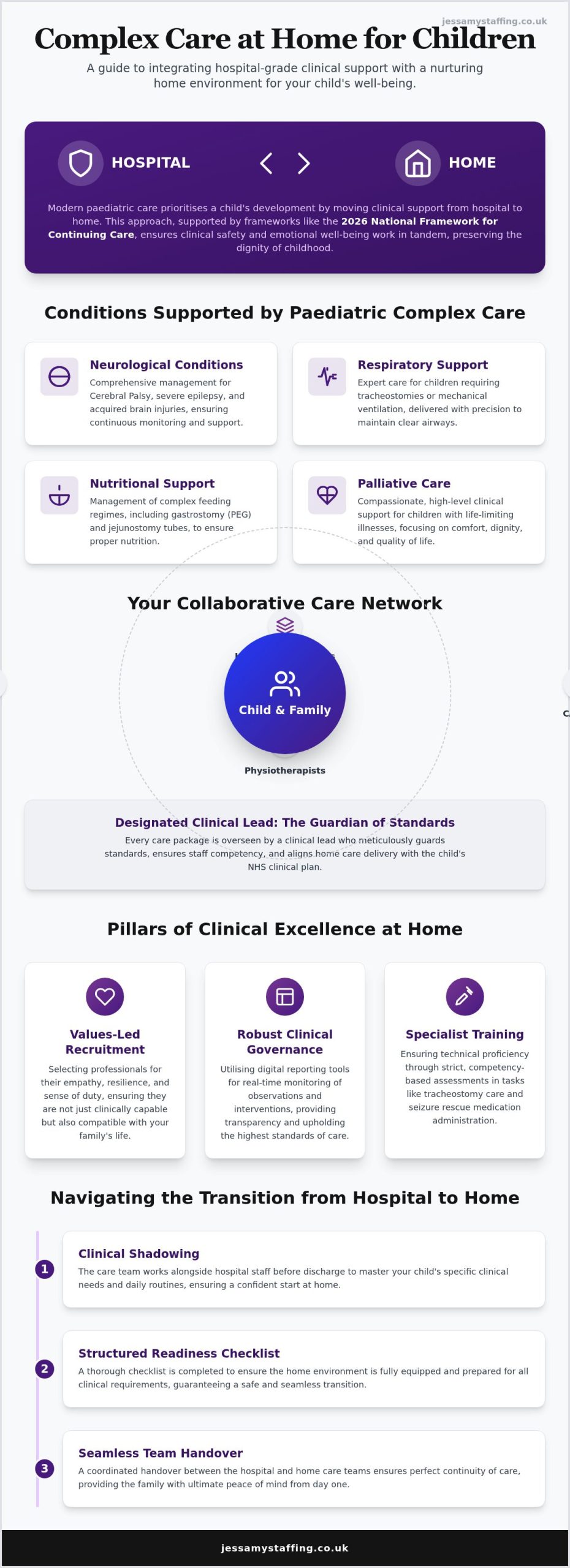
Complex care is a specialised branch of healthcare designed for children with multi-faceted, chronic health conditions that require clinical intervention. Unlike general home care, which might focus on domestic tasks or basic personal hygiene, complex care at home for children UK involves the delivery of medical support that was once only available in a hospital setting. This shift from hospital-centric care to community-based support reflects a growing understanding that children often achieve better developmental outcomes when they remain within their family unit. By 2026, national standards have evolved to demand a more integrated approach, ensuring that social care and nursing work in tandem rather than in isolation, a model championed by providers like S&P Care to ensure safety and continuity.
The refresh of the Children’s Social Care National Framework on 18 March 2026 has formalised this integration. It emphasises that clinical safety shouldn’t come at the expense of a child’s social and emotional wellbeing. This means a care package must be robust enough to manage life-sustaining equipment whilst being flexible enough to allow a child to participate in school and play. It is about preserving the dignity of childhood despite the complexity of a medical diagnosis.
Conditions Supported by Paediatric Complex Care
Specialist support workers and nurses manage a wide array of clinical needs that vary significantly from one child to the next. Common conditions and interventions include:
- Neurological conditions: Comprehensive management of Cerebral Palsy, severe epilepsy, and acquired brain injuries.
- Respiratory support: Expert care for children requiring tracheostomies or mechanical ventilation to breathe.
- Nutritional support: Management of complex feeding regimes, including gastrostomy (PEG) and jejunostomy tubes.
- Palliative care: Compassionate, high-level clinical support for children with life-limiting illnesses, focusing on comfort and dignity.
The Role of the Multi-Disciplinary Team (MDT)
Effective care is never delivered in a vacuum. It requires a seamless partnership between specialist staffing agencies and the wider healthcare network to deliver complex care at home for children UK safely. This Multi-Disciplinary Team often includes GPs, hospital consultants, physiotherapists, and Child and Adolescent Mental Health Services (CAMHS). By aligning with these professionals, care providers ensure that the child’s home care delivery is an exact reflection of their NHS clinical plan.
Every bespoke care package should have a designated clinical lead. This individual acts as a meticulous guardian of standards, overseeing the competency of support workers and ensuring that every medical intervention is performed with precision. This collaborative model reduces the risk of hospital readmission and provides the family with a stable, professional support structure.
Clinical Standards and Safety in the Home Environment
Clinical excellence in a domestic setting demands a higher level of vigilance than a traditional hospital ward. When delivering complex care at home for children UK, the residence must remain a sanctuary whilst functioning as a precision-led clinical space. This balance is achieved through values-led recruitment. It’s not enough to simply possess technical qualifications; we select professionals who demonstrate empathy, resilience, and a profound sense of duty. This rigorous approach ensures that the personnel entering your home are not only clinically capable but also compatible with your family’s unique daily rhythm.
Maintaining clinical governance within a non-clinical setting requires robust oversight. By 2026, digital reporting tools have become the standard for tracking patient outcomes and intervention accuracy. These systems allow for real-time monitoring of observations and medication administration. Clinical leads can review data instantly, ensuring that high standards are upheld even when they aren’t physically present. This level of transparency offers a layer of security that traditional paper-based methods simply cannot provide.
Specialist Training for Complex Paediatric Needs
Technical proficiency is established through strict competency-based sign-offs. Every member of the support team must demonstrate mastery in specific clinical tasks, such as tracheostomy suctioning or the administration of seizure rescue medication, before they work independently. These assessments are repeated regularly to ensure skills remain sharp. Training also extends to behavioural support, helping staff manage the psychological impact of chronic illness on a child’s development. Throughout all interactions, safeguarding remains the paramount focus, ensuring every child is protected through proactive risk management and ethical practice.
Compliance and Regulation: The CQC Framework
The Care Quality Commission (CQC) assesses every provider against five fundamental questions: is the service safe, effective, caring, responsive, and well-led? For parents, these criteria are the benchmarks of a reliable care package. We ensure all personnel are professionally prepared for inspections, reflecting our commitment to meticulous standards. There is an undeniable link between compliance-led healthcare staffing and the peace of mind a parent feels. By adhering to these frameworks, we provide the clinical safety equivalent to a hospital setting for complex care at home for children UK. If you require a team that prioritises these rigorous standards, our specialist staffing solutions offer the stability your child deserves.
Choosing the Right Staffing Model for Your Child
Selecting the appropriate framework for complex care at home for children UK is a decision that dictates the daily rhythm and safety of your household. Families generally choose between two primary models: fully managed care packages or specialist staffing supply. A managed service takes responsibility for the entire clinical oversight, including rota management and clinical lead supervision. Conversely, a staffing supply model provides highly trained personnel to work under the direction of an independent case manager or the family themselves. The right choice depends on your desired level of control and the specific clinical requirements of your child.
A stable team is the foundation of effective care. Working with specialist support worker recruitment agencies allows you to build a small, dedicated group of professionals who understand your child’s nuances. This consistency reduces the stress of having multiple strangers in your home and ensures that small changes in a child’s condition are recognised instantly. Beyond technical skills, it is essential to evaluate a provider’s culture. Their values should align with your family’s needs, prioritising integrity and a genuine sense of duty over mere compliance.
The 24/7 Emergency Staffing Requirement
Clinical needs do not adhere to standard office hours. For a child with complex health conditions, a sudden staff absence due to sickness can create an immediate safety crisis. Without a reliable backup, families often face the distressing prospect of an avoidable hospital readmission just to ensure clinical safety. Utilising 24/7 emergency care staffing provides a vital safety net. This capability ensures that a qualified professional is always available to step in, maintaining care continuity and protecting the child’s wellbeing regardless of the time or day.
Private Funding vs. Integrated Care Board (ICB) Funding
Navigating the financial landscape of complex care at home for children UK involves understanding the role of Integrated Care Boards (ICBs) and Personal Health Budgets (PHBs). Since the 2026 refresh of the national framework, there has been a significant emphasis on giving families more choice through PHBs. These budgets allow you to select providers that offer the best fit for your child’s specific needs rather than being restricted to a default local authority option. Professional agencies work closely with case managers to ensure these budgets are utilised effectively, delivering high-quality, clinical-grade care that remains cost-efficient and sustainable for the long term.
Navigating the Transition from Hospital to Home
The transition from a neonatal or paediatric intensive care unit to the domestic setting is a profound milestone. It represents a shift from institutional dependency to family-led independence. However, this journey requires a meticulous “Home Care Readiness” checklist to ensure clinical safety is maintained throughout the process. Before the child leaves the hospital, a period of shadowing clinical staff is essential. This allows the home care team to observe specific clinical nuances and routines that are unique to the child. Preparing for complex care at home for children UK also involves physical changes to the residence. You’ll need to designate specific areas for medical equipment, clinical supplies, and a respectful workspace for the support team. Managing the emotional shift is equally vital. Siblings often experience a mix of excitement and anxiety as the home environment changes, requiring parents to balance clinical demands with familial warmth.
The Discharge Planning Process
Success depends on close collaboration with hospital discharge coordinators and lead paediatricians. Every piece of medical equipment, from ventilators to suction machines, must be tested within the home environment before the child arrives. Staff training must be verified against the child’s specific devices to ensure absolute competency. Securing reliable complex care at home for children UK starts with this collaborative discharge process. It’s helpful to set realistic expectations for the first 72 hours. This period is often a time of adjustment where the theoretical care plan meets the practical reality of home life. Having a senior clinical lead present during these initial days provides an essential layer of reassurance for both the family and the support workers.
Local Support in Greater Manchester
For families in the North West, accessing community resources and parent support groups can provide much-needed emotional scaffolding. Local workforce intelligence is a critical factor in maintaining care consistency. Jessamy Staffing serves the Greater Manchester area with a pool of dependable, locally-based staff who understand the regional healthcare landscape. This local focus ensures that 24/7 emergency cover is responsive and that travel times don’t disrupt the care rota. If you are preparing for discharge and require a team that bridges the gap between hospital standards and home comfort, our specialist paediatric care teams are ready to support your transition.
The Jessamy Approach: Values-Led Complex Care
The delivery of complex care at home for children UK requires more than technical proficiency; it necessitates a deep alignment of clinical skill and personal integrity. At Jessamy Staffing, we operate through a “Principled Expert” model. This approach ensures that every professional we supply is not only technically proficient but also deeply empathetic to the nuances of family life. We recognise that our staff are entering sensitive domestic environments, often during times of significant stress. By prioritising both clinical rigour and human-centric warmth, we strengthen these care environments, providing a stable presence that families can rely on day and night.
Our commitment to 24/7 availability ensures that families and case managers are never left without support. Whether it’s a routine shift or an urgent requirement for emergency cover, our operational rhythm is designed to be steady and reassuring. We don’t just provide a service; we act as a meticulous guardian of your child’s safety and wellbeing, ensuring that every intervention is performed with the highest level of care and ethical consideration. This dedication to reliability is what allows parents to step back from the role of primary carer and return to being a parent.
Accredited Training as a Quality Guarantee
A competent workforce is the absolute prerequisite for patient safety in a home setting. We believe that standard industry requirements are merely the starting point for high-quality care. To ensure the highest levels of clinical governance, we integrate training for complex care workers directly into our recruitment and development pipeline. These accredited programmes are designed to foster a “culture of care” amongst our paediatric teams, moving beyond basic checklists to focus on the holistic needs of the child.
This dedication to professional development means our support workers are professionally prepared for the unique challenges of complex care at home for children UK. They’re trained to be proactive, identifying potential clinical issues before they escalate and maintaining the integrity of the child’s NHS care plan. When a support worker feels confident in their skills, they’re better equipped to provide the compassionate, high-quality care that every child deserves.
Building Long-Term Partnerships with Families
We move beyond the transactional nature of “filling shifts” to focus on long-term partnership. For a child with complex needs, a consistent and familiar face isn’t a luxury; it’s a clinical necessity that promotes better developmental outcomes. Our values-led recruitment process ensures that we match staff who are likely to build a lasting bond with your family, reducing the disruption often caused by high staff turnover in the care sector.
The Jessamy promise is one of safety, dependability, and integrity. We understand that your child’s health is your priority, and we make it ours too. If you’re seeking a care partner that values clinical excellence as much as human compassion, we invite you to enquire about our specialist paediatric staffing. Our team is ready to discuss how we can support your child’s journey toward a safer, more fulfilled life at home.
Securing a Brighter Future for Your Child’s Care
Transitioning to home care is a significant milestone that requires meticulous planning and a team that values your child’s safety as much as you do. By prioritising accredited social care training and values-led recruitment, families can achieve a level of clinical safety that mirrors a hospital setting whilst preserving the warmth of a domestic environment. Ensuring 24/7 emergency cover for complete reliability is essential, preventing avoidable readmissions and providing the stability your household deserves.
Finding the right provider for complex care at home for children UK is the first step towards reclaiming your role as a parent rather than just a carer. Our expert staffing for complex paediatric needs in Greater Manchester bridges the gap between institutional requirements and human needs. If you’re ready to build a stable, professional care team that allows your child to thrive at home, we’re here to support you every step of the way.
Contact Jessamy Staffing for Specialist Children’s Care Solutions
Your child’s wellbeing is our priority, and together, we can create a nurturing environment where they can truly flourish.
Frequently Asked Questions
What qualifies as complex care for a child in the UK?
Complex care is defined as multi-faceted support for children with chronic health conditions requiring clinical intervention. Under the 2026 refreshed framework, eligibility is determined by a detailed assessment of needs rather than a specific medical diagnosis. A recommendation for complex care at home for children UK usually occurs if a child presents with three high levels of need, one severe level, or one priority level as identified by healthcare professionals.
How is children’s complex care at home funded?
Funding is primarily provided through the National Framework for Children and Young People’s Continuing Care. Most eligible families now utilise Personal Health Budgets (PHBs), which grant more choice and control over how their care is delivered. These packages are jointly commissioned by local authorities and Integrated Care Boards (ICBs) to ensure that both social and clinical requirements are met without a fixed national rate.
Can agency staff perform clinical tasks like tracheostomy care?
Yes, specialist support workers can perform clinical tasks such as tracheostomy care or mechanical ventilation once they’ve completed competency-based sign-offs. We ensure our personnel undergo accredited social care training and development to master these specific interventions. Every clinical task is overseen by a designated lead to ensure hospital-grade safety standards are maintained within the domestic setting at all times.
What happens if our regular support worker is unwell?
If a regular support worker is unwell, our 24/7 emergency cover capability ensures that a qualified professional is available to step in immediately. We understand that clinical safety cannot wait for standard office hours. This safety net is designed to maintain care continuity and prevent avoidable hospital readmissions, providing families in Greater Manchester and beyond with complete reliability during staffing gaps.
How do we transition our child from hospital to home care?
Transitioning involves a structured discharge planning process that begins well before the child leaves the hospital. This includes shadowing clinical staff, testing medical equipment at home, and completing a “Home Care Readiness” checklist. Our teams collaborate with hospital discharge coordinators and paediatricians to ensure the home environment is clinically prepared and the staff are fully competent in the child’s specific routine.
Does complex care at home include support for siblings?
Complex care prioritises the child’s clinical needs, but it naturally improves the quality of life for siblings by reducing the parental burden. By providing dependable complex care at home for children UK, we enable parents to spend more meaningful time with their other children. Some comprehensive packages may also incorporate domestic staff to help manage the wider household, ensuring the entire family unit feels supported.
How does Jessamy Staffing ensure the quality of their paediatric staff?
We ensure quality through a rigorous, values-led recruitment process combined with in-house accredited training. Every candidate is assessed not only for their technical skill but for their empathy and integrity. Our “Principled Expert” model means we monitor staff performance through digital tools and regular clinical reviews, ensuring that our high standards for paediatric care are consistently and meticulously upheld.
Can we choose the specific carers who come into our home?
Families often have a significant say in who provides their care, especially when using a Personal Health Budget to fund their package. We aim to build small, stable teams of familiar faces rather than sending a rotating door of agency staff. This consistency is vital for a child’s development and allows for a deeper level of trust and understanding to form between the carers and the family.