



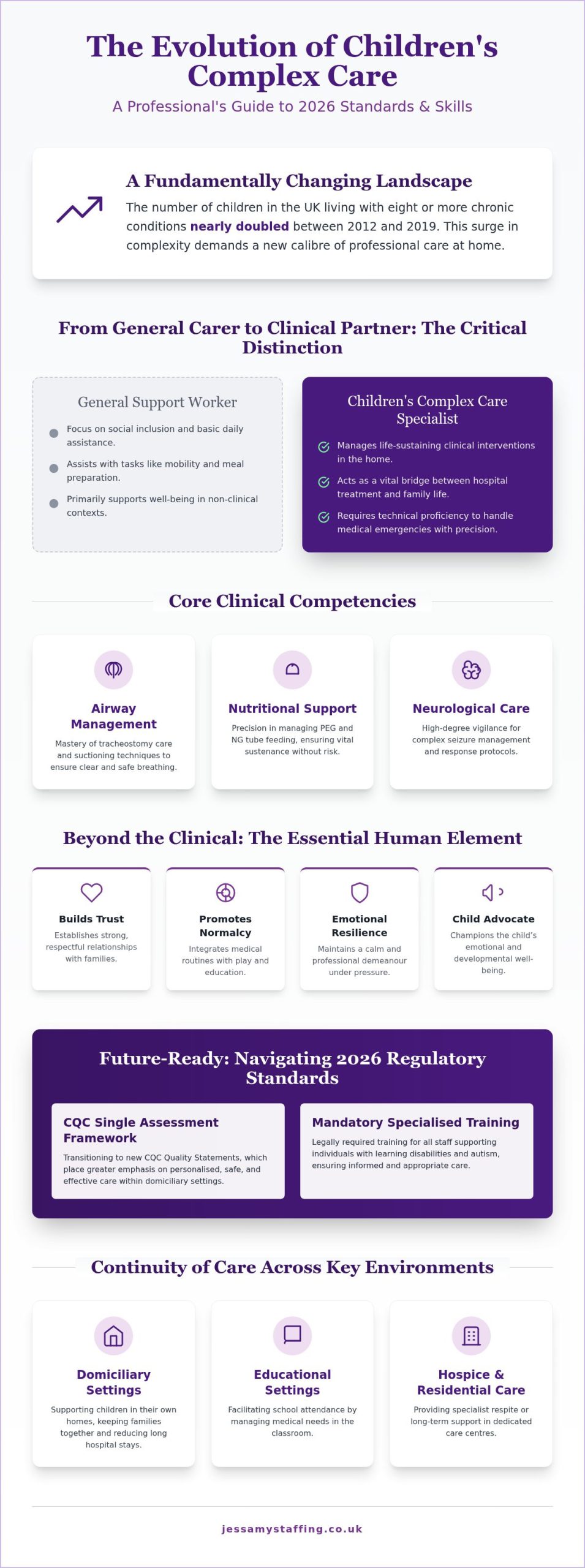
The number of children in the UK living with eight or more chronic conditions nearly doubled between 2012 and 2019, fundamentally changing the requirements for paediatric home care. This increased complexity means that children’s complex care support workers are no longer just caregivers; they are vital clinical partners who must manage intricate needs within a sensitive domestic environment.
If you’re responsible for a child’s well-being, you’ve likely felt the pressure of finding staff who are both technically proficient and emotionally grounded. It’s a common anxiety to worry that a lack of clinical competency or a poor cultural fit might disrupt the stability your family or organisation works so hard to maintain. You need more than just a presence in the room; you require a professional who understands the gravity of their role.
This definitive guide for 2026 provides the essential framework you need to navigate these challenges with confidence. You’ll discover the specific skills, updated regulatory standards, and recruitment benchmarks required to secure specialist personnel who truly understand their duty of care. We’ll explore the transition to the CQC Single Assessment Framework and the practical steps to ensuring every worker is professionally prepared for the complexities of modern support.
Key Takeaways
- Distinguish between general care roles and the specialist clinical interventions required to support children with multifaceted health conditions.
- Identify the core clinical competencies, including tracheostomy care and enteral feeding, that define high-quality children’s complex care support workers.
- Learn how a values-led recruitment strategy ensures that personnel possess the emotional intelligence and resilience necessary for sensitive domestic environments.
- Gain a clear understanding of the 2026 regulatory requirements, including the latest CQC Quality Statements and mandatory training for learning disabilities and autism.
- Discover how integrating accredited training with specialist staffing provides a reliable route to securing professionally prepared personnel in the North West.
Defining the Role: What is a Children’s Complex Care Support Worker?
A children’s complex care support worker represents a significant evolution in paediatric social care. Unlike general support roles that focus primarily on social inclusion or basic daily assistance, these professionals manage life-sustaining clinical interventions. They act as the primary operational force behind the UK’s ‘hospital-at-home’ model, ensuring that children with profound health needs can live safely outside of acute clinical settings. This role is a clinical linchpin. It bridges the gap between intensive hospital treatment and the comfort of a private residence.
The distinction between general support and complex care is defined by the level of risk and the requirement for technical expertise. Whilst a general support worker might assist with mobility or meal preparation, children’s complex care support workers are trained to manage airway safety, administer medication through specialised ports, and monitor vital signs with precision. They hold a dual responsibility: they must be technically proficient enough to handle a medical emergency, yet sensitive enough to respect the boundaries of a family home.
Managing high-risk health needs shouldn’t come at the expense of a child’s childhood. The most effective workers understand that their presence is meant to facilitate normalcy, not replace it with a sterile clinical atmosphere. They weave medical routines into the fabric of daily life, ensuring that a child can engage in play, education, and family activities without their equipment becoming the sole focus of their existence.
The Human Element: Beyond Clinical Tasks
Technical skill is the baseline, but the human element is what defines excellence in this field. Building trust with families is essential, especially amongst the challenges of demanding medical schedules. These professionals operate within the broader context of Child and Youth Care, acting as advocates for the child’s emotional and developmental wellbeing. They don’t just monitor a monitor; they promote independence and find creative ways to encourage play whilst maintaining absolute medical safety.
Key Environments for Complex Care
- Domiciliary settings: Supporting children in their own homes across Greater Manchester, which helps keep families together and reduces the need for long-term hospital stays.
- Educational settings: Facilitating school attendance by managing medical needs in the classroom, ensuring the child doesn’t miss out on vital social and academic opportunities.
- Hospice and residential care: Providing respite or long-term clinical support in specialist centres, offering families a reliable partner during transitions or periods of intense need.
By operating across these environments, these workers ensure continuity of care. They provide a stable presence that allows children to navigate different aspects of their lives with the same level of safety and support they receive at home.
Essential Clinical Competencies and Specialist Skills
Clinical excellence is the non-negotiable foundation of paediatric home care. It transforms a standard domestic setting into a safe, high-functioning environment where a child can thrive. For children’s complex care support workers, this means mastering a range of technical interventions that were previously reserved for hospital wards. Proficiency in these areas isn’t just a requirement; it’s the baseline for providing a secure and stable life for the children we support.
Airway management remains one of the most critical competencies. Tracheostomy care and suctioning techniques require a combination of technical dexterity and a calm temperament under pressure. When a child’s breathing is dependent on these interventions, the worker’s proficiency is their primary safety net. Similarly, nutritional support via PEG (Percutaneous Endoscopic Gastrostomy) or NG tubes must be delivered with meticulous attention to hygiene and flow rates. This ensures the child receives vital sustenance without the risk of infection or physical discomfort.
Managing neurological conditions involves a high degree of vigilance. Complex seizure management requires the ability to recognise subtle triggers and administer emergency medication with confidence. This technical capability must be paired with postural care, where the safe use of hoists and specialised positioning equipment protects the child’s physical integrity. These skills align with the principles for integrated complex care, which emphasise that technical tasks must be woven into a holistic support plan for the best outcomes.
Specialist Paediatric Training Standards
Technical skill is the result of rigorous, accredited training. Every worker must complete comprehensive clinical sign-offs before they enter a home. At Jessamy, we integrate professional care training programs to ensure our staff remain at the forefront of paediatric care. Continuous professional development is essential as medical technologies evolve. Our 24/7 support model ensures that workers have access to expert guidance whenever it’s needed. If you’re seeking a team that prioritises these high standards, consider our specialist staffing solutions in the North West.
Safeguarding and Regulatory Compliance
Safety extends beyond clinical tasks into the sphere of rigorous compliance. By 2026, adhering to the CQC’s Single Assessment Framework and its 34 Quality Statements is the benchmark for excellence. This includes mandatory Oliver McGowan training on learning disability and autism, alongside the updated Care Certificate standards. Meticulous documentation and clinical reporting are not mere administrative tasks; they are vital tools for monitoring a child’s progress and ensuring that every intervention is transparent and accountable.
Recruitment Standards: Identifying High-Quality Support Workers
Identifying the right children’s complex care support workers requires a methodology that looks past technical certifications. While a CV might list clinical competencies, it rarely reveals how a professional will behave at three in the morning during a medical crisis or how they’ll interact with a worried parent. Our values-led recruitment process focuses on ensuring every candidate possesses the inherent emotional intelligence and resilience needed for this high-stakes environment. We believe that character is the foundation upon which clinical excellence is built.
Safety is our absolute priority. For any child-facing role, an enhanced DBS (Disclosure and Barring Service) check is the starting point, not the conclusion. We maintain that professional preparation is a deliberate process that shouldn’t be rushed. Last-minute staffing solutions often fail because they prioritise speed over suitability. Even in emergency situations, we ensure that every worker has undergone rigorous vetting to protect the integrity of the home environment and the safety of the child.
The Interview and Vetting Process
Standard interviews don’t suffice for complex care. We employ scenario-based testing to observe how candidates respond to simulated emergency clinical situations, such as a blocked tracheostomy or a prolonged seizure. We verify references with a specific focus on past paediatric experience, ensuring that their history aligns with the delicate nature of home-based care. A key metric is their ability to organise complex medical routines around a family’s unique daily rhythm, rather than forcing the family to adapt to the worker.
Values-Led Staffing: Why Character Matters
Clinical tasks can be taught, but character is foundational. We look for workers who naturally prioritise dignity and respect in every interaction. As a specialist support worker recruitment agency, our role is to facilitate a match that considers personality as much as proficiency. We ensure our staff are professionally prepared for the emotional weight of complex care, providing them with the psychological support and training necessary to remain a stable, compassionate presence in your home. This approach ensures that the support provided is not only clinically safe but also humanly enriching.
Complex Care at Home: Supporting Families in Greater Manchester
The transition from a clinical ward to a private residence is often the most challenging period for a family. Home is a sanctuary; it’s not designed to be a medical facility. Specialist children’s complex care support workers play a crucial role in this environment by providing high-level clinical intervention whilst respecting the sanctity of the family home. By integrating seamlessly into the household, these professionals ensure that medical needs are met without destabilising the family’s natural rhythm. They provide the clinical foundation that allows a household to function as a home rather than a satellite ward.
Securing reliable children’s complex care at home in Greater Manchester requires a partner that understands the local health landscape. We bridge the critical gap between hospital discharge and long-term domestic care. This ensures that the high standards of safety established in acute settings are maintained as the child returns to their familiar surroundings. It’s about creating a sustainable model of support that empowers families rather than overwhelming them. This localised expertise ensures that help is always within reach for families in Manchester and the surrounding areas.
Coordinating Care with Multi-Disciplinary Teams
No support worker operates in isolation. They are a vital link in a wider ‘circle of care’ that includes NHS paediatricians, therapists, and social workers. Effective collaboration ensures that the child’s care plan is executed with precision across all disciplines. Our workers are trained to maintain seamless communication, providing detailed clinical reporting that keeps every member of the multi-disciplinary team informed. This integrated approach ensures that any changes in the child’s condition are noted and addressed promptly by the relevant professionals, ensuring the child’s wellbeing remains the central focus.
Rapid Response and Emergency Cover
The stability of a home care environment depends on absolute reliability. When regular carers are unexpectedly unavailable, the resulting gap can create significant anxiety and clinical risk. Access to 24/7 emergency care staffing is essential for maintaining continuity. We manage crisis staffing by deploying professionally prepared personnel who can step into sensitive environments at short notice. This rapid response model ensures that quality is never compromised, even during unforeseen absences. If your family requires dependable clinical support, you can secure our specialist staffing solutions to ensure your care environment remains stable and safe.
Why Jessamy Staffing is the Partner of Choice for Paediatric Care
Jessamy Staffing Solutions operates at the intersection of clinical precision and compassionate care. Our commitment to providing professionally prepared children’s complex care support workers is rooted in a deep understanding of the UK’s evolving healthcare standards. We don’t just supply staff; we integrate accredited training with practical workforce intelligence to ensure that every placement is stable, safe, and effective. This dual focus on technical mastery and human empathy ensures that we remain a reliable partner for both institutional clients and individual families.
By focusing our expertise on the Greater Manchester community, we’ve developed an intimate knowledge of the local healthcare landscape. This regional specialisation allows us to maintain dependable workforce capacity, ensuring that our clients never face the risks associated with staffing shortages or clinical gaps. We prioritise a values-led approach that ensures every worker is not only clinically competent but also a cultural fit for the sensitive environments they enter. Our methodical selection process ensures that integrity and high standards are maintained across every shift.
A Bridge Between Institutional Needs and Human Requirements
Jessamy acts as a dedicated guardian of standards in the complex care sector. Our approach to staffing is both methodical and intentional, designed to meet the rigorous requirements of institutional clients whilst remaining deeply attentive to the human needs of the families we serve. We have a proven track record of supplying nursing and support staff to diverse healthcare settings, from private homes to residential centres. This breadth of experience allows us to navigate the complexities of regulatory compliance with absolute confidence, providing a sense of reassurance to everyone involved in the circle of care.
Next Steps: Securing Specialist Support
Initiating a consultation for paediatric support is a straightforward yet thorough process. We begin by understanding your specific clinical requirements and the unique dynamics of your home or organisation. This allows for the personalised matching of children’s complex care support workers who possess the exact skills and temperament required for your situation. Our goal is to provide a long-term partnership that prioritises the well-being of the child above all else. To begin this journey, contact Jessamy Staffing Solutions for specialist paediatric care support. Our team is ready to provide the professional guidance and reliable personnel you need to maintain a safe and nurturing care environment.
Advancing the Standard of Paediatric Care
The landscape of paediatric home care in 2026 demands a rigorous integration of clinical excellence and compassionate support. By prioritising technical proficiency in areas like airway management and nutritional support, whilst maintaining a focus on emotional resilience, families can achieve a stable and nurturing domestic environment. Choosing the right children’s complex care support workers is about more than filling a shift; it’s about securing a dedicated clinical partner who respects the sanctity of your home and the dignity of your child.
Jessamy Staffing Solutions stands as a principled expert in this field, bridging the gap between institutional standards and individual human needs. As an accredited social care training provider with 24/7 emergency response capacity, we offer the specialist paediatric care expertise required to manage even the most complex clinical scenarios. We’re committed to ensuring that every child receives the high-quality, professionally prepared support they deserve. You don’t have to navigate these complexities alone; our team is here to provide the steady, value-driven support your family requires.
Secure Specialist Children’s Complex Care Support Workers with Jessamy Staffing
With the right partner, you can move forward with confidence, knowing that your child is supported by professionals who value integrity and excellence as much as you do.
Frequently Asked Questions
What is the difference between a carer and a complex care support worker?
The primary difference lies in the level of clinical responsibility and technical skill required for the role. Whilst a general carer focuses on personal care and social support, children’s complex care support workers are trained to manage life-sustaining interventions such as airway management and enteral feeding. This role requires specific clinical sign-offs and a deep understanding of medical risk, ensuring that children with multifaceted health conditions can live safely at home.
Do children’s complex care workers need specific nursing qualifications?
They don’t necessarily require a nursing degree, but they must possess specific clinical competencies verified by a registered nurse. These workers undergo intensive training to perform tasks that were traditionally the remit of nurses, such as tracheostomy care or catheterisation. Every worker must be clinically signed off for the specific needs of the child they support, ensuring absolute safety and regulatory compliance within the domestic setting.
How do you ensure the safety of a child in a home care setting?
Safety is maintained through a combination of rigorous vetting, clinical oversight, and environmental risk assessments. Every staff member undergoes an enhanced DBS check and regular competency reviews to ensure their skills remain current. We adhere to the latest CQC Single Assessment Framework, which involves continuous monitoring of care standards and meticulous clinical reporting to identify and mitigate potential risks before they escalate.
Can complex care support workers help with my child’s schooling?
Yes, support workers can facilitate school attendance by managing a child’s medical needs within the educational environment. This ensures that the child doesn’t miss out on vital social and academic opportunities due to their health conditions. By providing clinical support in the classroom, the worker acts as a bridge, allowing the child to participate in school life whilst their safety and health requirements are professionally managed.
What happens if our regular support worker is unavailable at short notice?
We maintain a 24/7 emergency cover model to address unexpected absences and ensure continuity of care. If a regular worker is unavailable, our rapid response system allows us to deploy a professionally prepared replacement who is familiar with the required clinical competencies. This prevents the destabilisation of the home environment and ensures that the child’s medical routines remain uninterrupted, providing peace of mind for the family.
Are complex care services covered by local authority funding or private pay?
Funding for complex care can come from several sources, including local authority budgets, NHS Continuing Healthcare (CHC), or private pay. Many families use Personal Health Budgets (PHB) to secure specialist support. The specific funding route often depends on the child’s clinical needs and the assessment provided by the Integrated Care Board (ICB). We work with various funding bodies to ensure families can access the specialist staffing they require.
How does Jessamy Staffing train their complex care personnel?
Jessamy provides accredited social care training and development programmes that integrate theory with practical clinical sign-offs. Our personnel undergo a values-led recruitment process followed by an intensive induction that covers safeguarding, emergency response, and specific medical interventions. This ensures that every worker is professionally prepared and possesses the emotional intelligence needed to support families in sensitive domestic environments.
Which areas of Greater Manchester do you provide complex care staffing for?
We provide specialist staffing solutions throughout Greater Manchester and the wider North West region. Our services reach families and healthcare organisations in areas including Manchester city centre, Salford, Stockport, Bury, and Bolton. By focusing on this specific geographical area, we can maintain a high level of responsive support and ensure that our workforce capacity meets the local demand for high-quality paediatric complex care.