



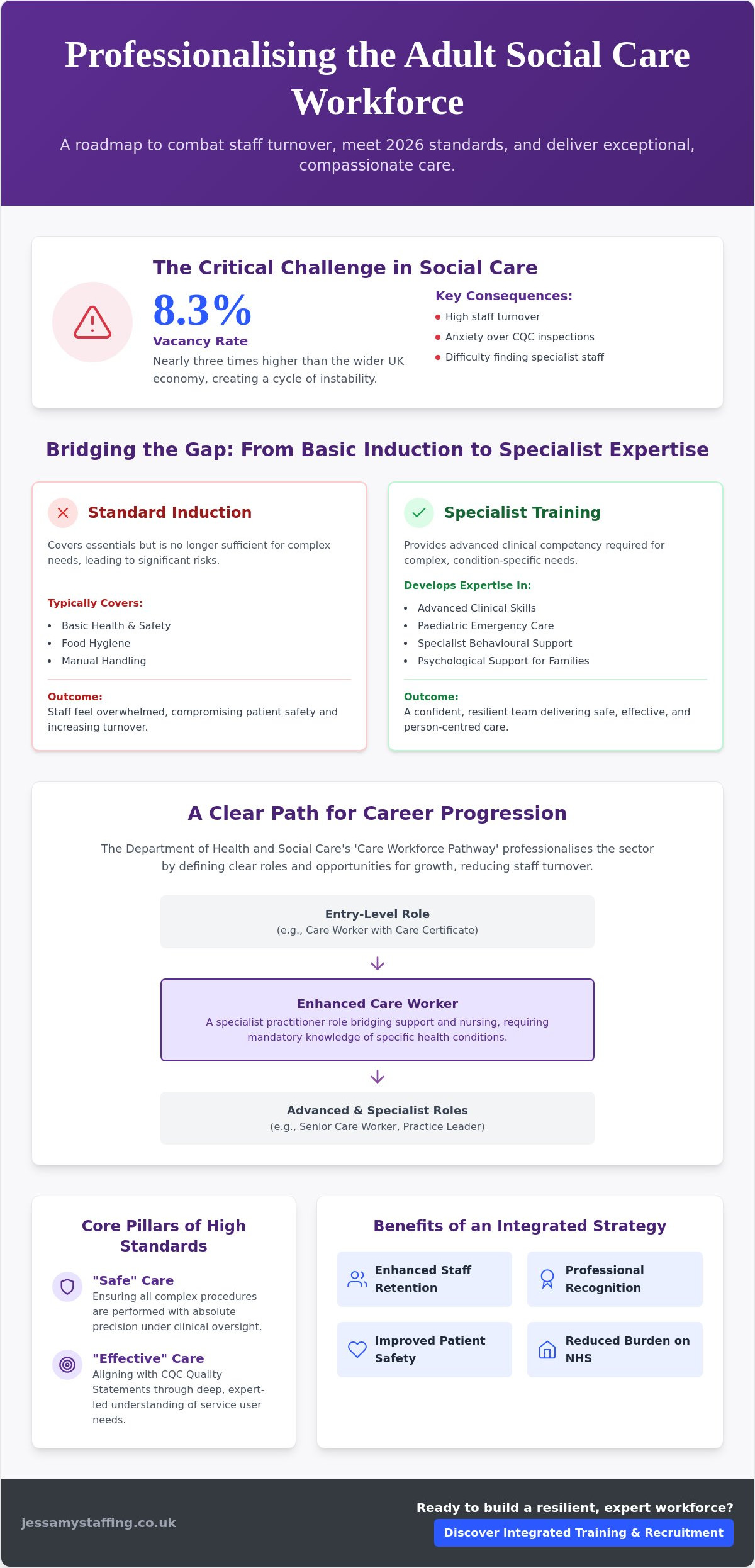
With a vacancy rate of 8.3% across the adult social care sector, which is nearly three times higher than the wider UK economy, the challenge for providers is no longer simply about recruitment; it’s about professionalising. You understand that high staff turnover often stems from a lack of clear career progression, which creates a cycle of anxiety over CQC inspections and the constant difficulty of finding staff equipped for complex paediatric or emergency needs. Investing in specialist care workforce training is the most effective way to break this cycle; it transforms your team from temporary cover into essential partners who are deeply invested in their roles.
You deserve a workforce that feels confident in their expertise and valued for their commitment. This comprehensive guide provides a clear roadmap for workforce development that prioritises both patient safety and staff retention. We will examine the latest 2026 implementation plans for children’s social care, the mandatory Oliver McGowan training requirements, and the specific standards for paediatric emergency care. By the end of this article, you’ll have the insights needed to foster a culture of excellence and professional recognition within your organisation.
Key Takeaways
- Understand why the 2026 regulatory landscape requires clinical competency that extends far beyond the foundational Care Certificate.
- Discover how to implement specialist care workforce training that integrates clinical oversight to ensure both compliance and compassionate service delivery.
- Gain insights into the advanced training requirements for children’s complex care at home, including the essential psychological support necessary for families.
- Learn a structured approach to workforce development, from conducting thorough skills-gap analyses to mapping training to specific service user outcomes.
- Explore how an integrated model of accredited training and rigorous recruitment can significantly enhance staff retention and professional recognition.
Defining Specialist Care Workforce Training in 2026
Specialist care workforce training is no longer an optional enhancement; it’s a fundamental requirement for modern healthcare providers. In 2026, the definition of excellence in care has shifted from generalist assistance to precise, clinical intervention. Whilst the Care Certificate provides a necessary baseline for entry-level workers, specialist training frameworks provide the advanced clinical competency required to manage complex, condition-specific needs. This approach moves beyond simple task completion. It focuses on a values-led professional preparation that ensures every staff member acts as a meticulous guardian of patient safety and dignity.
The Evolving UK Care Landscape
The UK is currently experiencing a demographic shift that places unprecedented pressure on community services. An ageing population, often living with multiple comorbidities, requires a level of support that was previously reserved for hospital settings. We’re seeing a significant rise in the demand for specialist domiciliary and community care as families seek to keep their loved ones at home for longer. By investing in robust training, providers can ensure their teams are capable of managing these high-acuity cases effectively. This development is supported by organisations like Skills for Care, which emphasises the need for strategic workforce planning to meet these evolving requirements. When support workers are equipped with specialist skills, they directly reduce the operational burden on local NHS Trusts, creating a more sustainable healthcare ecosystem for everyone involved.
Why Standard Induction is No Longer Sufficient
A standard induction typically covers basic health and safety, food hygiene, and manual handling. These are essential, but they don’t prepare a worker for the nuances of specialist behavioural support or paediatric airway management. Relying solely on basic induction creates significant risks, particularly in emergency care settings where split-second decisions are vital. Under-trained staff often feel overwhelmed, leading to higher turnover and, more critically, compromised patient outcomes. To bridge this gap, providers must look toward accredited social care training UK resources that offer depth and clinical oversight. Specialist training ensures that staff don’t just follow a checklist; they understand the physiological and psychological triggers behind a service user’s needs. This level of expertise fosters a sense of professional pride and reliability, which are the cornerstones of a resilient care team. It’s about moving from a reactive model to a proactive, expert-led service.
Core Pillars of Specialist Training Standards
Establishing high standards in social care requires a structured approach to education. A robust specialist care workforce training curriculum must be underpinned by clinical oversight to ensure that complex procedures are performed with absolute precision. This isn’t merely about compliance; it’s about aligning with the latest CQC Quality Statements, particularly those focused on “Safe” and “Effective” care. When training is delivered under the guidance of registered clinicians, it instils a level of confidence in the workforce that basic induction cannot match. Implementing a comprehensive specialist care workforce training strategy ensures that your organisation remains compliant whilst delivering a superior standard of person-centred support.
The Care Workforce Pathway Framework
The Department of Health and Social Care has introduced the Care Workforce Pathway, which defines eight distinct role categories to provide clear career progression. Amongst these, the “Enhanced Care Worker” role is particularly significant as it bridges the gap between traditional support roles and registered nursing. These specialist practitioners are required to possess mandatory knowledge in specific health conditions, ensuring that they can manage complex needs with a high degree of autonomy. For providers, this framework offers a blueprint for professionalising their team and reducing the persistent issue of staff turnover by offering tangible growth opportunities.
Clinical Competencies vs. Human-Centric Behaviours
Technical proficiency is the foundation of specialist care. Practitioners must be expertly trained in specific clinical tasks, including:
- PEG feeding and gastrostomy care
- Tracheostomy management and suctioning
- Complex medication administration and seizure management
- Ventilation support and oxygen therapy
While these skills are vital, they must be balanced with human-centric behaviours. Values-led care involves more than just physical support; it requires empathy, active listening, and a deep respect for the service user’s dignity. Specialist care is the intersection of technical mastery and emotional intelligence. Providers who prioritise this balance often see a marked improvement in service user outcomes and family satisfaction. If you’re looking to strengthen your team’s expertise, integrating these pillars into your internal social care training and development programmes is a vital step forward.
Specialisms: Children’s Complex Care and Emergency Response
Specialist care workforce training must be tailored to the specific environment in which care is delivered. Whilst hospital settings provide a controlled clinical backdrop, paediatric home care and emergency response require a unique set of skills. These specialisms demand a blend of technical precision and acute situational awareness. By focusing on these high-stakes areas, providers can build a team that remains calm under pressure and competent in the face of clinical complexity. This targeted approach ensures that the most vulnerable service users receive the highest standard of support, regardless of the setting.
Paediatric Complex Care Requirements
Caring for children with disabilities involves more than just managing medical devices. It requires a deep understanding of safeguarding and the ability to stabilise sensitive home environments. Staff must be trained to navigate the delicate balance between being a professional healthcare provider and a guest in a family’s private space. This is a core component of the children’s complex care at home model. In line with the government’s May 2026 Implementation Plan for Children’s Social Care, training now places a greater emphasis on professional standards for those working in home settings. Beyond clinical tasks, training must address the psychological support needed for families. Parents often experience significant stress when managing a child’s complex needs; a well-trained support worker acts as a reassuring anchor. This level of preparation ensures that the child receives safe care whilst the family feels supported and understood.
Training for 24/7 Emergency Environments
Emergency staffing requires a “rapid-readiness” mindset. When a shift needs covering at the last minute, there’s no time for a lengthy induction. Instead, workers must rely on “Workforce Intelligence”, a combination of prior experience and intensive preparatory training. This allows them to integrate seamlessly into unfamiliar ward cultures or private home settings without disrupting the continuity of care. The Care Workforce Pathway for adult social care provides a useful framework for these competencies, but emergency response demands even greater adaptability. Utilising trained agency care staff offers a strategic advantage during crises. These professionals are specifically prepared to step into high-pressure situations, adhering to the 2025 “Facing the Future” standards for paediatric emergency care. 24/7 support for temporary personnel is equally vital, providing a safety net for the worker and peace of mind for the provider. It’s this intersection of preparedness and ongoing support that defines a resilient emergency workforce.
Implementing a Robust Workforce Development Strategy
Building a resilient care team requires more than just filling rotas. It demands a methodical approach that aligns the professional aspirations of your staff with the complex clinical needs of those they support. A successful strategy for specialist care workforce training isn’t a one-off event; it’s a continuous cycle of assessment, education, and refinement. By following a structured roadmap, providers can ensure their team remains both clinically competent and deeply committed to the organisation’s core values.
To implement this effectively, consider these five essential steps:
- Step 1: Conduct a skills-gap analysis. Audit your current team’s competencies against the specific requirements of your service users.
- Step 2: Map training to outcomes. Ensure every learning module is linked to a tangible improvement in patient safety or care quality.
- Step 3: Source accredited providers. Partner with organisations that understand the 2026 care economy and the latest regulatory frameworks.
- Step 4: Establish a CPD cycle. Create a formal Continuous Professional Development programme that rewards staff for advancing their specialist knowledge.
- Step 5: Measure the impact. Track key performance indicators such as staff retention rates and clinical incident reports to validate your investment.
Balancing Compliance with Compassion
There’s a risk that training becomes a mere “tick-box” exercise designed solely to satisfy inspectors. To avoid this, you must integrate service user and family feedback into your staff development programmes. This ensures that the technical skills being taught are applied with genuine empathy and respect for individual preferences. Compliance is the floor, but compassion is the ceiling of care quality. When staff understand the “why” behind a procedure, they’re more likely to perform it with the level of care that your service users deserve.
The ROI of Specialist Training
The financial argument for specialist care workforce training is compelling. As of May 2026, the adult social care sector faces approximately 131,000 vacant roles, representing a vacancy rate of 8.3%. This crisis makes staff retention more critical than ever. Specialist training creates a clear career pathway, which is a proven driver for staff loyalty. By reducing turnover, you significantly lower recruitment and agency costs. Furthermore, having a highly skilled team allows your organisation to take on higher-acuity cases that generalist providers cannot manage. For facilities looking to address this challenge at the facility level, a strategic approach to training for domestic staff in care homes UK offers a proven framework for reducing turnover whilst meeting the 2026 regulatory requirements. If you’re seeking a partner to help build this expert team, our guide on choosing a support worker recruitment agency offers further strategic insights. Investing in your people is the most reliable way to secure the long-term success of your organisation.
The Jessamy Approach: Integrated Training and Recruitment
Jessamy operates at the intersection of institutional requirements and human needs. We believe that recruitment is only half the battle. The other half is ensuring every support worker possesses the clinical and emotional intelligence required for specialist environments. Our “Principled Expert” model ensures that every individual we supply is not just a CV, but a thoroughly prepared professional. By integrating our recruitment processes with rigorous specialist care workforce training, we provide a level of reliability that generalist agencies cannot match. This approach transforms the workforce from temporary cover into essential partners who are deeply invested in the well-being of the service user.
Our integrated model focuses on three core areas of preparation:
- Clinical Rigour: Staff are trained in specific clinical competencies before they ever step foot in a service user’s home.
- Emotional Intelligence: We prioritize values-led training that emphasizes empathy and the “human” side of care.
- Operational Excellence: Every team member understands the regulatory landscape, ensuring they act as guardians of your organisation’s compliance.
Values-Led Training in Greater Manchester
Our commitment to Greater Manchester and the wider North West is unwavering. We understand the local healthcare landscape and the specific challenges faced by providers in this region. Every staff member undergoes a “professionally prepared” protocol before they are placed. This includes a deep dive into professional standards and condition-specific care. Whether you require support for children’s complex care at home or need our 24/7 emergency cover capabilities, our team is ready to step in with minimal disruption. We don’t just send a worker; we send a professional who has been vetted and trained to meet the high standards expected in the North West care economy. This local focus allows us to respond quickly and effectively to the unique needs of our community.
Ensuring Dependable Workforce Capacity
Workforce capacity is about more than just numbers; it’s about the quality of those numbers. Jessamy’s training model is designed to strengthen sensitive care environments where the margin for error is non-existent. Our compliance-aware personnel provide the peace of mind that allows managers to focus on long-term strategy rather than daily firefighting. We act as a meticulous guardian of your standards, ensuring that every placement reflects your organisation’s commitment to excellence. By choosing a partner that prioritises specialist care workforce training, you’re investing in a more stable and high-performing team. We invite you to experience the difference that a principled, expert-led approach can make for your service delivery. Partner with Jessamy Staffing for your workforce needs and secure the future of your care team today.
Securing the Future of Your Care Delivery
The landscape of social care is undergoing a profound transformation, shifting from generalist support to acute clinical intervention. By prioritising specialist care workforce training, you don’t just meet regulatory requirements; you foster a culture of professional recognition and safety. We’ve explored how structured pathways and condition-specific skills can reduce the vacancy crisis whilst improving outcomes for those with complex needs. It’s clear that the most resilient providers are those who treat staff development as a strategic investment rather than an operational cost.
As an Accredited Social Care Training Provider and 24/7 Emergency Staffing Experts, Jessamy is uniquely positioned to help you navigate these challenges. Our values-led recruitment process ensures that every professional we supply is prepared for the technical and emotional demands of your service. Discover how Jessamy Staffing can elevate your team with specialist care training and recruitment. Building a team that is as compassionate as it is clinically capable is the surest way to provide the high-quality care your service users deserve.
Frequently Asked Questions
What is the difference between mandatory training and specialist care training?
Mandatory training provides the foundational safety knowledge required for all roles, such as the Care Certificate, whereas specialist training focuses on specific clinical conditions. Whilst mandatory modules cover basic health and safety, specialist programmes equip staff with advanced skills like tracheostomy management or PEG feeding. This targeted development allows workers to move beyond general support into high-acuity, condition-specific care.
Is specialist care workforce training required for CQC compliance?
Yes, providing specialist care workforce training is essential for meeting the CQC’s “Safe” and “Effective” Quality Statements. For example, the Oliver McGowan Mandatory Training on Learning Disability and Autism became a legal requirement in September 2025 for all registered providers. Failing to ensure staff are competent in the specific needs of your service users can lead to significant regulatory breaches and compromised safety.
How often should specialist care training be refreshed for staff?
Most clinical competencies require an annual refresher to ensure that skills remain precise and up to date. Whilst certain statutory requirements have fixed schedules, best practice in the care sector suggests that high-risk skills, such as emergency response or paediatric airway management, should be reviewed more frequently. Regular assessments help maintain the professional rigor necessary for complex care environments.
Can agency staff access specialist training through their recruitment firm?
Reputable recruitment partners provide their personnel with access to accredited training modules to ensure they’re professionally prepared for placement. This integrated approach ensures that temporary staff can integrate seamlessly into specialist teams without a drop in care quality. It’s vital for providers to partner with firms that prioritise continuous development as part of their recruitment process.
What are the most in-demand specialist care skills in 2026?
The most sought-after skills currently include paediatric ventilation support, complex medication administration, and specialist behavioural intervention. With the 2026 shift toward home-based complex care, there is also a significant demand for staff trained in 24/7 emergency response. These competencies allow providers to manage higher-acuity cases that were previously restricted to hospital settings.
How does specialist training improve staff retention in the care sector?
Investing in specialist care workforce training improves retention by providing staff with a clear sense of career progression and professional recognition. When workers see a defined path toward “Enhanced Care Worker” roles, they feel more valued and are less likely to leave the sector. This professionalisation is a key strategy in reducing the high vacancy rates currently impacting the UK care economy.
Are there accredited training programmes for children’s complex care?
Yes, there are several accredited frameworks that align with the Royal College of Paediatrics and Child Health standards. These programmes focus on the unique safeguarding needs of children and the technical skills required for home-based clinical support. They also address the vital psychological support needed for families, ensuring a holistic approach to paediatric care.
What is the Care Workforce Pathway and how does it affect my staff?
The Care Workforce Pathway is a national framework that standardises career structures across the adult social care sector. It organises roles into eight distinct categories, making it easier for your staff to understand the specific knowledge and skills needed for promotion. This framework helps managers align their internal training strategies with national standards, fostering a more transparent and motivated workforce.