



The 07:00 shift handover is moments away when your phone vibrates with a notification that a key team member cannot attend, leaving a critical gap in your rota. This scenario is all too familiar for care managers, particularly whilst the sector navigates a 7.0% vacancy rate in adult social care. Securing an urgent support worker supply isn’t merely about filling a hole in the schedule. It’s about protecting the safety and dignity of those in your care whilst maintaining rigorous compliance and safeguarding standards.
You likely feel the mounting pressure when agency staff arrive lacking the specific training your service requires, or when communication from staffing partners falters during a crisis. We believe that a rapid response should never necessitate a compromise on quality or professional integrity. This guide provides a definitive rapid-response checklist to help you secure competent, values-led professionals who integrate seamlessly into your team. We will examine how to vet for competence, ensure immediate compliance, and maintain excellence throughout every staffing emergency.
Key Takeaways
- Understand why prioritising professional values over mere speed is essential for maintaining safeguarding standards during a staffing crisis.
- Learn how to implement a rigorous five-point vetting process to secure a high-quality urgent support worker supply without compromising on compliance.
- Identify the non-negotiable documentation and training modules required for emergency staff, including Enhanced DBS status and mandatory safeguarding certifications.
- Discover how to create a streamlined agency induction pack that ensures temporary staff integrate safely and effectively into your existing team.
- Explore strategies for establishing reliable 24/7 emergency cover that minimises operational downtime whilst upholding the highest care standards.
Navigating the Pressure of Urgent Support Worker Supply
Staffing vacancies in the care sector are rarely just administrative inconveniences; they represent a direct challenge to the continuity of care. With the vacancy rate in adult social care currently sitting at 7.0% according to The King’s Fund, the pressure on managers to maintain safe staffing levels is constant. When a rota gap appears at short notice, the immediate operational impact ripples through the entire facility. Residents may experience heightened anxiety due to unfamiliar faces or delayed routines, whilst permanent staff face increased workloads that rapidly erode team morale. In this high-pressure environment, the temptation to accept “any warm body” to fill a shift is significant. However, this mindset is fundamentally dangerous. A worker who lacks the necessary values or skills can inadvertently compromise the very safety you are trying to preserve.
As a Registered Manager, your primary duty remains the maintenance of CQC safeguarding standards, even during a crisis. Understanding what is care work in its professional context is vital here; it’s a skilled discipline that requires both emotional intelligence and technical competence. There’s also a clear distinction between “last-minute” needs, such as covering a single sickness absence, and “emergency” staffing needs, which often involve complex care requirements or sudden increases in resident numbers. Recognising this difference allows you to tailor your urgent support worker supply request to ensure you receive a professional who is truly fit for purpose rather than just a temporary placeholder.
The Risks of Sub-Standard Emergency Cover
Sub-standard cover introduces profound safeguarding vulnerabilities. If a worker arrives without site-specific knowledge or specialist training in areas like dementia or complex physical needs, the risk of medication errors or poor manual handling increases. Beyond the immediate risk to residents, there’s a substantial financial and reputational cost. A failed CQC inspection triggered by inadequate staffing levels or incompetent agency use can lead to restrictive conditions on your registration. Poorly integrated staff can also destabilise sensitive environments, creating friction amongst the permanent team and diminishing the overall standard of care.
Defining “Reliability” in Rapid Response
True reliability in an urgent support worker supply partner extends beyond a 24/7 telephone line. It requires a staffing partner with a deep, pre-vetted talent pool and a granular understanding of the local Manchester care landscape. Reliability means knowing that the individual sent to your facility has been selected for their specific competence, not just their availability. By moving from reactive panic to a structured emergency staffing partnership, you can ensure that your facility remains a stable, safe environment for everyone. This proactive approach transforms a potential crisis into a managed operational task, allowing you to focus on leading your team with confidence.
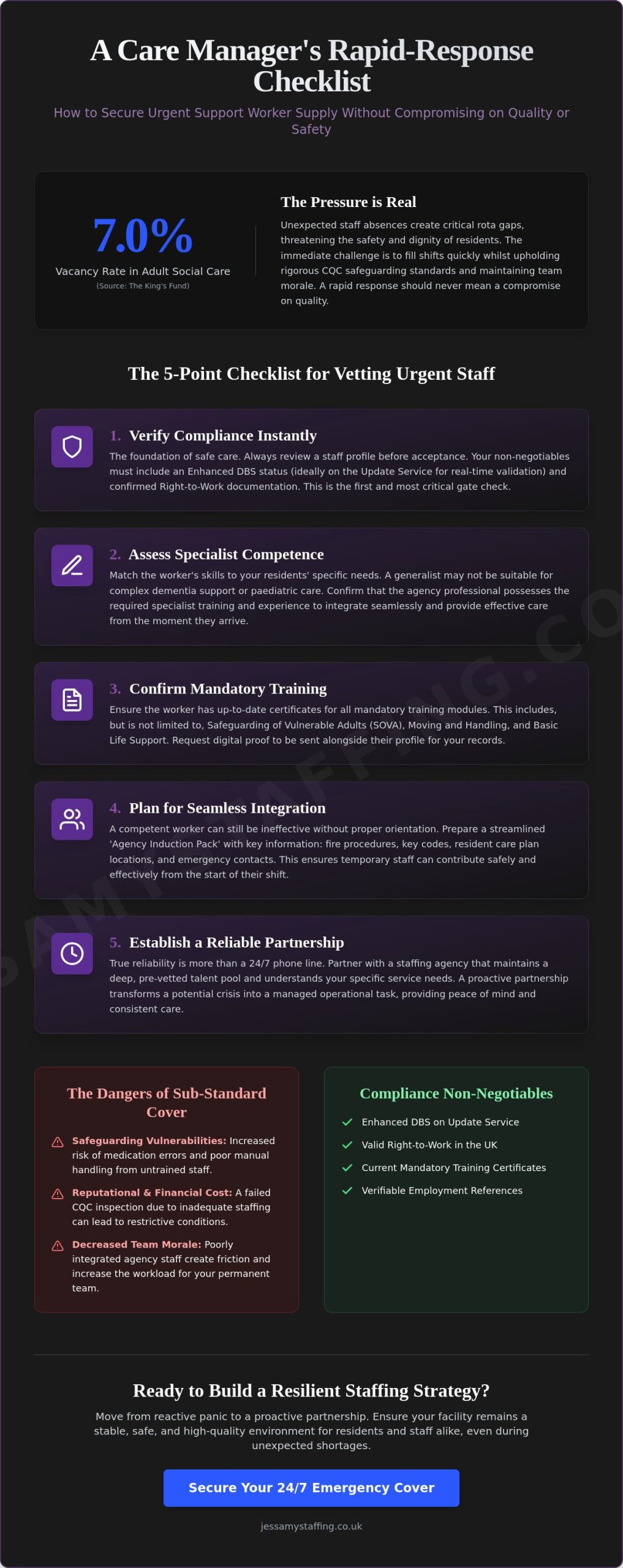
The 5-Point Checklist for Vetting Urgent Support Worker Supply
When a shift remains vacant, time becomes your greatest adversary. However, the speed of your response must be matched by the precision of your vetting. Securing an urgent support worker supply requires a structured approach to ensure that the professional entering your facility is ready to provide high-quality care immediately. You shouldn’t have to choose between a full rota and resident safety. By following a rigorous checklist, you can maintain your high standards even in the midst of a staffing emergency.
Step 1 & 2: Compliance and Competence
You must never accept a worker without first reviewing their staff profile. This digital or physical document should include their latest Enhanced DBS status and right-to-work verification. Compliance rigour is the foundation of safe care. It’s essential to verify that the worker’s DBS is registered with the Update Service, allowing for real-time validation of their suitability. Beyond the paperwork, you must assess their specialism. If your residents require dementia support or children’s complex care, a generalist worker may struggle to maintain the required standards. The impact of staffing shortages on vulnerable individuals can be profound, often leading to disrupted treatments and increased distress. Ensuring a precise match between a worker’s specific skills and your residents’ needs mitigates these risks and ensures continuity of care.
Step 3, 4 & 5: Training, Values, and Logistics
Training currency is your third pillar. Confirm that all mandatory social care modules, such as Moving and Handling, Safeguarding, and Medication Administration, are up to date and accredited. Accredited training prevents common errors that often occur during high-pressure emergency shifts. Fourth, evaluate values-alignment. Ask your staffing partner how they filter for empathy and professional integrity during their recruitment process. A values-led professional will strive to maintain a resident’s favourite care routine, preserving their dignity whilst the permanent team is stretched. Finally, review communication speed. A reliable 24/7 emergency care staffing UK partner should provide a confirmation or an escalation status within 30 minutes of your request. Delayed responses only heighten the risk to your service.
This structured vetting process ensures that your urgent support worker supply is a solution rather than an added risk. If you find your current arrangements lack this level of transparency or speed, it might be time to partner with an agency that prioritises these non-negotiables. You can explore how we uphold these standards for our partners at jessamystaffing.co.uk. By demanding excellence in these five areas, you protect your residents, your staff, and your professional reputation.
Compliance and Quality: Non-Negotiables for Last-Minute Staffing
Compliance serves as the invisible framework that supports every successful care interaction. In the context of an urgent support worker supply, this framework must be robust enough to withstand the pressures of rapid deployment. An Enhanced DBS check is the absolute minimum requirement, but its value is significantly amplified by the Update Service. This service allows care managers to perform instantaneous status checks, ensuring that a worker’s clearance is current without the delays associated with a new application. When a staffing gap appears in the middle of the night, this immediate verification isn’t just a regulatory necessity; it’s a fundamental component of mitigating risks of staffing shortages and protecting the vulnerable individuals in your care.
Mandatory training modules form the technical foundation of a worker’s competence. Modules such as Moving and Handling, Safeguarding, and Medication Administration must be current and accredited by recognised bodies. These certifications ensure that a temporary worker can step into a shift and perform essential tasks safely from the very first hour. This reduces the “onboarding lag”, which is the period where a new staff member requires constant supervision, allowing your permanent team to focus on their primary duties. Rigorous agency audits further ensure that this quality remains consistent over time, preventing the gradual slip in standards that often occurs with high-volume staffing partners who prioritises quantity over professional rigor. For a broader strategic perspective on maintaining quality across your workforce, our guide to care home staffing solutions outlines how to build a compliant, resilient team that meets CQC requirements at every level.
The Jessamy Standard of Professional Preparation
Our approach integrates social care training and development directly into our recruitment cycle. We don’t just supply staff; we prepare professionals who understand the intersection of technical skill and human empathy. This “values-led” preparation ensures that resident dignity is maintained even during the most frantic emergency cover. For managers overseeing specialised rotas, adhering to specific safety protocols is vital for overnight success. You can learn more about these requirements in our guide on night shift support worker cover.
Safeguarding in Specialist Environments
Specialist settings, such as children’s complex care at home or supported living for those with challenging behaviour, require an even higher register of compliance. Staff must be specifically prepared for high-acuity environments where a lack of familiarity can lead to escalated incidents or safety breaches. Maintaining an urgent support worker supply in these sectors requires a partner who maintains a pool of specialists rather than generalists. This focus on specialism ensures continuity of care, as the temporary personnel possess the specific skills required to manage complex needs whilst respecting the established routines and individual preferences of the service user.
The arrival of a temporary professional is only the first step in resolving a staffing gap. For an urgent support worker supply to be truly effective, your facility must be prepared to integrate them with precision. Speed of arrival must be met with speed of orientation. A structured onboarding process ensures that the worker can contribute immediately whilst maintaining the safety of your residents and the stability of your permanent team. This preparation prevents the “lost hours” often associated with new agency staff and minimises the risk of operational errors during a crisis.
Creating an “Agency Induction Pack” is a highly effective way to accelerate this transition. This pack should be a concise, physical or digital folder that contains everything a worker needs to function independently. Alongside this, identifying a “buddy” on the permanent team provides the temporary staff member with a direct point of contact for cultural and operational nuances that aren’t always captured in written protocols. This peer-to-peer support fosters a sense of belonging and encourages temporary staff to uphold your facility’s high standards. Finally, monitoring performance and providing prompt feedback to your staffing agency allows for continuous improvement and helps build a more resilient partnership for future needs.
The 10-Minute Induction Checklist
Time is a luxury you rarely have during a staffing emergency, so your induction must be focused and impactful. Focus on these three critical areas:
- Essential Safety: Clearly mark fire exits, explain emergency evacuation protocols, and highlight any immediate resident risks or behavioural triggers.
- Access and Logins: Provide necessary keys, security codes, and temporary logins for digital care records to ensure accurate documentation from the start of the shift.
- Resident Profiles: Share brief summaries of individual preferences and communication needs to ensure person-centred care continues uninterrupted.
A structured handover protects both the worker and the resident by ensuring that critical information is never lost in the transition between shifts.
Managing Integration in Supported Living
In supported living environments, the integration process requires additional sensitivity. When seeking emergency staffing for supported living, you must ensure that the worker understands they are entering someone’s home, not just a clinical workplace. This requires a balance of professional support and respect for the individual’s personal space and autonomy. Temporary staff should be briefed on the specific goals and aspirations of the person being supported, ensuring that the care provided is empowering rather than merely custodial. This approach maintains the dignity of the service user whilst ensuring that your facility remains compliant with CQC standards during periods of high pressure. If you require a partner that understands these operational nuances, you can contact our team to discuss your urgent support worker supply requirements.
Securing Reliable 24/7 Support with Jessamy Staffing Solutions
Effective staffing in a crisis requires more than just a list of available names; it requires a partner who operates with the same level of duty as your own internal team. At Jessamy Staffing Solutions, we provide a meticulous urgent support worker supply that bridges the gap between sudden vacancies and high-quality care. Our 24/7 emergency cover model is designed to minimise facility downtime, ensuring that a single absence doesn’t escalate into a safeguarding risk. By maintaining a deep pool of pre-vetted professionals, we provide the reassurance that help is always available, regardless of the hour or the complexity of the requirement.
We believe that the most reliable staffing solutions are built on a foundation of continuous professional development. Unlike agencies that merely act as intermediaries, we provide both expert staffing and accredited socialcare training & development. This dual capability ensures that every worker we deploy is not only compliant but also possesses the technical competence to handle specialized settings. This integrated approach reduces the burden on your permanent staff and maintains the integrity of your service’s care standards whilst you manage long-term rota adjustments.
Why Manchester Providers Trust Jessamy
Local expertise is vital when navigating the specific challenges of the Greater Manchester care sector. We combine this regional knowledge with rigorous national safeguarding standards to act as a stable, long-term partner for our clients. Our Principled Expert approach means we don’t just fill shifts; we provide professionals who reflect our core values of empathy and excellence. Local care home managers frequently report that our response times and the quality of our personnel provide a level of stability that is rare in the temporary staffing market. We act as a meticulous guardian of your standards, ensuring that every placement prioritises the well-being of the end-user as much as the success of your organisation.
Next Steps: Strengthening Your Workforce Capacity
The best time to secure your urgent support worker supply is before a crisis occurs. Establishing a partnership through a staffing consultation or an emergency cover agreement allows us to understand your facility’s specific needs and resident profiles in advance. This proactive preparation ensures that when a gap does arise, our response is even more precise and effective. Beyond emergency cover, you can also access our accredited training programmes for your permanent team to enhance overall service quality. We are here to support your operational excellence through every challenge, providing the stability you need to lead your facility with confidence. Contact Jessamy Staffing for reliable urgent support worker supply today to ensure your facility is never left without the support it deserves.
Building a Resilient Strategy for Future Staffing Gaps
Managing a care facility requires a constant balance between technical compliance and compassionate delivery. By implementing a rigorous vetting checklist and preparing your facility with structured induction packs, you transform a reactive crisis into a managed operational process. We’ve explored how prioritising values-led recruitment and accredited training ensures that resident dignity remains intact, even when the rota is under pressure. A safe, high-quality urgent support worker supply is not just a temporary fix; it’s a vital extension of your commitment to excellence.
As specialists in Greater Manchester care staffing, we act as a bridge between your institutional requirements and the human needs of your residents. Our 24/7 Emergency Response Team is always available to provide the stability you need, backed by our status as an Accredited Social Care Training Provider. You don’t have to navigate these challenges alone. We invite you to Secure Reliable Emergency Cover with Jessamy Staffing Solutions and establish a partnership that prioritises safety and integrity. With the right systems and partners in place, you can lead your team through any staffing emergency with absolute confidence.
Frequently Asked Questions
How quickly can an urgent support worker be deployed to my facility?
Deployment typically occurs within two to four hours of a confirmed request, depending on your specific location and requirements. Our 24/7 response team prioritises immediate needs to ensure your rota gaps are filled before the next shift handover. We focus on matching the right professional to your setting rather than just the nearest available person, ensuring safety is never compromised for speed.
What compliance documents should I expect to see for an agency worker?
You should receive a comprehensive staff profile including an Enhanced DBS certificate number, Right to Work verification, and a summary of mandatory training. We recommend checking the DBS Update Service for real-time validation of a worker’s status. These documents provide the necessary assurance that the professional meets all current CQC safeguarding requirements and is fit for practice.
Can you provide support workers with specialist training for complex care?
Yes, we provide professionals with specialist training in areas such as children’s complex care at home and dementia support. Every worker is matched to your specific environment based on their technical skills and previous experience. This ensures they can manage high-acuity needs with confidence and integrate into your existing care plans from the moment they arrive on-site.
Are your emergency staff available for night shifts and weekends in Manchester?
Our emergency staff are available 24 hours a day, seven days a week, across the Greater Manchester region. This includes full coverage for night shifts, weekends, and public holidays to maintain continuity of care. We understand that staffing crises don’t only happen during office hours, so our support remains accessible whenever a vacancy threatens your service’s stability.
How do you ensure the quality and values of your temporary staff?
We utilise a values-led recruitment process that filters for empathy and professional integrity alongside technical skill. Additionally, as an accredited training provider, we oversee the ongoing development of our team to ensure they meet our rigorous internal standards. This ensures that every individual we supply understands the intersection of high clinical standards and compassionate, human-centric support.
What happens if an agency worker is not a good fit for our environment?
We operate a transparent feedback loop and will arrange a replacement if a worker doesn’t meet your facility’s specific requirements or cultural fit. Whilst our vetting process is rigorous, we recognise that the harmony of your permanent team is vital for resident well-being. Providing prompt feedback allows us to refine our selection for your future urgent support worker supply needs.
Do you provide urgent support worker supply for private home care?
Yes, we provide urgent support worker supply for private home care settings, particularly for complex requirements such as children’s complex care at home. We ensure that the staff provided are respectful of the home environment whilst maintaining professional boundaries and high care standards. This service is designed to support families and individuals during sudden transitions or emergencies.
Is there a minimum booking duration for emergency staffing cover?
Emergency bookings typically follow standard shift patterns, such as six or twelve hours, to ensure continuity of care for the service user. This duration allows the worker to integrate into your team’s routine and complete necessary documentation accurately. We can discuss flexible arrangements during your initial consultation based on the specific acuity and duration of your staffing gap.