



Technical proficiency in the care sector is a non-negotiable baseline, but the true measure of a support worker lies in the intersection of accredited skill and authentic empathy. When you are responsible for the safety and well-being of vulnerable individuals, the process of finding qualified support workers UK becomes more than a recruitment task; it’s a fundamental commitment to quality and safeguarding. We recognise that the relentless cycle of staff turnover and the complexities of CQC compliance can leave even the most dedicated providers feeling stretched and uncertain.
You deserve a staffing strategy that prioritises continuity of care over mere shift-filling. This guide outlines how to identify and secure high-calibre professionals who possess both the technical competence to meet the latest standards, such as the Oliver McGowan Mandatory Training, and the character to provide meaningful support. We’ll explore the essential steps to build a reliable pipeline of vetted staff, ensuring your service remains resilient, compliant, and deeply human-centric, even when facing the pressure of last-minute emergency cover.
Key Takeaways
- Define the statutory requirements and the significance of the Care Certificate in establishing a baseline for professional excellence and regulatory compliance.
- Distinguish between high-volume recruitment agencies and specialist partners when finding qualified support workers UK to ensure a steady pipeline of vetted talent.
- Implement a rigorous “Safe Recruitment” checklist that encompasses enhanced safeguarding measures and a thorough understanding of DBS verification levels.
- Recognise the specialised clinical requirements for children’s complex care and domiciliary support, ensuring staff are equipped for technical tasks such as PEG feeding.
- Explore how a commitment to 24/7 emergency cover and accredited development programmes can eliminate service gaps and improve long-term continuity of care.
What Defines a Qualified Support Worker in the UK?
A support worker acts as the vital bridge between clinical necessity and personal autonomy. They don’t just provide assistance; they facilitate a life lived with dignity. Within the broader context of Social care in the United Kingdom, the definition of “qualified” has become increasingly rigorous. For those responsible for finding qualified support workers UK, the search begins with understanding that technical certification is a baseline, not a ceiling. A truly qualified professional integrates statutory knowledge with a deep commitment to the service user’s quality of life.
Statutory requirements provide the essential framework for safety. The Care Certificate, which underwent a significant update in March 2025, serves as the standard induction for staff across the health and care sectors. However, the distinction between general support and specialist roles is where quality truly diverges. Whilst a generalist may assist with daily living, specialists in mental health, learning disabilities, or complex physical care require bespoke expertise. This includes the Oliver McGowan Mandatory Training on learning disability and autism, which became a legal requirement for all CQC-registered service staff following the finalisation of its code of practice in September 2025.
Essential Qualifications and Certifications
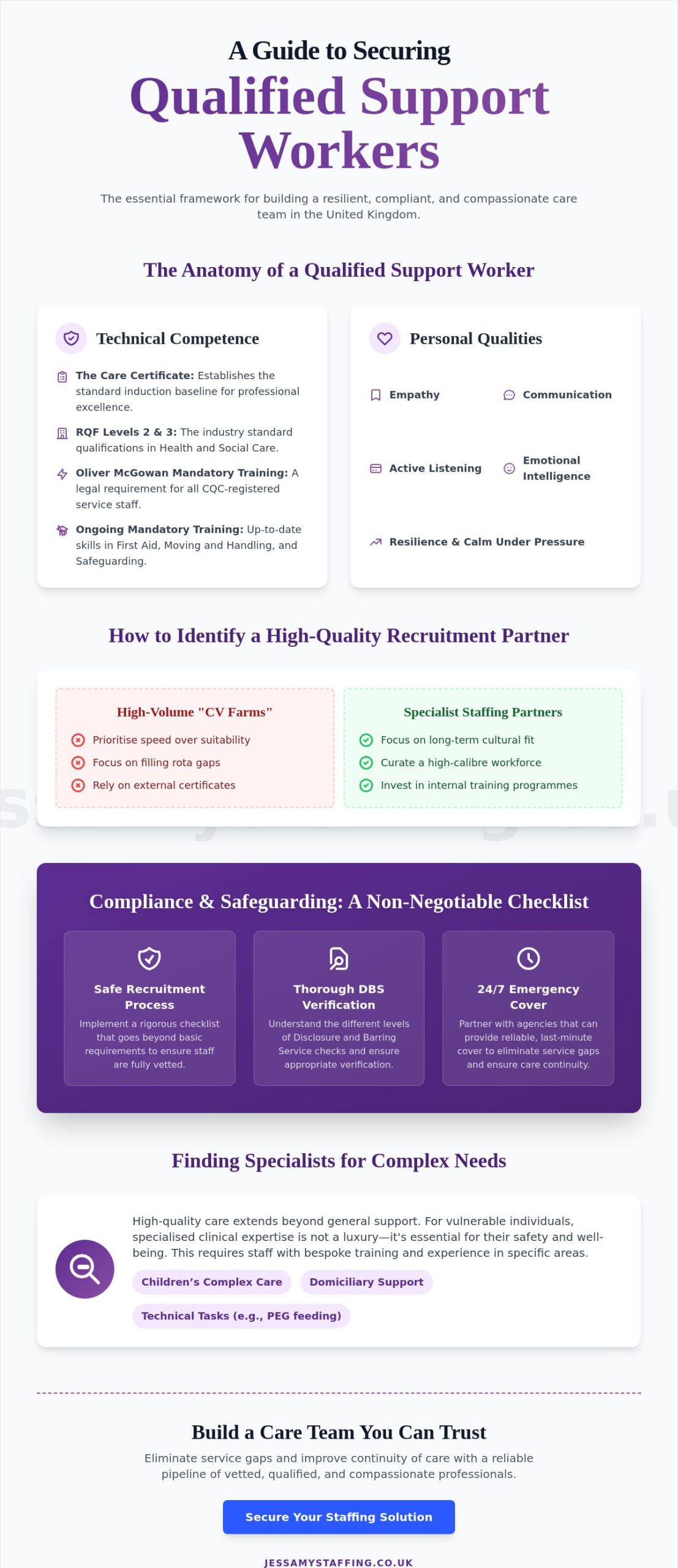
Technical competence is formally validated through the Regulated Qualifications Framework (RQF). Levels 2 and 3 in Health and Social Care remain the industry standard, whilst Level 4 is reserved for those in lead practitioner or management roles. Beyond these diplomas, a qualified worker must maintain up-to-date mandatory training. This includes First Aid, Moving and Handling, and Safeguarding. We view accredited social care training and development as the definitive benchmark; it ensures staff are prepared for the practicalities of the role whilst remaining compliant with Regulation 18 of the Health and Social Care Act.
The “Soft Skills” That Make a Support Worker Qualified
Qualifications on paper only tell half the story. Empathy and active listening are the foundations of person-centred care, allowing workers to build trust with those they support. Resilience is equally vital, particularly in settings involving challenging behaviour or emotional distress. A qualified professional possesses the emotional intelligence to remain calm under pressure and the communication skills to liaise effectively with families, clinicians, and social workers. They act as a steady, reliable presence in a service user’s life, ensuring that care is as compassionate as it is clinically sound.
True qualification is never a static achievement. It’s a continuous process of professional growth. The most effective workers are those who seek out ongoing development, ensuring their skills evolve alongside changing regulations and emerging best practices in the care sector.
How to Identify High-Quality Support Worker Recruitment Agencies
The process of finding qualified support workers UK often begins with a choice between two distinct agency models. On one side, you have high-volume “CV farms” that prioritise speed and quantity over clinical suitability. On the other, specialist staffing partners focus on long-term cultural and professional fit. A specialist partner doesn’t just fill a gap in a rota; they curate a workforce that aligns with the Care Workforce Pathway, ensuring that every individual possesses the core values and knowledge required for modern social care.
Evaluating an agency’s internal training is paramount for maintaining safety. High-quality partners invest in their own Socialcare Training & Development programmes rather than relying solely on certificates obtained elsewhere. This internal oversight ensures that staff aren’t just “trained” but are genuinely competent in real-world scenarios. For providers in regions like Greater Manchester, local expertise is a significant factor in reliability. An agency with deep local roots understands the geographical challenges of the area, ensuring that staff arrive on time and are familiar with the community resources available to service users.
Values-led recruitment is the foundation of this approach. It’s about looking beyond the skill set to identify the motivation behind a worker’s career choice. Agencies that prioritise integrity and a sense of duty create a more stable workforce, reducing the high turnover rates that often disrupt care continuity. If you are seeking a partner that embodies these standards, exploring professional staffing solutions can provide the stability your service requires.
Key Questions to Ask a Potential Staffing Partner
Transparency is the hallmark of a high-quality agency. When interviewing a potential partner, ask how they verify the authenticity of staff qualifications. Do they conduct manual checks or use automated systems? Inquire about their specific process for handling emergency, last-minute shift cover. A vague answer here often signals a lack of operational depth. Finally, determine if they can provide staff with documented experience in complex or paediatric care, as these roles require a higher level of clinical oversight than general support work.
The Importance of 24/7 Availability
Care needs don’t adhere to a nine-to-five schedule. A 24/7 emergency care staffing UK model is essential for maintaining continuity and safety. Using an agency without robust out-of-hours support introduces significant risk; a single sickness or emergency can quickly destabilise a sensitive care environment. Rapid response teams act as a safety net, providing the peace of mind that a qualified professional is always available to step in when required, regardless of the hour.
Compliance and Safeguarding: The Non-Negotiable Checklist
Compliance is the bedrock of safety in the care sector. It isn’t merely a bureaucratic exercise; it’s a rigorous safeguard designed to protect the most vulnerable members of our society. Finding qualified support workers UK involves a meticulous vetting process that goes far beyond a cursory glance at a CV. A robust “Safe Recruitment” framework ensures that every individual entering a service user’s home or facility is not only technically capable but also legally and ethically fit for practice. This process must be exhaustive, leaving no room for ambiguity or oversight.
The Disclosure and Barring Service (DBS) check is a primary tool in this framework. Whilst a Standard DBS check covers spent and unspent convictions, it’s often insufficient for the care sector. Most support roles constitute “regulated activity,” which necessitates an Enhanced DBS check. This higher level of scrutiny includes a check against the barred lists, ensuring the applicant isn’t legally prohibited from working with children or vulnerable adults. Alongside this, identity verification and Right to Work checks must be conducted with precision. We don’t just verify that a person can work; we verify exactly who they are through a combination of photographic ID and proof of address, as required by UK healthcare regulations.
Professional references and employment history gaps require equal attention. A qualified worker’s history should be a transparent map of their professional journey. Any unexplained gaps must be explored during the interview process to rule out concerns regarding conduct or safeguarding. We look for a minimum of two professional references, including the most recent employer, to confirm that their previous performance aligns with the high standards we demand.
The Compliance Audit Trail
Maintaining a Single Central Record (SCR) is vital for services that utilise temporary or agency staff. This live document provides an immediate overview of the vetting status of every worker on-site. By aligning recruitment practices with the standards set by Skills for Care, providers can ensure their workforce is both competent and ethically sound. Every training certificate must be verified against accredited awarding bodies to prevent the use of fraudulent or substandard documentation. Furthermore, staff must be regularly briefed on the latest CQC Quality Statements to ensure their daily practice reflects current regulatory expectations.
Safeguarding and Risk Management
Safeguarding is a proactive duty, not a reactive one. Qualified staff are trained to identify the subtle signs of abuse or neglect and understand the specific reporting pathways for “Prevent” and general safeguarding concerns. This vigilance is maintained through regular supervision and performance monitoring. Even when providing a rapid Support Worker Supply, the transition of new staff into existing care teams must be managed carefully. A thorough induction ensures that agency staff understand the specific risk assessments and support plans of the individuals they are caring for, maintaining a seamless standard of protection.
Finding Specialists: Children’s Complex Care and Domiciliary Support
General support workers often lack the specific clinical depth required for complex paediatric cases. Whilst a generalist might provide excellent social support, children with life-limiting conditions frequently require interventions that are acute and technical. Finding qualified support workers UK for these sensitive environments requires a shift in perspective; it’s about identifying practitioners who can manage tracheostomy care or PEG feeding whilst maintaining a playful, child-centred atmosphere. These clinical tasks are not merely checkboxes on a skills list. They are life-sustaining responsibilities that must be performed with precision inside a private family home.
The introduction of a support worker into a family’s domestic space can be a destabilising event. If the worker is not a perfect fit, the resulting tension can impact the well-being of the entire household. High-quality staffing focuses on balancing clinical safety with a nurturing touch. This ensures the child feels supported rather than medicalised in their own bedroom. For families requiring this level of precision, our Children’s Complex Care at Home services prioritise this delicate balance between technical skill and emotional intelligence.
Qualifications for Paediatric Support
Paediatric support demands a unique set of credentials. Beyond the standard Care Certificate, workers must possess specialist training in children’s safeguarding and paediatric first aid. They need to understand the unique emotional needs of children who may not communicate through traditional means. A supported living staffing agency plays a vital role here; they act as the coordinator between the family, the school, and multi-disciplinary clinical teams. This ensures that the care plan is a cohesive strategy rather than a series of disconnected shifts.
Domiciliary vs. Residential Staffing
The environment dictates the type of staff required. In a residential facility, the structure is institutional; in a domiciliary setting, the worker must adapt to the family’s rhythm. Personality matching becomes the deciding factor for long-term success. A support worker who is clinically perfect but culturally mismatched will rarely last in a home-based role. Additionally, even Domestic Staff working in these environments should receive basic care awareness and hygiene training. This ensures they don’t inadvertently compromise a sterile clinical area or a service user’s health whilst performing their duties. We believe that every individual entering the home, regardless of their primary role, must contribute to a safe and respectful environment.
The Jessamy Standard: A New Era of Health and Social Care Staffing
Jessamy Staffing Solutions represents a paradigm shift in the recruitment sector. We believe that finding qualified support workers UK should not be a gamble on a digital database; it should be a strategic partnership with a meticulous guardian of standards. Our approach is defined by the “Jessamy Standard,” a dual-commitment that pairs rigorous technical compliance with authentic human character. We don’t simply fill shifts. We curate a workforce of professionals who possess the technical competence to manage complex needs and the emotional intelligence to provide genuine companionship.
Integrity is our baseline. We operate on a values-led recruitment philosophy that asks a simple, definitive question: “Is this a person we would trust to care for our own families?” If the answer is anything less than an absolute yes, they do not join our team. This uncompromising filter ensures that our clients receive staff who are as compassionate as they are capable. By prioritising character alongside clinical skill, we help stabilise the care economy and reduce the disruptive effects of high staff turnover in Greater Manchester and across the region.
Our Accredited Training and Development Centre
Stability in care is built on a foundation of continuous learning. Unlike agencies that merely verify external certificates, we invest heavily in our own Socialcare Training & Development centre. This in-house facility allows us to oversee the induction and ongoing education of our personnel directly. Every worker undergoes a rigorous programme that covers the latest CQC requirements and safeguarding protocols. This ensures that when a Jessamy worker arrives at a service, they are professionally prepared to handle the most sensitive environments with confidence and precision. Our clients benefit from a dependable workforce that is always up to date with the latest statutory standards.
Partnering for Capacity and Excellence
We act as a vital resource for care homes and facilities facing chronic understaffing. Our 24/7 Emergency Cover ensures that clinical safety is never compromised by an empty rota. We provide a reliable pipeline of Support Worker Supply, offering personnel who are ready to integrate seamlessly into existing teams. The Jessamy guarantee is simple: we provide safe, competent, and compassionate staff every time. If you are ready to elevate the standard of care in your organisation, the next step is to contact our team to request a staff profile or book immediate emergency cover. We’re here to ensure your service users receive the continuity of care they deserve.
Elevating the Standard of Care Through Principled Partnership
Providing exceptional care is a commitment that requires the intersection of rigorous compliance and authentic character. Finding qualified support workers UK is no longer just about filling a rota; it’s about securing professionals who integrate technical skill with a genuine sense of duty. By prioritising enhanced safeguarding and accredited training, you ensure that your service remains a safe, stable environment for those who depend on it most.
Jessamy Staffing Solutions acts as a meticulous guardian of these standards. As an accredited social care training provider, we specialise in children’s complex care and provide reliable 24/7 emergency cover to eliminate service gaps. We’re dedicated to supporting the care economy through continuous workforce development and a values-led approach to recruitment. It’s time to move beyond transactional staffing and embrace a partnership built on integrity and excellence. Secure qualified, values-led support workers for your service today. Together, we can create a future where every service user receives the consistent, high-calibre support they deserve.
Frequently Asked Questions
What is the difference between a healthcare assistant and a support worker?
Healthcare assistants primarily operate within clinical environments, such as hospitals or GP surgeries, where they perform medical observations under nursing supervision. Support workers focus on social care and the promotion of independent living within domiciliary or community settings. Their role is to empower service users to manage daily tasks and participate in society. Whilst both roles require compassion, the support worker’s objective is often centred on holistic well-being rather than clinical intervention; for those seeking this type of dedicated support, Samash Holistic Homecare offers companion and elderly care services designed to maintain independence at home.
Do support workers in the UK need a specific licence or registration?
There is currently no mandatory professional register for support workers in England, unlike the requirements for nurses or social workers. However, providers must ensure that staff meet the standards set by the Care Quality Commission. This involves verifying that personnel are “fit and proper” for their roles. Employers achieve this through rigorous vetting, the completion of the Care Certificate, and ongoing adherence to Regulation 18 of the Health and Social Care Act.
How quickly can a staffing agency provide emergency cover in Manchester?
Specialist agencies that operate a 24/7 emergency model can often deploy staff within hours of a request in the Greater Manchester area. This rapid response is vital for stabilising care environments during unexpected absences or crises. Finding qualified support workers UK through a local partner ensures that personnel have the geographical proximity to arrive promptly. A reliable agency maintains a standby pool of vetted professionals specifically for these urgent, last-minute requirements.
What qualifications should I look for when hiring for children’s complex care?
Hiring for paediatric complex care requires staff with a Level 3 Diploma in Health and Social Care (Children and Young People). You must also verify that they hold current certifications in paediatric first aid and Level 3 safeguarding for children. If the service user has specific clinical needs, such as tracheostomy care or PEG feeding, the worker needs documented evidence of competency-based training in those specific procedures to ensure safety.
How can I verify that an agency’s staff training is up to date?
You should request a Single Central Record (SCR) extract or a training matrix that details the completion and expiry dates for all mandatory modules. A transparent agency will provide this documentation readily to demonstrate compliance. It’s also prudent to check that their training programmes are aligned with the standards set by Skills for Care. This verification ensures that the personnel entering your service are equipped with current knowledge and skills.
Is it possible to request the same support worker for continuity of care?
Yes, maintaining a consistent team is a priority for high-quality agencies because it fosters trust and improves outcomes for service users. Whilst emergency cover may occasionally require a different professional, a long-term staffing partner will strive to assign the same individuals to your service. This continuity allows the support worker to develop a deep understanding of the user’s preferences, routines, and specific care requirements over time.
What is the “Care Certificate” and is it mandatory for all staff?
The Care Certificate is an induction framework consisting of 15 standards that health and social care workers are expected to meet. Whilst it isn’t a legal licence, the CQC regards it as the minimum benchmark for demonstrating competence in a care role. Following its update in March 2025, it remains the definitive standard for ensuring that new staff possess the foundational skills and values required to provide safe, high-quality support.
How do agencies handle safeguarding concerns involving their own staff?
Agencies must follow a robust safeguarding policy that includes the immediate suspension of any staff member accused of misconduct pending a full investigation. They have a legal duty to report serious concerns to the local authority safeguarding team and the CQC. If a worker is dismissed due to safeguarding risks, the agency must also notify the Disclosure and Barring Service (DBS). This ensures that the safety of vulnerable individuals remains the absolute priority.