



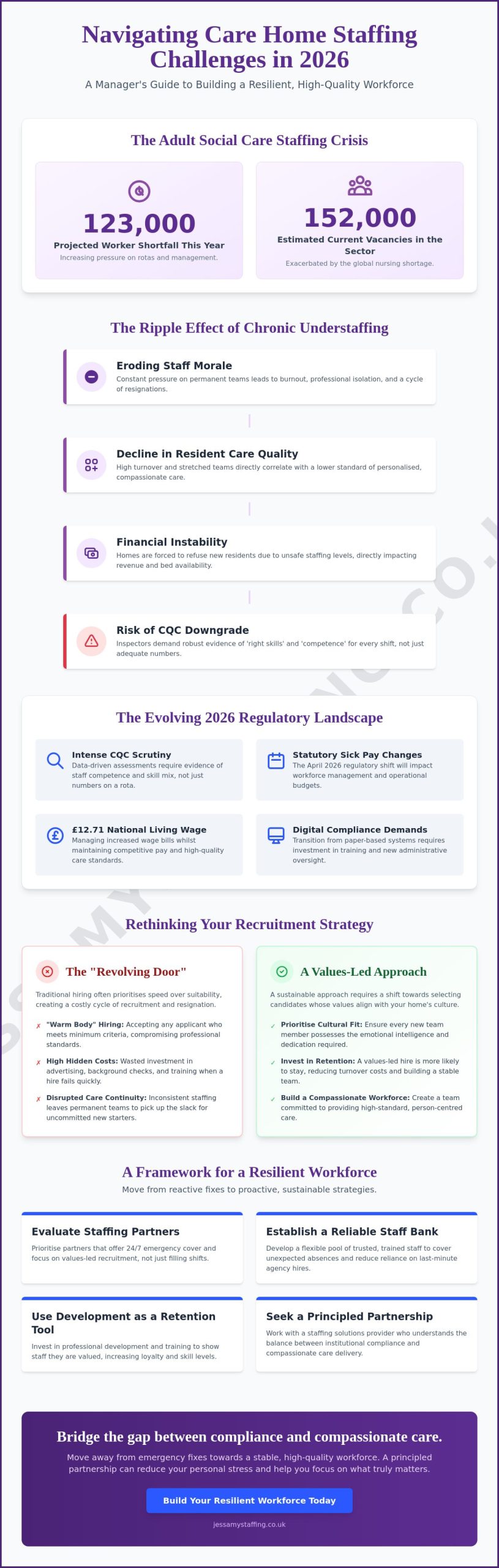
With the adult social care sector facing a projected shortfall of 123,000 workers this year, the pressure on your rotas has never been more acute. You’re likely exhausted by the relentless cycle of recruitment and resignation, whilst the looming fear of a CQC downgrade due to safe staffing levels remains a constant concern. Navigating care home manager staffing challenges in 2026 requires more than just filling gaps; it demands a shift towards values-led recruitment and more dependable professional partnerships.
We understand that the high cost of generic agency staff often fails to provide the reliability your residents deserve. This guide promises to show you how to overcome these hurdles, helping you move away from emergency fixes towards a stable, high-quality workforce. We’ll explore how to manage the latest regulatory shifts, including the April 2026 Statutory Sick Pay changes and the £12.71 National Living Wage, whilst ensuring you have reliable 24/7 emergency cover. By prioritising integrity and professional development, you can reduce your personal stress and focus on what truly matters: providing exceptional care.
Key Takeaways
- Understand how to navigate the evolving 2026 regulatory landscape and align your staffing levels with the latest CQC safe-care requirements.
- Recognise the hidden operational costs of high staff turnover and how to move beyond the cycle of reactive, short-term hiring.
- Implement a framework for evaluating staffing partners that prioritises 24/7 emergency cover and values-led recruitment to address care home manager staffing challenges.
- Develop a more resilient workforce by establishing a reliable staff bank and utilising professional development as a key retention strategy.
- Discover how a principled partnership can bridge the gap between institutional compliance and the delivery of compassionate, high-standard care.
Understanding the Care Home Manager Staffing Challenges in 2026
The 2026 social care landscape is defined by a complex intersection of heightened regulatory expectations and deep-seated workforce fatigue. Managers find themselves at the centre of this storm, balancing the need for operational excellence with the reality of a sector still grappling with an estimated 152,000 vacancies. These care home manager staffing challenges are no longer just about filling rotas; they’re about maintaining a standard of dignity amidst a wider global nursing shortage that has thinned the available talent pool. The transition from legacy paper-based systems to sophisticated digital compliance requirements has added a new layer of administrative weight, requiring significant initial investment in staff training and oversight.
For many leaders, this environment creates an emotional toll that is difficult to quantify. Operating in a perpetual ‘crisis mode’ leads to burnout and a sense of professional isolation. When every phone call could signal a last-minute resignation or a shift that cannot be covered, the ability to lead with compassion and vision is severely compromised. Failing to address these care home manager staffing challenges directly can lead to a cycle of fatigue that is difficult to break, making it essential to move beyond reactive hiring toward more sustainable, value-driven partnerships.
The Ripple Effect of Chronic Understaffing
When a home is consistently short-staffed, the burden falls heavily on the remaining permanent team. This chronic pressure erodes morale amongst even the most dedicated professionals, who find themselves stretched too thin to provide the level of personalised attention they aspire to. There’s a direct, measurable correlation between high turnover rates and a decline in the quality of resident care. Beyond the human cost, there’s a significant impact on admissions. Many managers are now forced to refuse new residents because they cannot guarantee safe care, directly affecting the financial stability of the home and the availability of beds for those in need.
Regulatory Pressures and CQC Compliance
The Care Quality Commission (CQC) has refined its assessment framework to place staffing under intense, data-driven scrutiny. It’s no longer sufficient to demonstrate ‘adequate numbers’ on a rota; inspectors now demand evidence of the ‘right skills’ and ‘competence’ for every shift. This means that a manager’s methodology for determining safe levels must be robust, transparent, and consistently applied. Safe staffing is a balance of numerical sufficiency and clinical competency tailored to the specific needs of the resident population. Failing to maintain this balance doesn’t just risk a downgrade; it undermines the fundamental promise of safety that every care home makes to its residents and their families.
Why Traditional Recruitment Often Fails Care Managers
The pressure to fill a vacancy quickly often leads to a “revolving door” phenomenon where speed is prioritised over suitability. Whilst a rapid hire might provide temporary relief for a depleted rota, it frequently results in a quick exit if the candidate’s values don’t align with the home’s culture. This cycle is one of the most persistent care home manager staffing challenges, as it forces leaders to spend their time in a constant state of reactive interviewing rather than proactive management. When a hire fails within the first ninety days, the investment in advertising, background checks, and initial training is effectively lost, creating a significant drain on both the budget and the team’s morale.
Relying on “warm body” hiring—the practice of accepting any applicant who meets the bare minimum criteria—is a strategy fraught with risk. It compromises professional standards and can lead to a dilution of the care quality that your residents rely upon. These systemic challenges for senior living facilities often manifest as a disruption in care continuity, leaving permanent staff to pick up the slack for uncommitted or underskilled new starters. A more sustainable approach requires a shift towards values-based selection, ensuring that every new team member possesses the emotional intelligence and dedication required for long-term success.
The Skills Gap in Complex and Specialist Care
Finding personnel for highly specialised roles, such as children’s complex care at home, presents a unique set of hurdles. Generic recruitment agencies often lack the clinical understanding to vet candidates for these technical positions, leading to a mismatch between the staff supplied and the specific needs of the service user. Bridging this gap requires a commitment to accredited training and development, ensuring that support workers don’t just fill a gap but actually enhance the clinical competency of the team. If your current recruitment efforts feel disconnected from these specialist requirements, it may be time to seek professional staffing support that understands the nuances of complex care.
The Competitive Labour Market in Greater Manchester
Navigating these regional pressures requires a strategy that looks beyond just the hourly rate, focusing instead on building a reputation as an employer of choice that values staff wellbeing and professional growth; to help establish this presence online, you might check out AHS Digital for expert creative support.
Evaluating Agency Quality: A Framework for Care Managers
Selecting a staffing partner shouldn’t be reduced to a simple comparison of hourly rates. Whilst budget constraints are a reality, a low-cost approach often masks the deeper care home manager staffing challenges that persist in 2026. A cheaper rate frequently correlates with higher staff turnover or lower clinical competency, which ultimately increases your long-term costs through poor performance and administrative friction. True value lies in the reduction of your personal stress and the assurance that every worker entering your facility is prepared for the specific environment they will encounter. It’s about finding a partner that views their staff not as commodities, but as a values-led extension of your own team.
Reliability is the cornerstone of any successful partnership, especially when managing the “always-on” nature of residential care. The provision of 24/7 emergency cover is essential for maintaining safe staffing levels during vulnerable periods, such as night shifts or weekend absences. Beyond availability, your agency must provide a rigorous compliance framework. This includes a non-negotiable checklist of current DBS certificates, verified Right to Work documentation, and comprehensive training records that align with the latest CQC standards. When an agency handles these care home manager staffing challenges with professional rigour, it frees you to focus on strategic leadership rather than chasing paperwork.
The Jessamy Standard vs. Generalist Agencies
There is a fundamental difference between transactional staffing and partnership-based workforce solutions. Generalist agencies often lack the nuanced understanding of the social care sector, resulting in a mismatch between the staff supplied and the needs of your residents. Utilising a specialist support worker recruitment agency ensures that the personnel provided have been vetted for their emotional intelligence as much as their technical skills. At Jessamy, we believe emergency cover should never feel like a compromise on safety; it should be a seamless integration of high-standard professionals who share your commitment to excellence.
Vetting for Reliability and Professional Rigour
To move beyond crisis hiring, you must ask potential partners direct questions about their staff retention and vetting processes. A high-quality agency will be transparent about how they recruit and retain their workforce, ensuring that domestic staff and nursing personnel are held to the same exacting standards. Values-led recruitment plays a vital role here; when temporary staff share your home’s core principles, friction decreases and resident satisfaction remains stable. Look for an agency that prioritises integrity and duty, acting as a bridge between your institutional requirements and the human needs of those in your care.
This commitment to high standards should also be reflected in staff appearance; sourcing professional attire such as work blouses from The Staff Uniform Company helps maintain a consistent, trustworthy image that reassures residents and reinforces the professional identity of your care team.
Operational Strategies to Stabilise Your Workforce
Stabilising a care team requires a fundamental shift from reactive firefighting to proactive foresight. In a climate where the National Living Wage has risen to £12.71 and Statutory Sick Pay is now payable from day one, the financial and operational stakes of care home manager staffing challenges have never been higher. Efficient managers are increasingly moving away from “crisis hiring” by developing a curated bank of reliable temporary staff who are already familiar with the home’s specific protocols. This internal or preferred-partner bank acts as a buffer, ensuring that when an absence occurs, the replacement is a known professional rather than a stranger to the residents.
Workforce intelligence is the next frontier in operational stability. By analysing historical data, such as peak sickness periods or holiday trends, you can predict shift gaps before they compromise your safe staffing levels. This data-driven approach allows for the pre-booking of high-quality support workers, which is significantly more cost-effective than last-minute emergency cover. Fostering a supportive environment that actively reduces burnout amongst your permanent team is equally vital. When staff feel heard and supported, their loyalty increases, directly lowering the turnover rates that so often trigger a staffing crisis.
Investing in Accredited Social Care Training
Professional development is a powerful tool for both competence and retention. When you offer staff access to accredited social care training, you aren’t just ticking a compliance box; you’re demonstrating a commitment to their career progression. This investment creates a more dependable workforce that feels valued and capable of handling complex scenarios. Accredited training significantly reduces the risk of clinical errors by ensuring every team member operates from a foundation of current, evidence-based practice. If you are struggling to maintain these standards internally, you can contact our specialist team to discuss integrated training and development solutions.
Creating a Crisis Management Plan for Last-Minute Shifts
Even the most organised rotas can be disrupted by unforeseen circumstances. Establishing a clear protocol for 24/7 emergency care staffing UK ensures that your home remains safe and compliant, even at 3:00 am on a Sunday. This plan should include detailed handover packs for agency personnel, covering resident preferences, emergency exits, and specific clinical needs. Maintaining continuity of care whilst using temporary nursing staff depends entirely on the quality of this communication. A robust handover ensures that the temporary professional can step into their role with confidence, providing a seamless experience for the residents and maintaining the high standards your facility is known for.
Partnering for Resilience: The Jessamy Staffing Solution
Jessamy Staffing Solutions acts as a deliberate bridge between the stringent requirements of regulatory compliance and the profound human needs of those in your care. We understand that care home manager staffing challenges in 2026 cannot be solved with transactional recruitment; they require a partnership built on shared values and mutual respect. Our commitment to providing safe, values-led, and professionally prepared personnel ensures that your home maintains its standards, even during periods of unexpected absence. By integrating our socialcare training and development directly with our staffing supply, we offer a level of clinical competency that generalist agencies simply cannot match.
Our 24/7 emergency cover is designed to be the stable partner your organisation deserves. Whether you are facing a last-minute night shift gap or require long-term support worker supply, our team is available to provide rapid, reliable solutions. This availability isn’t just about filling a rota; it’s about providing the peace of mind that comes from knowing your residents are in capable, compassionate hands. We prioritise integrity and duty, ensuring that every professional we send to your facility is fully briefed and ready to uphold your home’s reputation for excellence.
Tailored Workforce Solutions for Manchester Care Homes
We possess deep-rooted local expertise within the Greater Manchester healthcare personnel supply market. This regional focus allows us to navigate the specific labour dynamics of the North West, from the competitive pressures of the NHS to the logistical needs of local transport hubs. Our services are tailored to support a diverse range of settings, including residential care, supported living, and specialist children’s complex care at home. Partnering with a principled expert like Jessamy provides the reassurance that your staffing capacity is managed by professionals who understand the nuances of the local landscape and the high standards required by the CQC.
Secure Your Staffing Capacity Today
Starting a partnership with Jessamy is a straightforward process focused on quality and transparency. We ensure that all personnel are fully compliant with current DBS, right to work, and training requirements before they are cleared for placement. This rigorous vetting process means our staff are ready to make an immediate, positive impact on your service delivery. To move beyond the cycle of recruitment fatigue and build a more resilient workforce, we invite you to take the first step towards a dependable solution. Enquire about our dependable care workforce solutions to stabilise your team and focus on the future of your home.
Securing the Future of Your Care Delivery
Addressing care home manager staffing challenges requires a move away from reactive crisis management toward a strategy rooted in professional development and values-led recruitment. By establishing a reliable staff bank and vetting partners for clinical competency rather than just cost, you can safeguard both your residents and your professional reputation. Transitioning to these sustainable models ensures that staffing becomes a foundation for excellence rather than a persistent source of operational stress.
As an accredited social care training provider, Jessamy Staffing Solutions offers the expertise needed to bridge the gap between regulatory compliance and compassionate care. Our team provides 24/7 emergency cover and specialises in children’s complex care and nursing supply, acting as a meticulous guardian of your standards. Discover how Jessamy Staffing Solutions can stabilise your workforce with values-led personnel and regain the time you need to lead your home with confidence. Building a resilient team is a journey of precision and empathy. With the right partnership, you can face the complexities of the years ahead with a renewed sense of duty and professional pride.
Frequently Asked Questions
What are the most common care home manager staffing challenges in 2026?
Common care home manager staffing challenges in 2026 include managing a 9.9% sector vacancy rate whilst navigating the financial impact of the £12.71 National Living Wage. Managers also face heightened CQC scrutiny under the Single Assessment Framework, which demands evidence of clinical competency rather than just numerical sufficiency. These pressures are compounded by the removal of the three-day waiting period for Statutory Sick Pay, requiring more robust absence management.
How does high staff turnover affect CQC ratings for care homes?
High turnover is often interpreted by the CQC as a significant risk to both the ‘Safe’ and ‘Well-led’ assessment domains. It disrupts the continuity of care that residents require, making it difficult to demonstrate that staff possess the specific knowledge of resident preferences. If a home cannot evidence consistent staffing levels, it faces a high probability of a rating downgrade and increased regulatory intervention.
Why should a care manager choose a specialist recruitment agency over a generalist one?
Specialist agencies prioritise clinical vetting and specific social care experience, whereas generalists often focus on volume. Choosing a specialist ensures that the personnel supplied are already familiar with the rigorous standards of the sector, such as safeguarding and infection control. This reduces the administrative burden on managers, as they don’t need to provide basic healthcare orientation to every temporary worker who arrives.
Can values-led recruitment really improve staff retention in social care?
Values-led recruitment improves retention by ensuring candidates are emotionally and ethically aligned with the care profession before they’re hired. When staff share a fundamental sense of duty and integrity, they’re more resilient to the daily pressures of the role. This alignment reduces the “revolving door” effect, fostering a more stable and compassionate environment for both the team and the residents.
What should be included in a care home’s emergency staffing contingency plan?
A robust contingency plan should include a pre-vetted bank of temporary staff and a clear protocol for accessing 24/7 emergency cover. It must also feature comprehensive handover packs that detail resident clinical needs, emergency exits, and specific preferences. Ensuring that temporary staff can integrate quickly is essential for maintaining safety and compliance during a last-minute staffing crisis or unforeseen absence.
How does accredited training benefit both the care home and the individual staff member?
Accredited training provides the home with a verifiable trail of clinical competency, which is essential for maintaining high standards and CQC compliance. For the individual, it offers a clear pathway for career progression and enhances their professional confidence. This dual benefit creates a culture of excellence where staff feel valued and are more likely to commit to the organisation long-term.
What is the role of 24/7 emergency cover in maintaining resident safety?
24/7 emergency cover serves as a critical safety net that prevents unsafe staffing ratios during last-minute absences or emergencies. It ensures that clinical standards and resident dignity are never compromised, even during unsociable hours or weekends. Having a reliable partner for immediate cover allows managers to maintain safety without the intense personal stress of trying to fill a gap at short notice.
How can managers in Greater Manchester compete with the NHS for qualified care staff?
Managers in the North West can compete by offering a more personalised, supportive work culture that larger trusts often struggle to provide. Focusing on workforce wellbeing, flexible rotas, and clear professional development can make a private provider highly attractive. Highlighting the impact of individual care within a smaller, dedicated team helps foster a sense of belonging that encourages long-term staff loyalty.