



The drive towards internal staff banks was intended to stabilise the workforce, yet recent findings suggest that some bank shifts now incur higher costs than traditional agency cover. For healthcare leaders, the challenge of securing reliable temporary staffing for NHS trusts UK remains a primary source of operational strain and financial complexity. You’re likely navigating the pressure of the March 2026 price caps whilst striving to eliminate the risks associated with inconsistent staff quality. It’s a difficult position to be in when the safety of patients depends on the swiftness and reliability of your recruitment response.
This guide provides a roadmap for managing these gaps through strategic, values-led partnerships that prioritise clinical excellence over simple shift-filling. You’ll discover how to navigate the 2026/27 NHS Payment Scheme and IR35 regulations to reduce the administrative burden on your HR teams. We will examine how a disciplined approach to compliance and 24/7 emergency cover can transform your staffing model from a reactive necessity into a dependable pillar of your Trust’s operational success, ensuring better staffing ratios and improved patient outcomes.
Key Takeaways
- Understand the 2026 regulatory environment, including the latest price caps and the strategic balance required between internal banks and external agencies.
- Identify how to maintain safe staffing ratios and patient safety by effectively managing temporary staffing for NHS trusts UK.
- Ensure clinical excellence through a rigorous compliance framework that prioritises enhanced vetting and verified professional registrations.
- Discover strategies for seamless staff integration and securing dependable 24/7 emergency cover to mitigate the impact of last-minute shift failures.
- Explore how a values-led approach and accredited training can bridge the gap between workforce flexibility and the high standards of NHS care.
The Landscape of Temporary Staffing for NHS Trusts in 2026
The health service operates in a state of constant motion. To maintain safe staffing levels, Trusts rely on a dual-track approach involving both internal bank workers and external agency personnel. In 2026, the demand for workforce flexibility has reached a critical point. Patients are presenting with higher acuity and increasingly complex needs, necessitating a staffing model that’s as agile as it is expert. Effective temporary staffing for NHS trusts UK is no longer just about filling gaps; it’s about building clinical resilience through a disciplined mix of resources.
Trusts that succeed in this environment don’t view temporary staff as a secondary workforce. Instead, they integrate them as a vital component of the care team. This integration requires a values-led recruitment strategy. It’s not enough for a nurse or support worker to possess the correct technical qualifications. They must also align with the Trust’s specific culture and ethical standards. This alignment ensures that even a temporary staff member provides the compassionate, high-standard care that patients expect and deserve.
The Role of the NHS Staff Bank
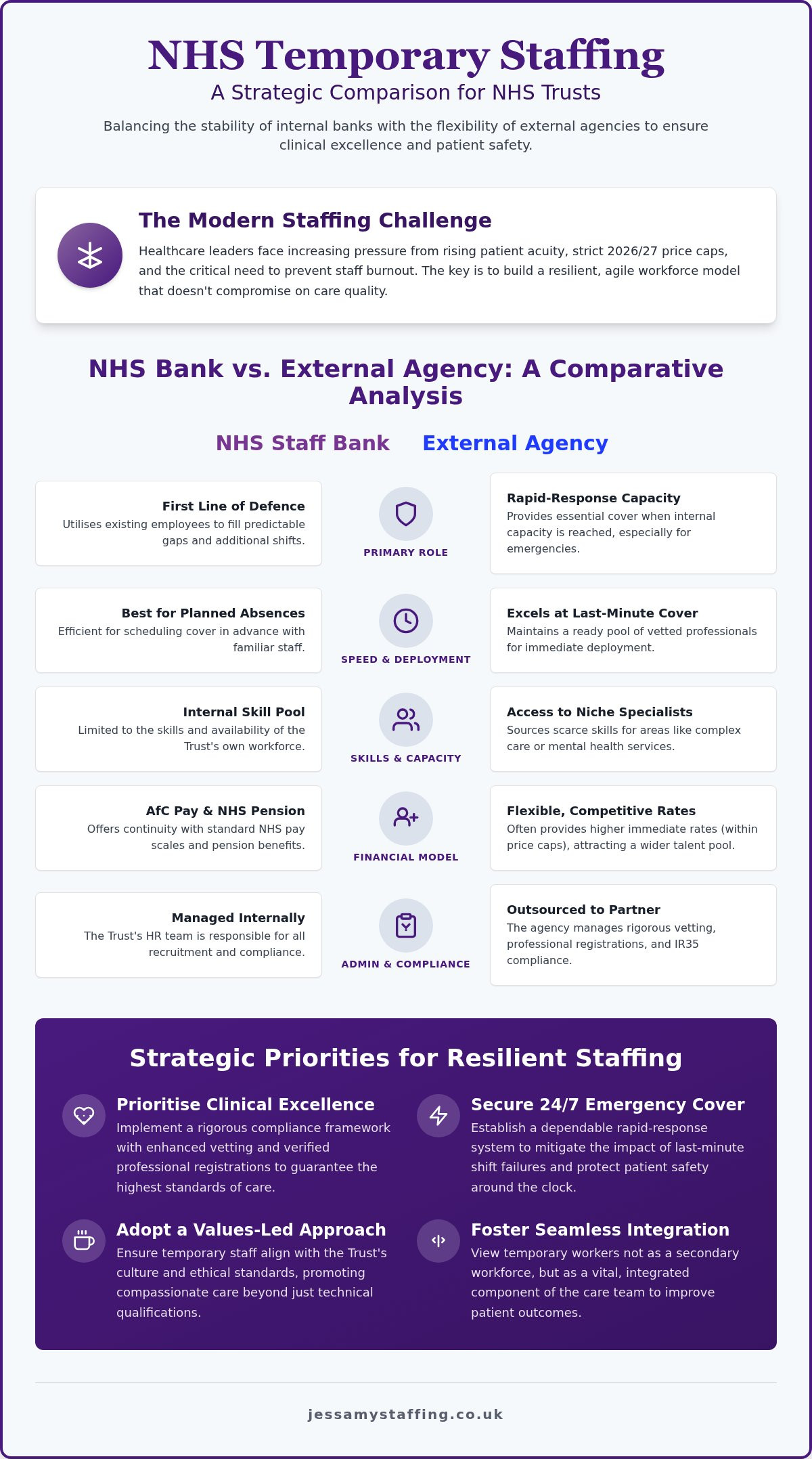
Internal banks serve as the first line of defence for most organisations. They allow existing employees to pick up additional shifts with the benefit of NHS pension access and total familiarity with local protocols. Many Trusts coordinate these flexible workers through NHS Professionals or their own bespoke managed systems. These banks provide a sense of continuity that’s highly valued. However, internal banks have natural ceilings. During winter pressures or periods of high staff absence, internal capacity often reaches its limit. Relying solely on a bank in these moments can lead to burnout among the core workforce, making external support a necessity rather than an option.
The Vital Function of External Nursing Agencies
When the internal bank cannot meet demand, external agencies provide essential rapid-response capacity. These partners act as specialists who can source niche skills for children’s complex care or mental health services that might be scarce within a single Trust’s local pool. High-quality agencies play a crucial role in the broader health and social care staff supply UK, acting as a bridge for professionals who require greater flexibility than a standard contract allows. This capacity is particularly vital for 24/7 emergency cover, ensuring that patient safety is never compromised by a sudden shift failure or an unexpected surge in admissions.
NHS Bank vs. External Agency Staffing: A Comparative Analysis
Choosing the right model for temporary staffing for NHS trusts UK requires a balanced understanding of both internal and external resources. While internal banks operate under the Agenda for Change (AfC) pay scales, agencies often provide a different value proposition through enhanced flexibility and speed of deployment. Despite the government crackdown on agency spending, high-quality agencies remain indispensable for filling critical gaps that internal banks cannot cover. They provide a vital safety net that prevents service degradation when local staff availability fluctuates.
Pay structures differ significantly between the two models. Bank workers enjoy NHS pension continuity, but agency staff often benefit from higher immediate rates, even within the 2026/27 price caps. This attracts professionals who prioritise shift choice and variety over long-term contractual ties. Deployment speed is another differentiator. Whilst banks are excellent for planned absences, agencies excel at providing last-minute emergency cover. They maintain a ready pool of vetted professionals, allowing Trusts to respond to sudden spikes in patient acuity within hours. This is particularly crucial given the current IR35 regulations, which require precise determination of employment status to ensure tax compliance for all temporary workers.
Financial and Operational Considerations for Trusts
The true cost of staffing isn’t just the hourly rate. Trusts must account for the administrative burden of recruitment, vetting, and compliance. Partnering with an external agency shifts this weight, as the provider manages the rigorous checks required for safe practice. This ensures continuity of care whilst allowing Trust HR teams to focus on core workforce strategy. When internal banks are exhausted, a dependable agency partner prevents the operational paralysis that follows unfilled shifts. If your Trust requires reliable support, exploring professional staffing partnerships can provide the necessary capacity.
Benefits for Healthcare Professionals
For the individual clinician, agency work offers a pathway to specialise. Professionals can access training for complex care workers, gaining skills that are often more advanced than the standard Care Certificate. This exposure to diverse clinical environments, from acute wards to community settings, accelerates career progression and builds technical competence. Some find that agency work serves as a flexible bridge into permanent roles, while others value the autonomy it provides in managing their work-life balance. It’s a model that supports both the professional’s growth and the Trust’s need for a versatile, skilled workforce that can adapt to the shifting demands of modern healthcare.
Ensuring Compliance and Quality in Temporary Placements
Patient safety is the primary metric by which any staffing strategy is judged. For those managing temporary staffing for NHS trusts UK, this requires a meticulous approach to vetting that goes beyond mere tick-box exercises. Every professional entering a clinical environment must meet stringent mandatory requirements, including current Enhanced DBS checks, verified right-to-work status, and active professional registration with the NMC or HCPC. These aren’t just administrative hurdles; they’re the essential safeguards of the healthcare system. A failure in compliance is a failure in care, which is why rigorous standards must be non-negotiable.
Beyond basic eligibility, sophisticated providers use workforce intelligence to ensure a precise match between a worker’s specific competencies and the requirements of the ward or unit. This data-driven approach reduces the risk of clinical incidents by ensuring that staff aren’t just available, but genuinely capable of handling the specific acuity of their assigned environment. It’s why Trusts must hold their support worker recruitment agency partners to the highest possible compliance benchmarks, demanding transparency at every stage of the supply chain.
The Jessamy Standard: Accredited Training and Development
Reliability is built through thorough preparation. By integrating accredited social care training directly into the recruitment process, we ensure that every staff member is professionally prepared for the technical and emotional demands of the role. This values-led approach tests for empathy and professional integrity alongside clinical skill. It creates a workforce that understands the gravity of their responsibilities, maintaining high compliance awareness even in the most sensitive or high-pressure environments. This proactive development ensures that temporary personnel are a seamless extension of the Trust’s own high standards.
Quality Assurance in Specialist Care
Specialist settings require an even more nuanced layer of oversight. Providing children’s complex care at home involves unique compliance hurdles that demand constant vigilance and specific clinical competencies. We maintain these standards through regular audits and performance monitoring, ensuring that temporary personnel consistently meet the rigorous expectations of both the family and the commissioning Trust. This commitment to transparency and rigorous professional preparation builds the trust necessary for long-term partnerships in complex care delivery.
Strategic Workforce Management: Optimising Trust Capacity
Strategic workforce management requires a transition from reactive “firefighting” towards the deliberate, planned integration of external resources. To achieve this, Trusts must view temporary staffing for NHS trusts UK as a strategic lever rather than a last resort. Seamless integration begins with clear induction processes and consistent clinical expectations. When temporary staff feel supported and informed, they perform at their best, ensuring patient safety remains uncompromised. This methodical approach allows for a more resilient workforce that can adapt to the shifting demands of modern healthcare without sacrificing quality.
Managing last-minute shift failures is a significant operational challenge. Reliability is non-negotiable, and staffing coordinators need 24/7 access to their partners to resolve gaps as they arise. A system that only operates during standard office hours is insufficient for a 24-hour health service. Long-term planning should also account for seasonal peaks and project-based needs, such as elective surgery backlogs or winter pressures. By using temporary staff to manage these known fluctuations, Trusts can protect their permanent workforce from burnout and maintain consistent service delivery throughout the year.
Effective Communication with Staffing Partners
Detail-oriented communication is the foundation of a successful partnership. Trusts should provide agencies with granular shift requirements, including specific ward protocols and patient acuity levels. For organisations in Greater Manchester, having a dedicated account manager provides a single point of accountability. This relationship ensures that the agency understands the unique operational pressures of the specific site, leading to faster, more accurate placements. Streamlining the booking process through digital platforms or direct coordination further ensures the rapid deployment of nurses and support workers when they’re needed most.
Reducing the Crisis: Proactive Staffing Strategies
Crisis management is both costly and stressful for clinical leads. Proactive organisations use historical data to anticipate staffing gaps before they become emergencies. By building a robust Preferred Supplier List (PSL) of high-quality, values-aligned agencies, Trusts can secure capacity before the wider market tightens. This strategy must include a clear protocol for 24/7 emergency care staffing UK, ensuring that contingency plans are live and tested. If you’re looking to strengthen your Trust’s operational resilience, you can partner with our expert recruitment team for dependable, professionally prepared staff.
Jessamy Staffing: Delivering Excellence to NHS Trusts
Jessamy Staffing Solutions acts as a meticulous guardian of standards. We bridge the gap between institutional requirements and human needs by providing highly prepared personnel who understand the gravity of their roles. Our commitment to clinical excellence ensures that patient safety remains the cornerstone of every placement we facilitate. By focusing on the intersection of efficiency and empathy, we provide a stable, long-term partnership for organisations needing reliable temporary staffing for NHS trusts UK.
Our location in Greater Manchester is a strategic advantage. It enables a deep understanding of the local healthcare landscape and facilitates a rapid response to urgent requests. We don’t simply fill shifts; we provide professionals who have undergone accredited training and development. This model for temporary staffing for NHS trusts UK is built on the foundation of professional preparation. Our staff are equipped with both the technical skills and the emotional intelligence required for sensitive care environments.
24/7 Emergency Cover and Specialist Support
Reliability is most critical when the unexpected occurs. Our 24/7 emergency cover ensures that last-minute night shift failures or sudden nursing shortages don’t compromise care quality. We maintain the capacity to deploy specialist personnel for complex environments, including children’s complex care at home and support worker supply. Every placement is informed by a culture of care, ensuring that temporary staff align with the compassionate values of the NHS. This specialist focus allows us to support domiciliary and paediatric settings with the same rigor we apply to acute ward cover.
Partnering with Jessamy Staffing Solutions
Operational excellence shouldn’t come at the cost of administrative exhaustion. We support Trust managers by assuming the burden of rigorous vetting and professional preparation. Our focus remains on integrity, high standards, and a profound sense of duty to the UK healthcare sector. We act as a dependable extension of your team, providing the reassurance that every staff member is a principled expert in their field. If you are seeking a partnership built on transparency and clinical excellence, contact us today to discuss your Trust’s temporary staffing requirements.
Strengthening Workforce Resilience for the Future of Care
Building a resilient healthcare system in 2026 requires more than just filling shifts; it demands a disciplined, strategic approach to workforce management. We’ve explored how a hybrid model, which balances internal banks with values-led external partnerships, provides the clinical capacity needed to handle rising patient acuity. By prioritising rigorous vetting and accredited training, your organisation can maintain high standards of patient safety whilst navigating the complexities of temporary staffing for NHS trusts UK. These strategies ensure that workforce flexibility never comes at the cost of care quality.
Our commitment to these standards is reflected in our 24/7 emergency cover for last-minute staffing crises and the accredited social care training integrated into every recruitment cycle. With deep local expertise serving Greater Manchester and the wider UK, we act as a principled partner in your mission to deliver excellence. It’s about creating a stable environment where both permanent and temporary staff can thrive together for the benefit of the patient.
If you’re ready to enhance your Trust’s operational capacity, we’re here to support you. Discuss your NHS Trust staffing requirements with our expert team to discover a more dependable way to manage your workforce. Together, we can ensure your clinical teams remain strong, supported, and ready for the challenges ahead.
Frequently Asked Questions
What is the difference between NHS bank staff and agency staff?
Bank staff are usually individuals who work for a specific Trust’s internal pool, often enjoying NHS pension access and total familiarity with local protocols. Agency staff are employed by external providers to offer additional capacity and specialist expertise. While bank workers provide continuity, agencies offer a wider reach for temporary staffing for NHS trusts UK, particularly when internal resources are exhausted or niche clinical specialisms are required at very short notice.
How do NHS Trusts ensure agency staff are compliant and safe?
Trusts ensure safety by mandating that all agencies adhere to strict framework agreements and national audit standards. This process includes verifying Enhanced DBS checks, right-to-work documentation, and professional registrations with the NMC or HCPC. We maintain a meticulous approach to these checks, providing a transparent audit trail for every placement. This ensures that every temporary professional is not only qualified but also fully compliant with the latest NHS regulatory requirements.
Can agency nurses work in specialist NHS departments like A&E or ICU?
Yes, agency nurses can work in specialist departments provided they possess the required post-registration qualifications and documented competencies for those environments. Agencies often maintain a specific pool of high-acuity professionals who are vetted for the unique pressures of A&E or ICU. This specialist support allows Trusts to maintain safe staffing ratios in critical areas during periods of peak demand or when internal specialist staff are unavailable for a particular shift.
What are the benefits of using a local staffing agency in Greater Manchester?
A local agency offers deep regional market knowledge and the ability to respond rapidly to urgent requests within the North West. Being based in Greater Manchester allows us to build closer, values-led relationships with local clinical leads and understand the specific operational challenges of regional Trusts. This proximity ensures a faster deployment of staff and a more personal, attentive service that a national, volume-based recruitment provider often cannot replicate for your organisation.
How does the NHS manage the cost of temporary staffing in 2026?
The NHS manages costs through the strict enforcement of agency price caps and the mandatory use of approved procurement frameworks. In 2026, Trusts must align with the latest NHS England “Agency price card” to ensure financial discipline across all departments. Effective management also involves strategic workforce planning to reduce the reliance on expensive “break glass” overrides. By partnering with transparent agencies, Trusts can secure compliant temporary staffing for NHS trusts UK while staying within these critical budget constraints.
Is 24/7 emergency cover available for last-minute shift failures?
Yes, 24/7 emergency cover is a core component of a dependable staffing partnership. We provide a dedicated response team available at all hours to manage last-minute shift failures or sudden surges in patient demand. This rapid-response capability ensures that clinical teams are never left unsupported during night shifts or weekends. It provides the necessary reassurance that patient safety will be maintained, even when unforeseen staffing gaps occur at very short notice during antisocial hours.
What training do Jessamy Staffing workers receive before placement?
Every worker undergoes accredited social care training and development as an integral part of our recruitment process. This ensures they’re professionally prepared for the technical and emotional demands of sensitive healthcare environments before their first placement. We focus on clinical competence, professional integrity, and empathy. This rigorous preparation ensures that our staff don’t just fill a gap but actively contribute to the high standards of care and safety expected within the modern NHS.
How can a Trust join the Jessamy Staffing partnership network?
Trust managers can join our partnership network by contacting our Greater Manchester office to discuss their specific workforce requirements. We begin with a thorough consultation to understand your Trust’s clinical needs, compliance standards, and preferred operational protocols. This allows us to create a tailored service level agreement that focuses on reliability and excellence. Our goal is to act as a stable, long-term partner that prioritises your Trust’s success and the well-being of every patient.