



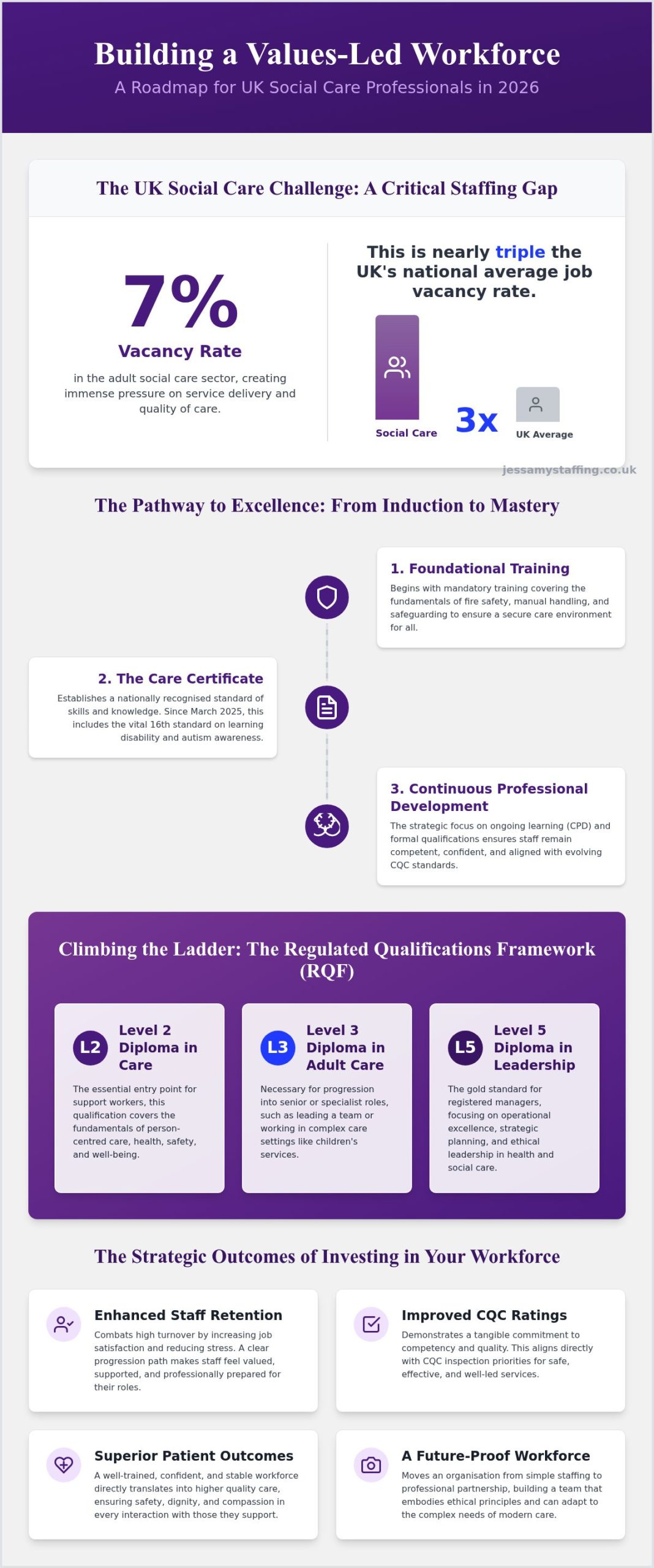
With a vacancy rate of 7 per cent, nearly triple the national average, the UK social care sector is facing a defining moment in how it supports and retains its workforce. You likely recognise the constant pressure of meeting stringent CQC standards whilst managing high staff turnover and a shortage of specialist skills for complex cases. It is a challenging environment where the need for professional excellence often competes with the daily demands of service delivery. Finding a balance between regulatory compliance and the warmth of human-centric care is essential for any provider aiming to lead the field.
We believe that care worker development programmes UK should be more than a simple compliance exercise; they are a strategic bridge between clinical rigor and sincere compassion. By investing in structured growth, you can transform your team into a values-led workforce that delivers exceptional outcomes for those in their care. This guide provides a comprehensive roadmap for staff progression in 2026, detailing the latest RQF requirements and funding opportunities like the Learning and Development Support Scheme. You will discover how to build a culture of competency that improves CQC ratings and ensures your organisation remains a reliable, principled partner for families in Greater Manchester and across the country.
Key Takeaways
- Understand the vital transition from basic induction to continuous professional development (CPD) as a primary strategy to reduce staff turnover and enhance care quality.
- Navigate the Regulated Qualifications Framework (RQF) to select the most effective care worker development programmes UK for maintaining 2026 compliance.
- Recognise the critical necessity of specialised training when supporting highly sensitive cases, such as children’s complex care at home.
- Learn how to align your internal training culture with CQC inspection standards through comprehensive skills gap analysis and targeted development pathways.
- Discover the operational benefits of an integrated recruitment and training model in ensuring a workforce that is professionally prepared for emergency cover requirements.
Understanding Care Worker Development Programmes in the UK
Professional development is more than a regulatory requirement; it’s a commitment to excellence. Effective care worker development programmes UK provide a structured framework that guides a professional from their initial induction through to advanced specialist roles. Within the current 2026 environment, the sector has moved beyond a simple procedural checklist of basic training. Instead, there is a focus on Continuous Professional Development (CPD) that ensures staff remain competent as Social care in the United Kingdom evolves to meet increasingly complex needs. The Care Quality Commission (CQC) now prioritises evidence of real-world competency. They look for providers who can demonstrate that their staff don’t just possess certificates, but actually apply their knowledge to ensure safety and dignity in every interaction. This shift reflects a broader industry move towards accountability and ethical service delivery.
The Core Pillars of Professional Care Training
A robust development framework is built upon three distinct layers of expertise. Mandatory training ensures every worker understands the fundamentals of fire safety, manual handling, and safeguarding. Following this, the Care Certificate provides a nationally recognised foundation. Since March 2025, this has included a vital 16th standard regarding learning disability and autism awareness, aligning with the legal requirements of the Oliver McGowan Mandatory Training. Implementing comprehensive care worker development programmes UK allows providers to bridge the gap between entry-level skills and the high-level expertise required for complex care. This structured approach ensures that every team member is not only compliant but truly equipped to handle the nuances of modern care delivery.
Why Development Matters for Staff Retention
Investing in people is the most effective way to combat the high staff turnover currently affecting the sector. With adult social care vacancy rates sitting at 7 per cent, which is triple the wider UK job vacancy rate, retention is a strategic priority. When a support worker feels “professionally prepared” for their role, their job satisfaction increases whilst their stress levels decrease. Ongoing mentorship and clear progression paths foster a culture of care where staff feel valued and supported. This psychological security translates directly into better patient outcomes and a more stable, reliable workforce for providers. This strategy moves the organisation from a model of simple staffing to one of professional partnership that prioritises the well-being of the end-user.
The Framework of Accredited Social Care Training
A career in social care requires a clear trajectory that balances academic theory with practical application. The official care workforce pathway provides this structure, ensuring that care worker development programmes UK are grounded in national standards. Choosing an accredited provider isn’t just about compliance; it’s about ensuring that the certification carries weight across the sector and reflects a genuine mastery of the required skills. At Jessamy Staffing Solutions, we integrate this high-level accreditation into our recruitment process. This ensures every professional is prepared for the specific challenges of their placement, combining workforce intelligence with the latest regulatory theory.
RQF Levels 2 through 5: From Entry to Management
The Regulated Qualifications Framework (RQF) serves as the backbone for professional growth. It allows workers to build their expertise incrementally through standardised stages of learning:
- Level 2 Diploma in Care: This is the essential entry point for support workers, covering the fundamentals of person-centred care and safety.
- Level 3 Diploma in Adult Care: This qualification is necessary for those moving into senior roles or specialist positions, such as children’s complex care.
- Level 5 Diploma in Leadership and Management: As the gold standard for care home managers, this level focuses on operational excellence and ethical leadership.
Values-Led Development: The Human Element
Technical proficiency is only half of the equation in high-quality social care. True excellence requires a high degree of emotional intelligence and a commitment to dignity. Many generic training modules overlook the “human element,” but sophisticated care worker development programmes UK must teach staff to interpret behaviour as communication, especially in complex care settings. This approach ensures that care is delivered with empathy rather than just efficiency. It involves maintaining a client’s autonomy and respect whilst managing their physical needs. For organisations seeking a partner that understands this balance, exploring our bespoke staffing and development solutions can provide the necessary bridge between regulatory standards and compassionate care. By focusing on the intersection of technical skill and emotional intelligence, we help create a workforce that is both competent and deeply principled.
Specialist Training for Complex Care Workers
The demand for training for complex care workers has reached a critical point as the acuity of home-based care continues to rise. High-level clinical needs require a workforce that possesses more than just a willing heart; they require technical precision and clinical confidence. Advanced care worker development programmes UK are now essential for ensuring that support staff can safely manage life-sustaining equipment and procedures. Generic induction training often fails to address these nuances, leaving workers feeling ill-equipped and increasing the risk of clinical errors. To bridge this gap, modern development must focus on competency-based sign-offs for specific tasks such as PEG feeding, tracheostomy care, and ventilator management. These are not skills that can be mastered through theory alone. They require direct observation and validation by a Registered Nurse to ensure that every support worker’s execution meets the highest standards of clinical governance.
Pediatric Complex Care Development
Delivering children’s complex care at home presents a unique set of challenges that extend beyond the clinical task itself. A support worker becomes a guest in a family’s private sanctuary, which requires a sophisticated understanding of family dynamics and professional boundaries. Development in this area must prioritise specialist safeguarding, particularly for non-verbal or highly vulnerable children who cannot easily communicate their needs or distress. It’s vital that staff are trained to work within Multi-Disciplinary Teams (MDTs), collaborating seamlessly with occupational therapists, speech and language specialists, and community nurses. This integrated approach ensures the child receives holistic support that promotes both their health and their quality of life.
Mental Health and Learning Disability Specialisms
For those supporting individuals with mental health needs or learning disabilities, Positive Behavioural Support (PBS) has become a primary development priority in 2026. This framework moves away from restrictive practices, focusing instead on understanding the “why” behind specific behaviours. Effective care worker development programmes UK now integrate trauma-informed care and de-escalation techniques as standard. These skills empower staff to support independence in supported living environments whilst maintaining a safe atmosphere for everyone involved. By focusing on the root causes of distress rather than just the outward behaviour, support workers can foster an environment of trust and respect. This sophisticated level of training ensures that staff are not just reacting to crises, but are actively working to prevent them through empathetic and informed support.
Implementing a Development Culture in Greater Manchester
Establishing a proactive culture of growth in Manchester’s social care landscape requires a move away from reactive, “tick-box” exercises. With the Greater Manchester Integrated Care System (ICS) increasingly focused on workforce wellbeing and integrated working, providers must adopt a methodical approach to care worker development programmes UK. This transition ensures that every team member is not just present, but truly proficient in their specific duties. A culture of development doesn’t happen by accident; it’s the result of intentional, structured planning that prioritises both staff confidence and patient safety.
To build this culture effectively, follow these five essential steps:
- Conduct a skills gap analysis: Evaluate your current team to identify where specialist confidence is lacking, particularly in complex care areas.
- Align with CQC standards: Ensure every training module maps directly to the CQC “Key Lines of Enquiry” (KLOEs) to support your next inspection.
- Source accredited partners: Work with accredited social care training UK providers who understand the nuances of the 2026 regulatory framework.
- Maintain a CPD calendar: Implement a rolling schedule for Continuous Professional Development to prevent the last-minute rush when certifications expire.
- Measure feedback: Correlate training completion with service user satisfaction and a reduction in clinical incidents to prove the programme’s value.
Local Resources for Manchester Care Providers
Manchester offers a wealth of regional support that often goes underutilised. Engaging with the Greater Manchester ICS provides access to local priorities and potential funding through initiatives like the Learning and Development Support Scheme. Networking with local peer-support groups for care managers allows for the exchange of practical solutions to shared operational hurdles. When your permanent team is undergoing training, utilising local staffing agencies that provide “ready-trained” personnel ensures that your service standards never slip. This collaborative approach strengthens the entire local care ecosystem.
Overcoming Training Barriers in Small Facilities
Smaller providers often find it difficult to release staff for training whilst maintaining safe staffing ratios. You can mitigate this by using e-learning for theoretical knowledge, which allows staff to learn at their own pace. For practical skills like manual handling, a “train the trainer” model can keep expertise in-house and reduce long-term costs. When training days do create unavoidable gaps, a professional support worker recruitment agency can provide competent, values-led cover. This ensures your facility remains operational and safe whilst your core team upskills. If you need to secure reliable cover to support your team’s growth, our bespoke staffing solutions can help you maintain high standards during development periods.
The Jessamy Approach: Integrating Training and Recruitment
Most agencies treat recruitment as a simple supply chain, but we view it as a professional partnership. By integrating care worker development programmes UK directly into our staffing model, we ensure every individual we supply is professionally prepared before they step onto your site. This synergy eliminates the uncertainty that often accompanies temporary staffing. Our personnel arrive with a deep understanding of 2026 regulatory requirements and clinical best practices, having been vetted through a process that values technical skill as much as emotional intelligence. This integrated model ensures that recruitment is never a siloed activity but a continuous cycle of professional improvement.
Reliability in a crisis is the ultimate test of any development programme. Our 24/7 emergency care staffing UK solutions are underpinned by rigorous, ongoing assessment. When a facility faces an immediate staffing gap, they don’t just need a person to fill a shift; they need a competent professional who can maintain continuity of care without a lengthy induction. Our commitment to values-led recruitment means we select candidates for their empathy and integrity, then layer on technical excellence through our accredited training pathways. This ensures that even in emergency scenarios, the standard of care remains uncompromised and principled.
The impact of this approach is best seen in complex care environments. For instance, when a specialist facility in Greater Manchester faced instability due to inconsistent staff skills, we introduced a team trained specifically in Positive Behavioural Support (PBS). By applying specialist knowledge to de-escalate tension and understand the root causes of distress, our staff stabilised the environment within weeks. This wasn’t achieved through numbers alone, but through the precise application of clinical expertise and trauma-informed care that our development programmes provide.
Ensuring Dependable Workforce Capacity
The “Jessamy Standard” represents a level of preparation that exceeds mandatory compliance. By operating as an accredited social care training provider, we remove the burden of upskilling from care home managers. This training-first model supports the local care economy by providing a steady supply of skilled personnel who are ready to handle the most sensitive environments. It reduces the operational risk for managers, knowing that the staff provided are already compliant with the latest RQF standards and CQC expectations.
Your Partner in Professional Excellence
We recognise that every care setting has unique requirements. Whether you manage a large residential home or a small supported living facility, we offer tailored care worker development programmes UK designed to meet your specific service needs. Accessing our pool of accredited, specialist support workers ensures your organisation remains a beacon of quality and safety. To discuss how we can support your workforce goals and improve your service outcomes, Contact Jessamy Staffing for Specialist Training and Recruitment today.
Securing the Future of Professional Social Care
The landscape of social care in 2026 demands a shift from reactive training to intentional, values-led growth. We’ve explored how structured care worker development programmes UK serve as the foundation for clinical safety and staff retention. By aligning your team’s skills with the Regulated Qualifications Framework and the latest CQC expectations, you ensure that your organisation remains both compliant and compassionate. This strategic investment doesn’t just meet a regulatory requirement; it fosters a culture where professionals feel empowered to deliver their best work.
Professional excellence is achieved when technical proficiency meets sincere empathy. As an Accredited Social Care Training Provider with a Values-Led Recruitment Process, Jessamy Staffing Solutions is dedicated to bridging the gap between institutional standards and human needs. We are Specialists in Emergency and Complex Care, providing the stability your service requires during challenging times. Partner with Jessamy Staffing for Accredited Training and Reliable Personnel to build a workforce that truly transforms lives. Together, we can create a sustainable future where high standards of care are the norm, not the exception.
Frequently Asked Questions
What are the mandatory care worker development programmes in the UK?
Mandatory training includes fire safety, manual handling, safeguarding, and basic life support. Under the Health and Care Act 2022, the Oliver McGowan Mandatory Training on Learning Disability and Autism is also a legal requirement for all CQC-registered health and social care providers. These core modules ensure that staff possess the fundamental safety knowledge required to protect both themselves and the individuals they support in diverse care settings.
How long does it take to complete the Care Certificate?
New care workers typically complete the Care Certificate within 12 weeks of starting their employment. It consists of 15 standards, plus a 16th standard on learning disability and autism introduced in 2025, that must be assessed in the workplace. Whilst the theory can be studied quickly, the practical assessment ensures that the worker can apply their learning to real-world scenarios, establishing a consistent national standard for the workforce.
Can I work as a care worker whilst completing my RQF Level 2?
Yes, you can certainly work as a care worker whilst studying for your RQF Level 2 Diploma in Care. In fact, most care worker development programmes UK are designed to be completed alongside active employment. This vocational approach allows you to use your daily workplace experiences as evidence for your qualification. Employers often encourage this progression as it demonstrates a commitment to professional standards whilst maintaining service capacity.
What is the difference between RQF Level 2 and Level 3 in social care?
RQF Level 2 is the entry-level qualification for support workers, focusing on the fundamental principles of person-centred care. RQF Level 3 is more advanced and is generally required for senior care workers or those working in specialist areas like children’s complex care. Level 3 involves greater responsibility, requiring staff to lead others, manage more complex cases, and demonstrate a deeper understanding of clinical governance and ethical decision-making.
Are there specific development programmes for paediatric complex care?
Specialist programmes exist specifically for paediatric complex care, focusing on clinical tasks such as tracheostomy management and PEG feeding. These care worker development programmes UK also cover the psychological aspects of working within a family home and specialist safeguarding for vulnerable children. Because children’s needs differ significantly from adults, these pathways require competency-based sign-offs from Registered Nurses to ensure that support workers safely execute technical medical tasks.
How often do care worker training certifications need to be refreshed?
Refresher intervals vary depending on the specific certification and local policy, but most mandatory training requires an annual update. For example, manual handling and basic life support are typically refreshed every 12 months to ensure skills remain sharp. Specialist clinical competencies may require more frequent assessment if the worker does not perform the task regularly. Maintaining an up-to-date training matrix is essential for meeting CQC inspection standards.
Does Jessamy Staffing provide accredited training for external organisations?
We operate as an accredited social care training provider primarily to ensure that our own workforce is professionally prepared for sensitive environments. Whilst our integrated model focuses on providing “ready-trained” personnel for our clients, we can discuss bespoke training and development solutions for organisations seeking to upskill their existing teams. Our approach ensures that all training is grounded in practical workforce intelligence and the latest 2026 regulatory frameworks.
How does staff development affect CQC inspection ratings?
Staff development is a critical factor in determining CQC ratings, particularly under the “Effective” and “Well-led” Key Lines of Enquiry. Inspectors look for evidence that staff are competent, well-supported, and possess the necessary skills to meet the specific needs of service users. Demonstrating a robust culture of continuous professional development shows that a provider is committed to safety, quality, and the ongoing improvement of their service outcomes.