

In 2026, a “Good” CQC rating is no longer a destination you reach; it’s a standard you must defend every single day. You likely feel the weight of this shift as the new Fair Work Agency begins its oversight and the Employment Rights Act 2026 transforms how we manage our teams. The constant pressure of manual document checks and the anxiety of verifying last-minute agency staff can make maintaining care staff compliance UK feel like an exhausting, uphill battle. It’s a burden that often pulls your focus away from what matters most: the people in your care.
We understand that behind every compliance file is a commitment to patient safety and staff wellbeing. This guide provides the clarity you need to move beyond reactive auditing and build a workforce defined by both technical excellence and compassionate values. You’ll find a clear framework to help you organise your files and master the latest statutory changes, including the removal of Statutory Sick Pay waiting periods and the new curbs on zero-hour contracts. By the end of this article, you’ll have the tools to ensure your organisation remains a beacon of safety, reliability, and regulatory integrity.
Key Takeaways
- Understand the central role of the CQC’s Single Assessment Framework in maintaining workforce standards and safeguarding your professional reputation.
- Identify the five essential pillars of care staff compliance UK, from navigating 2026 digital Right to Work checks to utilising the DBS Update Service.
- Implement robust Service Level Agreements to ensure that temporary and emergency agency staff meet the same rigorous safety standards as your permanent team.
- Develop a ‘Golden Thread’ of documentation that transitions your record-keeping from static files to a dynamic, audit-ready system of continuous assessment.
- Learn how to combine accredited social care training with values-led recruitment to ensure your personnel possess both technical competence and genuine empathy.
Understanding the Framework of Care Staff Compliance in the UK
Compliance is the silent engine that drives excellence in healthcare. In its truest form, care staff compliance UK is the meticulous intersection of legal mandates, professional codes of conduct, and the ethical standards we owe to those in our care. It’s a dynamic discipline that ensures every support worker or nurse is not only legally permitted to work but is also fundamentally equipped to handle the complexities of their role. The Care Quality Commission (CQC) acts as the central authority in this landscape, enforcing workforce standards that serve as the baseline for safety and dignity across England.
Regulation 18 (Staffing) stands as the cornerstone of every care inspection in 2026. This regulation requires providers to maintain a workforce that is sufficient in numbers and possesses the necessary qualifications and skills. We’ve moved past an era where “years on the job” was the primary metric of value. Today, the focus is squarely on evidence-based competence. Inspectors now look for tangible proof that staff can apply their training to real-world scenarios, particularly when managing children’s complex care at home or supporting individuals with fluctuating needs. This shift towards strategic workforce development is a key component of modern leadership, as explored by Sullivan Group HR in their latest guide on human capital management. It’s about what a staff member can do today, not just where they worked yesterday.
The Legislative Landscape: Health and Social Care Act 2008
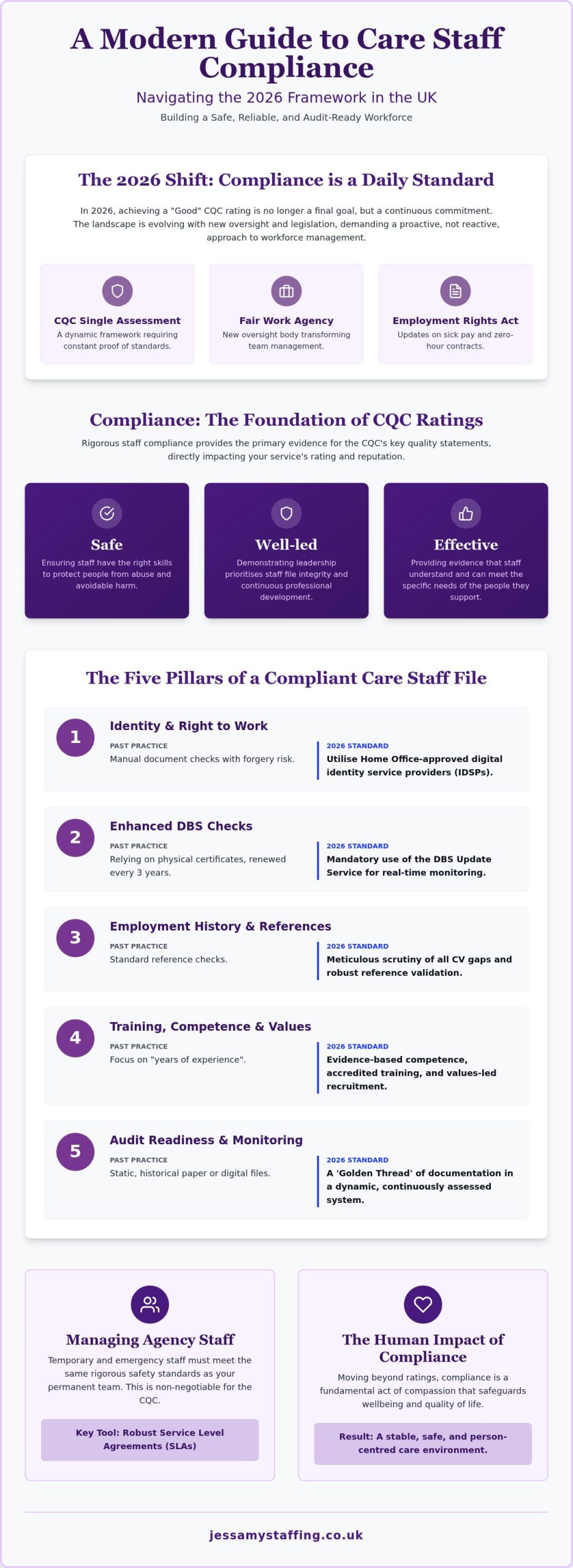
The regulatory environment is governed by the Health and Social Care Act 2008 (Regulated Activities) Regulations 2014, which received significant updates in early 2026 to reflect modern staffing challenges. These laws provide a structured framework that protects both the service user and the provider. By maintaining rigorous compliance, an organisation effectively mitigates legal liability and reduces the risk of safeguarding incidents. There’s a direct, unbreakable link between staff compliance and the CQC’s assessment of whether a service is “Safe” and “Well-led.” Compliance is the primary evidence for several key quality statements:
- Safe: Ensuring that staff have the right skills to protect people from abuse and avoidable harm.
- Well-led: Demonstrating that leaders prioritise the integrity of staff files and continuous professional development.
- Effective: Providing evidence that staff understand the specific needs of the people they support.
The Human Impact of Non-Compliance
The consequences of a compliance failure extend far beyond the threat of financial penalties or “Inadequate” ratings. Poor compliance destabilises the very heart of a care environment. When staff vetting is inadequate, the consistency of person-centred care begins to crumble, leading to increased anxiety for service users and their families. We define a regulatory breach as any deviation from statutory standards that introduces an avoidable risk to patient safety or well-being. Ensuring every staff member is fully vetted and competent isn’t a bureaucratic hurdle; it’s a fundamental act of compassion that guarantees the quality of life for those we support. Rigorous recruitment ensures that the person entering a vulnerable individual’s home has both the character and the capability to protect them.
The Five Pillars of a Compliant Care Staff File
A compliant staff file serves as more than just an administrative record; it’s a testament to your organisation’s integrity and commitment to safety. To achieve excellence in care staff compliance UK, providers must look beyond a simple checklist. A robust file is built upon five non-negotiable pillars that ensure every individual entering a service is vetted, qualified, and safe to practice. In 2026, this process has become increasingly digitised, requiring a blend of technical precision and professional intuition.
- Identity and Right to Work: You must now utilise Home Office-approved digital identity service providers (IDSPs) to verify documents. This 2026 standard eliminates the risks associated with manual forgery checks and ensures that every worker has the legal right to practice in the UK.
- Enhanced DBS Checks: Relying on a physical certificate is no longer sufficient for high-standard providers. Real-time monitoring via the DBS Update Service is essential to capture any changes in a staff member’s criminal record immediately, rather than waiting for a three-year renewal.
- Employment History and References: You must scrutinise every gap in a CV. Red flags, such as frequent job-hopping or inconsistent dates, require thorough investigation through verbal reference verification to confirm the candidate’s professional conduct.
- Mandatory Training: All certifications must align with the Core Skills Training Framework (CSTF). This ensures a standardised level of competence across the sector, regardless of where the staff member was previously employed.
- Professional Registration: For nursing staff, verifying their status with the Nursing and Midwifery Council (NMC) is a daily necessity. This confirms they remain fit to practice and haven’t been subject to recent disciplinary restrictions.
DBS and Safeguarding: Going Beyond the Certificate
Safeguarding is a continuous obligation, not a one-time event. Whilst a clean DBS certificate is the baseline, you must also refer to the Care Act 2014 statutory guidance to understand your broader responsibilities in protecting vulnerable adults. When a disclosure is ‘positive’, a meticulous risk assessment is required. You must evaluate the nature of the offence, its relevance to the role, and the time elapsed since it occurred. This principled approach ensures that your recruitment decisions are both fair and safe, prioritising the protection of service users above all else.
Mandatory vs. Specialist Training Requirements
Core training covers the essentials: Manual Handling, Fire Safety, Safeguarding, and Infection Control. However, complex environments require deeper expertise. For those providing children’s complex care at home, training must extend to specialist clinical skills and paediatric safeguarding. Ensuring your team is refreshed according to 2026 industry standards is vital for maintaining high patient outcomes. If you require support in maintaining these rigorous standards, Jessamy Staffing Solutions provides accredited training and fully vetted personnel to bridge any compliance gaps in your workforce.
Managing Compliance for Temporary and Emergency Agency Staff
Managing the compliance of temporary personnel requires a different tactical approach than managing permanent teams. Emergency cover often presents the greatest risk to care staff compliance UK because the urgency of the need can tempt managers to bypass standard vetting. When a shift needs filling at short notice, speed is essential, but it must never compromise the safety of your service users. The legal responsibility for ensuring a worker is qualified remains with you, the provider, regardless of how quickly they were deployed.
A robust Service Level Agreement (SLA) is your first line of defence. This document should outline the specific compliance guarantees you demand from an agency, including the frequency of their internal audits and their methods for verifying training. You should also insist on a ‘Staff Profile’ system. This ensures that a digital copy of the worker’s DBS status, training certifications, and identity verification is sent to your management team before the worker arrives on-site. Once they are present, integrating them into local site inductions and fire safety protocols is mandatory to maintain a safe environment.
Vetting Your Staffing Partners
Choosing the right partner is a strategic decision that affects your CQC standing. You should ask a potential support worker recruitment agency about their specific vetting processes for last-minute cover. Do they conduct their own face-to-face interviews? How do they handle the 2026 requirements for digital Right to Work checks? It’s vital to verify that the agency holds comprehensive insurance and that their recruitment philosophy is values-led, ensuring they check for character as well as technical competence.
Consistency in Care: The ‘One Team’ Approach
Service users shouldn’t notice a difference in the quality of care when an agency worker is on duty. This “One Team” approach ensures that temporary staff follow the same behaviour and reporting standards as your permanent employees. This consistency is a core part of the CQC requirements for employing fit and proper staff, which mandate that all personnel must be qualified and competent for their specific roles. Providers like Jessamy, who specialise in 24/7 emergency care staffing UK, maintain these rigorous standards by keeping detailed documentation ready for inspectors at a moment’s notice. This transparency builds trust and ensures that patient safety remains the priority, even during staffing crises.
Audit Readiness: Documentation and Continuous Monitoring
Audit readiness isn’t a state of panic triggered by a notification; it’s the natural result of a consistent, principled approach to record-keeping. We refer to this as the “Golden Thread” of documentation. This thread begins at the moment of initial application and weaves through every induction, supervision, and annual appraisal. It provides the narrative evidence that your organisation prioritises both safety and professional growth. In the context of care staff compliance UK, this means having a seamless trail that proves every worker is not only vetted but also continuously supported to maintain their high standards of care.
The transition from fragmented paper files to centralised digital systems is a defining feature of 2026. Digital records allow for real-time tracking of expiry dates and training gaps, ensuring you’re never caught off guard by an expired certificate. However, technology is only as effective as the culture that surrounds it. The modern approach to compliance involves regular “Competency Assessments” where managers observe staff in practice. These observations confirm that the theory learned in training is being applied compassionately and safely in a real-world care setting. If you’re struggling to maintain an audit-ready workforce, partner with Jessamy Staffing Solutions for compliant 24/7 staffing and accredited training.
Conducting an Internal Compliance Audit
A proactive auditing schedule prevents small administrative errors from becoming major regulatory breaches. You should establish a routine that mirrors the CQC’s own investigative depth. Follow these four essential steps to ensure your files remain beyond reproach:
- Step 1: Randomly select 10% of your staff files each month for a deep-dive review to ensure consistency across the team.
- Step 2: Cross-reference every training certificate against your central expiry matrix to identify upcoming refreshers.
- Step 3: Verify that all DBS checks are current and actively monitored via the Update Service for real-time safeguarding.
- Step 4: Create a formal action plan for any identified gaps, assigning clear deadlines and responsibilities for resolution.
GDPR and Data Protection in Care Staffing
Maintaining thorough records requires a delicate balance with the Data Protection Act 2018. You must ensure that sensitive personal data is stored securely and is only accessible to authorised personnel. Retention periods must be strictly managed; whilst you need records for historical accountability, you shouldn’t hold data longer than necessary after a staff member has left your service. You must provide a clear and accessible ‘Privacy Notice’ to all applicants that details exactly how their data will be processed and stored during the recruitment journey. This transparency builds trust and ensures your organisation meets the highest ethical standards of data management.
The Jessamy Approach: Elevating Standards in Greater Manchester
The Jessamy approach is rooted in the belief that a staff file is only as strong as the person it represents. In Greater Manchester, we serve as a dedicated partner to organisations navigating the complexities of care staff compliance UK. We recognise that regional healthcare dynamics require a workforce that is not only locally available but also rigorously prepared for the unique challenges of the North West’s care sector. By focusing on values-led recruitment, we ensure that every individual we supply possesses the emotional intelligence required for sensitive environments, alongside the technical certifications demanded by the CQC. It’s about checking hearts as well as certificates to ensure a perfect fit for your service users.
Our commitment to excellence means we provide a dependable workforce capacity for the region’s most sensitive environments. We don’t just fill gaps; we provide professionals who understand the weight of their responsibility. This local expertise allows us to respond rapidly to staffing needs whilst maintaining the high register of compliance that modern healthcare demands. We act as a bridge between your institutional requirements and the human needs of those you support, ensuring that every placement strengthens your team’s integrity.
Accredited Training as a Compliance Shield
We don’t view training as a periodic obligation; we see it as a continuous shield against risk. By integrating training for complex care workers directly into our recruitment lifecycle, we provide our clients with a workforce that is ready from day one. This proactive development moves beyond basic compliance to an advanced level of professional readiness. Our accredited social care training programmes ensure that when our staff provide emergency 24/7 cover, they do so with a deep understanding of current 2026 standards. This continuous development reduces risk for our clients and ensures staff are professionally prepared for even the most complex clinical scenarios.
Partnering for Long-Term Excellence
Our role extends beyond simple supply; we act as a meticulous guardian of standards for our partner organisations. Whether you operate in supported living or residential care, we tailor our staffing solutions to mirror your specific operational goals and values. This collaborative model allows us to maintain a consistent quality of care even during periods of high demand. We handle the heavy lifting of compliance auditing and training management, allowing your leadership team to focus on the strategic delivery of care. To secure a partner that values integrity as much as you do, Contact Jessamy Staffing for a compliance-led workforce solution today. We are here to ensure your organisation doesn’t just meet standards, but consistently exceeds them.
Leading Your Organisation Towards Regulatory Excellence
Regulatory excellence is a continuous journey of improvement. It requires a proactive commitment to safety and professional development to stay ahead of shifting legislation. By mastering the five pillars of a compliant file and implementing a “Golden Thread” of documentation, you’ll ensure your organisation remains audit-ready at every turn. True excellence in care staff compliance UK is achieved when technical precision meets genuine empathy, creating a stable environment where both staff and service users can thrive.
As an accredited social care training provider with a dedicated 24/7 emergency rapid-response team, we understand the pressure of maintaining these standards. We specialise in children’s complex care and provide the meticulous vetting required for Greater Manchester’s most sensitive settings. Secure your facility with our compliant, values-led care staff today and let us handle the regulatory burden for you.
You have the tools to transform your compliance from a source of anxiety into a hallmark of your professional integrity. We’re here to support you in every step of that journey, ensuring your team is prepared for any challenge the future holds.
Frequently Asked Questions
What are the mandatory training requirements for UK care staff in 2026?
Mandatory training for UK care staff in 2026 must align with the Core Skills Training Framework (CSTF) to ensure standardised competence across the sector. Essential subjects include Safeguarding Adults and Children, Manual Handling, Fire Safety, and Infection Prevention and Control. Depending on the specific service setting, staff may also require the Oliver McGowan Mandatory Training on Learning Disability and Autism or specialist clinical skills for complex care environments.
How often should DBS checks be renewed for healthcare workers?
Enhanced DBS checks for healthcare workers should be renewed every three years, or as specifically required by your contractual and commissioning agreements. We strongly recommend that all staff register for the DBS Update Service, which allows for real-time status checks and ensures continuous safeguarding. This proactive approach to care staff compliance UK prevents the administrative delays often associated with full re-applications and maintains your audit readiness.
What is CQC Regulation 18 and why does it matter for staffing?
CQC Regulation 18 requires health and social care providers to deploy enough suitably qualified, competent, and experienced staff to meet the needs of service users. It is the fundamental benchmark for staffing adequacy and professional development within the Single Assessment Framework. Failure to demonstrate robust recruitment and training processes under this regulation can lead to “Inadequate” ratings and potential enforcement action during a regulatory inspection.
Can I hire a care worker before their DBS check is complete?
You cannot allow a care worker to start unsupervised work before a full Enhanced DBS check is complete and verified. Whilst a “DBS Adult First” check can provide a temporary result for adult services, it is not a substitute for the final certificate. Meticulous risk assessments must be documented if a staff member begins a supervised induction whilst waiting for their formal disclosure to arrive in the post.
How do I verify the compliance of an agency worker?
You verify the compliance of an agency worker by requesting a comprehensive “Staff Profile” or compliance pack before they commence their first shift. This document should include proof of their Enhanced DBS status, digital Right to Work verification, and up-to-date training certifications. Reputable providers of care staff compliance UK will ensure these records are shared securely to maintain transparency and protect the integrity of your service.
What documents must be kept in a care staff personnel file?
A compliant personnel file must contain a specific set of documents to meet CQC Regulation 19 standards. This includes a verified identity document, Home Office digital Right to Work evidence, and an Enhanced DBS certificate. Additionally, you must store at least two professional references, a full employment history with explained gaps, and a record of all mandatory training, supervisions, and annual appraisals to demonstrate ongoing competence.
Is the Care Certificate still a requirement for new staff?
The Care Certificate remains the industry standard for new staff entering the health and social care sector without prior experience. Whilst it is not a mandatory qualification in a legal sense, the CQC expects providers to use it as part of a robust induction process. It ensures that workers have the foundational knowledge and skills required to provide compassionate, high-quality care before they work independently.
How does UK GDPR affect the storage of care staff records?
UK GDPR requires care providers to store staff records securely and only for as long as is strictly necessary for legal or operational purposes. You must provide a clear Privacy Notice to all applicants explaining how their sensitive data is handled during recruitment. Secure digital storage is preferred over paper files to ensure that access is restricted to authorised personnel and that data can be managed with professional rigour.