

With the Care Quality Commission aiming to complete 9,000 assessments by September 2026, the margin for error in regulatory compliance has never been slimmer. Many providers find themselves caught in a cycle of high turnover and mounting anxiety over inspection outcomes, often because their social care staff training programmes fail to bridge the gap between classroom theory and the practical realities of person-centred care. It’s a heavy burden to carry, especially when you’re striving to maintain exceptional standards whilst managing the complexities of an increasingly regulated workforce.
This guide provides a definitive roadmap for implementing accredited training that does more than tick a box; it’s a strategic investment in your people. You’ll discover how to leverage the Learning and Development Support Scheme funding and meet the finalised Oliver McGowan mandatory requirements to build a loyal, confident team. We will explore the shift towards competency-based models and the integration of digital skills, ensuring your organisation moves from a reliance on emergency agency cover to a foundation of stable, internal excellence.
Key Takeaways
- Navigate the 2026 CQC inspection landscape by aligning your professional development with the latest statutory requirements and safety standards.
- Build a high-standard workforce by implementing social care staff training programmes that integrate the updated Care Certificate with specialist modules for complex care.
- Optimise your delivery model by balancing the cost-effectiveness of digital platforms with the essential practical rigour of face-to-face training for clinical skills.
- Secure long-term compliance and improve staff retention through a structured training needs analysis and a rolling development calendar.
- Learn how an integrated approach to staffing and accredited training can reduce your reliance on emergency cover whilst ensuring personnel are professionally prepared.
The Regulatory Landscape: Why Social Care Staff Training Programmes Matter
Effective training serves as the essential bridge between legal compliance and the delivery of compassionate, high-quality support. Within the broad context of Health and social care, social care staff training programmes represent a sophisticated blend of statutory requirements and continuous professional development. This dual focus ensures that every interaction within a care setting is grounded in both technical precision and emotional intelligence. By prioritising these programmes, providers do more than meet a baseline; they foster a culture where excellence is the standard and safety is a shared responsibility.
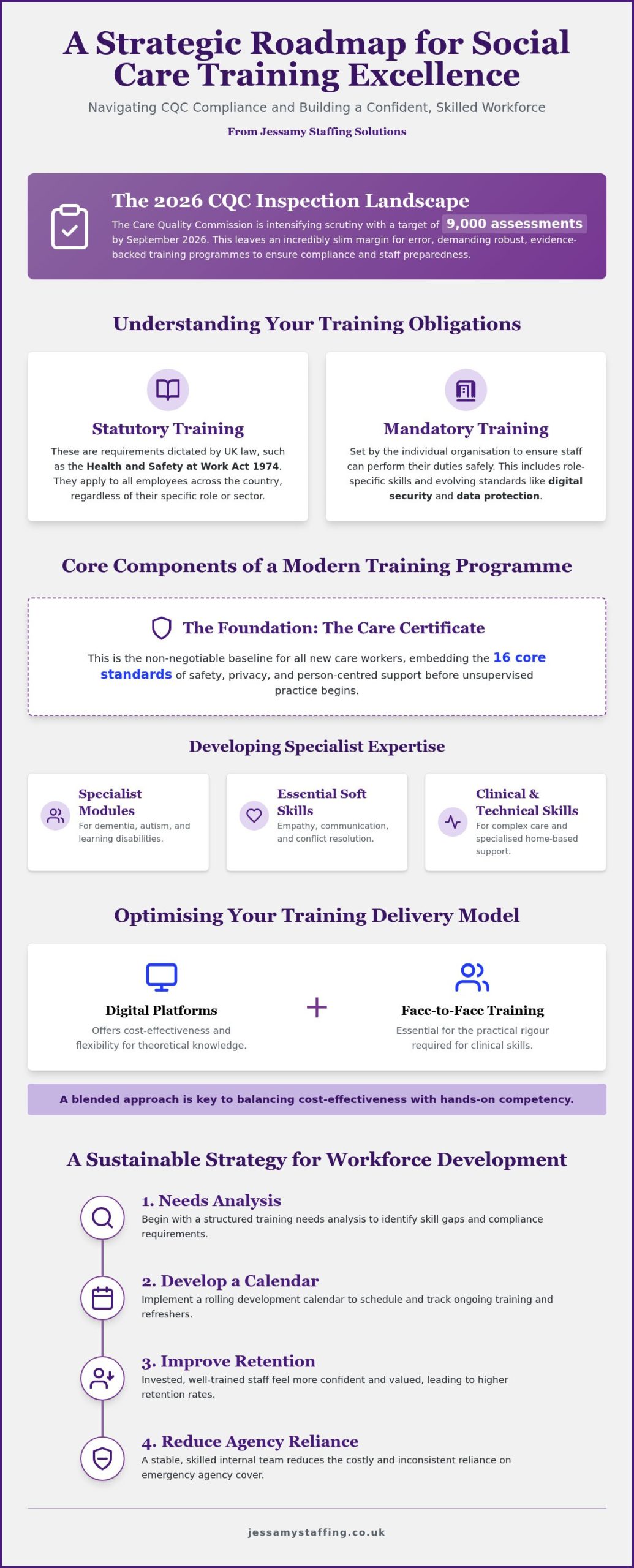
The Care Quality Commission (CQC) remains the primary guardian of these standards. As they aim to complete 9,000 assessments by September 2026, the scrutiny on workforce development has intensified. Inspectors look for tangible evidence that staff aren’t just present, but are professionally prepared to handle the complexities of modern care. Safety depends on skill. In high-pressure environments, robust training mitigates risks by equipping personnel with the foresight to prevent incidents before they occur. There’s a direct, undeniable correlation between staff competence and patient safety, particularly when supporting individuals with complex needs.
Statutory vs. Mandatory Training: Knowing the Difference
Understanding the distinction between statutory and mandatory training is vital for operational clarity. Statutory training refers to the requirements dictated by UK law, such as the Health and Safety at Work Act 1974, which apply to all employees regardless of their specific role. Mandatory training involves requirements set by the individual organisation or local authority to ensure staff can perform their duties safely and effectively. In 2026, these standards have evolved to require a more frequent refresh of digital security and data protection modules, reflecting the sector’s increased reliance on electronic care records whilst navigating new cybersecurity threats.
The Impact on CQC Inspection Outcomes
A comprehensive record of social care staff training programmes is a powerful indicator of a “Well-Led” service. During an inspection, these records provide a vital paper trail that demonstrates a commitment to safety and effectiveness. When providers can show that their team has undergone rigorous, accredited training, it instils confidence in the regulator that the service is capable of maintaining high standards under pressure. Compliance is non-negotiable. The Care Certificate serves as the essential baseline for all new care workers, ensuring they possess the fundamental skills and knowledge required to provide safe, compassionate care from their first day on the job.
Core Components of Modern Social Care Training Programmes
A robust induction serves as the essential bedrock of any care provision. In 2026, social care staff training programmes must align with the minimum training standards for care staff as outlined by Skills for Care. This ensures that the 16 standards of the Care Certificate are fully embedded before a worker begins unsupervised practice. This foundation isn’t merely a compliance hurdle; it’s a vital period where new personnel internalise the core principles of safety, privacy, and person-centred support. By establishing these high standards early, organisations can reduce the risk of future errors and build a workforce that feels confident and capable from their first shift.
Beyond the initial induction, modern programmes must evolve to include specialist modules that address the specific needs of service users. Supporting individuals with dementia, autism, or learning disabilities requires more than a generalist approach. It demands a sophisticated understanding of communication techniques and positive behaviour support. These programmes also place a growing emphasis on “soft skills” such as empathy and conflict resolution. In an industry where the human connection is the primary vehicle for care, the ability to navigate complex emotional landscapes is as critical as any technical competency.
Clinical and Technical Skills for Complex Care
Technical proficiency is non-negotiable in sensitive environments, particularly as the sector moves towards more specialised home-based interventions. For those providing children’s complex care at home, training must cover the management of medical equipment that was once the sole domain of acute hospital settings. This includes rigorous competency assessments in PEG feeding, tracheostomy care, and ventilation support. These interventions require a meticulous guardian of standards, often involving continuous assessment overseen by Registered Nurses to ensure that every staff member remains sharp and safe in their practice.
The Shift Towards Values-Based Training
Whilst clinical skill is vital, it remains secondary to a deep-seated culture of care and professional integrity. High-quality training now prioritises the recognition and upholding of a service user’s dignity in every interaction. This creates a natural synergy with values-led care recruitment, where the initial selection of personnel is based on their innate emotional intelligence and then polished through ongoing professional development. By focusing on the “why” of care as much as the “how,” organisations can foster a team that is both technically expert and deeply compassionate. For providers looking to strengthen their workforce, partnering with an organisation that specialises in socialcare training and development ensures that every team member is professionally prepared for the challenges of the role.
Choosing the Right Delivery Method: eLearning vs. Face-to-Face
The digital transformation of the sector has reached a peak in 2026, offering providers more choices than ever when selecting social care staff training programmes. Whilst digital platforms provide unmatched efficiency, a purely online approach often falls short in high-stakes environments where physical precision is required. The most effective strategy isn’t about choosing one over the other; it’s about identifying which skills require the nuance of human interaction and which can be mastered through structured digital modules. A balanced delivery method ensures that technical knowledge is backed by practical confidence.
The Pros and Cons of Digital Learning
eLearning has become a cornerstone of modern development due to its flexibility and ease of tracking. For large teams spread across multiple sites, digital platforms ensure a consistent message and allow managers to monitor compliance in real-time. Research indicates that online learning can improve knowledge retention by 25-60%, compared to just 8-10% in traditional classroom settings. However, these benefits are only realised when modules are CPD certified and Skills for Care aligned. The primary drawback remains the lack of peer interaction; without it, learning can become a passive “checkbox” exercise rather than a meaningful professional upgrade.
When Practical, In-Person Training is Essential
Certain competencies simply cannot be verified through a screen. Manual handling, for instance, is a legal and safety necessity that requires physical demonstration and expert correction to prevent workplace injuries. Similarly, emergency first aid and basic life support demand hands-on practice to ensure staff can act instinctively during a crisis. In these scenarios, the presence of a qualified instructor ensures that techniques are performed safely, protecting both the staff member and the service user. This is particularly true for specialist training for complex care workers, where the nuances of clinical interventions require direct, expert supervision.
To achieve the gold standard of care, providers should adopt a blended learning model. This hybrid approach uses eLearning for theoretical foundations and face-to-face sessions for practical application. When assessing a potential training partner, it’s vital to look for those quality-assured through the Quality Assured Care Learning Service (QACLS). In the 2026 financial year, this accreditation is a prerequisite for accessing funding through the Learning and Development Support Scheme. By choosing an accredited partner, you ensure your social care staff training programmes are not only compliant but are delivered with the professional rigour and human-centric warmth your team deserves.
Implementing a Sustainable Workforce Development Strategy
Sustainable development requires a methodical approach that aligns organisational goals with individual aspirations. It’s not enough to simply schedule courses; you need a strategy that ensures social care staff training programmes are integrated into the daily rhythm of the facility. This involves a clear-eyed assessment of where the team stands today and where the service needs to be tomorrow. When training is treated as a core operational pillar rather than an afterthought, it transforms from a compliance burden into a powerful driver of excellence and stability.
Budgeting for these programmes must look beyond the initial course fees. A realistic financial plan factors in staff time, the cost of resources, and the necessary backfill requirements to maintain safe ratios. Whilst the upfront cost may seem significant, the long-term savings are substantial. By investing in your internal team, you reduce the heavy financial drain of constant recruitment and the high costs associated with long-term agency reliance. In a sector where the vacancy rate was recorded at 7.0% in 2024/25 by The King’s Fund, a robust development strategy is your best defence against the industry’s churn.
Conducting a Training Needs Analysis
A Training Needs Analysis (TNA) is the first step in building a resilient workforce. It involves identifying the gap between current skill sets and the specific requirements of your service users, whether that involves elderly care or specialist mental health support. By mapping these requirements, you can ensure that training is targeted and meaningful rather than generic. Regular appraisals serve as a vital feedback loop, ensuring that individual learning pathways are tailored to both the professional’s ambitions and the service’s clinical needs.
Balancing Training with Operational Demands
One of the greatest challenges for care managers is the logistical puzzle of staffing shifts whilst personnel are in training. To maintain safe ratios without compromising the quality of care, providers must plan for “backfilling” shifts. Utilising 24/7 emergency care staffing can provide the necessary cover to allow permanent staff the time they need to develop their skills without leaving the floor short-handed. “Bite-sized” learning modules also play a role here, allowing for continuous development in manageable increments that don’t require staff to be away from service users for extended periods.
If you’re ready to build a more resilient team through accredited socialcare training and development, it’s time to partner with an expert who understands the operational realities of the sector. Investing in your people today ensures a safer, more confident service for the future.
The Jessamy Approach: Integrated Training and Staffing Solutions
Many providers view training as a separate entity from recruitment, yet the two are inextricably linked. At Jessamy Staffing Solutions, we bridge this gap by offering a unified model where social care staff training programmes are the foundation of our workforce supply. This integrated approach ensures that every professional we provide isn’t just a name on a rota, but a fully vetted and prepared expert ready to uphold your service’s standards. By aligning our development protocols with your operational needs, we create a seamless transition between training and active care delivery.
Why Professionally Prepared Personnel Make the Difference
The stability of a care environment depends on the competence of its staff. Our internal training rigour goes beyond basic compliance; it focuses on instilling a deep awareness of current CQC frameworks and safety protocols. This level of preparation ensures that our personnel strengthen your existing team rather than destabilising sensitive care settings. There’s a profound sense of reassurance for providers in knowing that every worker is not only values-led but also carries the weight of full accreditation. It’s about providing a meticulous guardian of standards for every shift, ensuring that the human needs of service users are met with technical excellence and genuine empathy.
Partnering for Long-Term Success in Greater Manchester
Based in Greater Manchester, we combine local expertise with national standards to support the region’s care economy. We don’t believe in one-size-fits-all solutions. Instead, we offer customised training programmes tailored to the needs of local care providers, from supported living facilities to families requiring children’s complex care. This commitment to expert-led education ensures that the workforce remains resilient and capable of meeting the evolving demands of the sector. Our role is to act as a bridge between institutional requirements and human needs, projecting the image of a meticulous guardian of standards.
Choosing a partner that understands both the practicalities of care and the necessity of rigorous development is the most effective way to secure your service’s future. Our dual focus on staffing and education allows us to maintain high workforce capacity whilst fostering a culture of continuous improvement. By integrating our social care staff training programmes with 24/7 emergency cover and specialist support worker supply, we provide a holistic solution that addresses the root causes of staff turnover and compliance anxiety. If you’re looking to elevate your care standards and reduce your reliance on unprepared agency cover, contact Jessamy Staffing today to discuss your training and recruitment needs.
Securing the Future of Excellence in Social Care
Building a sustainable care environment requires more than a reactive approach to regulation; it demands a commitment to continuous, high-quality development that empowers every team member. By aligning your social care staff training programmes with the latest CQC standards and adopting a blended learning model, you ensure your workforce is technically expert and deeply compassionate. This strategic investment is the most effective way to improve staff retention and safeguard the well-being of those in your care.
As a specialist in complex and emergency care, Jessamy Staffing Solutions brings a deeply embedded culture of professional rigour to every partnership. We’re accredited by leading industry bodies and offer the stability your organisation needs to thrive in an evolving landscape. Partner with Jessamy for Accredited Social Care Training and Staffing to ensure your personnel are professionally prepared for any challenge. Your dedication to raising standards today creates a safer, more resilient environment for the entire care community. Let’s build that future together.
Frequently Asked Questions
What training is legally required for social care staff in the UK?
Legally, all staff must receive training on health and safety, fire safety, and moving and handling. As of 2026, the Oliver McGowan Mandatory Training on Learning Disability and Autism is a legal requirement for all CQC-registered health and social care providers. This ensures that every professional has the foundational knowledge to support diverse needs safely and with dignity.
How often do social care staff need to refresh their mandatory training?
Refresh frequencies are increasingly determined by a competency-led model rather than a fixed annual schedule. Whilst some certifications like Emergency First Aid at Work typically require a refresh every three years, other skills are assessed based on risk and changes in role. This approach ensures that training remains relevant to the practicalities of the care environment rather than being a checkbox exercise.
Is the Care Certificate a legal requirement for all care workers?
The Care Certificate is the expected national minimum standard for all new care workers entering the sector. Whilst it is not a standalone piece of legislation, the CQC uses it as a benchmark to assess whether a service is safe and well-led. The updated 2025 version includes 16 standards that every new professional must meet to ensure high-quality, person-centred support.
Can eLearning be used for all social care staff training programmes?
How can I ensure my staff training programme meets CQC standards?
To meet CQC standards, your programme should be quality assured through the Quality Assured Care Learning Service (QACLS). This ensures that your training is eligible for Learning and Development Support Scheme (LDSS) funding and aligns with the latest regulatory expectations. Maintaining meticulous digital records is also vital to provide a clear paper trail of staff competence during inspections.
What are the benefits of accredited social care training for my business?
Accredited training significantly improves staff retention by providing a clear pathway for professional progression. It also leads to higher CQC ratings and reduces the financial burden of relying on emergency agency cover. By investing in social care staff training programmes, you build a resilient team that is both technically capable and emotionally intelligent, enhancing the overall quality of care.
How does Jessamy Staffing ensure its temporary staff are properly trained?
Jessamy Staffing ensures all personnel are professionally prepared through our own accredited socialcare training and development programmes. Every support worker we supply undergoes a rigorous vetting process that prioritises values-led recruitment alongside technical proficiency. This integrated approach ensures that our staff can seamlessly support your service whilst maintaining the highest standards of safety and dignity.
What is the best way to track staff training and compliance?
Digital learning management systems (LMS) are the most reliable way to track training and compliance across a large workforce. These platforms provide real-time alerts for upcoming refreshes and allow managers to generate reports for CQC inspections instantly. Moving away from paper-based systems reduces administrative error and ensures that no staff member’s certifications are allowed to lapse.