



Clinical excellence in the home is not merely a matter of technical proficiency; it is the result of a precise alignment between medical necessity and the human touch. You likely recognise that for a child with complex needs, the transition from hospital to home is often fraught with deep-seated anxiety. It’s a delicate period where a lack of specialised training for rare conditions or the arrival of unreliable agency staff can quickly destabilise an entire care plan. You deserve a partner who views safety and compassion as two sides of the same coin.
This article explores how specialist paediatric care staffing bridges the critical gap between clinical requirements and the compassionate, stable support these families deserve. We’ll examine how the 2026 CQC Single Assessment Framework demands continuous evidence of competency and why a values-led approach to recruitment is essential for long-term stability. Discover how to ensure your multidisciplinary team is supported by professionals who are as meticulous about clinical standards as they are dedicated to the wellbeing of the children they serve.
Key Takeaways
- Understand how specialist paediatric care staffing facilitates a safe transition from hospital to home, ensuring clinical continuity for children with complex, life-limiting conditions.
- Identify the core technical competencies, including invasive ventilation and gastrostomy feeding, required to maintain high standards of safety in a domestic environment.
- Learn why integrating accredited social care training into the recruitment process is essential for mitigating risks and ensuring personnel are truly competent.
- Acquire a robust framework for evaluating staffing providers, focusing on CQC compliance, staff retention rates, and the ability to provide reliable 24/7 emergency cover.
- Discover how a values-led approach to personnel helps to build stable, long-term care teams that integrate seamlessly with existing multidisciplinary professionals.
What is Specialist Paediatric Care Staffing in 2026?
Specialist paediatric care staffing represents a fundamental shift in how we approach the health of children with complex needs. It isn’t merely about filling a rota or providing a basic presence in the room. Instead, it’s the provision of highly trained clinical personnel who manage life-limiting conditions within the family home. In 2026, the healthcare sector has largely pivoted away from long-term hospital stays in favour of a hospital-to-home transition. This allows children to remain in familiar surroundings, but it demands a level of expertise that goes far beyond generalist healthcare support. Generalist staffing often lacks the specific physiological and emotional insights required for young patients, making specialisation a prerequisite for safety.
The distinction between simple shift-filling and a managed care package is critical. Whilst many agencies provide staff to cover hours, a managed approach involves continuous oversight, clinical governance, and a deep understanding of the child’s specific care plan. In 2026, families and Integrated Care Boards (ICBs) increasingly seek partnerships that offer this level of rigour. It’s about ensuring that every professional who enters a home is not just a temporary worker, but a vital component of a stable, long-term clinical strategy.
The Rise of Complex Care at Home
Advancements in medical technology have been the primary catalyst for this change. Portable ventilators, sophisticated monitoring systems, and refined enteral feeding methods now allow for clinical environments to be replicated in domestic settings. This shift is vital for a child’s developmental milestones. Being at home amongst siblings and parents fosters emotional stability and social growth that a clinical ward cannot replicate. In 2026, the care economy is defined as the collective infrastructure of formal and informal support systems that sustain human life and well-being through professional, home-based clinical intervention. This infrastructure allows children with profound needs to live lives that are as full and integrated as possible.
Why Specialisation Matters for Paediatric Safety
Safety in this context is non-negotiable. Utilising non-specialist staff to manage a paediatric tracheostomy or invasive ventilation introduces unacceptable risks. Children aren’t just small adults; their physiological responses are rapid and their emotional needs are distinct. A Pediatric Nursing Overview highlights that specialised training is essential for recognising subtle changes in a child’s condition before they become emergencies.
We advocate for a values-led approach that transcends purely task-based care. It’s about understanding the family dynamic whilst maintaining rigorous clinical standards. When staff are selected based on their integrity and empathy as much as their technical skill, the quality of care improves. For a deeper look at these requirements and how they affect your family, you can explore our Children’s Complex Care at Home: A Comprehensive Guide for UK Families. This guide outlines the standards you should expect from any provider in the modern landscape.
Clinical Competencies and Complex Conditions Supported
Clinical excellence in paediatric care is built upon a foundation of highly specific technical competencies. Specialist paediatric care staffing must address a spectrum of complex conditions, from neuro-disabilities and chronic respiratory failure to acute traumatic injuries. Unlike adult care, paediatric support requires an acute awareness of developmental stages and rapid physiological changes. Technical skills such as gastrostomy feeding, complex seizure management, and the maintenance of invasive ventilation are essential requirements for any professional entering a high-dependency home environment.
Beyond technical tasks, the integration of Positive Behaviour Support (PBS) is vital. This framework ensures that children with sensory processing needs or communication difficulties receive care that respects their dignity whilst maintaining safety. In this model, the Registered Nurse plays a pivotal role. They don’t simply manage the rota; they’re responsible for assessing and signing off the clinical competencies of support workers, ensuring every member of the team operates within the strict boundaries of the child’s care plan. This oversight is a legal and ethical necessity under CQC Regulation 18, which mandates that staff must be qualified and skilled to provide safe care.
Managing Technology-Dependent Care
Children requiring 24/7 ventilation or BiPAP/CPAP support demand a level of vigilance that cannot be compromised. Staff must be proficient in troubleshooting medical equipment, from responding to ventilator alarms to managing tracheostomy blockages in real-time. This often necessitates ‘double-up’ care, particularly where complex manual handling or personal care is involved. Addressing Pediatric Workforce Challenges requires a commitment to rigorous, ongoing training that ensures staff are prepared for the technical demands of home-based care. Reliability in these settings is paramount, as equipment failure or a lack of staff competence can lead to immediate hospital readmission.
Neurodiversity and Emotional Intelligence
Clinical skill alone is insufficient when supporting children with autism or profound learning disabilities. Building trust with a non-verbal child requires a high degree of emotional intelligence and human-centric warmth. The demand for specialist paediatric care staffing often hinges on finding personnel who can interpret subtle cues and provide a reassuring presence. We select personnel based on an ’emotional fit’ that complements their clinical background, ensuring they integrate naturally into the family home. If you’re seeking professionals who balance technical mastery with genuine empathy, exploring our bespoke staffing solutions can help you find the right match for your child’s unique needs.
The Integration of Accredited Training and Staffing
Recruitment in isolation is a clinical gamble that families cannot afford to take. In the context of specialist paediatric care staffing, the mere presence of a qualification on a CV does not guarantee that a worker is prepared for the unique pressures of a high-dependency home environment. We believe that clinical safety is inextricably linked to continuous, accredited training. By integrating social care development directly into our recruitment model, we ensure that every staff member is vetted not just for what they have done, but for what they are currently capable of achieving under the 2026 CQC Single Assessment Framework.
Our workforce intelligence model takes this a step further. By analysing training completion rates and performance data, we can predict staffing reliability and identify potential gaps before they impact a child’s care. This proactive stance is essential when discussing Expanding Pediatric Workforce Capacity, as it moves the industry away from reactive shift-filling towards a stable, strategic partnership. Our protocols are always ‘child-first’, meaning we prioritise the individual needs and personality of the child during the selection process to ensure long-term placement success.
Beyond Compliance: The Jessamy Training Model
We move beyond basic compliance by requiring specific modules for all paediatric complex care workers. These include advanced tracheostomy care, PEG feeding, and emergency seizure management. Our curriculum is updated quarterly to reflect the latest clinical standards of 2026, ensuring our team remains at the forefront of paediatric medicine. For a detailed breakdown of our educational standards, please refer to our Training for Complex Care Workers: The 2026 Professional Development Guide. This resource outlines the mandatory competencies we expect from every professional we place.
Ensuring 24/7 Emergency Readiness in Greater Manchester
The logistical challenge of providing last-minute paediatric cover is significant. A sudden gap in a night shift can lead to immediate hospital readmissions, which are both costly for the Integrated Care Boards and traumatic for the family. We maintain a local talent pool specifically within Greater Manchester to provide rapid response capabilities. This 24/7 emergency readiness ensures that families in Manchester never have to face a clinical crisis alone. By focusing our specialist paediatric care staffing efforts locally, we provide a reliable safety net that supports the entire multidisciplinary team and maintains the stability of the home environment.
Evaluating Paediatric Staffing Providers: A Framework
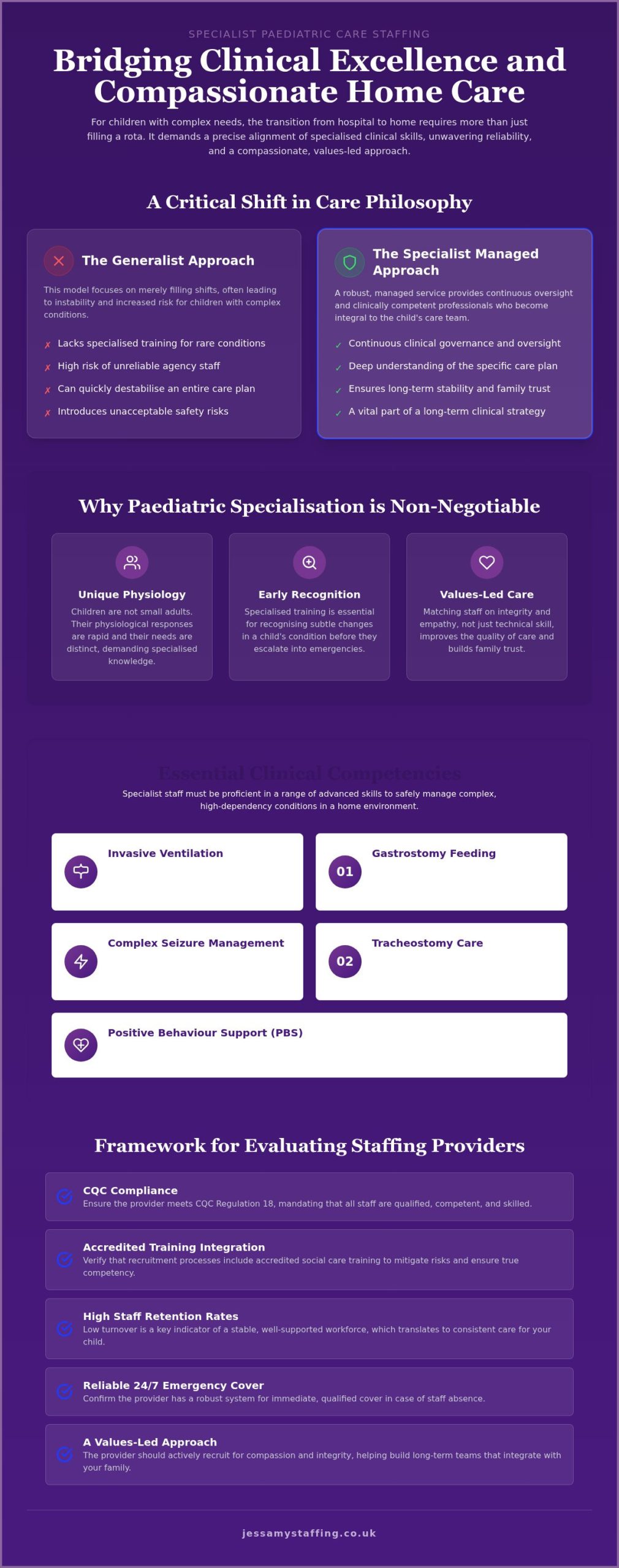
Selecting a provider for specialist paediatric care staffing is a decision that carries immense weight. It’s about finding a partner who can maintain clinical safety whilst respecting the sanctity of the family home. To assist Integrated Care Boards (ICBs) and families, we’ve developed a framework for evaluation that focuses on three core pillars of excellence:
- CQC Single Assessment Framework: Ensure the provider is ‘audit-ready’ with real-time evidence of staff competency and safety.
- Staff Retention Rates: High retention is the primary indicator of a stable, long-term care team; high turnover is a red flag for care stability.
- Clinical Oversight: Verify that a Registered Nurse actively supervises support workers and signs off on specific technical competencies.
There’s a fundamental difference between an introductory agency and a fully managed service. Whilst an agency might simply fill a shift, a managed service takes full ownership of the care package, including the management of staff absences and the provision of emergency cover. This prevents the care plan from becoming fragmented. We address the common concern that agency staff might ‘destabilise’ the home by prioritising continuity of care. By providing a small, dedicated team rather than a rotating cast of strangers, we ensure that the child feels safe and the family feels supported in their own environment.
Vetting, Safeguarding, and Professional Rigor
Vetting and safeguarding are the bedrock of professional rigour. Beyond mandatory Enhanced DBS checks and paediatric-specific references, we utilise values-led interviews to identify candidates who possess both technical skill and emotional intelligence. Regular clinical audits and supervisions are not just administrative tasks; they are essential safety mechanisms. They ensure every carer remains proficient in the latest 2026 standards and is fully aligned with the child’s evolving needs.
Managing the Transition from Hospital to Home
The transition from hospital to home is a critical phase that requires meticulous planning. A successful setup typically requires several weeks of collaboration between the staffing provider, NHS clinicians, and the family. This ensures the home environment is clinically viable and the staff are fully integrated into the existing multidisciplinary team. For a deeper analysis of how to select the right partner for this journey, consult The Definitive Guide to Choosing a Support Worker Recruitment Agency in 2026.
If you are looking for a provider that balances professional rigour with human-centric warmth, speak with our paediatric specialists to explore how we can support your specific requirements.
Specialist Paediatric Care Staffing with Jessamy Solutions
Jessamy Solutions stands as the premier partner for specialist paediatric care staffing in Greater Manchester. We don’t merely provide personnel; we deliver a clinical partnership rooted in the ‘Principled Expert’ philosophy. This approach ensures that every child with complex needs is supported by a team that balances meticulous clinical standards with genuine human-centric warmth. Our focus remains on bridging the gap between hospital-level necessity and the comfort of the home environment. By prioritising safe and competent service delivery, we strengthen care environments across the region, providing the reassurance that families and commissioners require.
Accessing our 24/7 emergency paediatric staffing services is a straightforward process designed for rapid intervention. We recognise that clinical crises don’t adhere to office hours. Our emergency recruitment model is specifically built to handle last-minute gaps in Greater Manchester, ensuring that a child’s safety is never compromised by a lack of personnel. We invite families, case managers, and Integrated Care Board (ICB) commissioners to discuss bespoke workforce solutions that align with their specific clinical and operational requirements. Our team is prepared to act as a meticulous guardian of standards for every child we support.
Values-Led Recruitment for Sensitive Environments
Partnering for Better Paediatric Outcomes
We view our relationship with ICBs and case managers as a long-term clinical partnership rather than a simple transactional service. By offering a stable, values-led workforce, we help maintain the continuity of care that is so vital for children with life-limiting conditions. Our model addresses the critical need for speed without sacrificing quality. If you require immediate support, our 24/7 Emergency Care Staffing UK: Reliable Rapid-Response Solutions ensure that help is available exactly when it’s needed most. We remain dedicated to providing Manchester with a staffing solution that is as compassionate as it is clinically excellent. Whether you’re managing a single complex care package or a regional framework, we’re ready to provide the professional rigour your service demands.
Advancing Clinical Excellence in Paediatric Home Care
Clinical safety in the home is a standard that must be continuously earned through rigorous oversight and compassionate dedication. The landscape of 2026 demands a partner who understands that every care package is a commitment to a child’s future, not just a series of shifts to be filled. By integrating accredited training with a deep understanding of complex conditions, specialist paediatric care staffing ensures that children can thrive in the environment where they feel most secure.
As an accredited social care training provider with a values-led recruitment protocol, we bridge the gap between institutional requirements and human needs. Whether you require 24/7 emergency rapid-response or a long-term managed team, we’re here to provide the stability your service requires. You can take the first step towards a more reliable care solution by choosing a partner dedicated to excellence at every level of delivery.
Secure Specialist Paediatric Staffing for Your Service Today and ensure your child or service is supported by the highest standards of professional care. We’re ready to help you build a safer, more compassionate future for those who need it most.
Frequently Asked Questions
What qualifications should specialist paediatric care staff have?
Specialist paediatric care staff must hold accredited social care training alongside specific clinical competencies verified by a Registered Nurse. These typically include certifications in Basic Life Support, Safeguarding Children at Level 3, and technical proficiencies such as enteral feeding or seizure management. We ensure every professional undergoes a rigorous vetting process, including enhanced DBS checks and paediatric-specific referencing, to maintain the safety and integrity of the care environment.
How quickly can you provide emergency paediatric cover in Manchester?
We provide 24/7 emergency cover across Greater Manchester with a focus on rapid-response deployment. Our local talent pool allows us to address urgent staffing gaps, such as sickness or unexpected hospital discharges, often within a few hours. This immediate availability is a cornerstone of our service, ensuring that complex care packages remain stable and that families are never left without essential clinical support during a crisis.
Can Jessamy Staffing support children with tracheostomies and ventilators?
Yes, we specialise in providing trained personnel for children requiring tracheostomy care and invasive or non-invasive ventilation. Our staff are proficient in troubleshooting medical equipment, managing airway emergencies, and performing routine suctioning. Every worker assigned to a technology-dependent child must first demonstrate their competency to a Registered Nurse, ensuring that technical mastery is paired with the specific requirements of the child’s clinical care plan.
How do you ensure staff continuity for long-term complex care packages?
Continuity is achieved by building small, dedicated staff teams for each individual child rather than using a large pool of rotating workers. We prioritise staff retention through ongoing professional development and values-led recruitment protocols. This approach fosters deep trust between the carer and the family, which is essential for the long-term success of complex care packages and the emotional well-being of the child.
Is your paediatric staffing service CQC regulated?
Our services are aligned with the Care Quality Commission standards, specifically the Single Assessment Framework implemented in 2026. We maintain a state of continuous audit-readiness to ensure our specialist paediatric care staffing meets all legal requirements for safety and effectiveness. This includes regular clinical supervisions, meticulous record-keeping, and proactive governance to ensure that our service delivery remains at the highest professional register.
What is the difference between a paediatric nurse and a complex care support worker?
A paediatric nurse is a registered professional responsible for clinical oversight, care planning, and the assessment of technical competencies. In contrast, a complex care support worker provides the day-to-day, hands-on care under the nurse’s guidance. Whilst both are highly trained, the nurse holds the ultimate accountability for the clinical governance of the package, ensuring that all medical interventions are safe and evidence-based.
How do you match staff to a child’s specific emotional and developmental needs?
Matching is conducted through a combination of clinical skill assessment and values-led personality profiling. We look for carers whose emotional intelligence and communication style align with the child’s specific developmental stage and sensory needs. This human-centric approach ensures that the professional can interpret non-verbal cues and build a meaningful connection, which is particularly vital for children with neurodiverse conditions or learning disabilities.
Do you provide paediatric staffing for schools or just home care?
We provide paediatric staffing for both home-based care and educational settings to ensure a seamless transition for the child throughout their day. Our staff can accompany children to school to manage their clinical needs, such as ventilation or gastrostomy feeding, whilst they engage in learning. This holistic support model ensures that the child’s health requirements are met without compromising their access to education and social development. For families seeking high-quality early childhood education and development resources, gapccc.com provides an excellent example of a year-round approach to supporting these vital early stages.