



What if the clinical safety of your child didn’t have to come at the expense of your family’s privacy or peace of mind? For many parents, the search for a reliable children’s complex care agency UK is often overshadowed by the fear of a staff member failing to arrive or the anxiety that a carer might lack the precise skills needed for tracheostomy care. You deserve a partner that treats your home with respect whilst maintaining the highest medical standards. It’s a delicate balance, but one that is essential for a stable and happy household.
We understand that managing complex needs is exhausting, especially as you work through the significant reforms introduced by the Children’s Wellbeing and Schools Act 2026. This guide promises to simplify that journey by detailing how to identify clinical excellence and values-led recruitment in a specialist provider. We’ll explore the practicalities of home-based paediatric support, from meeting CQC regulations to streamlining the referral process. By the end, you’ll have a clear roadmap to securing expert care that protects your child’s health and your family’s wellbeing.
Key Takeaways
- Understand the vital role a specialist agency plays in bridging the gap between hospital discharge and achieving long-term stability at home.
- Learn how to identify a high-quality children’s complex care agency UK by focusing on paediatric-specific competencies rather than general care experience.
- Discover why values-led recruitment is the cornerstone of clinical safety, ensuring that staff possess the integrity and empathy required for sensitive environments.
- Access a practical framework for evaluating providers, including essential questions to ask about 24/7 emergency cover and clinical oversight.
- Explore how local expertise in Greater Manchester can streamline the referral process and provide more responsive, community-integrated support.
What is a Children’s Complex Care Agency and Why is it Essential?
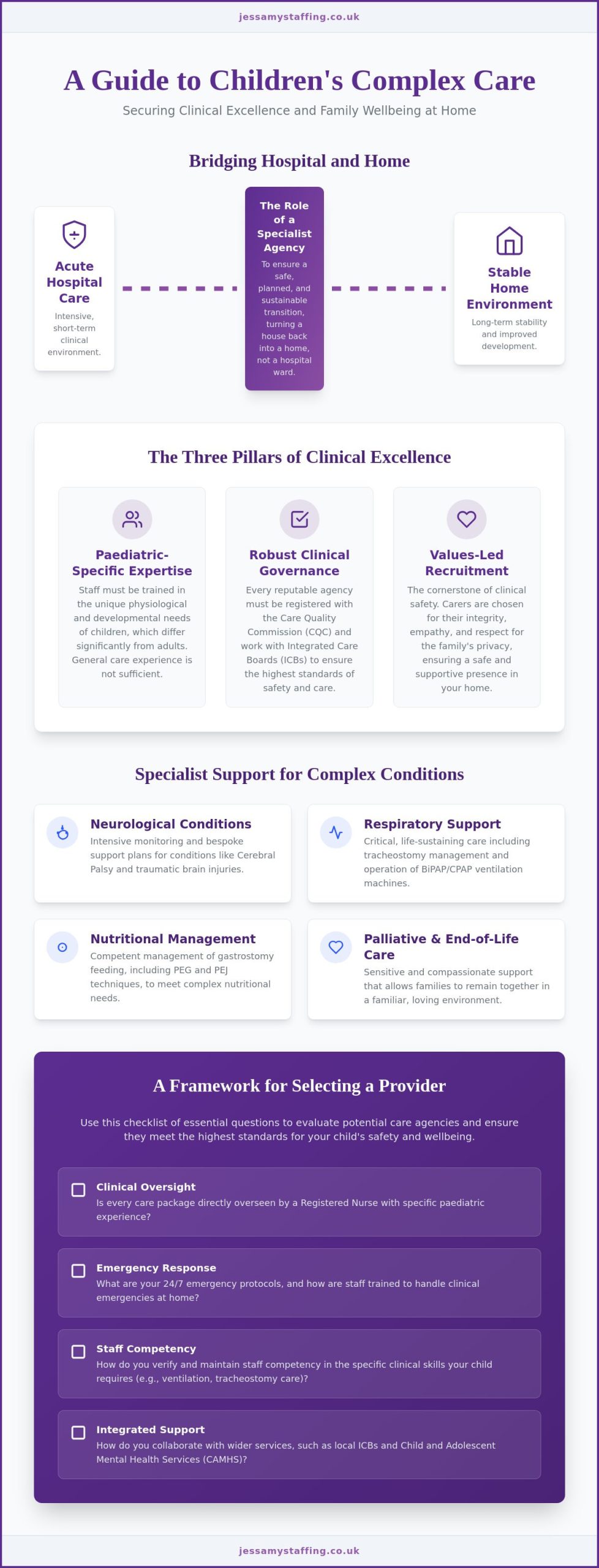
A children’s complex care agency UK serves as a vital clinical partner for families managing multi-faceted health needs. Complex care involves more than just routine support; it requires skilled interventions that were once only available in hospital settings. By providing a bridge between acute clinical environments and the sanctuary of the home, these agencies ensure that a child’s transition from hospital discharge is safe, planned, and sustainable. It’s a role that demands both technical precision and deep empathy.
Families often turn to specialist providers because they require precise expertise in life-sustaining technologies. This includes managing long-term ventilation, gastrostomy feeding, and complex seizure patterns. The shift towards home-based care isn’t just about convenience. It’s about outcomes. Evidence suggests children develop better when they’re surrounded by family, provided the clinical safety net is robust enough to support them. A dedicated agency provides the stability needed to turn a house back into a home, rather than a satellite hospital ward.
Conditions Supported by Specialist Paediatric Agencies
Specialist providers manage a wide spectrum of needs that require constant vigilance. Neurological conditions like Cerebral Palsy or traumatic brain injuries often require intensive, round-the-clock monitoring and bespoke support plans. Respiratory support is equally critical, involving tracheostomy care and the management of BiPAP or CPAP machines. For children with nutritional challenges, staff must be competent in PEG and PEJ feeding techniques. In more sensitive circumstances, these agencies provide palliative care, allowing families to remain together during end-of-life support in a familiar, loving environment.
The UK Regulatory Landscape: CQC and ICB Standards
Safety in this sector is governed by strict frameworks that protect vulnerable children. Every reputable children’s complex care agency UK must be registered with the Care Quality Commission (CQC). This registration ensures that the service is safe, effective, and well-led, with regular inspections to maintain high standards. Agencies also work closely with Integrated Care Boards (ICBs) to manage funded care packages, ensuring that public resources are used to provide the highest standard of clinical oversight.
Whilst clinical tasks like ventilation are primary, agencies often coordinate with Child and Adolescent Mental Health Services (CAMHS) to address the emotional impact of long-term illness on a young person. This integrated approach ensures that the child’s holistic wellbeing remains the priority. By navigating these complex regulations on behalf of the family, an agency acts as a meticulous guardian of standards, allowing parents to focus on being parents rather than care coordinators.
Clinical Excellence: Navigating Paediatric Nursing and Specialist Support
Clinical excellence in a home setting is a deliberate achievement. It distinguishes a children’s complex care agency UK from standard domiciliary providers. Whilst general care focuses on activities of daily living, complex support integrates clinical interventions that require rigorous training and constant assessment. It’s not enough for staff to have adult care experience; they must understand the unique physiological and developmental needs of a child. A child’s respiratory system or nutritional requirements differ significantly from an adult’s, making paediatric-specific expertise a non-negotiable requirement for safety.
A Registered Nurse typically oversees every complex package. They serve as the clinical lead, ensuring that support workers are not only trained but also competent in the specific nuances of your child’s care plan. This oversight is central to risk management. In a domestic setting, agencies must prepare for clinical emergencies with the same precision as a hospital ward. This involves detailed emergency protocols, regular simulation of high-pressure scenarios, and ensuring that every piece of equipment is maintained to exacting standards. Every action is designed to prevent hospital readmission and maintain a stable home environment.
These standards align with the Children’s Social Care National Framework, which emphasises that high-quality care must be outcome-focused and safe. By adhering to these national expectations, an agency provides a level of security that allows families to rest, knowing their child is in expert hands. If you’re currently assessing the level of skill required for your household, exploring specialist staffing solutions can help clarify the necessary qualifications for your child’s specific needs.
Specialist Paediatric Clinical Competencies
Clinical skill sets must be tailored to the child’s specific diagnosis. Specialist competencies often include respiratory health management, such as the expert use of suctioning and cough assist devices to maintain clear airways. Staff are also trained in precise medication administration, including the delivery of rescue medications like buccal midazolam for epilepsy. Furthermore, moving and handling tasks are performed using specialist hoists and slings, always prioritising the child’s physical safety and their personal dignity.
The Importance of Continuity in Care Teams
Consistency is the foundation of trust. For a child with complex needs, familiar faces aren’t just a preference; they’re vital for emotional wellbeing and managing behaviour. A stable team understands the subtle cues that an unfamiliar carer might miss. Agencies manage this by building robust rotas that provide 24/7 coverage whilst preventing staff burnout. This approach ensures that support workers remain alert and engaged, acting as an integrated part of the wider multidisciplinary team alongside therapists and NHS consultants.
The Critical Importance of Values-Led Recruitment and Accredited Training
Clinical skills are the foundation of any children’s complex care agency UK, but they’re insufficient on their own. High-level technical ability must be paired with unwavering integrity. A support worker might be an expert at tracheostomy care, but if they lack empathy or fail to respect the boundaries of a family home, the care package will inevitably fail. Values-led recruitment is the process of screening for these intangible qualities, such as patience, resilience, and a genuine sense of duty. By prioritising character alongside competence, an agency builds a team that families can actually trust.
This trust is reinforced through a commitment to the care economy’s wider standards. Adhering to NICE guidelines for severe complex needs ensures that clinical interventions are evidence-based and delivered within a coordinated framework. It isn’t just about the initial hire. Continuous professional development (CPD) keeps staff updated on the latest paediatric standards, ensuring that their practice remains current as regulations evolve. This methodical approach to growth ensures that the care provided is as compassionate as it is clinically sound.
In-House Training vs. Outsourced Certifications
Many agencies rely on generic, outsourced certificates that lack specific context. A superior children’s complex care agency UK invests in its own accredited training arm. This allows for a much tighter mapping to the Care Certificate and specialised paediatric requirements. When an organisation provides its own training for complex care workers, it can simulate real-world home scenarios that generic courses often miss. This level of workforce intelligence ensures that when a carer enters your home, they aren’t just theoretically capable; they’re practically prepared for the unique challenges of a domestic environment.
Vetting and Compliance: Ensuring Child Safety
Rigorous vetting is the first line of defence in protecting vulnerable children. This involves more than just a standard DBS check. It requires thorough reference verification and a compliance-led approach to healthcare staffing. Safety bars must remain high, particularly in sensitive home environments where privacy and protection are paramount. Beyond the initial checks, regular supervision and appraisals are essential. These sessions allow for the monitoring of staff behaviour and performance, ensuring that the high standards established during recruitment are maintained every single day. It’s a methodical process that ensures every team member remains a meticulous guardian of your child’s well-being.
Selecting a Provider: A Framework for Families and Case Managers
Choosing the right children’s complex care agency UK is a decision that requires a systematic evaluation of clinical competence and operational reliability. It’s more than a simple recruitment exercise; it’s the selection of a long-term partner who will enter your private space. Families and Case Managers must look for a provider that demonstrates a structured approach to care delivery, moving beyond surface-level promises to show evidence of rigorous clinical oversight. A principled expert in this field will always be transparent about their capabilities and their limitations.
One of the first distinctions to make is between a “fully managed” service and an introductory agency. A fully managed provider takes full legal and clinical responsibility for the care package. This includes the continuous supervision of staff, the management of CQC compliance, and the provision of ongoing training. Introductory agencies merely match you with a carer, often leaving the family with the burden of employment law and clinical risk. For a child with life-sustaining needs, the security of a managed model is usually the only viable option for long-term peace of mind.
Reliability is the most common concern for families. You must scrutinise an agency’s ability to provide 24/7 emergency care staffing UK before signing any agreement. Ask specifically how they handle last-minute sickness or equipment failure during a night shift. A dependable partner will have a robust contingency plan that doesn’t rely on parents to fill the gaps. If you’re seeking a provider that prioritises this level of clinical stability, you can request a consultation with our specialist team to discuss your requirements.
Checklist for Evaluating an Agency’s Suitability
- Condition-Specific Experience: Can they demonstrate successful management of your child’s specific diagnosis, such as Spinal Muscular Atrophy or complex epilepsy?
- Emergency Protocols: What is their documented process for handling clinical emergencies or staff no-shows in a domestic setting?
- Introduction Process: Do they facilitate shadowing shifts where new staff members are introduced to your home environment by a familiar team member?
- Evidence of Standards: Can they provide their most recent CQC inspection report and up-to-date training records for the specific staff members assigned to your child?
Funding and Referrals: Navigating the System
Navigating the funding landscape is often a source of significant anxiety. Many families now use Personal Health Budgets (PHBs), which offer greater flexibility in choosing a children’s complex care agency UK that aligns with their values. For Case Managers and Solicitors managing clinical negligence cases, the focus is often on finding a provider that can offer detailed clinical reporting and consistent staffing to satisfy legal requirements. A high-quality agency acts as a bridge between the NHS and the home, ensuring that the transition from a hospital ward is seamless, safe, and fully supported by the relevant Integrated Care Board (ICB).
Specialist Complex Care Solutions in Greater Manchester
Choosing a local children’s complex care agency UK offers practical advantages that national providers often struggle to replicate. A regional presence means the management team possesses a granular understanding of the Greater Manchester healthcare landscape, from the specific discharge protocols of local hospitals to the regional Integrated Care Board (ICB) requirements. This local knowledge is essential when establishing children’s complex care at home. It ensures that the initial assessment is not just a clinical tick-box exercise, but a thorough evaluation of how support will integrate with your family’s daily life.
A dependable workforce is the backbone of any successful care package. By focusing our efforts on the Greater Manchester community, we’ve built a network of professionals who are committed to the area. This local concentration of talent allows us to provide a level of workforce capacity that strengthens sensitive care environments. We don’t just supply staff; we provide a stable clinical foundation that allows local healthcare providers and families to operate with confidence. Our commitment to the North West is rooted in the belief that every child deserves high-quality care that is both accessible and responsive.
24/7 Emergency and Rapid Response in Manchester
Proximity is the key to reliability. In the North West, the demand for urgent support worker supply is significant, and a local agency can respond with a speed that national hubs simply cannot match. When a staff member is delayed or a clinical emergency arises, being based in Greater Manchester allows for a rapid response that keeps the care environment stable. We act as a trusted partner for regional nursing and care homes, ensuring that shift cover is reliable and that clinical safety is never compromised by distance or travel delays. This local responsiveness is a vital safeguard for children with life-sustaining medical needs.
The Jessamy Difference: Excellence Through Integrity
Jessamy blends high-level corporate authority with a compassionate, human-centric service. We act as a meticulous guardian of standards for every child we support, ensuring that technical competence is always paired with emotional intelligence. Our approach is grounded in professional rigor, yet we remain an approachable guide for families navigating the complexities of the care system. To begin the process of building a stable, specialist team for your household, contact Jessamy Staffing for a confidential consultation. We’ll work with you to conduct a comprehensive initial assessment and develop a bespoke care plan tailored to your child’s unique needs.
Securing a Stable Foundation for Your Child’s Care
Finding the right children’s complex care agency UK is about more than ticking clinical boxes; it’s about reclaiming your home as a place of safety and peace. We’ve established that the most effective care packages are built on the intersection of paediatric-specific competencies and a values-led recruitment philosophy. This approach ensures that every professional entering your sanctuary possesses both the technical skill for complex interventions and the integrity required for a domestic setting. A meticulously managed team provides the clinical safety net your child needs whilst protecting your family’s privacy.
As an accredited social care training provider, we offer the reassurance of 24/7 emergency cover available alongside a workforce that is professionally prepared for the unique demands of paediatric support. By prioritising character and rigour, we act as a bridge between complex institutional requirements and your child’s daily well-being. It’s a partnership designed for long-term stability and clinical excellence, ensuring that the standards of care never falter.
Secure specialist care for your child with Jessamy Staffing Solutions. You don’t have to navigate these complexities alone; the right support is ready to help your family move forward with confidence.
Frequently Asked Questions
What qualifies as ‘complex care’ for a child in the UK?
Complex care involves supporting children with multi-faceted health needs that require regular clinical intervention. This usually includes conditions requiring life-sustaining technology, such as long-term ventilation or gastrostomy feeding. It also covers children with severe neurological impairments or complex seizure management needs. These cases require a specialised children’s complex care agency UK to provide staff with the specific medical training necessary to manage these risks safely in a home environment.
Can I choose the specific support workers who come into my home?
You can certainly participate in the selection process to ensure the team is a good fit for your family. We encourage shadowing shifts where you can observe potential carers in your home before they begin regular shifts. This process ensures that the support workers align with your family’s values and routines. Building a team that you feel comfortable with is essential for the long-term success and stability of the care package.
How does a children’s complex care agency ensure staff are clinically competent?
Clinical competence is verified through a rigorous process of accredited training and nurse-led assessments. Staff must complete specific training modules for tasks like tracheostomy care or suctioning before they’re allowed to work independently. A Registered Nurse then conducts a formal competency sign-off in the child’s home to ensure the carer can perform these tasks safely in a real-world setting. Regular audits and refresher training ensure these standards remain high.
Is there funding available for children’s complex care at home?
Funding is primarily available through the NHS via Integrated Care Boards (ICBs) or Personal Health Budgets (PHBs). These budgets allow families to direct their own care by choosing a specialist children’s complex care agency UK that meets their specific requirements. In cases involving clinical negligence, care is often funded through settlements managed by solicitors or case managers. We work closely with these bodies to ensure the referral and funding process is as streamlined as possible.
What happens if our regular support worker is unwell or unable to attend?
Our 24/7 emergency cover model is designed to handle staff sickness or unforeseen absences immediately. We maintain a pool of shadow staff who are already familiar with your child’s care plan and have been introduced to your home. This contingency planning ensures that you aren’t left without support at short notice. Reliability is a cornerstone of our service, and we prioritise finding a competent replacement to maintain the safety of the care package.
How quickly can a complex care package be set up for a child?
The timeline for setting up a package typically takes several weeks to ensure safety and clinical competence. This period allows for thorough initial assessments, bespoke care planning, and the recruitment of a dedicated team. If specific clinical training is required for your child’s equipment, staff must complete these competencies before the package goes live. Whilst we aim for a swift transition, we never compromise on the rigorous vetting and training required for complex cases.
Do you provide 24/7 nursing cover for children with ventilators?
We provide 24/7 emergency cover and round-the-clock staffing for children requiring constant clinical vigilance, including those on ventilators. Our teams are trained in the specific management of respiratory equipment and emergency troubleshooting. This ensures that your child has access to skilled support during the day and night, allowing you to rest with the confidence that their clinical needs are being monitored by competent, professionally prepared personnel.
What is the difference between a paediatric nursing agency and a complex care agency?
A paediatric nursing agency typically focuses on supplying registered nurses for short-term or acute needs. In contrast, a complex care agency provides a fully managed, long-term solution that often includes a mix of nurses and specially trained support workers. This model includes clinical oversight, bespoke care planning, and the management of CQC compliance. It’s designed to provide a stable, sustainable alternative to hospital stays by building a permanent team around the child’s specific requirements.