

The domestic team is the first line of defence in infection prevention, yet they are often the most overlooked component of a care home’s clinical safety strategy. Ensuring rigorous training for care home domestic staff UK is no longer just a matter of operational efficiency; it is a fundamental pillar of resident safeguarding and regulatory excellence. You likely recognise that whilst your care staff are meticulously prepared, it is the domestic team’s understanding of complex hygiene standards and CQC expectations that truly secures the environment against modern health challenges.
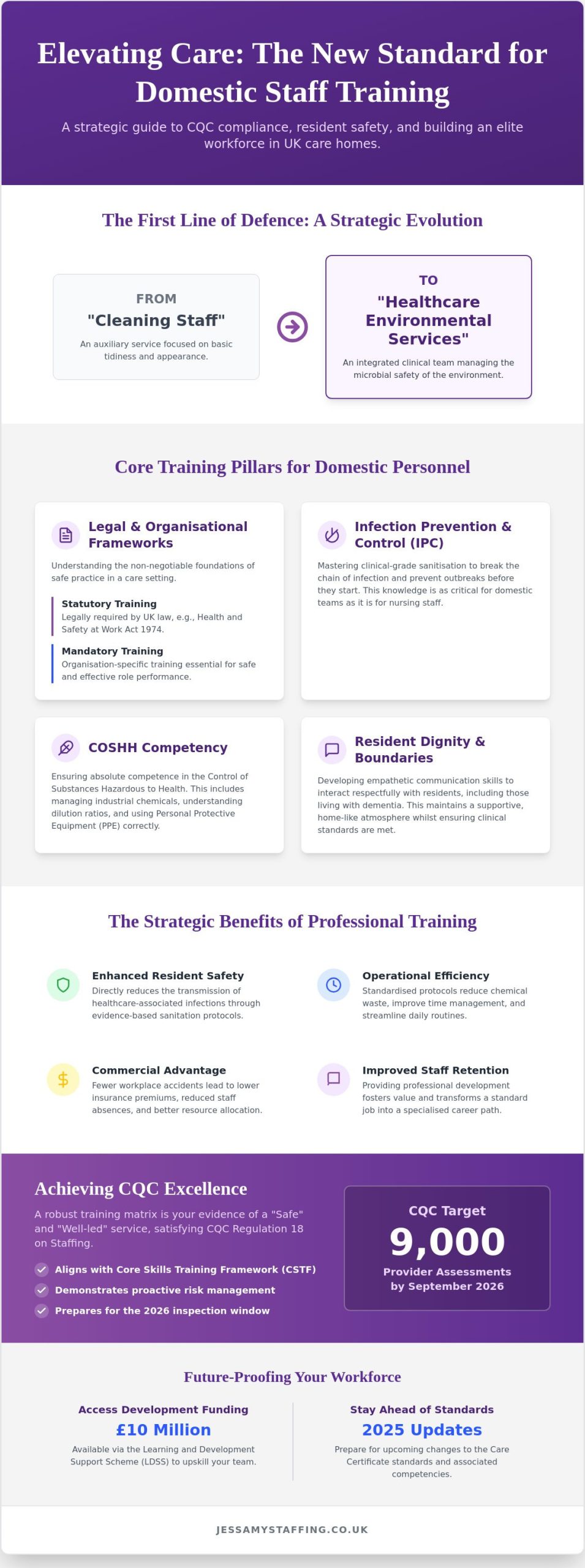
We understand the immense pressure of preparing for the 9,000 provider assessments the CQC aims to complete by September 2026, particularly whilst managing the persistent challenges of high staff turnover. This guide provides the clarity you need to develop an elite domestic workforce by outlining the statutory requirements and specialist competencies necessary for a professional, integrated team. You will discover the latest updates on the Oliver McGowan mandatory training, the 2025 Care Certificate standards, and how to access the £10 million Learning and Development Support Scheme (LDSS) funding to ensure your facility remains a benchmark for safety and care.
Key Takeaways
- Understand why domestic personnel act as the vital first line of defence in infection prevention and how their work directly preserves resident dignity and mental wellbeing.
- Identify the specific legal and organisational requirements for training for care home domestic staff UK, ensuring full alignment with the Core Skills Training Framework.
- Master role-specific competencies for housekeeping and laundry teams to achieve clinical-grade sanitisation and the safe management of infectious materials.
- Learn how to maintain a robust training matrix that demonstrates compliance with CQC “Safe” and “Well-led” standards during the 2026 inspection window.
- Discover the advantages of integrating accredited social care training with a values-led recruitment model to build a more professional, stable, and integrated domestic team.
The Strategic Importance of Training for Care Home Domestic Staff
Domestic staff are the unseen pillars of a facility’s clinical safety. By 2026, the sector has moved away from the simple label of “cleaning” towards the more accurate “healthcare environmental services”. This shift reflects a deeper understanding of how the physical environment dictates clinical outcomes. Professional training for care home domestic staff UK ensures that these individuals aren’t just tidying rooms; they’re actively managing the microbial safety of the building. When staff understand the “why” behind their tasks, they become a proactive force in resident health.
This evolution in role definition brings several strategic benefits:
- Clinical Integration: Domestic teams become a recognised part of the infection control hierarchy rather than an auxiliary service.
- Enhanced Resident Safety: There’s a direct reduction in the transmission of healthcare-associated infections through evidence-based sanitation.
- Operational Efficiency: Standardised protocols reduce chemical waste and improve daily time management.
Investing in high-level training provides a clear commercial advantage. Properly trained staff are far less likely to suffer workplace accidents, such as needle-stick injuries or chemical burns from COSHH-regulated substances. This reduction in risk naturally leads to lower insurance premiums and fewer staff absences. Within the wider context of Social care in England, where recruitment and retention remain critical challenges, providing domestic teams with professional development fosters a sense of value. It transforms a standard job into a specialised career path.
Infection Control: The First Line of Defence
Domestic staff require the same foundational knowledge of Infection Prevention and Control (IPC) as nursing personnel. They must understand the chain of infection to break it effectively. Without this insight, a simple mop can become a tool for cross-contamination. Comprehensive training for care home domestic staff UK ensures they master clinical-grade sanitisation. This expertise allows domestic teams to prevent outbreaks before they start, protecting vulnerable residents from infections that can be life-threatening in a residential setting.
Resident Dignity and Professional Boundaries
A care home is a resident’s private sanctuary. Training must address the delicate balance of performing tasks whilst residents are in their personal spaces. Domestic staff often have more frequent, informal interactions with residents than clinical teams do. They need specific communication skills to engage empathetically with people living with dementia. This ensures their presence feels like a supportive service rather than an intrusion. It maintains a home-like atmosphere whilst meeting the rigorous clinical standards required for modern compliance.
Statutory and Mandatory Training Requirements for Domestic Personnel
Compliance in a residential setting begins with a clear distinction between statutory and mandatory obligations. Statutory training is a legal requirement dictated by national legislation, such as the Health and Safety at Work Act 1974, which applies to every employee regardless of their specific role. Mandatory training, conversely, is determined by the care provider to ensure that staff can perform their duties safely and effectively. Both categories are fundamental to meeting CQC Regulation 18: Staffing, which insists that all employees receive the support and training necessary to carry out their roles.
Aligning training for care home domestic staff UK with the Core Skills Training Framework (CSTF) ensures a high level of standardisation. This framework provides a recognised benchmark, allowing managers to verify that domestic personnel possess the same foundational safety knowledge as their clinical colleagues. For the domestic team, the Control of Substances Hazardous to Health (COSHH) remains a non-negotiable priority. They must demonstrate absolute competence in managing industrial chemicals, understanding dilution ratios, and maintaining the safety data sheets that auditors scrutinise during inspections. To ensure your team meets these rigorous standards, investing in accredited social care training and development can bridge the gap between basic cleaning and professional environmental care.
The Essential Training Checklist
Beyond chemical safety, several core competencies are vital for a safe working environment. Fire safety awareness must be tailored for domestic staff, focusing on evacuation procedures whilst handling heavy equipment. Manual handling training is equally critical; domestic roles involve the constant movement of furniture and industrial machinery, which carries a high risk of musculoskeletal injury if performed incorrectly. Furthermore, domestic staff require safeguarding training. Because they work in residents’ private rooms, they’re often the first to notice subtle signs of abuse or neglect that might be missed during brief clinical interventions.
Food Hygiene and Nutrition for Domestic Staff
In many UK care settings, the domestic and catering functions overlap, particularly during peak meal times. Domestic staff assisting in dining areas should hold a Level 2 Food Safety certificate to prevent cross-contamination risks. Their training should also encompass a basic understanding of hydration and nutrition support. When a domestic worker understands why a resident requires thickened fluids or a specific diet, they become an active participant in the resident’s care plan, ensuring that environmental cleanliness never comes at the expense of nutritional safety.
Role-Specific Competencies: Housekeeping, Laundry, and Catering Support
Professional domestic work in a residential setting requires a level of technical precision that exceeds standard commercial cleaning. High-touch surfaces, such as light switches, door handles, and bed rails, are the primary vectors for viral and bacterial transmission. Effective training for care home domestic staff UK focuses on clinical-grade sanitisation techniques that neutralise these threats without damaging sensitive medical equipment or irritating residents’ respiratory systems. This level of expertise ensures that the environment remains both safe for clinical care and comfortable for daily living.
Effective waste management is another critical competency that defines a high-performing domestic team. Staff must be proficient in colour-coded bagging systems to ensure that hazardous waste is disposed of correctly and safely. According to Skills for Care, maintaining these standards is essential for both workforce safety and public health compliance. Misidentifying waste streams can lead to severe regulatory breaches and environmental hazards. Precise training for care home domestic staff UK transforms these daily tasks into a sophisticated defensive strategy against cross-contamination.
Domestic personnel also play a significant role in catering support, particularly during peak service times. Their involvement includes:
- Safe Meal Service: Assisting with the distribution of meals whilst maintaining strict hand hygiene.
- Dining Room Sanitisation: Ensuring that communal eating areas are cleaned to a food-safe standard between sittings.
- Allergen Awareness: Understanding the importance of preventing cross-contact for residents with specific dietary requirements.
Laundry and Fabric Care Standards
Laundry management is a complex operation that demands strict adherence to thermal disinfection protocols. Staff must ensure that machines operate at specific temperatures to eliminate pathogens from bedding and clothing. The “Red Bag” system is a specialised procedure where soiled or infectious linen is placed in water-soluble bags that are transferred directly into the washing machine to prevent manual handling of contaminated fabric. Whilst technical accuracy is paramount, staff must also handle delicate personal items with care. Preserving the quality of a resident’s clothing is a subtle but powerful way to maintain their dignity and identity.
Chemical Safety and COSHH Excellence
The safe use of healthcare-grade detergents requires a deep understanding of chemical properties. Domestic personnel must be trained in the exact dilution ratios needed for various surfaces, as incorrect mixtures can be either ineffective or dangerously corrosive. Mastery of Safety Data Sheets (SDS) allows staff to respond quickly to spillages or accidental exposure. Selecting the correct Personal Protective Equipment (PPE) is also a core skill. Staff must know which gloves or aprons are appropriate for specific tasks to protect themselves whilst ensuring they don’t inadvertently carry contaminants between rooms.
Ensuring CQC Compliance and Workforce Quality
The CQC inspection framework for 2026 places significant emphasis on how non-clinical functions contribute to the “Safe” and “Well-led” domains. Inspectors are no longer satisfied with a simple list of names on a spreadsheet; they require evidence that training for care home domestic staff UK translates into tangible competency on the floor. With the CQC aiming to complete 9,000 provider assessments by September 2026, the pressure to maintain a meticulous, audit-ready training matrix is substantial. A robust matrix demonstrates that your team isn’t just compliant on paper but is actively managed to ensure resident safety and environmental excellence.
Refresher intervals are now more stringent to ensure skills remain sharp against evolving health challenges. In 2026, core competencies such as infection control and COSHH require annual updates to account for new safety protocols and chemical standards. For temporary or agency personnel, a comprehensive induction remains non-negotiable. This ensures that every individual on-site, regardless of their contract length, aligns with your facility’s specific safety culture. Effective management of these requirements is often a hallmark of sophisticated healthcare personnel supply UK strategies, ensuring every person in the building is fully prepared for their specific duties.
Audit Readiness for Domestic Services
True audit readiness is defined by the quality of your documentation. You must move beyond simple attendance logs and begin documenting formal competency assessments. This involves observing a staff member as they perform a task, such as the correct dilution of a healthcare-grade detergent, and recording the outcome. Demonstrating “continuous improvement” is also vital; inspectors want to see how internal audit findings have led to specific training interventions. If you require support in building this level of workforce quality, our team at Jessamy Staffing Solutions can provide the expert domestic staff and training resources necessary for total compliance.
The Role of Accredited Training Providers
Utilising an external, accredited provider adds significant weight to your compliance evidence. It signals a commitment to high standards that internal, ad-hoc training sessions often struggle to match. For managers seeking accredited social care training UK in Greater Manchester, Jessamy Staffing Solutions offers a values-led approach that resonates with both staff and inspectors. A blended learning model is particularly effective for domestic teams. Combining online knowledge modules with face-to-face practical sessions allows staff to learn at their own pace whilst ensuring they can apply their skills correctly in the physical care environment.
Accredited Training and Reliable Domestic Staff Supply with Jessamy Staffing Solutions
Jessamy Staffing Solutions operates as a principled expert in the healthcare sector, acting as a bridge between rigorous institutional requirements and the essential human needs of residents. We don’t just supply personnel; we provide a comprehensive ecosystem of support that ensures your facility remains a sanctuary of safety and dignity. Our dual approach combines the delivery of accredited training for care home domestic staff UK with the supply of elite personnel who are already professionally prepared for the complexities of a clinical environment. This integration ensures that your domestic team is never an isolated department but a core component of your safeguarding strategy.
Our values-led recruitment model is designed to instill confidence in care home managers. We recognise that technical skill alone is insufficient in a residential setting. Every individual we represent is selected for their integrity and sense of duty, ensuring they possess the emotional intelligence required to work amongst vulnerable residents. By embedding our social care training & development programmes into our staffing solutions, we provide a workforce that understands the nuance of their role. They don’t just clean; they protect the health and wellbeing of every person in the building.
The Jessamy Staffing Solutions Standard for Domestic Personnel
In Greater Manchester and beyond, we provide 24/7 support to ensure your facility is never compromised by staffing shortfalls. Every domestic worker undergoes a meticulous compliance check that exceeds standard industry requirements. Our staff are trained to understand the specific “culture of care” within your home, allowing them to integrate seamlessly with your clinical teams. When unexpected absences occur, our rapid-response emergency care staffing UK service ensures that your hygiene and safety standards never falter, even during peak pressure periods.
Partnering for Excellence in Social Care
We believe in building long-term partnerships based on transparency and reliability. Our team can provide bespoke training for care home domestic staff UK, tailored specifically to the unique layout and resident needs of your facility. Whether you require a comprehensive training audit to prepare for an upcoming CQC inspection or a reliable supply of pre-trained temporary staff, Jessamy Staffing Solutions offers the professional rigor needed to succeed. We invite you to experience a service where efficiency and empathy intersect to create a truly professional domestic workforce.
Enquire about our domestic staff training and supply services today to secure the standards your residents deserve.
Elevating Environmental Standards for Long-Term Success
The transition from basic cleaning to professional healthcare environmental services is the defining shift for the sector in 2026. By integrating technical precision with a human-centric approach, providers can ensure that their domestic teams are not just auxiliary staff, but essential guardians of resident health. Implementing robust training for care home domestic staff UK is the most reliable way to navigate the rigorous CQC landscape whilst fostering a culture of pride and professionalism within your workforce.
We’ve discussed the technical requirements of COSHH, the nuances of the Red Bag system, and the vital importance of audit-ready documentation. As an accredited social care training provider and Greater Manchester specialist, Jessamy Staffing Solutions is uniquely positioned to help you maintain these high standards through both expert personnel supply and accredited development programmes. Whether you’re addressing immediate staffing gaps or looking to audit your internal training matrix, we provide the stable, expert support your facility requires.
Secure accredited training or reliable domestic staff for your care home today to ensure your facility remains a benchmark for safety and excellence. Together, we can create a cleaner, safer, and more compassionate environment for every resident.
Frequently Asked Questions
What is the difference between statutory and mandatory training for domestic staff?
Statutory training is legally required by UK legislation, such as the Health and Safety at Work Act 1974, and applies to all employees. Mandatory training is specified by the care provider to ensure staff can perform their specific roles safely and effectively. Whilst statutory training ensures basic legal compliance, mandatory training for care home domestic staff UK focuses on organisational standards and specialised environmental safety protocols necessary for a clinical setting.
How often do domestic staff in care homes need refresher training?
Most core safety subjects, including infection prevention and fire safety, require annual refresher training to maintain high standards. In 2026, the trend has shifted towards more frequent competency checks rather than just attending a course. Whilst some manual handling certificates traditionally lasted longer, we recommend annual reviews to ensure domestic teams remain proficient in using specialised equipment and handling hazardous chemicals safely within a residential care environment.
Is COSHH training a legal requirement for care home cleaners?
Yes, COSHH training is a strict legal requirement under the Control of Substances Hazardous to Health Regulations 2002. Employers are legally obligated to provide staff with comprehensive instruction on the risks associated with the chemicals they use daily. This includes understanding safety data sheets, correct dilution ratios, and the proper use of personal protective equipment to prevent workplace accidents and ensure the long-term safety of both staff and residents.
Can domestic staff perform basic care tasks if they have completed training?
Domestic staff should not perform care tasks, such as assisting with personal hygiene or medication, unless they have completed specific care qualifications like the Care Certificate. Their role is environmental, focusing on hygiene and safety. Allowing untrained staff to perform care duties is a significant breach of CQC regulations and compromises resident safety. Roles must remain distinct to ensure that professional standards of care and cleanliness are always upheld.
What food hygiene certificate do domestic staff need in a care home?
A Level 2 Food Safety and Hygiene certificate is the required standard for domestic staff who assist in dining areas or handle food. This qualification ensures they understand how to prevent cross-contamination and maintain temperature controls whilst serving residents. It is a vital component of training for care home domestic staff UK, particularly in facilities where domestic and catering duties overlap during busy periods, ensuring that nutritional service remains safe and hygienic.
How does the CQC inspect domestic and housekeeping services?
The CQC assesses domestic services primarily through the “Safe” and “Well-led” key lines of enquiry. Inspectors observe the cleanliness of the environment, speak with staff about their knowledge of infection control, and scrutinise training matrices for gaps. They look for evidence that domestic personnel are integrated into the wider care team and that their training is regularly audited for effectiveness, reflecting a commitment to continuous improvement.
Does Jessamy Staffing provide pre-trained domestic staff for emergencies?
Jessamy Staffing specialise in providing professionally prepared domestic staff who are ready for immediate deployment in Greater Manchester and surrounding areas. Every member of our team undergoes rigorous compliance checks and has completed the essential training required for residential settings. This ensures that when you face emergency shortfalls, the temporary staff you receive are already competent in clinical-grade cleaning, COSHH, and safeguarding protocols from their first shift.
What safeguarding training is required for non-care staff in residential homes?
Non-care staff, including domestic and maintenance personnel, must complete Level 1 Safeguarding Adults training as a minimum requirement. This enables them to identify the physical, emotional, or financial signs of abuse whilst they are working in residents’ private spaces. Because domestic staff often build informal rapport with residents, they play a crucial role in the early detection and reporting of potential safeguarding concerns to the designated lead.