



True vetting is a continuous culture of safeguarding, not just a one-off DBS check. For providers across the country, the pressure to secure reliably vetted care workers UK is often coupled with a persistent anxiety over CQC non-compliance and the profound weight of safeguarding risks. It’s understandable to feel overwhelmed by the complexities of modern recruitment, especially when the safety of vulnerable individuals is your primary responsibility. You recognise that a single oversight in the vetting process doesn’t just invite regulatory scrutiny; it compromises the very foundation of trust your service is built upon.
This guide clarifies exactly what rigorous vetting entails in 2026, from the £49.50 statutory fee for Enhanced DBS checks to the £23,200 salary threshold for international care workers. We’ll explore how to move beyond basic checklists to find reliable, values-led personnel who truly align with your organisation’s mission. By understanding the intersection of legal compliance and emotional intelligence, you’ll gain the peace of mind that comes from knowing your staffing is both safe and exemplary. We’ll examine the specific requirements for domestic and international recruitment, ensuring your team meets the highest quality standards whilst remaining fully compliant with current UK laws.
Key Takeaways
- Understand the mandatory nature of vetting under the Health and Social Care Act, framing it as a multi-stage commitment to safety rather than a mere administrative hurdle.
- Identify the five essential pillars of screening required to secure vetted care workers UK, focusing on the continuous monitoring provided by the DBS Update Service.
- Recognise the operational and ethical risks of improper vetting, including the potential for legal enforcement and the loss of institutional trust through ‘Inadequate’ CQC ratings.
- Learn how to rigorously verify a professional’s compliance status by requesting a comprehensive Staff Profile and cross-referencing identity documents with original certificates.
- See how integrating accredited training with values-based screening creates a stable, long-term partnership that prioritises the well-being of service users and families.
What Defines Vetted Care Workers in the UK?
Professional vetting is far more than a simple administrative hurdle; it’s a fundamental commitment to the safety and dignity of vulnerable individuals. For vetted care workers UK wide, the process involves a meticulous, multi-stage examination of identity, professional history, and personal character. It’s a structured methodology designed to filter out risk and identify individuals whose values align with the high standards of the healthcare sector. True vetting doesn’t just ask if a person can do the job, but whether they should be trusted to do it in the most sensitive of environments.
The legal necessity for this rigor is established under the Health and Social Care Act 2008. These regulations mandate that providers only employ individuals of ‘good character’ who possess the necessary qualifications and skills. The Care Quality Commission (CQC) oversees these standards, viewing recruitment as a primary indicator of a service’s safety and leadership. Whilst general UK security vetting levels provide a framework for national trust, the healthcare sector requires specific, granular checks designed specifically for safeguarding. There’s a distinct difference between basic compliance and the ‘safer recruitment’ gold standard; the latter involves a proactive, inquisitive approach to a candidate’s past rather than just ticking boxes.
The Core Components of Professional Vetting
A robust compliance pack begins with an Enhanced Disclosure and Barring Service (DBS) check, which includes a search of the Adult and Children’s Barred Lists. As of 2026, the statutory fee for an Enhanced DBS remains £49.50, a small but vital investment in security. Beyond criminal records, we enforce a strict ‘no gaps’ rule for employment history. Any period of unemployment must be accounted for and verified to ensure no hidden risks exist. Identity verification protocols are equally stringent, requiring original documentation to confirm the right to work in the UK. For international staff, this includes verifying visa status, where application fees currently stand at £324 for up to three years, ensuring every team member is legally and ethically positioned to provide care.
For international workers relocating to the UK, services like SimOnly Club provide essential eSIM plans that facilitate immediate communication upon arrival, which is a key part of a supportive onboarding experience.
Vetting Standards in Greater Manchester
In the North West, local authority expectations often exceed national baselines, requiring care providers to demonstrate a deep commitment to community safeguarding. Our presence in Greater Manchester facilitates a faster, more reliable verification process. We can conduct physical document checks in person, which remains the most secure method of identity confirmation. This local knowledge is invaluable for community-based support work; it allows us to understand the specific needs of Manchester families and ensures that the care workers we supply aren’t just vetted, but are also culturally and geographically prepared for their roles.
The 5 Pillars of Rigorous Care Staff Screening
Securing vetted care workers UK wide requires a framework that balances technical compliance with moral suitability. We view screening as a five-pillar architecture designed to support the safety of every service user. This methodology moves beyond the surface to ensure that every individual entering a care environment is both legally compliant and ethically prepared. A robust screening process is the only way to transform recruitment from a gamble into a reliable, quality-assured operation.
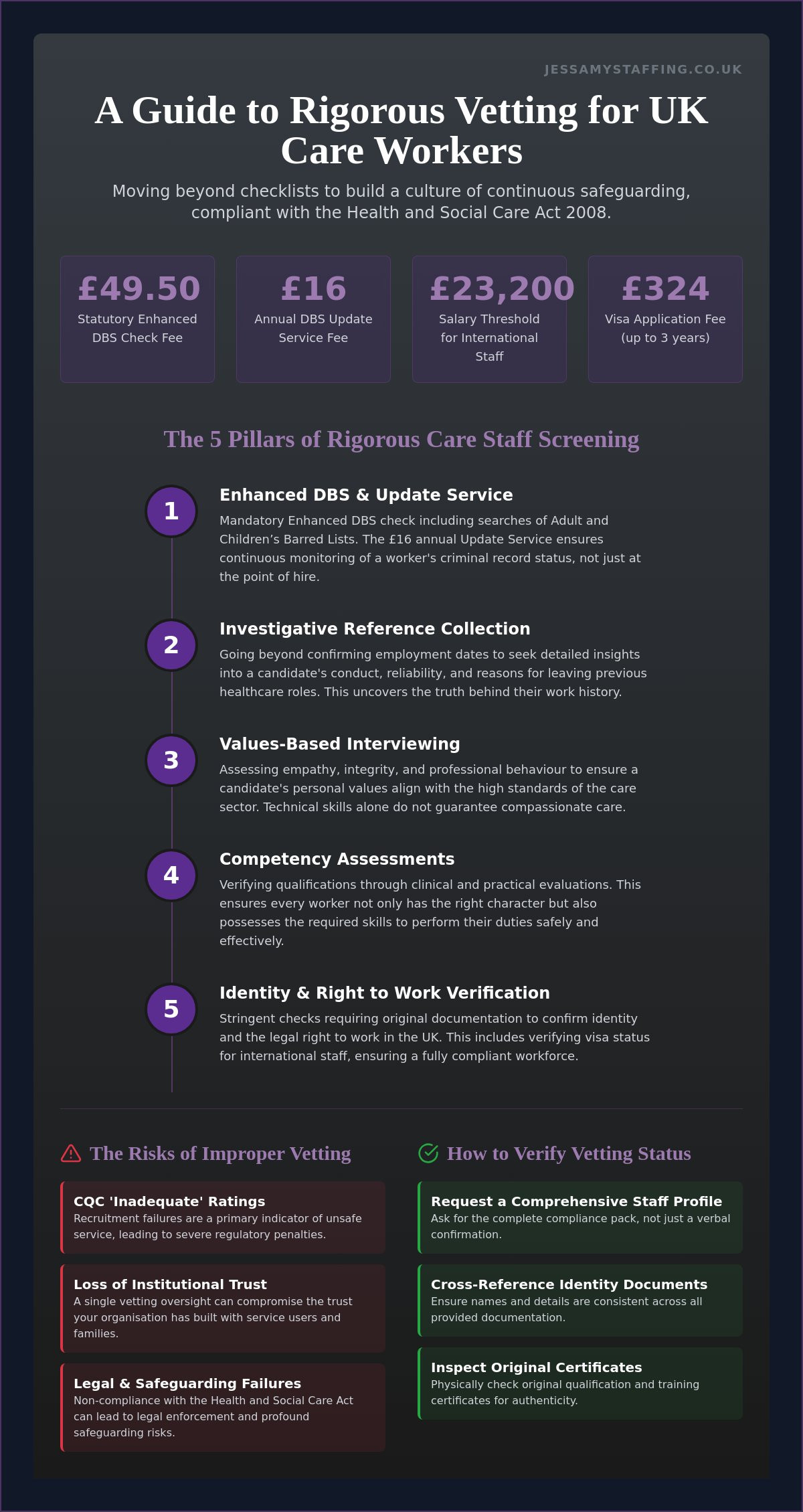
- Enhanced DBS and Update Service: We mandate an Enhanced Disclosure and Barring Service check, which currently carries a statutory fee of £49.50. By insisting on the £16 annual Update Service subscription, we ensure that a worker’s criminal record status is monitored continuously rather than just at the point of hire.
- Investigative Reference Collection: A standard reference often only confirms dates of employment. Our approach involves seeking ‘the truth’ through detailed inquiries into a candidate’s conduct, reliability, and reason for leaving previous healthcare roles.
- Values-Based Interviewing: Technical skills are essential, but they don’t guarantee compassionate care. We assess empathy, integrity, and professional behaviour to ensure a candidate’s personal values align with the high standards of the sector.
- Competency Assessments: Every worker must undergo clinical and practical evaluations. This includes verifying their performance during accredited social care training to ensure they can apply theoretical knowledge in real-world scenarios.
- Occupational Health Screening: Care is a physically and emotionally demanding profession. We verify that staff are fit for their specific roles, ensuring they can provide consistent support without compromising their own well-being or the safety of the service user.
Going Beyond the DBS: Values-Led Recruitment
Character cannot be taught. Whilst technical proficiency is a prerequisite for any role, it’s the underlying empathy and integrity of a professional that defines the quality of care they provide. We identify ‘Principled Experts’ by using scenario-based questions that reveal a candidate’s natural instincts. This focus on inherent values leads to better patient outcomes and significantly higher facility morale. Our approach to Support Worker Supply ensures that every candidate is assessed through this multi-dimensional lens, creating a team that is as compassionate as it is capable.
Verification of Training and Qualifications
Compliance is a moving target that requires constant vigilance. We don’t just collect certificates; we verify their validity with the issuing accredited bodies. This is particularly vital for specialist roles, such as children’s complex care at home, where specific clinical skills are mandatory. For those entering the sector via international routes, adhering to Health and Care Worker visa requirements is non-negotiable. We ensure that all staff, regardless of their origin, meet the £23,200 salary threshold and possess the necessary qualifications to deliver expert care within the UK’s regulatory framework.
The Risks of ‘Improper’ Vetting in Healthcare
Compromising on recruitment standards is a gamble that no healthcare provider can afford to take. When the process of securing vetted care workers UK is rushed or handled with negligence, the consequences ripple through every level of the organisation. It isn’t merely a matter of administrative non-compliance; it’s a systemic failure that endangers the very individuals we’re committed to protecting. The CQC views robust vetting as a non-negotiable pillar of safe leadership, and any deviation can lead to immediate enforcement action or the imposition of an ‘Inadequate’ service grade.
Financial and legal repercussions are often the first visible signs of a vetting failure. Beyond the potential for heavy fines, the cost of rectifying a safeguarding breach far outweighs the initial investment in rigorous screening. Service providers must be vigilant in identifying ‘red flags’ within agency staff profiles. Vague employment histories, missing references, or a refusal to provide original identity documents are clear indicators of risk. A professional compliance pack should be transparent and exhaustive, leaving no room for ambiguity regarding a worker’s past conduct or current suitability. True safety is found in the meticulous verification of every detail.
Safeguarding Vulnerable Service Users
The human cost of improper vetting is the most profound risk of all. In sensitive environments, such as children’s complex care at home, the presence of an unvetted or unsuitable worker can destabilise a family’s entire support structure. Proactive screening acts as a vital barrier against abuse and neglect, ensuring that those with access to vulnerable individuals have been thoroughly scrutinised. Building trust with families requires a transparent compliance process where safety is never sacrificed for the sake of filling a rota. It’s about providing the peace of mind that every professional in the home is a vetted care worker UK families can depend on with absolute certainty.
Protecting Your Organisation’s Reputation
A single vetting failure can lead to institutional closure or devastating legal action that tarnishes a brand’s reputation for years. This is why choosing a support worker recruitment agency that prioritises ethics over speed is a strategic necessity. Whilst the pressure to maintain workforce capacity is constant, it must never come at the expense of safety standards. A principled partner acts as a meticulous guardian of your reputation, ensuring that every placement strengthens your service rather than exposing it to liability. By maintaining a culture of continuous safeguarding, you ensure the long-term viability and success of your organisation amongst your peers and the community you serve.
How to Verify a Care Worker’s Vetting Status
Verification is the final, essential bridge between recruitment claims and frontline reality. Whilst a provider may state they supply vetted care workers UK wide, the responsibility for ensuring that worker is safe to practice ultimately rests with the registered manager. You must treat every new placement as a unique compliance event. This involves requesting a comprehensive ‘Compliance Pack’ or ‘Staff Profile’ before the worker arrives on-site. This document shouldn’t just be a summary; it must be a verified dossier of their professional existence, providing clear evidence of their suitability for the role.
Once the pack is received, cross-referencing is your most powerful tool. You should compare the details on the Enhanced DBS certificate with original identity documents, such as a passport or biometric residence permit. This ensures the person standing in front of you is exactly who they claim to be. Beyond paper checks, a mini-induction provides a vital opportunity to verify practical competency. Observing a worker’s initial interactions and their understanding of your specific protocols allows you to assess their suitability in a live environment, ensuring their behaviour aligns with your facility’s values.
A Manager’s Compliance Checklist
Consistency is the foundation of safety. To maintain a rigorous standard, every manager should follow a structured three-step verification process for every new staff member:
- Step 1: Confirm the Enhanced DBS is current. If the worker is on the Update Service, perform a real-time check to ensure no new information has been recorded since the certificate was issued.
- Step 2: Verify that at least two professional references are present. These must be from previous healthcare employers and should explicitly confirm the worker’s conduct and reliability rather than just confirming dates.
- Step 3: Ensure all mandatory training, such as Moving and Handling or Safeguarding, is in date and was delivered by an accredited provider.
Auditing Your Staffing Partners
Your choice of health and social care staff supply UK partner dictates your level of regulatory risk. It is vital to audit your agency’s vetting files regularly to ensure they aren’t ‘fast-tracking’ candidates at the expense of compliance. Ask direct questions about their reference verification process and their methods for assessing clinical skills. A reliable partner will offer 24/7 access to compliance documentation, reflecting a culture of transparency and mutual trust. If you require a partner that prioritises these rigorous standards, you can view our staffing and training services to see how we maintain our ‘Safe and Competent’ model.
Why Jessamy Staffing is the UK Standard for Vetted Care
Jessamy Staffing operates at the intersection of regulatory excellence and compassionate service. We’ve developed a ‘Safe and Competent’ model that redefines what it means to supply vetted care workers UK wide. This isn’t a passive system; it’s an active, ongoing commitment to quality that ensures every professional we represent is as capable as they are compliant. By positioning ourselves as a meticulous guardian of standards, we provide the stability and peace of mind that institutional clients and families require in an increasingly complex healthcare landscape. Our methodology ensures that compliance is a lived reality rather than a dormant file.
We recognise that the success of a care organisation depends on the integrity of its frontline staff. As a principled expert in the sector, we act as a bridge between your institutional requirements and the human needs of your service users. Our presence in Greater Manchester allows us to maintain a high register of oversight, ensuring that every worker is personally known to our team. This local reliability, combined with our national standards of excellence, makes us a stable, long-term partner for providers who refuse to compromise on the safety of their residents or patients.
Accredited Training as a Vetting Tool
Training serves as our final, most definitive filter. Whilst many agencies view social care training as a separate requirement, we integrate it directly into our recruitment journey. This allows us to observe a candidate’s practical application of skills and their adherence to safety protocols before they ever reach a client’s facility. We develop a dependable workforce through continuous professional development, ensuring our staff are not only vetted but are also professionally prepared for the specific nuances of their roles. This dual approach minimises risk and maximises the quality of the human connection at the point of care, creating a team that is both technically competent and emotionally intelligent.
24/7 Reliability and Professional Rigour
Reliability must never be an excuse for reduced rigour. Our commitment to 24/7 emergency care staffing UK means we maintain high standards even when responding to last-minute requests. Whether it’s children’s complex care or specialist support work, our teams manage every placement with the same attention to detail. We understand that emergency cover often involves high-pressure environments where the quality of vetted care workers UK is most critical. By maintaining a pre-vetted pool of professionals, we can respond with speed whilst guaranteeing that every individual sent to your service has met our exhaustive screening criteria. Contact us today to secure the values-led, vetted personnel your organisation deserves.
Securing the Future of Your Care Delivery
Rigorous vetting is the cornerstone of a safe and resilient care environment. It represents the difference between a merely compliant service and an exemplary one. We’ve explored how the five pillars of screening, from Enhanced DBS monitoring to values-based interviewing, create a robust barrier against risk. By moving beyond basic checklists and adopting a culture of continuous verification, you protect both your service users and your organisation’s reputation. Finding reliable vetted care workers UK doesn’t have to be a source of anxiety when you partner with a provider that shares your commitment to excellence.
Jessamy Staffing stands ready to support you as an accredited social care training provider and specialists in children’s complex care at home. Whether you require 24/7 emergency cover across Greater Manchester or stable long-term staffing, our ‘Safe and Competent’ model ensures every professional is prepared to lead with integrity. We’re here to act as your meticulous guardian of standards, allowing you to focus on what matters most: the well-being of those in your care. Secure Vetted and Values-Led Care Staff for Your Service Today and build a workforce you can trust with absolute certainty.
Frequently Asked Questions
What is the difference between a standard and an enhanced DBS check?
Standard checks reveal spent and unspent convictions, cautions, reprimands, and final warnings. Enhanced checks provide the same information but include any relevant data held by local police and, most importantly, a search of the Adult or Children’s Barred Lists. For vetted care workers UK, an Enhanced check is the mandatory baseline for anyone engaging in regulated activity with vulnerable individuals.
How often should a care worker’s vetting be updated in the UK?
Vetting is a continuous commitment rather than a singular event. Whilst DBS certificates don’t have a formal expiry date, CQC guidance encourages regular reviews, traditionally every three years. However, the most secure method is using the DBS Update Service for real-time monitoring. We recommend an annual audit of all compliance documentation to ensure every team member remains suitable for their specific role.
Can a care worker start work before their DBS check is complete?
No, a care worker should not begin regulated activity until their Enhanced DBS check is returned and verified. Although a DBS Adult First check can sometimes allow for supervised work in exceptional circumstances, this is a high-risk strategy that we generally discourage. Most reputable providers insist on full clearance before any placement to maintain the highest possible safeguarding standards for service users and their families.
What specific vetting is required for international care workers in 2026?
International personnel must meet stringent Home Office requirements, including a minimum salary threshold of £23,200 as of 2026. They are required to provide a certificate of good conduct from every country they have resided in for 12 months or more over the past ten years. This is mandatory in addition to the standard UK Enhanced DBS check, ensuring a comprehensive global history is established before they commence work.
How do agencies verify the right to work for non-UK citizens?
Agencies utilise the Home Office online service to verify the right to work for non-UK citizens. Candidates provide a share code and their date of birth, which allows the employer to view their current immigration status and any employment restrictions in real time. This digital verification is now the standard requirement for biometric residence permit holders, ensuring that vetted care workers UK are legally authorised to practice.
What should I do if I have concerns about an agency worker’s vetting?
You should immediately contact the agency’s compliance manager to request the worker’s full compliance pack for inspection. If the documentation is incomplete or raises further suspicion, you have the right to refuse the worker’s services. As a registered manager, you are ultimately responsible for the safety of your service, so any suspected vetting failure must be investigated and reported to the CQC if a safeguarding risk is identified.
Are references from previous care employers mandatory for vetting?
Yes, obtaining at least two professional references is a mandatory component of safer recruitment. At least one reference must be from the candidate’s most recent employer within a healthcare or social care setting. These documents must be verified to confirm they are genuine and should explicitly address the worker’s conduct and suitability for the role. Vague or personal character references are insufficient for meeting professional compliance standards.
How does Jessamy Staffing ensure the quality of their domestic staff?
We maintain the quality of our domestic staff through a rigorous three-tier screening process that mirrors our clinical recruitment. This includes an Enhanced DBS check, exhaustive reference verification, and values-based interviewing to assess personal integrity. We also integrate our accredited social care training into their onboarding, ensuring that even domestic personnel understand the core principles of safeguarding and professional conduct within a care environment.