



Securing the right clinical support for your child isn’t just a recruitment task; it’s an act of safeguarding the sanctuary of your home. You likely feel the weight of every decision, from deciphering the latest Social Care Common Inspection Framework (SCCIF) updates to managing a Personal Health Budget (PHB) that feels more like a full-time administrative job than a support mechanism. It’s exhausting to worry whether a new carer will truly understand your child’s unique clinical needs or if they’ll simply be another unreliable face in a revolving door of staff. We understand that for families, the stakes aren’t just high; they’re everything.
This 2026 guide provides a clear, expert roadmap to children’s complex care recruitment UK, ensuring you can build a stable, 24/7 clinical team that prioritises safety and excellence. We’ll explore the latest regulatory updates, practical strategies for clinical compliance, and how to reduce your administrative burden whilst maintaining the highest standards of care. By the end of this article, you’ll have the confidence to move from a place of anxiety to one of structured, reliable support that allows you to be a parent first and a care manager second.
Key Takeaways
- Learn to distinguish between standard home care and the specialist clinical support required for children with life-limiting or long-term conditions.
- Discover how to navigate children’s complex care recruitment UK by understanding the three distinct ways to manage and deploy a Personal Health Budget (PHB).
- Gain clarity on the 2026 CQC regulatory framework to ensure your chosen provider is legally compliant and clinically safe for home-based paediatric care.
- Use our expert checklist to verify a recruitment partner’s clinical credentials and their specific experience in managing your child’s unique medical needs.
- Understand the importance of a values-led staffing model that offers 24/7 emergency rapid-response cover to protect the stability of your home environment.
What is Children’s Complex Care Recruitment in the UK?
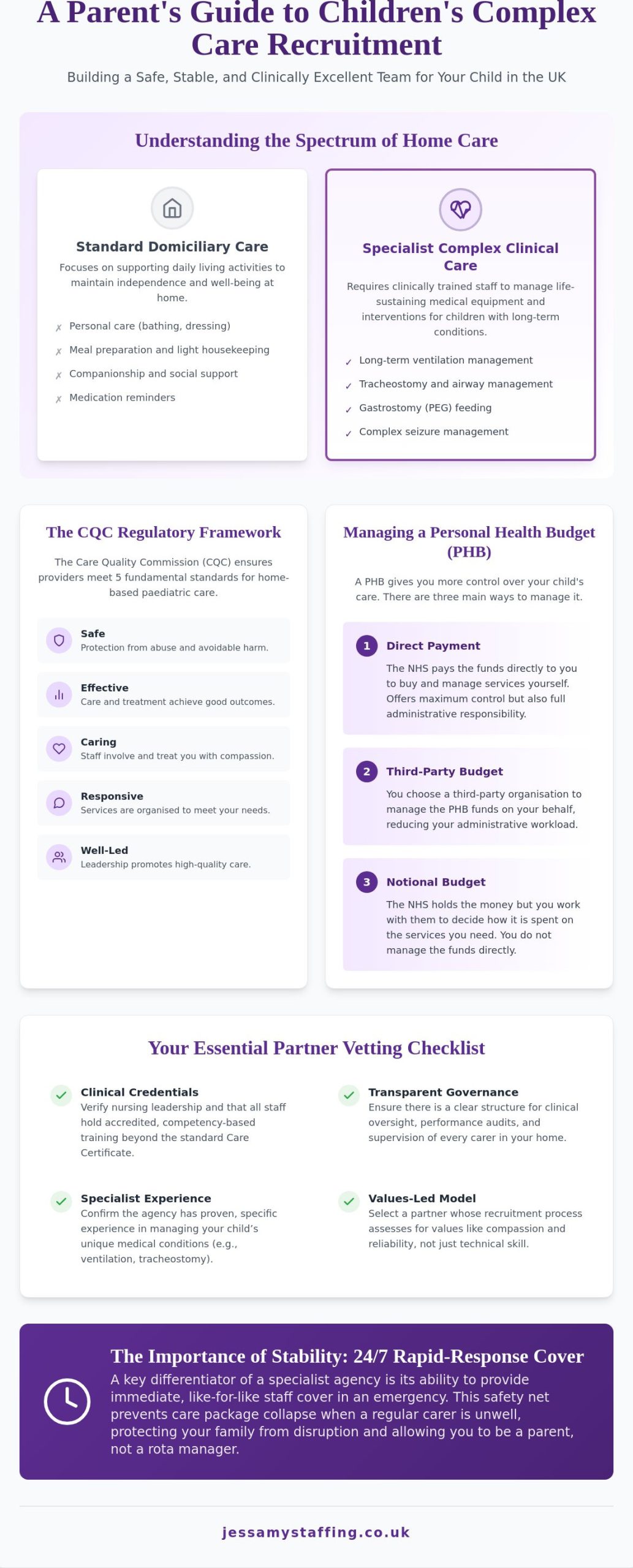
Children’s complex care recruitment UK represents a vital lifeline for households managing high-intensity medical needs. It is the process of identifying and placing highly skilled professionals to provide medical support for children with long-term or life-limiting conditions within the family home. This is a specialised field that bridges the gap between hospital-based acute care and community living. Unlike general domiciliary care, which focuses on daily living activities like bathing or meal preparation, complex clinical care requires staff who are trained to manage life-sustaining equipment and respond to medical emergencies. It’s about maintaining a hospital-grade standard of safety without compromising the warmth and privacy of the family environment.
Common clinical requirements in this sector include long-term ventilation, tracheostomy management, gastrostomy (PEG) feeding, and complex seizure management. These aren’t just tasks; they’re critical interventions that ensure a child’s safety and quality of life. Families often seek private recruitment to ensure these needs are met by a consistent team rather than a rotating cast of unfamiliar agency staff. By choosing a dedicated partner for children’s complex care recruitment UK, parents can secure a level of clinical oversight that mirrors an acute setting whilst remaining in their own living room.
The Clinical Scope of Paediatric Support
Support workers and nurses in this field handle technical tasks such as airway management and the administration of complex medications. There’s a distinct hierarchy of care: while a paediatric nurse may oversee the clinical plan, a specialist support worker often provides the day-to-day, 24/7 presence. This care doesn’t exist in a vacuum. It must integrate with the child’s educational and social development. For instance, a child might require support from Child and Adolescent Mental Health Services (CAMHS) alongside their physical care, requiring a team that understands the emotional and psychological complexities of growing up with a disability.
To support these emotional needs, families often seek specialist therapeutic guidance. Practitioners such as Tracy Kimberg provide relationship counselling and therapy for teenagers, offering a supportive space to navigate the unique psychological challenges that accompany long-term paediatric clinical care.
Why Families Choose the Private Agency Route
Many families find that relying solely on NHS rotas leaves them vulnerable to the “postcode lottery” of staff availability. Private recruitment offers a level of consistency and control that is often missing from statutory services. It allows families to select a team that matches their child’s personality and the family’s core values. This is essential for a service that operates 24/7 inside a private residence. A private agency provides a safety net; if a regular carer falls ill, the agency is responsible for ensuring the care package doesn’t collapse. This reliability reduces the immense pressure on parents, allowing them to focus on being a family rather than a rota manager.
Regulatory Standards: Ensuring Safety and Compliance
Regulatory standards provide the vital architecture of safety in children’s complex care recruitment UK. The Care Quality Commission (CQC) serves as the primary arbiter of quality, evaluating every provider against five foundational pillars: Is the service safe, effective, caring, responsive, and well-led? For families, these aren’t merely bureaucratic tick-boxes. They’re a guarantee that the clinical care delivered at the kitchen table is as rigorous and reliable as that found in a specialist hospital ward. Compliance is the baseline, but true safety is found in how those standards are lived out every day in your home.
Effective governance requires more than just a background check; it demands a meticulous oversight structure where every carer is supported by a clinical lead. At Jessamy, our process for vetting paediatric home care staff involves deep-dive interviews and values-based assessments that exceed mandatory requirements. We believe that clinical governance must be transparent. You should always know exactly who is overseeing the carers in your home and how their performance is being audited. This layered approach to supervision ensures that clinical standards never slip, even in the most settled long-term care packages.
Accredited Training and Competency
A standard Care Certificate is a necessary baseline, but it doesn’t prepare a support worker for the nuances of a paediatric tracheostomy or the specifics of a ventilator alarm. True clinical excellence requires paediatric complex care training UK that is tailored to your child’s specific condition. We mandate annual competency sign-offs for all high-risk clinical tasks. This process ensures that skills don’t just exist as a certificate on a file but are actively demonstrated under clinical supervision, providing you with the confidence that your child is in expert hands at all times.
Safeguarding in the Home Environment
Safeguarding children with complex needs requires a delicate balance between clinical vigilance and the right to a “normal” family life. Recent Ofsted guidance on complex needs provision highlights the importance of child-centric recruitment and robust management structures. Our Registered Managers conduct regular clinical audits and proactive risk assessments to ensure the environment remains safe without feeling institutionalised. If you’re currently reviewing your options, you might find it helpful to speak with a principled expert in paediatric staffing to understand how these safety standards apply to your specific home situation.
Funding Pathways: Navigating PHBs and Private Funding
Understanding the financial landscape is essential for families seeking children’s complex care recruitment UK. A Personal Health Budget (PHB) isn’t just a funding stream; it’s a mechanism for empowerment. It allows you to move away from a “one-size-fits-all” NHS provision toward a bespoke care plan that suits your child’s specific needs. By March 2026, 25,248 children and young people in England were using these budgets to gain greater control over their care. This shift represents a fundamental change in how paediatric support is delivered, placing the family at the centre of the decision-making process.
There are three primary routes to managing a PHB. A notional budget means the NHS retains the money and organises the care for you. A third-party budget involves an external organisation managing the funds on your behalf. Finally, a direct payment gives you the most autonomy, as the funds are paid directly to you to purchase services. Data from early 2026 shows that while 79% of families still use notional budgets, 17% have moved to direct payments. This latter group often seeks children’s complex care recruitment UK to build a dedicated team that offers higher levels of personalisation than standard community rotas can provide.
The Direct Payment Model with Agencies
When you opt for a direct payment, you can partner with a paediatric nursing agency UK to manage the clinical delivery. This model is often the most effective for families who want control without the administrative burden of being an individual employer. The agency takes on the responsibility for recruitment, clinical training, and payroll. It ensures that the 24/7 security you need is managed by professionals who understand the regulatory requirements of the CQC. This transition from NHS-managed care to an agency-led model offers a level of consistency that is difficult to achieve through standard community services.
Combining Public and Private Support
Sometimes, the funding allocated by the NHS doesn’t cover every hour of needed care. Families may choose to supplement their PHB with private funding to fill gaps in rotas or to secure specific specialist staff. This hybrid approach requires clear financial reporting to the Integrated Care Board (ICB). It’s about creating a seamless transition where the clinical quality remains consistent, regardless of whether the hour of care is funded by the state or privately. Managing the clinical “top-up” ensures that your child’s care never feels fragmented, providing a stable environment where educational and social goals can be met alongside medical ones.
The Family Checklist: How to Select a Recruitment Partner
Selecting a partner for children’s complex care recruitment UK is a decision that carries immense clinical and emotional weight. It requires a balance between rigorous technical assessment and an intuitive sense of who will best fit within your family’s private life. Whilst many agencies offer general staffing, few possess the specialised infrastructure required to manage high-dependency paediatric care. To ensure your child receives the safest and most consistent support, you must look beyond glossy brochures and focus on the operational realities of the provider.
Your first step is to verify the agency’s specific CQC registration. It’s vital to ensure they are registered for the ‘Treatment of disease, disorder or injury’ specifically for children, rather than just ‘Personal care’. This distinction is critical; it dictates the level of clinical intervention the staff are legally permitted to perform. Once the legal baseline is confirmed, assess their experience with your child’s specific condition. Ask for evidence of how they have managed similar care packages, focusing on their ability to recruit for rare or highly technical medical needs. A local presence in regions like Greater Manchester is equally important, as it ensures that management and clinical leads can provide rapid, face-to-face support when situations evolve. For families seeking additional clinical options in the North West, you can learn more about Ready Health to explore their private medical services.
Interviewing the clinical lead is as important as meeting the carers themselves. This individual is the guardian of your child’s safety and the person responsible for the competency of the staff. If you cannot speak directly with the person overseeing the clinical governance, it may indicate a lack of transparency or a disconnected management structure. A principled expert will always welcome these deep-dive conversations.
Critical Questions for the Vetting Process
During your initial consultations, move beyond surface-level queries. You need to know exactly how the agency functions when things go wrong. Consider asking these targeted questions:
- ‘How do you handle last-minute sickness for a night shift?’ The answer should involve a concrete plan, not just a promise to “try our best.”
- ‘What specific training do you provide for tracheostomy or ventilation support?’ Look for accredited, child-specific training programmes rather than generic adult care modules.
- ‘How do you involve our family in the final selection of carers?’ You should always have the final say on who enters your home.
The Role of 24/7 Emergency Cover
For families managing life-limiting conditions, a staffing gap isn’t just an inconvenience; it’s a clinical risk. This is why 24/7 emergency care staffing UK is a non-negotiable requirement. A reliable agency must operate a ‘live’ on-call system staffed by individuals who know your child’s care plan, rather than a generic answering service. Local Manchester-based staffing ensures that response times are minimised during a crisis, providing a physical safety net that remote agencies simply cannot match. If you are ready to build a more resilient care team, contact Jessamy Staffing Solutions today to discuss our values-led approach to paediatric recruitment.
The Jessamy Model: Values-Led Staffing and Clinical Excellence
Clinical competence is the mandatory entry requirement; shared values are the foundation of longevity. The Jessamy Model is built on the firm belief that children’s complex care recruitment UK must transcend technical checklists to ensure a sustainable future for the family. We recognise that your home is a sanctuary, not a ward. Our approach is designed to strengthen these sensitive environments rather than destabilising them with intrusive or impersonal care. By focusing on empathy, integrity, and reliability, we ensure that every professional entering your home is as committed to your child’s emotional well-being as they are to their clinical safety.
By prioritising these core values, Jessamy Staffing Solutions acts as a bridge between high-level clinical requirements and the human needs of a household. Our ‘Principled Expert’ persona means we serve as meticulous guardians of standards whilst remaining approachable guides for parents. We don’t just provide a staff member; we facilitate a comprehensive system of children’s complex care at home that evolves alongside your child’s development. This commitment to ongoing development ensures that care never becomes stagnant or purely transactional.
A Partnership, Not a Placement
We serve families across Greater Manchester with a focus on creating deep-rooted partnerships rather than temporary placements. The Jessamy Staffing Solutions guarantee is underpinned by rigorous vetting and continuous clinical oversight, providing a level of reassurance that allows parents to step back from constant monitoring. We believe a child has a fundamental right to a normal, happy life. Our staff are trained to facilitate play, education, and social interaction whilst managing complex medical needs, ensuring the child is seen as an individual first and a patient second.
Taking the Next Step with Jessamy Staffing Solutions
The path to a stable care team begins with an intentional and thorough consultation process. We take the time to understand your unique household routine, your child’s personality, and your specific clinical concerns before suggesting a staffing match. This methodical matching process is why we are the preferred choice for children’s complex care recruitment UK in the North West. We don’t rush the integration. Instead, we move at a pace that ensures trust is established and standards are met from the very first shift, providing a stable, long-term partner for your family’s journey.
Securing a Sustainable Future for Your Child’s Care
Building a resilient care team is a journey that requires both clinical precision and deep emotional intelligence. We’ve explored how navigating the 2026 CQC framework and effectively managing Personal Health Budgets can transform the quality of life for your child. By prioritising a values-led approach to children’s complex care recruitment UK, you move beyond mere staffing towards a stable clinical partnership that respects the sanctity of your home.
Success in complex care is found at the intersection of rigorous standards and human empathy. Our model ensures that your child’s medical needs are met with the highest level of expertise whilst fostering an environment where they can simply be a child. With our accredited specialist training centre and CQC-compliant clinical governance, we provide the stability you need to focus on what matters most: your family.
If you’re ready to transition from managing rotas to receiving reliable support, we’re here to help. Book a specialist consultation for your child’s care needs and discover our 24/7 emergency response capabilities across Greater Manchester. You don’t have to navigate this complex landscape alone.
Frequently Asked Questions
What is the difference between home care and complex care for children?
Complex care is defined by the requirement for specialist clinical interventions that go beyond standard personal care. Whilst traditional home care focuses on daily living activities, complex support involves managing life-sustaining equipment and high-risk medical conditions. This level of care requires a higher register of training and consistent clinical oversight to ensure the child remains safe in a domestic setting rather than a hospital ward.
How is private children’s complex care funded in the UK?
Most specialist care is funded through NHS Continuing Care, which is typically delivered via a Personal Health Budget (PHB). This funding allows families to bypass standard community nursing rotas and choose a provider that better fits their child’s specific needs. Families can also choose to use private funds to supplement their statutory allocation, ensuring they have the 24/7 security they require.
Can I use my Personal Health Budget (PHB) to hire a private recruitment agency?
Yes, families have a ‘right to have’ a PHB, which can be used to procure services from a specialist provider. This is a common route for children’s complex care recruitment UK, as it allows parents to secure a dedicated team without the administrative burden of being a direct employer. Using an agency ensures that all clinical governance, payroll, and training requirements are managed by professionals.
Are all children’s complex care agencies CQC regulated?
Any provider delivering ‘Treatment of disease, disorder or injury’ must be registered with and regulated by the Care Quality Commission (CQC). It’s essential to verify that an agency’s registration specifically covers paediatric services. This regulation provides a vital safety net, ensuring that the clinical care delivered in your home is audited against national standards for safety and effectiveness.
What qualifications should a complex care support worker have?
A worker should possess the standard Care Certificate alongside condition-specific clinical competencies signed off by a Registered Nurse. These might include specialised training in airway management, gastrostomy care, or emergency seizure protocols. Continuous professional development is a requirement in this sector, ensuring that every staff member’s skills remain sharp and relevant to the child’s evolving medical needs.
How does Jessamy Staffing Solutions handle emergency night-shift cover?
Jessamy Staffing Solutions maintains a 24/7 rapid-response team based in Greater Manchester to address unexpected staffing gaps. We understand that a missed night shift is a significant clinical risk for a child with complex needs. Our on-call system is managed by individuals who understand your specific care plan, allowing us to deploy qualified backup personnel quickly to maintain the continuity of your child’s care.
Can private care staff support my child at school as well as at home?
Yes, care packages can be designed to follow the child from the home into educational settings to provide seamless clinical support. This continuity is often essential for children with high-dependency needs who require constant monitoring. Coordination between the agency, the family, and the school ensures that the child can access education safely whilst their medical requirements are managed by a familiar professional.
How do I transition from NHS-managed care to a private agency model?
The transition starts with an assessment of needs by your local Integrated Care Board (ICB) to establish a Personal Health Budget. Once the budget is approved, you can select a partner for children’s complex care recruitment UK to take over the clinical management. This move gives you greater control over who enters your home and allows for a more personalised approach to your child’s daily routine and medical care.